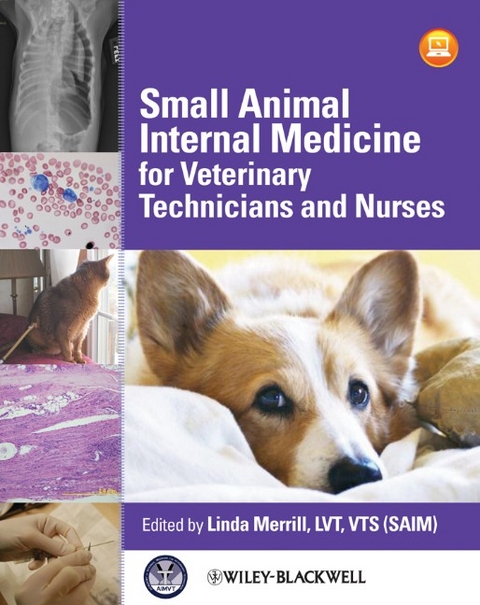
Small Animal Internal Medicine for Veterinary Technicians and Nurses (eBook)
John Wiley & Sons (Verlag)
978-1-118-31827-0 (ISBN)
Small Animal Internal Medicine for Veterinary Technicians and Nurses is the first comprehensive resource on internal medicine written for the veterinary technician. Organized by body system, each chapter discusses pertinent diseases, from clinical signs, diagnostic testing, and prevalence to treatment options and nursing considerations. Published in association with the Academy of Internal Medicine for Veterinary Technicians, this book offers both a thorough grounding in the foundations of internal medicine for students and new veterinary technicians and detailed, advanced information suitable for experienced veterinary technicians.
Coverage includes an overview of neurological disorders and discussion of the surgical, emergency, and nursing considerations for each condition. This complete reference, which includes a companion website with quizzes, images, and video clips, is essential reading for veterinary technician students, practicing technicians, and those studying for the AIMVT specialty exam.
Linda Merrill, LVT, VTS (Small Animal Internal Medicine, Clinical Practice) is the executive director and founding chair of the Academy of Internal Medicine for Veterinary Technicians and organizing committee member of the Academy of Veterinary Technicians in Clinical Practice. She is also a former president of NAVTA and has nearly 30 years of practice experience in small animal, cardiology, oncology, and internal medicine.
Small Animal Internal Medicine for Veterinary Technicians and Nurses is the first comprehensive resource on internal medicine written for the veterinary technician. Organized by body system, each chapter discusses pertinent diseases, from clinical signs, diagnostic testing, and prevalence to treatment options and nursing considerations. Published in association with the Academy of Internal Medicine for Veterinary Technicians, this book offers both a thorough grounding in the foundations of internal medicine for students and new veterinary technicians and detailed, advanced information suitable for experienced veterinary technicians. Coverage includes an overview of neurological disorders and discussion of the surgical, emergency, and nursing considerations for each condition. This complete reference, which includes a companion website with quizzes, images, and video clips, is essential reading for veterinary technician students, practicing technicians, and those studying for the AIMVT specialty exam.
Linda Merrill, LVT, VTS (Small Animal Internal Medicine, Clinical Practice) is the executive director and founding chair of the Academy of Internal Medicine for Veterinary Technicians and organizing committee member of the Academy of Veterinary Technicians in Clinical Practice. She is also a former president of NAVTA and has nearly 30 years of practice experience in small animal, cardiology, oncology, and internal medicine.
Small Animal Internal Medicine for Veterinary Technicians and Nurses 5
Contents 9
Contributors 15
Preface 17
Chapter 1: Physical Examination 19
Charting 19
Goals of the consultation appointment 20
Conclusion 27
Chapter 2: Endocrinology 29
SECTION 1 PITUITARY GLAND 29
Growth hormone disorders 29
Diabetes insipidus 31
SECTION 2 THYROID GLANDS 32
Canine hypothyroidism 32
Feline hyperthyroidism 34
Canine thyroid tumors 38
SECTION 3 PARATHYROID GLANDS 40
Hypoparathyroidism 40
Hyperparathyroidism 41
SECTION 4 ADRENAL GLANDS 43
Hypoadrenocorticism: Addison’s disease 43
Hyperadrenocorticism: Cushing’s disease 44
Pheochromocytoma 47
SECTION 5 PANCREAS 49
Feline diabetes mellitus 49
Canine diabetes mellitus 55
Canine diabetic ketoacidosis 58
Insulinomas 59
Glucagonoma 63
SECTION 6 MISCELLANEOUS HORMONES, GLANDS, AND DISEASE 65
Calcitriol 65
Erythropoietin 66
Gastrin 68
Gastrinoma 69
The kinins 70
Melatonin 71
Natriuretic peptides 73
Renin 75
Somatostatin 77
Other rare neuroendocrine tumors 78
Bibliography 80
Chapter 3: Musculoskeletal 87
SECTION 1 ANATOMY AND PHYSIOLOGY 87
The skeletal system 87
The muscular system 89
SECTION 2 SELECTED DIAGNOSTICS IN MUSCULOSKELETAL DISEASE 90
Arthrocentesis 90
Muscle biopsy 91
SECTION 3 DISEASES OF THE MUSCULOSKELETAL SYSTEM 91
Inflammatory joint disease 91
Noninflammatory joint disease 94
Neuromuscular diseases 95
Inflammatory myopathies 96
Hepatozoonosis 97
Neoplasia 98
SECTION 4 GENERAL MUSCULOSKELETAL EXAMINATION 99
SECTION 5 MUSCULOSKELETAL THERAPY 100
Veterinary rehabilitation therapy 100
Palliative radiation therapy 106
SECTION 6 MUSCULOSKELETAL NUTRITION 107
Nutrients 108
Antioxidants 109
Energy and growth 109
Osteoarthritis 110
Body condition scoring 110
Body condition score uses 110
Muscle condition scoring 111
Bibliography 114
Chapter 4: The Neurological Examination 117
Clinical signs and the relevant anatomy 117
Seizures 120
Encephalopathies 121
Cerebral neoplasia 123
Inflammatory/infectious etiologies: encephalitis 123
Meningitis 125
Cranial nerve syndromes 125
Spinal diseases 127
Neuromuscular diseases 131
Diagnostic testing 132
Pharmacology 137
Nursing considerations 139
Neurological glossary 140
Suggested readings 142
Chapter 5: Thrombotic Disorders in Small Animal Medicine 145
Physiology 145
Thrombotic disorders 147
Diagnosis 148
Therapy 150
Client education 152
Suggested readings 152
Chapter 6: Respiratory 155
SECTION 1 UPPER AIRWAY DISEASE 155
Anatomy and physiology 155
Diseases of the upper airway 155
Nutritional considerations 158
Anesthetic and analgesic considerations 158
SECTION 2 MEDIASTINAL DISEASE 159
Anatomy and physiology 159
Mediastinitis 159
Pneumomediastinum 159
Mediastinal masses 159
SECTION 3 LOWER AIRWAY DISEASE 160
Anatomy and physiology 160
Clinical signs 160
Diagnostic testing 160
Specific airway diseases and treatment 161
Anesthetic and analgesic considerations 164
SECTION 4 PULMONARY PARENCHYMAL DISEASE 164
Anatomy and physiology 164
Clinical signs 164
Diagnostic testing 165
Treatment 166
Diseases 166
Nutritional considerations 169
Anesthetic and analgesic considerations 169
SECTION 5 PLEURAL DISEASE 170
Anatomy and physiology 170
Clinical signs 170
Diagnostic testing 170
Treatment 172
Nutritional considerations 174
Anesthetic and analgesic considerations 174
SECTION 6 ANESTHESIC AND ANALGESIC CONSIDERATIONS IN RESPIRATORY DISEASE 174
Premedication 174
Induction 175
Maintenance anesthesia 175
Monitoring 175
Recovery 175
SECTION 7 FEEDING CONSIDERATIONS FOR RESPIRATORY DISEASE 175
Bibliography 176
Chapter 7: Hematology 179
SECTION 1 ANATOMY AND PHYSIOLOGY 179
The circulatory system 179
The lymphatic system 180
The spleen 180
The coagulation system 181
SECTION 2 RED BLOOD CELL DISORDERS 181
Anemia 181
Polycythemia 185
Transfusion medicine 185
Immune-mediated hemolytic anemia 189
SECTION 3 LEUKOCYTE DISORDERS 192
Methods for determining the leukogram 192
Disorders of neutrophils 193
Disorders of eosinophils 198
Disorders of basophils 198
Disorders of monocytes 198
Disorders of lymphocytes 199
SECTION 4 PLATELET, COAGULATION, AND INHERITED DISORDERS 200
Diseases of coagulation 200
Disorders of platelets 202
Breed-related disorders 206
Bibliography 207
Chapter 8: Gastrointestinal 211
SECTION 1 CLINICAL SIGNS AND EXAMINATION OF THE GI PATIENT 211
Patient history 211
Physical examination 212
Clinical signs of gastrointestinal disorders 212
Conclusion 215
SECTION 2 SELECTED DIAGNOSTICS IN GASTROINTESTINAL DISEASE 215
Laboratory evaluation 216
Microscopic fecal evaluation 216
Bacteriologic examination 217
Virologic examination 217
Occult blood 217
Alpha1-protease inhibitor 218
Imaging 218
Special tests 219
Conclusion 219
SECTION 3 GASTROINTESTINAL DISEASE 219
Oral disease 219
Esophageal disorders 222
Gastric disease 225
Alimentary tract parasites 231
Diseases of the small intestine 234
Diseases of the large intestine 253
SECTION 4 PHARMACOLOGY 256
Antacids 256
Antiemetics 257
Anti-inflammatory and immunosuppressive drugs 258
Antibiotics 259
Gastromucosal protectants 259
Digestive enzymes 259
Laxatives 259
SECTION 5 FEEDING TUBES 260
Feeding tubes 260
Esophagostomy tube placement 261
Gastrostomy tube placement 262
Jejunostomy tube placement 265
Conclusion 265
Feeding tube management and complications 265
SECTION 6 FOOD INTOLERANCE AND FOOD ALLERGY 269
Clinical signs 269
Causes 269
Diagnostics 269
Treatment 269
Elimination diets 270
Proteins 270
Carbohydrates 270
Prebiotics and probiotics 271
SECTION 7 ANESTHESIA AND ANALGESIA CONSIDERATIONS IN GASTROINTESTINAL DISEASE 273
Premedication 273
Induction 273
Maintenance anesthesia 274
Monitoring 274
Recovery 274
Bibliography 274
Chapter 9: Liver 281
SECTION 1 HEPATIC DISEASE 281
Acute hepatitis 281
Chronic hepatitis 283
Copper-associated chronic hepatitis 284
Hepatic lipidosis 286
Toxic hepatopathy 288
Hepatocutaneous syndrome 290
Congenital vascular anomaly 292
Liver neoplasia 293
SECTION 2 POSTHEPATIC DISEASE 294
Feline cholangitis complex 294
Biliary cysts 296
Extrahepatic biliary obstruction 297
Gallbladder mucocoeles 298
SECTION 3 NUTRITION IN LIVER DISEASE 300
Protein 301
Fats 301
Carbohydrates 301
Fiber 301
Vitamins and minerals 302
Feeding plan 302
SECTION 4 ANESTHESIA AND ANALGESIA CONSIDERATIONS IN HEPATIC DISEASE 302
Premedication 302
Induction 302
Maintenance anesthesia 303
Monitoring 303
Recovery 304
Bibliography 304
Chapter 10: Urinary and Renal Diseases 307
SECTION 1 URINARY ANATOMY AND PHYSIOLOGY 307
SECTION 2 CLINICAL SIGNS 309
SECTION 3 URINARY DISEASES 310
Chronic kidney disease 310
Acute renal failure 311
Urinary tract infections 312
Pyelonephritis 313
Urolithiasis 313
Prostatic diseases 316
Lower urinary tract disease in cats 317
Ectopic ureters 317
Urethral sphincter mechanism incompetence 318
Protein-losing nephropathy 319
Urinary neoplasia 319
SECTION 4 URINARY DIAGNOSTICS AND THERAPEUTIC IMPLICATIONS 320
Urinalysis 320
Complete blood count and serum biochemistry profile 324
Proteinuria 327
Blood pressure 329
Urine culture 331
SECTION 5 URINARY TRACT BIOPSY TECHNIQUES 333
Aspiration biopsy 333
Biopsy 334
Sample handling 337
Postbiopsy nursing care 337
SECTION 6 URINARY IMAGING 337
Radiology 337
Ultrasound 339
Cystoscopy and vaginoscopy 341
Computed tomography 341
SECTION 7 RENAL AND URINARY DISEASE PHARMACOLOGY 342
Fluid therapy and correction of electrolyte imbalances 345
SECTION 8 ANESTHETIC AND ANALGESIC CONSIDERATIONS 353
Anesthesia 353
Pain management 354
SECTION 9 NUTRITIONAL CONSIDERATIONS 354
Chronic kidney disease 354
Urolithiasis 356
Feline idiopathic cystitis 359
Bibliography 359
Chapter 11: Infectious Diseases 367
SECTION 1 INFECTIOUS BACTERIAL DISEASES 367
Bartonella 367
Lyme borreliosis 368
Canine brucellosis 370
Ehrlichiosis 371
Helicobacter-associated disease 373
Leptospirosis 375
Methicillin-resistant Staphylococcus aureus 378
Mycobacterial disease 379
Mycoplasmal diseases 381
Plague 383
SECTION 2 FUNGAL DISEASES 384
Histoplasmosis 384
Aspergillosis 386
Coccidioidomycosis 386
Cryptococcosis 387
Blastomycosis 388
SECTION 3 PROTOZOAL DISEASES 392
Amebiasis 392
Babesiosis 392
Giardia 393
Trichomoniasis 393
Leishmaniasis 394
Toxoplasmosis 394
Neosporosis 395
Cytauxzoonosis 396
Hepatozoonosis 397
SECTION 4 INFECTIOUS VIRAL DISEASES 399
Canine and feline herpesvirus 399
Influenza 401
Papillomas 402
SECTION 5 INFECTIOUS DISEASE TESTING 403
Disease prevention and control in the small animal hospital 413
Bibliography 418
Chapter 12: Vaccine, Vaccination, and Immunology 421
SECTION 1 THE IMMUNE RESPONSE AND CANCER IMMUNOTHERAPY 421
Innate and adaptive immune response 421
Humoral and cell-mediated immunity 422
Immunomodulation 422
Cancer vaccines 422
Cytokine immunotherapy 423
Summary 423
SECTION 2 LABORATORY DIAGNOSTICS IN IMMUNOLOGY 423
Serology 423
Biopsy techniques 425
SECTION 3 IMMUNOSUPPRESSIVE MEDICATIONS 427
Corticosteroids 427
Immunosuppresives 429
Less commonly used immunosuppressives 430
Novel immunosuppressive medications 430
Immunomodulating medications 431
Conclusion 431
SECTION 4 VACCINES AND VACCINATION 431
Vaccination strategies 431
Canine vaccines 434
Feline vaccines 440
Vaccinations and adverse reactions 445
Bibliography 447
Chapter 13: Pain and Its Management 451
Veterinary technician as pain management team leader 451
What is pain? 452
Pathophysiology of pain 452
Types of pain 453
Causes of pain 454
General approach to pain control 454
General rules of thumb in managing pain 454
Questions to consider 455
How to be an analgesic advocate for your patient 455
Clinical signs and means of detection 456
Pain scoring systems 457
Analgesics 457
Nursing care as analgesic 464
Clinical examples 465
Conclusion 466
Bibliography 466
Chapter 14: Nursing 467
SECTION 1 OCCUPATIONAL HEALTH AND SAFETY 467
Making the work place safe 467
Health and safety committees 467
Hazards in the workplace 468
Chemotherapy safety 470
Conclusion 471
SECTION 2 PHARMACOLOGICAL IMPLICATIONS IN INTERNAL MEDICINE 471
Drug calculations, compatibilities, dosing, and administration 471
Constant rate infusion 471
Drug compatibilities 472
Drug dosage adjustments in patients with heart, renal, and hepatic insufficiency or failure 472
Oxygen therapy 478
Drug calculations 479
Client education 480
SECTION 3 NUTRITIONAL SUPPORT 481
Nutritional support 481
Energy balance: weight loss versus weight gain 486
Refeeding syndrome 489
SECTION 4 DIAGNOSTIC PROCEDURES 492
Cystocentesis 492
Abdominocentesis 493
Thoracocentesis 496
Urinary catheters 498
Bone marrow collection 502
SECTION 5 ENDOSCOPY 505
Flexible endoscope 505
Videoendoscope 507
Instrumentation 507
Rigid endoscopes 508
Reprocessing 510
Patient and equipment preparation 513
SECTION 6 SELECTED NURSING CONSIDERATIONS OF INTERNAL MEDICINE PATIENTS 513
Thermoregulation 513
Fever or hyperthermia? 513
Hypothermia 516
The sepsis syndrome 517
Bibliography 522
Appendix: Accredited State Veterinary Diagnostic Laboratories 527
Abbreviations 533
Index 539
"I would recommend this book for nurses and technicians
studying towards a Diploma in Advanced Nursing or a Veterinary
Nursing degree but also to those qualified nurses working in
practice as a great reference book. I enjoyed the secret login for
the website and the multiple choice questions (MCQs) are a great
study aid." (The Veterinary Journal, 1 October
2013)
"This textbook is an excellent addition to the library of
any veterinary hospital, especially a speciality practice or
academic institution." (Journal of The
American Veterinary Medical Association, 15 March 2013)
"Overall, this is an extremely useful textbook for nurses of any
experience and ability. It is something that can be kept handy
during the working day, both for in-depth study of unfamiliar
diagnoses or as a general reference for more common disorders of a
body system." (Australian Veterinary Journal, 6
June 2013)
"No veterinary reference holding should be without this
detailed guide!." (Midwest Book Review, 1 March
2013)
"It is superb value for money and should be a welcome
addition to any personal or practice library."
(Veterinary Practice News, 1 March 2013)
"Linda Merrill's SMALL ANIMAL INTERNAL MEDICINE FOR VETERINARY
TECHNICIANS AND NURSES (9780813821641, $79.99) deserves ongoing
recommendation as a basic reference - the first written - for the
veterinary technician. Chapters cover everything from diagnostic
testing to evaluating clinical signs, and includes reviews of
nursing requirements for a wide range of conditions. All are top
picks for any vet's practice." (Midwest Book
Reviews, 1 December 2012)
"This is a high quality book. I work with CVTs in a
university setting and would definitely recommend it to any
technician seeking to better understand internal
medicine." (Doody's, 30 November
2012)"This is really a great tool for revising before exams
but also for in house training." (Vet Nurses
Today, 1November
2012)
"Small Animal Internal Medicine for Veterinary Technicians
and Nurses provides veterinary technicians with the information
they need and is essential reading for veterinary technician
students, practicing technicians, and those studying for the AIMVT
speciality exam." (Small Animal Internal Medicine,
Clinical Practice, 1 September 2012)
| Erscheint lt. Verlag | 12.6.2012 |
|---|---|
| Sprache | englisch |
| Themenwelt | Medizin / Pharmazie |
| Veterinärmedizin ► Kleintier | |
| Schlagworte | Academy • animal • association • Body • Clinical • Comprehensive • Considerations • First • Foundations • Internal • Medicine • nurses • nursing • Pflege i. d. Veterinärmedizin • Pflege i. d. Veterinärmedizin • Prevalence • resource • signs • System • technicians • Veterinärmedizin • Veterinärmedizin / Innere Medizin • Veterinärmedizin • Veterinärmedizin / Innere Medizin • Veterinary • Veterinary Internal Medicine • Veterinary Medicine • Veterinary Nursing & Animal Care • veterinary technicians • Written |
| ISBN-10 | 1-118-31827-7 / 1118318277 |
| ISBN-13 | 978-1-118-31827-0 / 9781118318270 |
| Informationen gemäß Produktsicherheitsverordnung (GPSR) | |
| Haben Sie eine Frage zum Produkt? |
 PDF (Adobe DRM)
Kopierschutz: Adobe-DRM
Adobe-DRM ist ein Kopierschutz, der das eBook vor Mißbrauch schützen soll. Dabei wird das eBook bereits beim Download auf Ihre persönliche Adobe-ID autorisiert. Lesen können Sie das eBook dann nur auf den Geräten, welche ebenfalls auf Ihre Adobe-ID registriert sind.
Details zum Adobe-DRM
Dateiformat: PDF (Portable Document Format)
Mit einem festen Seitenlayout eignet sich die PDF besonders für Fachbücher mit Spalten, Tabellen und Abbildungen. Eine PDF kann auf fast allen Geräten angezeigt werden, ist aber für kleine Displays (Smartphone, eReader) nur eingeschränkt geeignet.
Systemvoraussetzungen:
PC/Mac: Mit einem PC oder Mac können Sie dieses eBook lesen. Sie benötigen eine
eReader: Dieses eBook kann mit (fast) allen eBook-Readern gelesen werden. Mit dem amazon-Kindle ist es aber nicht kompatibel.
Smartphone/Tablet: Egal ob Apple oder Android, dieses eBook können Sie lesen. Sie benötigen eine
Geräteliste und zusätzliche Hinweise
Buying eBooks from abroad
For tax law reasons we can sell eBooks just within Germany and Switzerland. Regrettably we cannot fulfill eBook-orders from other countries.
aus dem Bereich