


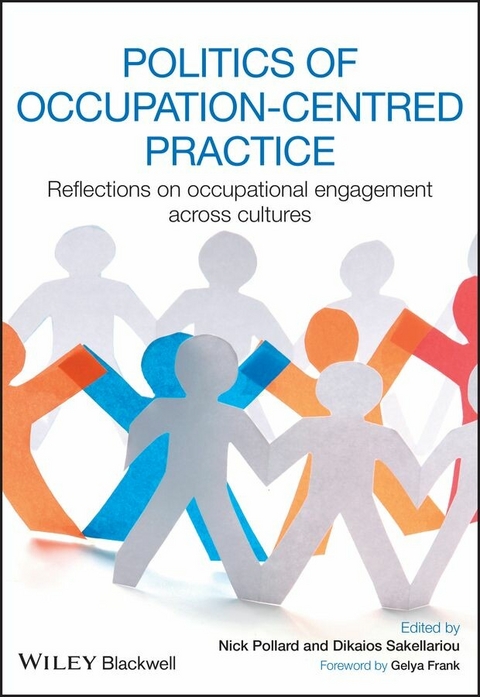
Politics of Occupation-Centred Practice (eBook)
John Wiley & Sons (Verlag)
978-1-118-29096-5 (ISBN)
It explores the development of individual occupational narratives, community traditions and their roots in everyday experiences, offering a range of examples from distinctive populations to demonstrate approaches to forming sustainable occupational engagements. Chapters span such key areas as 'Experiences of Disaster', 'Social Inclusion', 'Disability and Participation', and 'Sexuality, Disability Cultures and Occupation'.
This cutting edge text, coordinated by two distinguished researchers and educators in the global field of occupational therapy and science, is designed to meet the needs of students studying the conceptual foundations of occupational therapy, occupational science, role emerging practice, occupational justice, community development and community based rehabilitation. The book will also be of interest to academics and practitioners exploring new practice contexts created by the drive to address the diversity and inclusion agenda.
Nick Pollard is research coordinator for occupational therapy in the Centre for Health and Social Care Research and is a senior lecturer in occupational therapy. Nick has published in peer reviewed journals and influential texts and his work has been presented at international conferences in the UK, Europe, North America and Australia.
Dikaios Sakellariou is a Lecturer in Occupational Therapy at Cardiff University. His research interests include occupational justice, injustice and apartheid; sexuality and disability; and qualitative research methodologies and their usefulness in exploring experiences of occupation.
POLITICS OF OCCUPATION-CENTRED PRACTICE Reflections on occupational engagement across cultures Politics of Occupation-Centred Practice: Reflections on occupational engagement across cultures addresses the cultural aspects of occupational identity and draws out the implications for practice, moving beyond the clinical environment to include the occupational therapist s work in the wider community. It explores the development of individual occupational narratives, community traditions and their roots in everyday experiences, offering a range of examples from distinctive populations to demonstrate approaches to forming sustainable occupational engagements. Chapters span such key areas as Experiences of Disaster , Social Inclusion , Disability and Participation , and Sexuality, Disability Cultures and Occupation . This cutting-edge text, coordinated by two distinguished researchers and educators in the global field of occupational therapy and science, is designed to meet the needs of students studying the conceptual foundations of occupational therapy, occupational science, role emerging practice, occupational justice, community development and community-based rehabilitation. The book will also be of interest to academics and practitioners exploring new practice contexts created by the drive to address the diversity and inclusion agenda.
About the Editors Nick Pollard is a Senior Lecturer in Occupational Therapy at Sheffield Hallam University. In addition to papers with Dikaios on community-based rehabilitation, he has also written widely on community publishing and group work. Dikaios Sakellariou is a Lecturer in Occupational Therapy at Cardiff University. He has published widely on sexuality and disability, community-based rehabilitation, occupational therapy education and occupational justice. Nick and Dikaios are co-authors and co-editors of Occupational Therapies without Borders (2011) and A Political Practice of Occupational Therapy (2008), both with Frank Kronenberg.
POLITICS OF OCCUPATION-CENTRED PRACTICE :Reflections on occupational engagement across cultures 1
Contents 7
List of Contributors 9
Foreword 11
Acknowledgements 13
1 Introduction 15
The Meaning of Occupation 16
The Term ‘Occupation’ 19
So, What Is Occupation? 23
Occupational Being 25
Cultural Change and Acceptable Occupations 26
Occupational Effect 29
Being with the Others 32
How this Book is Organized 33
References 33
2 The Language of Occupation 39
Language, Cultural Meanings and Nosologies 39
Language, Occupation and Professional Status 40
Conclusion 51
References 51
3 Occupational Literacy 56
Being Trialogical 57
Making Sense of the World 60
Occupational Literacy as a Skill 62
References 64
4 A Grammar for a Language of Occupation 65
Comprehension 66
Language Structures and Occupation 67
Recognizing Occupation 70
‘Doingness’ 71
Morphemes 72
Domains of Symbolic Logic 73
References 74
5 Towards a Transformational Grammar of Occupation 75
Human Scale Development Theory 76
Language and Occupation 77
Territories of Words 79
Conviviality 82
My Baby Took the Train . . . 83
References 84
6 Narratives of Recognition 86
Occupational Therapy Stories 86
Heteroglossia 91
References 93
7 Narratives and Truths 95
Features of Narratives 96
Narrative and Illness 98
Whose Narrative and Whose Language? 101
References 102
8 Occupation in a Greek Town: Flowing, Emergent, Flexible across Time and Space 106
Introduction 106
Introduction to Melissa 107
The places of everyday life 108
Ta xorafia (the fields) 108
To spiti (home) 109
Oi plateies (the squares) 109
Magazia kai ipiresies (shops, businesses and public services) 110
Independence and interdependence 111
Public and private places 113
Temporal rhythms 113
Spatio-temporal rhythms 115
Discussion 115
Conclusion 117
References 117
9 Indigenous Ainu Occupational Identities and the Natural Environment in Hokkaido 120
Ainu Worldview and Traditional Occupations in the Pre-Tokugawa Period: Occupations and Worldview Linked with Nature’s Cycles 123
Ainu worldview 123
Traditional Ainu occupations and the occupational cycle 125
Traditional occupations and worldview 130
Ainu Occupational Changes from the Early Modern Period: Domination by Japanese Social Norms and Contempt of the Cycles of Nature 131
Ainu history and occupational changes from the early modern period 131
The invasion of Japanese society and occupational injustice 135
Ainu today 136
Conclusions 137
References 139
10 People with Disabilities and Participation: Experiences and Challenges of an Occupational Therapy Practice in the City of São Paulo, Brazil 142
Participation, Disability in Daily Life and Access to Human Rights in an Urban and Unequal Scenario 143
Participation, daily life and community intervention: concepts, perspectives and challenges 143
People with disabilities, poverty and lack of access to human rights 145
Identifying the Rupture of Social Support Networks and the Social Isolation of People with Disabilities in Poor Areas of São Paulo: An Experience of Active Search 148
Knowing the disability as a collective problem: territorial approach 149
Knowing personal trajectories: life stories 150
The Construction of Participation in the Daily Life of People with Disabilities: Community Alternatives for Intervention 152
Individual care 152
Group activities 154
Human rights forums 156
Socio-cultural activities 156
Conclusion 156
References 157
11 Communities of Writing 160
Communities, Writing and Publishing 162
Community Publishing, Occupational Narratives and Occupational Science 166
Writing and Consciousness 167
Can Do: Affirmation and Participation 168
References 171
12 Disability, Sexuality and Intimacy 176
Overview 176
Teaching Sexuality and Disability 176
Theorizing Sexuality and Disability 178
Research on Policy Context: The First Step in a More Progressive Practice 179
Sexuality and Disability in Non-Western Societies 181
Sexual Access 182
Inclusion of Disabled People as Co-participants in Research, Writing, and Policy-Making 182
Hope and Jacob 183
Hope 185
Jacob 186
Final Thoughts 186
Appendix 188
References 191
13 Models and Human Occupation 194
Introduction 194
The Social Status of Modelling 195
Model Making Defined 196
Models in Early History 197
The Value of Modelling to Modellers 197
Critiques of Modelling 201
The History, Scale and Nature of the Modelling Market 203
Conclusion: Models, Competences, Identities, and Representing Human Occupation 206
References 207
14 Participation, Time, Effort and Speech Disability Justice 211
Introduction 211
Participation and Citizenship 214
Experiences in Time and of Effort 217
Anger, Advocacy, Responsibility, and Disability Justice 223
Time and Thought 224
Conclusion 226
References 228
15 A Society Founded on Occupation 231
Occupation and Codependency 233
The Ownership of Occupation 235
Occupational Justice 238
Determining Needs 239
Choice and Contradiction 242
The Professionalization of Doing 244
Occupational Literacy and Occupational Justice 246
References 247
Index 251
"What makes this book exciting is the fresh insights it
offers to persistent issues within the occupational
therapy." (British Journal of Occupational
Therapy, 1 February 2013)
"...it is a rare occurrence when one particular book
sparks an immediate connection and I really want to read the next
bit. That was the case with this particular volume. The editors
have crafted an elegant flow between and across chapters that
introduces the foundational concepts of the occupational therapy
profession, then leads the reader into realms that are less
familiar perhaps...A book full of new triggers of interest; a
book that presents a fresh and unexpected dissection and synthesis
of ''occupation'' as linked with languages,
cultures, and narratives; a book well worth another read and one
that can inform with fresh eyes when probing our practice and
professional understanding." (Canadian Journal of
Occupational Therapy, 26 June 2014)
| Erscheint lt. Verlag | 27.3.2012 |
|---|---|
| Vorwort | Gelya Frank |
| Sprache | englisch |
| Themenwelt | Medizin / Pharmazie ► Gesundheitswesen |
| Medizin / Pharmazie ► Medizinische Fachgebiete ► Arbeits- / Sozial- / Umweltmedizin | |
| Medizin / Pharmazie ► Naturheilkunde | |
| Medizin / Pharmazie ► Physiotherapie / Ergotherapie ► Ergotherapie | |
| Schlagworte | Aspects • Clinical • Cultural • Development • engagement across • Environment • Ergotherapie • Everyday • Experiences • Gesundheits- u. Sozialwesen • Health & Social Care • Identity • Individual • Narratives • Occupational • occupational therapy • occupationcentred • Politics • practice reflections • Therapists • wider community • Work |
| ISBN-10 | 1-118-29096-8 / 1118290968 |
| ISBN-13 | 978-1-118-29096-5 / 9781118290965 |
| Informationen gemäß Produktsicherheitsverordnung (GPSR) | |
| Haben Sie eine Frage zum Produkt? |
 PDF (Adobe DRM)
Kopierschutz: Adobe-DRM
Adobe-DRM ist ein Kopierschutz, der das eBook vor Mißbrauch schützen soll. Dabei wird das eBook bereits beim Download auf Ihre persönliche Adobe-ID autorisiert. Lesen können Sie das eBook dann nur auf den Geräten, welche ebenfalls auf Ihre Adobe-ID registriert sind.
Details zum Adobe-DRM
Dateiformat: PDF (Portable Document Format)
Mit einem festen Seitenlayout eignet sich die PDF besonders für Fachbücher mit Spalten, Tabellen und Abbildungen. Eine PDF kann auf fast allen Geräten angezeigt werden, ist aber für kleine Displays (Smartphone, eReader) nur eingeschränkt geeignet.
Systemvoraussetzungen:
PC/Mac: Mit einem PC oder Mac können Sie dieses eBook lesen. Sie benötigen eine
eReader: Dieses eBook kann mit (fast) allen eBook-Readern gelesen werden. Mit dem amazon-Kindle ist es aber nicht kompatibel.
Smartphone/Tablet: Egal ob Apple oder Android, dieses eBook können Sie lesen. Sie benötigen eine
Geräteliste und zusätzliche Hinweise
Buying eBooks from abroad
For tax law reasons we can sell eBooks just within Germany and Switzerland. Regrettably we cannot fulfill eBook-orders from other countries.


