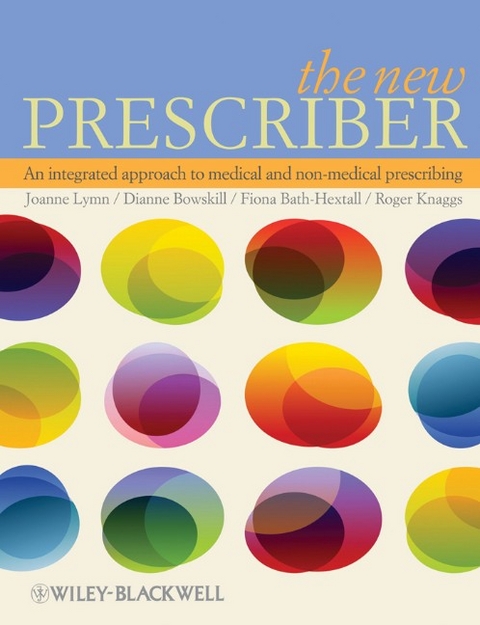
The New Prescriber (eBook)
John Wiley & Sons (Verlag)
978-1-118-27833-8 (ISBN)
Divided into three sections, this text first looks at the consultation with the patient, and outlines legal, professional and ethical frameworks which guide medical and non medical prescribing. The second section is devoted to evidence based practice, highlighting key skills essential to all clinicians. This section encourages the student to identify why evidence based practice should underpin prescribing decisions. The third and final section is concerned with pharmacology. The student is introduced to basic concepts of pharmacodynamics and pharmacokinetics, adverse drug reactions and variability of response. The importance of these pharmacological principles is highlighted throughout the subsequent discussion of drug groups affecting major body systems.
Key features:
- Pulls together all key elements of prescribing using an integrated approach.
- ‘Stop and think' boxes and ‘practice applications' activities provided throughout, enabling the reader link theory to practice
- Key terms and glossary provided
This text will be invaluable for all nursing, health and medical students taking courses in prescribing and pharmacology.
Joanne Lymn is an Associate Professor in Pharmacology, University of Nottingham.
Dianne Bowskill is a Lecturer in Non Medical Prescribing, University of Nottingham.
Fiona Bath-Hextall is an Associate Professor and Reader in Evidence-Based Healthcare, University of Nottingham.
Roger Knaggs is an Advanced Pharmacy Practitioner - Anaesthesia and Pain Management, Nottingham University Hospitals NHS Trust.
The New Prescriber is a comprehensive, accessible textbook that provides essential coverage of the three core components for prescribing: the client/patient, the evidence, and the pharmacology. Divided into three sections, this text first looks at the consultation with the patient, and outlines legal, professional and ethical frameworks which guide medical and non-medical prescribing. The second section is devoted to evidence-based practice, highlighting key skills essential to all clinicians. This section encourages the student to identify why evidence-based practice should underpin prescribing decisions. The third and final section is concerned with pharmacology. The student is introduced to basic concepts of pharmacodynamics and pharmacokinetics, adverse drug reactions and variability of response. The importance of these pharmacological principles is highlighted throughout the subsequent discussion of drug groups affecting major body systems. Key features: Pulls together all key elements of prescribing using an integrated approach Stop and Think' boxes and practice application activities provided throughout, enabling the reader to link theory to practice Key terms and glossary provided This text is invaluable for all nursing, health and medical students taking courses in prescribing and pharmacology.
Joanne Lymn is an Associate Professor in Pharmacology, University of Nottingham. Dianne Bowskill is a Lecturer in Non Medical Prescribing, University of Nottingham. Fiona Bath-Hextall is an Associate Professor and Reader in Evidence-Based Healthcare, University of Nottingham. Roger Knaggs is an Advanced Pharmacy Practitioner - Anaesthesia and Pain Management, Nottingham University Hospitals NHS Trust.
Contributors List.
Preface.
SECTION 1 THE PATIENT.
1 The consultation (Frank Coffey and Dianne
Bowskill).
2 Accountability and prescribing (Nigel Plant and Richard
Pitt).
3 Legal aspects of prescribing (Joy Wingfield).
4 The ethics of prescribing (Richard Cooper).
5 Prescribing in practice (Dianne Bowskill).
6 Record keeping (Fiona Dobson).
7 Public health issues (Michael Watson).
Quiz Answers.
Glossary.
SECTION 2 EVIDENCE-BASED PRACTICE.
8 What is evidence-based practice? (Fiona
Bath-Hextall).
9 How do we find the evidence? (Finola Delamere).
10 What are the different types of study design? (Sarah
Armstrong).
11 Appraising the evidence (Fiona Bath-Hextall and Sarah
Armstrong).
12 How do we interpret the evidence? (Jo
Leonardi-Bee).
13 How do we apply the evidence? (Nick Allcock).
Quiz Answers.
Glossary.
SECTION 3 PHARMACOLOGY.
14 General principles underlying drug action (Joanne
Lymn).
15 Pharmacokinetics 1 - absorption and distribution
(Joanne Lymn).
16 Pharmacokinetics 2 - metabolism and excretion
(Joanne Lymn).
17 Routes of administration (Roger Knaggs and Joanne
Lymn).
18 Variations in drug handling (Margaret Stone).
19 Adverse drug reactions and interactions (Margaret
Stone).
20 Introduction to the autonomic nervous system (Joanne
Lymn).
21 Clinical application of the principles of the autonomic
nervous system (Joanne Lymn).
22 The respiratory system (Michael Schachter).
23 The cardiovascular system (Martyn Kingsbury and Joanne
Lymn).
24 Haemostasis and thrombosis (Joanne Lymn).
25 The renal system (Judith Gregory and Sarah Jones).
26 The gastrointestinal system (Briony Leighton).
27 The endocrine system (Alison Mostyn).
28 Contraception (Alison Mostyn).
29 Introduction to the central nervous system (Dave
Skingsley).
30 Neurodegenerative disorders (Dave Skingsley).
31 Depression and anxiety (Dave Skingsley).
32 Schizophrenia (Dave Skingsley).
33 Epilepsy and aticonvulsant drugs (Michael
Schachter).
34 Pain and analgesia (Roger Knaggs).
35 Antibacterial chemotherapy (Tim Hills).
36 Antibiotic resistance and Clostridium difficile
(Tim Hills).
37 Antifungal and antiviral drugs (Tim Hills).
Quiz Answers.
Glossary.
Index.
| Erscheint lt. Verlag | 23.11.2011 |
|---|---|
| Sprache | englisch |
| Themenwelt | Medizin / Pharmazie ► Pflege |
| Schlagworte | accessible • book first • Client • Clinicians • components • Comprehensive • Consultation • Core • Coverage • Essential • Evidence • Frameworks • Key Skills • Krankenpflege • Medical • New • nursing • Patient • Pflege • Practice • prescriber • Professional • section • sections • Three |
| ISBN-10 | 1-118-27833-X / 111827833X |
| ISBN-13 | 978-1-118-27833-8 / 9781118278338 |
| Informationen gemäß Produktsicherheitsverordnung (GPSR) | |
| Haben Sie eine Frage zum Produkt? |
 EPUB (Adobe DRM)
Kopierschutz: Adobe-DRM
Adobe-DRM ist ein Kopierschutz, der das eBook vor Mißbrauch schützen soll. Dabei wird das eBook bereits beim Download auf Ihre persönliche Adobe-ID autorisiert. Lesen können Sie das eBook dann nur auf den Geräten, welche ebenfalls auf Ihre Adobe-ID registriert sind.
Details zum Adobe-DRM
Dateiformat: EPUB (Electronic Publication)
EPUB ist ein offener Standard für eBooks und eignet sich besonders zur Darstellung von Belletristik und Sachbüchern. Der Fließtext wird dynamisch an die Display- und Schriftgröße angepasst. Auch für mobile Lesegeräte ist EPUB daher gut geeignet.
Systemvoraussetzungen:
PC/Mac: Mit einem PC oder Mac können Sie dieses eBook lesen. Sie benötigen eine
eReader: Dieses eBook kann mit (fast) allen eBook-Readern gelesen werden. Mit dem amazon-Kindle ist es aber nicht kompatibel.
Smartphone/Tablet: Egal ob Apple oder Android, dieses eBook können Sie lesen. Sie benötigen eine
Geräteliste und zusätzliche Hinweise
Buying eBooks from abroad
For tax law reasons we can sell eBooks just within Germany and Switzerland. Regrettably we cannot fulfill eBook-orders from other countries.
aus dem Bereich