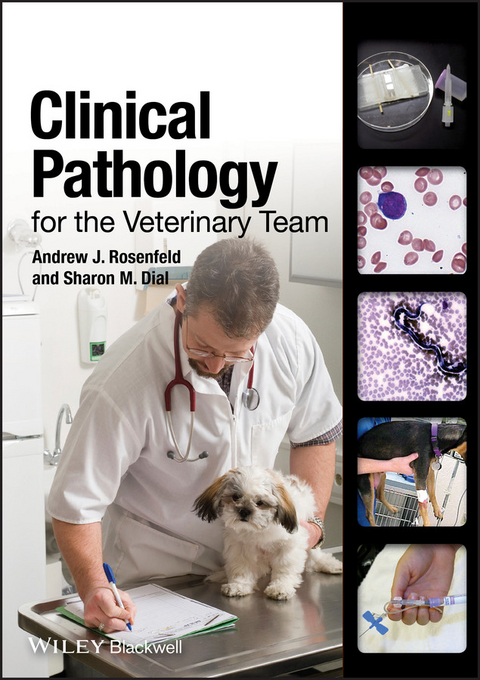
Clinical Pathology for the Veterinary Team (eBook)
John Wiley & Sons (Verlag)
978-1-118-27556-6 (ISBN)
With chapters on blood counts, chemistry, urinalysis and electrolytes, advanced diagnostics, and cytology, Clinical Pathology for the Veterinary Team offers key technical information for consistently obtaining and evaluating samples. The book is a practical resource for anyone performing lab work, including veterinary technicians, technician and veterinary students, and veterinarians.
The authors:
Andrew J. Rosenfeld, DVM, ABVP is the cofounder and head instructor of VTEC, an education corporation that specializes in seminar training for the hospital team. Dr. Rosenfeld has also written the Veterinary Medical Team Handbook, a training manual for the medical team (Wiley-Blackwell, 2007).
Sharon M. Dial, DVM, PhD, Diplomate ACVP (Clinical and Anatomic Pathology) is an Associate Research Scientist in the Department of Veterinary Science and Microbiology at the University of Arizona.
Clinical Pathology for the Veterinary Team is a concise, reliable resource for technical team members performing clinical diagnostic evaluation. Focusing on sample handling, machinery calibration, normal physiology and anatomy, clinical diagnostics, and disease processes, this essential bench-side reference for in-house laboratories helps technical team members to consistently achieve high-quality results in small animal lab work. With chapters on blood counts, chemistry, urinalysis and electrolytes, advanced diagnostics, and cytology, Clinical Pathology for the Veterinary Team offers key technical information for consistently obtaining and evaluating samples. The book is a practical resource for anyone performing lab work, including veterinary technicians, technician and veterinary students, and veterinarians.
The authors: Andrew J. Rosenfeld, DVM, ABVP is the cofounder and head instructor of VTEC, an education corporation that specializes in seminar training for the hospital team. Dr. Rosenfeld has also written the Veterinary Medical Team Handbook, a training manual for the medical team (Wiley-Blackwell, 2007). Sharon M. Dial, DVM, PhD, Diplomate ACVP (Clinical and Anatomic Pathology) is an Associate Research Scientist in the Department of Veterinary Science and Microbiology at the University of Arizona.
About the Authors ix
Foreword xi
1. Sample Handling and Laboratory Standardization--Developing Standard Operating Procedures 1
2. Components of the Complete Blood Count 19
3. Hematology: The Erythrocytes, White Blood Cells, and Immune System 33
4. Abnormalities in the Red and White Blood Cell Populations 45
5. Renal Physiology and Anatomy, Clinical Diagnostics, and Disease 75
6. Liver Physiology and Anatomy, Clinical Diagnostics, and Disease 93
7. Pancreatic and Gastrointestinal Physiology and Anatomy, Clinical Diagnostics, and Disease 105
8. Electrolyte Physiology, Function, and Derangement 119
9. Components of the Urinalysis 129
10. Evaluating the Urinalysis with Disease Conditions 139
11. Adrenal Function and Testing 151
12. Blood Gas 167
13. Coagulation 175
14. Emergency Diagnostics--A Discussion of Shock and Clinical Diagnostics 183
15. Obtaining Samples from Different Body Systems and Evaluating Cytology 193
Appendix A: Tables 207
Appendix B: Clinical Pathology for the Veterinary Team DVD Instructions 237
Appendix C: Case Worksheet for Clinical Pathology Cases 247
Additional Resources 257
Glossary 259
Index 271
Clinical Pathology for the Veterinary Team will help experienced
veterinary technicians set up various clinical laboratory
diagnostic tests. It provides a good explanation of basic
laboratory practices, the underlying concepts of many laboratory
tests, and the physiology of common disease conditions. This book
is well worth the price. (Journal of the American Veterinary
Medical Association, December 2010)
This book provides a good overall summary of basic clinical
pathology in small animals. Although it is fairly short and
concise, it contains all the necessary relevant information and
includes a CD that takes readers thorough six complicated cases,
step by step. This is a useful book that would be a handy reference
to have in a practice. It is easy to read, concise, and
informative. Although it is aimed at small animal veterinary teams,
it includes limited information about large animal species, which
is important for a good, general understanding. (Doodys,
December 2010)
Clinical Pathology for the Veterinary Team offers a fine
recourse for technical team members involved in clinical diagnostic
evaluation. Machinery calibration, normal anatomy, clinical
diagnostics and more are revealed in chapters that provide key
technical information for Obtaining and evaluating samples,
surveying the disease process, the progress of identification and
treatment, and including a DVD with interactive cases. Vet
collections need this! (The Midwest Book Review, November
2010)
Rosenfeld, a veterinarian who is associated with an education
corporation that specializes in seminar training for the hospital
team, and Dial (veterinary science and microbiology, U. of Arizona)
provide a resource for technical veterinary team members performing
clinical diagnostic evaluation in small animal lab work. (Book
News, September 2010)
It will also be essential reading for those preparing for
professional qualifications such as FIBMS and FRCPath, possibly
even MRCP, and will serve as an excellent resources for the more
senior researcher, lecturer and academic. (The Bulletin of
The Royal College of Pathologists, January 2013)
1
Sample Handling and Laboratory Standardization—Developing Standard Operating Procedures
Over the last decade, the availability of hematology and clinical chemistry instrumentation for in-clinic use has increased exponentially. There is a wide choice of instruments being marketed for use in veterinary practices. While the convenience of rapid result turnaround is touted as a primary reason for purchase and use of in-clinic instrumentation, the full impact of their use on technical personnel time or training needs and the full cost of appropriate management of the in-clinic laboratory are usually not well addressed during the decision process. When a veterinary practice decides to provide in-clinic clinical pathology service, it must make the commitment to ensure that the data produced by its in-clinic laboratory is of the same quality as that obtained by reference laboratories. The management of the practice must understand the need for trained personnel, standard operating procedures, and appropriate quality control and quality assurance programs.
The In-House Clinical Laboratory
Once a veterinary practice decides to purchase in-clinic clinical pathology instrumentation, it is the veterinary technician who is given the responsibility to obtain accurate data from the diagnostic samples for clinical management of the patient. This chapter is an introduction to laboratory management. The first aspect of integrating an in-clinic laboratory into the general practice is to identify a location for the laboratory equipment with sufficient workspace that includes space for sample processing, sample/reagent storage, and instrumentation. The area should be convenient to the treatment/surgery areas and examination rooms but out of congested traffic areas. In addition to hematology and clinical chemistry instrumentation, a free-arm centrifuge for spinning down serum and urine samples, a microhematocrit centrifuge, a quality microscope, and a refrigerator with a non–frost-free freezer compartment are needed.
Figure 1.1. Image of a high-quality microscope as part of the in-hospital medical lab equipment.
The need for a quality microscope cannot be emphasized enough. The ability to critically examine hematology and cytology specimens depends upon the clear optics of the microscope. Figure 1.1 identifies the components of a compound bright field microscope. The objective lenses of the microscope should be the highest quality affordable. The standard lenses on most light microscopes are 10×, 40×, and 100× oil emersion. The addition of a 20× or a 50× oil emersion lens can facilitate the rapid examination of cytology and hematology samples. Each microscope manufacturer can provide options for magnification and optical correction and should be able to assist in the choice of objectives for the type of clinical use in each practice. Objective lenses differ considerably in cost. It is worth the additional cost for higher-quality lenses that provide a large, flat viewing field. The higher-quality objective will significantly reduce eyestrain experience by the microscopist and improve diagnostic accuracy by providing the best quality image for viewing.
One important note is that the 40× high dry objective requires a coverslipped slide. The optics of this objective are optimized for viewing histopathology slides that are always coverslipped. A simple way to use the 40× objective to view hematology and cytology slides is to use a drop of immersion oil as a cover slip mounting medium. Place a drop of oil on the microscope slide and place a cover slip in top of the oil. This will allow sharp focus of the slide with the 40× objective. It is imperative that the high dry objective does not get immersed in oil. If this inadvertently happens, immediate cleaning with a quality lens cleaner (not xylene) and lens paper is necessary. A good habit is to always rotate the microscope objectives in one direction, from lowest power to highest power. This will keep the microscopist from dragging the 40× objective through oil.
The microscope manufacturer and the individual who is chosen to clean and maintain the scope are great resources for choosing good immersion oil. Immersion oils have been standardized over the years and the most frequently asked question is concerning the viscosity of the oil. High-viscosity oils are often preferred by microscopes because less oil is required to fill the gap between the slide and the objective lens (high-viscosity oil does not spread out as much as low-viscosity oil) and, when viewing multiple slides, less oil is needed on subsequent slides because the oil clings to the objective when the previous slide is removed. To prevent oil dropping on the next slide before it is needed, the microscopist should develop a habit of switching to the 10x objective before removing one slide and placing a new slide on the stage.
Figure 1.2. (a) An out-of-focus field diaphragm with fuzzy edges. (b) An in-focus field diaphragm with sharp edges.
As with all laboratory equipment, maintenance is necessary to keep the microscope working appropriately. A yearly maintenance and cleaning schedule will result in a long and useful life for a good microscope. Microscopy training is essential for all personnel using the microscope. Tasks that should be understood by all microscopists include adjusting the microscope condenser to provide the best illumination (Köhler illumination), correct lens cleaning techniques, and bulb replacement. Köhler illumination is the process of adjusting the condenser to produce the best focus of the illumination source. The process is as follows:
1. Place a microscope slide on the stage and focus the image on the slide to 10×.
2. Close the field diaphragm completely.
3. Carefully move the condenser up or down to bring the edges of the field diaphragm into sharp focus (Figure 1.2).
4. Open the field diaphragm to allow complete illumination of the field.
Most good-quality microscopes sold today have an adjustable condenser and are parfocal. Parfocal means that if the image is in focus at 10×, there should be little need to focus at the higher magnification objectives. One way to optimize the parfocal lenses is to focus a microscope slide at the higher objective (preferably at 40×) and switch to the 10× objective. If the image is out of focus, use the focus rings of the eyepieces to bring the image back into focus. Once this is done, only fine focus should be needed as the microscopist moves from one objective to the next.
An excellent resource for microscopy tips is the individual that is contracted to maintain the microscope. In addition, there are excellent Internet resources for microscopy. Optimizing microscopy skills will allow veterinary technicians to fully utilize their microscopes and increase the efficiency of viewing hematology, urinalysis, and cytology slides.
A working understanding of the available clinical instrumentation and the procedures necessary to provide accurate clinical laboratory values is necessary—in fact, required—to best serve the interests of the patient. Veterinarians will make better decisions based on their physical exam, history, and diagnostic skills without any clinical pathology data than they will if they are given erroneous data. No clinical pathology data is far better than trying to interpret erroneous data. The following are the primary responsibilities of the veterinary technician placed in charge of laboratory equipment:
1. Institute and monitor a quality control system.
2. Maintain maintenance protocols.
3. Develop standard operating procedures for all tests performed in the laboratory.
4. Provide consistent training for all individuals who will be using the equipment in the laboratory.
Currently, there are several hematology instruments available for the in-clinic laboratory. It is often the responsibility of the veterinary technician to review the instruments available prior to the investment of a large amount of money. An understanding of the types of instruments available and the differences in methods used by each instrument in obtaining data will greatly increase the potential for making an appropriate choice.
Hematology Instruments
There are basically three types of instruments available for the veterinary clinic: centrifugal, impedance, and laser-based. The centrifugal system uses a large-bore capillary tube with a special float that expands the buffy coat when the tube is spun. The tube is coated with an eosin stain that will stain DNA and RNA. The differential uptake of the stain by white blood cells and erythrocytes allows the instrument to separate the populations in the expanded buffy coat. In the erythrocyte population, immature erythrocytes (reticulocytes) will take up the stain for RNA and, therefore, an estimate of reticulocyte number is possible. Once the sample is spun, white blood cell and platelet counts are estimated based on the height of each portion of the buffy coat that corresponds to each cell type and the average size of the cell type. The packed cell volume (PCV) is determined by measuring the height of the red cell column as a percentage of the total blood column in the tube.
Studies evaluating the accuracy of this methodology have shown good correlation with standard impedance instruments when samples from healthy animals are analyzed. When samples from ill animals are compared, the expanded buffy coat has poor correlation with other methods and with blood film analysis. Many pathological changes in blood interfere...
| Erscheint lt. Verlag | 28.11.2011 |
|---|---|
| Sprache | englisch |
| Themenwelt | Medizin / Pharmazie |
| Veterinärmedizin ► Vorklinik | |
| Veterinärmedizin ► Klinische Fächer ► Pathologie | |
| Schlagworte | achieve • animal • Book • Clinical • Clinical diagnostic • concise • consistently • Essential • highquality • lab • Members • Normal • Pathology • performing • Pflege i. d. Veterinärmedizin • Pflege i. d. Veterinärmedizin • Reference • reliable • resource • Sample • Team • technical team • Veterinärmedizin • Veterinärmedizin f. Kleintiere • Veterinärmedizin / klinische Pathologie u. Labormedizin • Veterinärmedizin • Veterinärmedizin f. Kleintiere • Veterinärmedizin / klinische Pathologie u. Labormedizin • Veterinary • Veterinary Clinical Pathology & Laboratory Medicine • Veterinary Medicine • Veterinary Medicine - Small Animal General • Veterinary Nursing & Animal Care |
| ISBN-10 | 1-118-27556-X / 111827556X |
| ISBN-13 | 978-1-118-27556-6 / 9781118275566 |
| Informationen gemäß Produktsicherheitsverordnung (GPSR) | |
| Haben Sie eine Frage zum Produkt? |
 EPUB (Adobe DRM)
Kopierschutz: Adobe-DRM
Adobe-DRM ist ein Kopierschutz, der das eBook vor Mißbrauch schützen soll. Dabei wird das eBook bereits beim Download auf Ihre persönliche Adobe-ID autorisiert. Lesen können Sie das eBook dann nur auf den Geräten, welche ebenfalls auf Ihre Adobe-ID registriert sind.
Details zum Adobe-DRM
Dateiformat: EPUB (Electronic Publication)
EPUB ist ein offener Standard für eBooks und eignet sich besonders zur Darstellung von Belletristik und Sachbüchern. Der Fließtext wird dynamisch an die Display- und Schriftgröße angepasst. Auch für mobile Lesegeräte ist EPUB daher gut geeignet.
Systemvoraussetzungen:
PC/Mac: Mit einem PC oder Mac können Sie dieses eBook lesen. Sie benötigen eine
eReader: Dieses eBook kann mit (fast) allen eBook-Readern gelesen werden. Mit dem amazon-Kindle ist es aber nicht kompatibel.
Smartphone/Tablet: Egal ob Apple oder Android, dieses eBook können Sie lesen. Sie benötigen eine
Geräteliste und zusätzliche Hinweise
Buying eBooks from abroad
For tax law reasons we can sell eBooks just within Germany and Switzerland. Regrettably we cannot fulfill eBook-orders from other countries.
aus dem Bereich