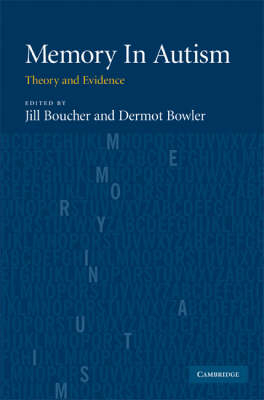
Memory In Autism (eBook)
Cambridge University Press (Verlag)
978-0-511-40619-5 (ISBN)
Many people with autism spectrum disorders (ASDs) are remarkably proficient at remembering how things look and sound, even years after an event. They are also good at rote learning and establishing habits and routines. Some even have encyclopaedic memories. However, all individuals with ASD have difficulty in recalling personal memories and reliving experiences, and less able people may have additional difficulty in memorising facts. This book assembles new research on memory in autism to examine why this happens and the effects it has on people's lives. The contributors utilise recent advances in the understanding of normal memory systems and their breakdown as frameworks for analysing the neuropsychology and neurobiology of memory in autism. The unique patterning of memory functions across the spectrum illuminates difficulties with sense of self, emotion processing, mental time travel, language and learning, providing a window into the nature and causes of autism itself.
Many people with autism spectrum disorders (ASDs) are remarkably proficient at remembering how things look and sound, even years after an event. They are also good at rote learning and establishing habits and routines. Some even have encyclopaedic memories. However, all individuals with ASD have difficulty in recalling personal memories and reliving experiences, and less able people may have additional difficulty in memorising facts. This book assembles research on memory in autism to examine why this happens and the effects it has on people''s lives. The contributors utilise advances in the understanding of normal memory systems and their breakdown as frameworks for analysing the neuropsychology and neurobiology of memory in autism. The unique patterning of memory functions across the spectrum illuminates difficulties with sense of self, emotion processing, mental time travel, language and learning, providing a window into the nature and causes of autism itself.
| Erscheint lt. Verlag | 2.7.2008 |
|---|---|
| Sprache | englisch |
| Themenwelt | Sachbuch/Ratgeber |
| Geisteswissenschaften ► Psychologie ► Allgemeine Psychologie | |
| Geisteswissenschaften ► Psychologie ► Biopsychologie / Neurowissenschaften | |
| Geisteswissenschaften ► Psychologie ► Verhaltenstherapie | |
| Medizin / Pharmazie ► Medizinische Fachgebiete ► Neurologie | |
| Naturwissenschaften ► Biologie ► Humanbiologie | |
| Naturwissenschaften ► Biologie ► Zoologie | |
| ISBN-10 | 0-511-40619-3 / 0511406193 |
| ISBN-13 | 978-0-511-40619-5 / 9780511406195 |
| Informationen gemäß Produktsicherheitsverordnung (GPSR) | |
| Haben Sie eine Frage zum Produkt? |
 PDF (Adobe DRM)
Kopierschutz: Adobe-DRM
Adobe-DRM ist ein Kopierschutz, der das eBook vor Mißbrauch schützen soll. Dabei wird das eBook bereits beim Download auf Ihre persönliche Adobe-ID autorisiert. Lesen können Sie das eBook dann nur auf den Geräten, welche ebenfalls auf Ihre Adobe-ID registriert sind.
Details zum Adobe-DRM
Dateiformat: PDF (Portable Document Format)
Mit einem festen Seitenlayout eignet sich die PDF besonders für Fachbücher mit Spalten, Tabellen und Abbildungen. Eine PDF kann auf fast allen Geräten angezeigt werden, ist aber für kleine Displays (Smartphone, eReader) nur eingeschränkt geeignet.
Systemvoraussetzungen:
PC/Mac: Mit einem PC oder Mac können Sie dieses eBook lesen. Sie benötigen eine
eReader: Dieses eBook kann mit (fast) allen eBook-Readern gelesen werden. Mit dem amazon-Kindle ist es aber nicht kompatibel.
Smartphone/Tablet: Egal ob Apple oder Android, dieses eBook können Sie lesen. Sie benötigen eine
Geräteliste und zusätzliche Hinweise
Buying eBooks from abroad
For tax law reasons we can sell eBooks just within Germany and Switzerland. Regrettably we cannot fulfill eBook-orders from other countries.
aus dem Bereich