


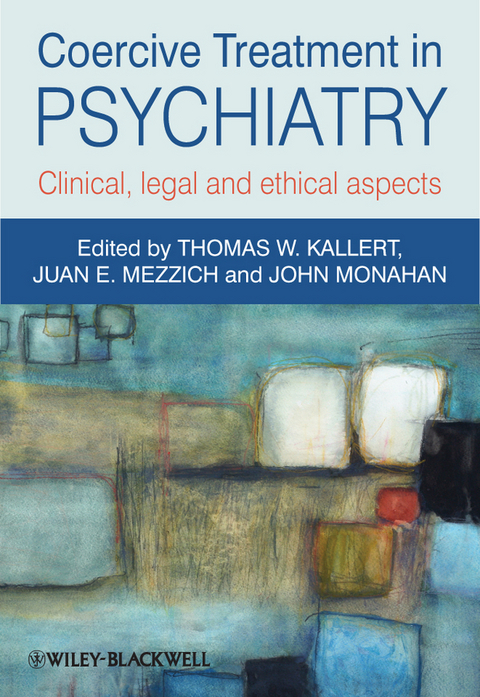
Coercive Treatment in Psychiatry (eBook)
John Wiley & Sons (Verlag)
978-0-470-97854-2 (ISBN)
Coercive Treatment in Psychiatry is a much needed contribution to the literature. The first three sections deal with the conceptual and clinical aspects of coercive treatment, the legal aspects and the ethical aspects of coercive treatment. In detail, these sections cover a broad spectrum of issues: coercion in institutions and in the community, coercive treatment and stigma, the definition of best practice standards for coercive treatment, de-escalation of risk situations, recent developments in mental health legislation, mental health care and patients' rights, cross-cultural perspectives on coercive treatment, historical injustice in psychiatry, and paternalism in mental health. The fourth section features users' views on coercive treatment: giving voice to an often-unheeded population. Finally, the book addresses the original topic of coercion and undue influence in decisions to participate in psychiatric research.
This book presents the first comprehensive review of the issue of coercion in psychiatry. With chapters written by the leading experts in the field, many of whom are renowned as clear thinkers and experienced clinicians, it may be seen as a starting point for international discussions and initiatives in this field aiming to minimize coercion.
Highly Commended in the Psychiatry section of the 2012 BMA Book Awards.
Professor Kallert has been active in the field of mental health services research for many years. He was co-ordinator of the EC-funded research project, European evaluation of coercion in psychiatry and harmonisation of best clinical practice (EUNOMIA). He has published 6 books, more than 35 chapters in books, and more than 125 articles in peer-reviewed journals. He has received the Hermann-Simon-Prize for Social Psychiatry, and the Hans-Heimann-Prize of the German Society of Psychiatry, Psychotherapy and Neurosciences. He is an Honorary Member of the World Psychiatric Association.
Dr. Mezzich was Chair of the World Psychiatric Association (WPA) Section on Classification and Diagnostic Assessment, and a member of the ICD-10 Mental Disorders Workgroup and the DSM-IV Task Force. He has authored over 200 scientific journal articles and book chapters and 25 books and monographs primarily on psychiatric diagnosis and epidemiology from clinical, philosophical, statistical, and cultural perspectives and more recently on person-centered psychiatry and medicine. He has received six Honorary Doctorates from universities in the Americas and Europe as well as the Simon Bolivar Award of the American Psychiatric Association, the Medal for Extraordinary Merit of the Medical Council of Peru, and the Linneaus Medal of Uppsala University in Sweden. He is President of the InternationalNetwork for Person-centered Medicine.
Professor Monahan is well known internationally for his numerous publications and presentations in mental health law, for his leadership of the MacArthur Research Network on Violence, Coercion and Competence and of the current MacArthur Research Network on Mandated Treatment in the Community, and for his generous support and encouragement of scholars in coercion and in all areas of mental health law.
Coercion is one of the most fascinating and controversial subjects in psychiatry. It is a highly sensitive, and hotly debated topic in which clinical practice, ethics, the law and public policy converge. This book considers coercion within the healing and ethical framework of therapeutic relationships and partnerships at all levels, and addresses the universal problem of how to balance safety versus autonomy when dealing with psychiatric treatment. Coercive Treatment in Psychiatry is a much needed contribution to the literature. The first three sections deal with the conceptual and clinical aspects of coercive treatment, the legal aspects and the ethical aspects of coercive treatment. In detail, these sections cover a broad spectrum of issues: coercion in institutions and in the community, coercive treatment and stigma, the definition of best practice standards for coercive treatment, de-escalation of risk situations, recent developments in mental health legislation, mental health care and patients' rights, cross-cultural perspectives on coercive treatment, historical injustice in psychiatry, and paternalism in mental health. The fourth section features users' views on coercive treatment: giving voice to an often-unheeded population. Finally, the book addresses the original topic of coercion and undue influence in decisions to participate in psychiatric research. This book presents the first comprehensive review of the issue of coercion in psychiatry. With chapters written by the leading experts in the field, many of whom are renowned as clear thinkers and experienced clinicians, it may be seen as a starting point for international discussions and initiatives in this field aiming to minimize coercion. Highly Commended in the Psychiatry section of the 2012 BMA Book Awards.
Professor Kallert has been active in the field of mental health services research for many years. He was co-ordinator of the EC-funded research project, European evaluation of coercion in psychiatry and harmonisation of best clinical practice (EUNOMIA). He has published 6 books, more than 35 chapters in books, and more than 125 articles in peer-reviewed journals. He has received the Hermann-Simon-Prize for Social Psychiatry, and the Hans-Heimann-Prize of the German Society of Psychiatry, Psychotherapy and Neurosciences. He is an Honorary Member of the World Psychiatric Association. Dr. Mezzich was Chair of the World Psychiatric Association (WPA) Section on Classification and Diagnostic Assessment, and a member of the ICD-10 Mental Disorders Workgroup and the DSM-IV Task Force. He has authored over 200 scientific journal articles and book chapters and 25 books and monographs primarily on psychiatric diagnosis and epidemiology from clinical, philosophical, statistical, and cultural perspectives and more recently on person-centered psychiatry and medicine. He has received six Honorary Doctorates from universities in the Americas and Europe as well as the Simon Bolivar Award of the American Psychiatric Association, the Medal for Extraordinary Merit of the Medical Council of Peru, and the Linneaus Medal of Uppsala University in Sweden. He is President of the InternationalNetwork for Person-centered Medicine. Professor Monahan is well known internationally for his numerous publications and presentations in mental health law, for his leadership of the MacArthur Research Network on Violence, Coercion and Competence and of the current MacArthur Research Network on Mandated Treatment in the Community, and for his generous support and encouragement of scholars in coercion and in all areas of mental health law.
Coercive Treatment in Psychiatry: Clinical, Legal and Ethical Aspects 1
Contents 7
List of Contributors 9
Introduction 13
Section 1: Conceptual and clinical aspects of coercive treatment 25
1 Person-centred psychiatry perspectives on coercion and cooperation 27
2 Coercive treatment and stigma – is there a link? 37
3 Mandated psychiatric treatment in the community – forms, prevalence, outcomes and controversies 57
4 Is it possible to define a best practice standard for coercive treatment in psychiatry? 73
5 How to de-escalate a risk situation to avoid the use of coercion 81
Section 2: Legal aspects of coercive treatment 105
6 Psychiatry and the law – do the fields agree in their views on coercive treatment? 107
7 Reducing discrimination in mental health law – the ‘fusion’ of incapacity and mental health legislation 121
8 Mental health care and patients’ rights – are these two fields currently compatible? 145
Section 3: Ethical aspects of coercive treatment 175
9 Cross-cultural perspectives on coercive treatment in psychiatry 177
10 Historical injustice in psychiatry with examples from Nazi Germany and others – ethical lessons for the modern professional 185
11 Paternalism in mental health – when boots are superior to Pushkin 199
Section 4: Users’ views on coercive treatment 209
12 The moral imperative for dialogue with organizations of survivors of coerced psychiatric human rights violations 211
13 Resisting variables – service user/survivor perspectives on researching coercion 237
14 Seventy years of coercion in psychiatric institutions, experienced and witnessed 259
15 Coercion – point, perception, process 269
Section 5: Coercion and undue influence in decisions to participate in psychiatric research 293
16 Ethical issues of participating in psychiatric research on coercion 295
17 Coercion and undue influence in decisions to participate in psychiatric research 317
Index 339
"Summing up then, this is a rich and valuable collection.
It comes at a time when ideas about both coercion and treatment are
being revised, and in addition to raising more practical and
policy-related challenges, it demonstrates important philosophical
issues requiring further attention." (Metapsychology
Online, 23 April 2013)
| Erscheint lt. Verlag | 31.3.2011 |
|---|---|
| Sprache | englisch |
| Themenwelt | Medizin / Pharmazie ► Gesundheitsfachberufe |
| Medizin / Pharmazie ► Gesundheitswesen | |
| Medizin / Pharmazie ► Medizinische Fachgebiete ► Medizinethik | |
| Medizin / Pharmazie ► Medizinische Fachgebiete ► Psychiatrie / Psychotherapie | |
| Studium ► Querschnittsbereiche ► Geschichte / Ethik der Medizin | |
| Schlagworte | Book • clinical practice • Coercion • Considers • Controversial Subjects • Converge • Ethical • fascinating • Forensic Psychology • Forensische Psychologie • Framework • highly • levels • Medical Science • Medizin • Partnerships • Policy • Psychiatric • Psychiatry • Psychologie • Psychology • Public • safety versus • sensitive • Social Psychiatry • Sozialpsychiatrie • Therapeutic • topic • Universal |
| ISBN-10 | 0-470-97854-6 / 0470978546 |
| ISBN-13 | 978-0-470-97854-2 / 9780470978542 |
| Informationen gemäß Produktsicherheitsverordnung (GPSR) | |
| Haben Sie eine Frage zum Produkt? |
 PDF (Adobe DRM)
Kopierschutz: Adobe-DRM
Adobe-DRM ist ein Kopierschutz, der das eBook vor Mißbrauch schützen soll. Dabei wird das eBook bereits beim Download auf Ihre persönliche Adobe-ID autorisiert. Lesen können Sie das eBook dann nur auf den Geräten, welche ebenfalls auf Ihre Adobe-ID registriert sind.
Details zum Adobe-DRM
Dateiformat: PDF (Portable Document Format)
Mit einem festen Seitenlayout eignet sich die PDF besonders für Fachbücher mit Spalten, Tabellen und Abbildungen. Eine PDF kann auf fast allen Geräten angezeigt werden, ist aber für kleine Displays (Smartphone, eReader) nur eingeschränkt geeignet.
Systemvoraussetzungen:
PC/Mac: Mit einem PC oder Mac können Sie dieses eBook lesen. Sie benötigen eine
eReader: Dieses eBook kann mit (fast) allen eBook-Readern gelesen werden. Mit dem amazon-Kindle ist es aber nicht kompatibel.
Smartphone/Tablet: Egal ob Apple oder Android, dieses eBook können Sie lesen. Sie benötigen eine
Geräteliste und zusätzliche Hinweise
Buying eBooks from abroad
For tax law reasons we can sell eBooks just within Germany and Switzerland. Regrettably we cannot fulfill eBook-orders from other countries.
aus dem Bereich


