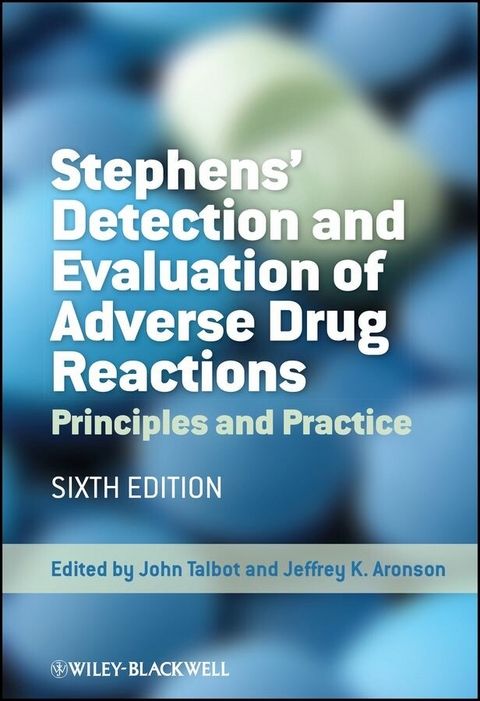
Stephens' Detection and Evaluation of Adverse Drug Reactions (eBook)
John Wiley & Sons (Verlag)
978-0-470-97504-6 (ISBN)
Stephens' Detection and Evaluation of Adverse Drug Reactions provides a comprehensive review of all aspects of adverse drug reactions throughout the life cycle of a medicine, from toxicology and clinical trials through to pharmacovigilance, risk management, and legal and regulatory requirements. It also covers the safety of biotherapeutics and vaccines and includes new chapters on pharmacogenetics, proactive risk management, societal considerations, and the safety of drugs used in oncology and herbal medicines.
This sixth edition of the classic text on drug safety is an authoritative reference text for all those who work in pharmacovigilance or have an interest in adverse drug reactions, whether in regulatory authorities, pharmaceutical companies, or academia.
Praise for previous editions
'This book presents a comprehensive and wide-ranging overview of the science of pharmacovigilance. For those entering or already experienced in the pharmaceutical sciences, this is an essential work.' - from a review in E-STREAMS
'...a key text in the area of pharmacovigilance...extensively referenced and well-written...a valuable resource...' - from a review in The Pharmaceutical Journal
John Talbot, Senior Lecturer, University of Hertfordshire, UK. Formerly Director, Global Drug Safety, AstraZeneca R&D Charnwood, Loughborough, Leicestershire, UK
Jeffrey Aronson, Reader in Clinical Pharmacology, University of Oxford, Oxford, UK and President Emeritus of the British Pharmacological Society
The detection and evaluation of adverse drug reactions is crucial for understanding the safety of medicines and for preventing harm in patients. Not only is it necessary to detect new adverse drug reactions, but the principles and practice of pharmacovigilance apply to the surveillance of a wide range of medicinal products. Stephens' Detection and Evaluation of Adverse Drug Reactions provides a comprehensive review of all aspects of adverse drug reactions throughout the life cycle of a medicine, from toxicology and clinical trials through to pharmacovigilance, risk management, and legal and regulatory requirements. It also covers the safety of biotherapeutics and vaccines and includes new chapters on pharmacogenetics, proactive risk management, societal considerations, and the safety of drugs used in oncology and herbal medicines. This sixth edition of the classic text on drug safety is an authoritative reference text for all those who work in pharmacovigilance or have an interest in adverse drug reactions, whether in regulatory authorities, pharmaceutical companies, or academia. Praise for previous editions "e;This book presents a comprehensive and wide-ranging overview of the science of pharmacovigilance. For those entering or already experienced in the pharmaceutical sciences, this is an essential work. - from a review in E-STREAMS "e;...a key text in the area of pharmacovigilance...extensively referenced and well-written...a valuable resource..."e; - from a review in The Pharmaceutical Journal
John Talbot, Senior Lecturer, University of Hertfordshire, UK. Formerly Director, Global Drug Safety, AstraZeneca R&D Charnwood, Loughborough, Leicestershire, UK Jeffrey Aronson, Reader in Clinical Pharmacology, University of Oxford, Oxford, UK and President Emeritus of the British Pharmacological Society
Stephens’ Detection and Evaluation of Adverse Drug Reactions : Principles and Practice 3
Contents 7
Foreword 13
Preface to the Sixth Edition 15
List of Contributors 17
Acknowledgements 19
1 Adverse Drug Reactions: History, Terminology, Classification, Causality, Frequency, Preventability 21
1.1 Introduction 21
1.2 Defining pharmacovigilance 21
1.3 The modern history of pharmacovigilance 23
1.4 Terminology and definitions in pharmacovigilance 26
1.5 Medication errors 45
1.6 Pharmacological classification of adverse drug reactions 52
1.7 Drug interactions 73
1.8 Reporting suspected adverse drug reactions 79
1.9 Causality assessment 84
1.10 Frequencies of adverse drug reactions 89
1.11 Risk perception and adverse drug reactions 97
1.12 Class effects of drugs 98
1.13 Unlicensed indications, off-label uses, and orphan drugs 100
1.14 Preventing adverse drug reactions 104
1.15 Publishing accounts of adverse drug reactions 115
References 121
2 Pharmacogenetics of Adverse Drug Reactions 141
2.1 Introduction 141
2.2 Historical review 141
2.3 Sources of genetic variability 142
2.4 Role of pharmacogenetic factors in drug pharmacokinetics 143
2.5 Role of pharmacogenetic factors in drug pharmacodynamics 153
2.6 The role of pharmacogenetics in pharmaceutical companies 159
2.7 The impact of pharmacogenetics on regulatory agencies 161
2.8 The impact of pharmacogenetics on clinical practice 163
2.9 Conclusions 165
References 165
3 Toxicology and Adverse Drug Reactions 177
3.1 Introduction 177
3.2 Toxicity testing 177
3.3 Drug discovery and development 188
3.4 Data interpretation and risk assessment 194
3.5 Adverse drug reactions detected after marketing authorization 206
3.6 Examples of toxicological investigation of ADRs 219
3.7 Conclusions 220
Acknowledgements 221
References 221
4 Clinical Trials—Collecting Safety Data and Establishing the Adverse Drug Reactions Profile 235
4.1 Introduction 235
4.2 Adverse events 236
4.3 Clinical studies and safety 256
4.4 The emerging safety profile 287
4.5 Presentation of safety data 291
4.6 Conclusions 300
References 301
5 Clinical Laboratory Safety Data 311
5.1 Introduction 311
5.2 Factors that influence the interpretation of clinical laboratory data 314
5.3 Sample collection procedure 320
5.4 Analytical variation 321
5.5 Reference ranges 324
5.6 Intra-individual biological variation 327
5.7 Detecting adverse events during drug development 329
5.8 Test selection 353
5.9 Exclusion criteria and “panic levels” 355
5.10 Harmonization of data from different laboratories 357
5.11 Data analysis and presentation 359
5.12 Conclusions 364
5.13 Appendix 365
References 366
6 Statistics: Analysis and Presentation of Safety Data 369
6.1 Introduction and background 369
6.2 Problems with efficacy trials for detecting adverse drug reactions 372
6.3 Analysis and presentation of data from trials 375
6.4 Statistical measures of the occurrence of adverse events 376
6.5 Combining data from several trials—meta-analysis 384
6.6 Use of statistical methods for signal detection from spontaneous reports 385
6.7 Analysis and presentation of data from observational studies 393
6.8 Summary and conclusions 404
Acknowledgements 405
References 406
7 Proactive Pharmacovigilance and Risk Management 409
7.1 Introduction 409
7.2 Risk management—definition and general principles 410
7.3 Defining the knowledge base—the safety specification 411
7.4 Extending the knowledge of safety and characterizing risk—the pharmacovigilance plan 414
7.5 Minimizing risks 415
7.6 Special challenges for risk management 417
7.7 Experience with risk evaluation and mitigation strategies (REMS) in the USA 418
7.8 A possible method for risk management when a new adverse reaction is discovered after marketing 419
7.9 Future challenges for risk management 425
7.10 Conclusions 426
References 427
8 Regulatory Aspects of Pharmacovigilance 431
8.1 Introduction 431
8.2 The standardization and harmonization of safety data collection and reporting: CIOMS and ICH 432
8.3 The European Union 467
8.4 The UK 501
8.5 France 503
8.6 Germany 505
8.7 USA 507
8.8 Japan 520
Acknowledgements 525
References 526
Useful web sites 529
9 Legal Aspects of Pharmacovigilance in the European Union 531
9.1 Introduction 531
9.2 Application of EU legislation in Member States 531
9.3 Interpretation of EU law 534
9.4 Relationship between law and guidelines 535
9.5 Issues in interpreting EU pharmacovigilance legislation 537
9.6 Legal responsibility for pharmacovigilance activities 539
9.7 Failures to meet pharmacovigilance requirements 542
9.8 Enforcement and sanctions 544
9.9 European powers and procedures in the event of a product safety issue 548
9.10 Civil liability 554
9.11 Personal data privacy 557
9.12 Safety in research products 558
References 561
10 Dictionaries and Coding in Pharmacovigilance 565
10.1 Introduction 565
10.2 Scope of this chapter 566
10.3 What is a dictionary? 566
10.4 Drug dictionaries 567
10.5 Disease classifications 574
10.6 Medical Dictionary for Regulatory Activities, MedDRA ® 577
10.7 Common Terminology Criteria for Adverse Events (CTCAE) 587
10.8 Definition of adverse reaction terms 587
10.9 Dictionaries used in electronic health records 588
10.10 Use of dictionaries in standard product information 590
10.11 Conclusions 591
Acknowledgements 591
References 591
11 Adverse Drug Reactions: Societal Considerations 593
11.1 Introduction 593
11.2 Adverse drug reactions at the population level 594
11.3 The social production of ADRs 596
11.4 Trust 599
11.5 Information about ADRs 601
11.6 Conclusions 603
References 603
12 Safety of Biotherapeutics 605
12.1 Introduction 605
12.2 Properties of proteins 606
12.3 Classification of biotherapeutics 607
12.4 Monitoring for adverse events due to biotherapeutics 609
12.5 Conclusions 618
References 618
13 Vaccine Safety Surveillance 623
13.1 Introduction 623
13.2 What is special about vaccine safety compared with other drugs? 624
13.3 Pathogenesis of vaccine reactions 625
13.4 Criteria for establishing causality after vaccine-related adverse events 628
13.5 Pre-licensing evaluation of vaccine safety 630
13.6 Objectives of an ideal post-licensing vaccine safety surveillance system 631
13.7 Conclusions 640
References 640
14 Assessing the Safety of Drugs Used in Oncology 645
14.1 Introduction 645
14.2 Factors to consider when assessing the safety of drugs used in oncology 647
14.3 Sources of adverse effect data 652
14.4 Nature of the data 654
14.5 Assessment of adverse effects data in oncology 655
14.6 Conclusions 661
References 662
15 Adverse Drug Reactions and Pharmacovigilance of Herbal Medicines 665
15.1 Introduction 665
15.2 Herbal medicines: definitions and descriptions 666
15.3 Characteristics of herbal medicines 667
15.4 Regulation of herbal medicines and pharmacovigilance requirements 668
15.5 Access to and use of herbal medicines 675
15.6 Adverse reactions associated with herbal medicines 676
15.7 Methods for pharmacovigilance of herbal medicines 686
15.8 Responding to safety concerns associated with herbal medicines 693
15.9 The future for pharmacovigilance of herbal medicines 694
15.10 Conclusions 695
References 696
Appendix 1 Web Sites Relevant to Pharmacovigilance—An Analysis of Contents 705
A1.1 Introduction 705
A1.2 Ten national pharmacovigilance web sites 705
A1.3 Twelve institutional web sites 709
Acknowledgements 717
References 717
Appendix 2 Guidelines and a Checklist for Reporting Suspected Adverse Drug Reactions Anecdotally in Journals 719
A2.1 Introduction 719
A2.2 Notes on the checklist 720
A2.3 Conclusions 726
Note 726
References 726
Index 729
"A vast array of experts in the science of
pharmacovigilance contribute to this book, but the editors have
maintained a clarity of presentation, keeping in mind that
communication is a key factor in pharmacovigilance."
(Doody's, 27 July 2012)
| Erscheint lt. Verlag | 8.12.2011 |
|---|---|
| Sprache | englisch |
| Themenwelt | Medizin / Pharmazie ► Gesundheitsfachberufe |
| Medizin / Pharmazie ► Medizinische Fachgebiete ► Pharmakologie / Pharmakotherapie | |
| Schlagworte | adverse • Aspects • Clinical Pharmacology & Therapeutics • comprehensive review • crucial • detection • Drug • Drug reactions • Harm • Klinische Pharmakologie u. Therapie • Medical Science • Medicinal • Medizin • Necessary • New • Pharmacology & Pharmaceutical Medicine • pharmacovigilance • Pharmakologie u. Pharmazeutische Medizin • Pharmazeutische Medizin • Practice • Principles • Products • Range • Reactions • Safety • Stephens • Surveillance • wide |
| ISBN-10 | 0-470-97504-0 / 0470975040 |
| ISBN-13 | 978-0-470-97504-6 / 9780470975046 |
| Informationen gemäß Produktsicherheitsverordnung (GPSR) | |
| Haben Sie eine Frage zum Produkt? |
 PDF (Adobe DRM)
Kopierschutz: Adobe-DRM
Adobe-DRM ist ein Kopierschutz, der das eBook vor Mißbrauch schützen soll. Dabei wird das eBook bereits beim Download auf Ihre persönliche Adobe-ID autorisiert. Lesen können Sie das eBook dann nur auf den Geräten, welche ebenfalls auf Ihre Adobe-ID registriert sind.
Details zum Adobe-DRM
Dateiformat: PDF (Portable Document Format)
Mit einem festen Seitenlayout eignet sich die PDF besonders für Fachbücher mit Spalten, Tabellen und Abbildungen. Eine PDF kann auf fast allen Geräten angezeigt werden, ist aber für kleine Displays (Smartphone, eReader) nur eingeschränkt geeignet.
Systemvoraussetzungen:
PC/Mac: Mit einem PC oder Mac können Sie dieses eBook lesen. Sie benötigen eine
eReader: Dieses eBook kann mit (fast) allen eBook-Readern gelesen werden. Mit dem amazon-Kindle ist es aber nicht kompatibel.
Smartphone/Tablet: Egal ob Apple oder Android, dieses eBook können Sie lesen. Sie benötigen eine
Geräteliste und zusätzliche Hinweise
Buying eBooks from abroad
For tax law reasons we can sell eBooks just within Germany and Switzerland. Regrettably we cannot fulfill eBook-orders from other countries.
aus dem Bereich