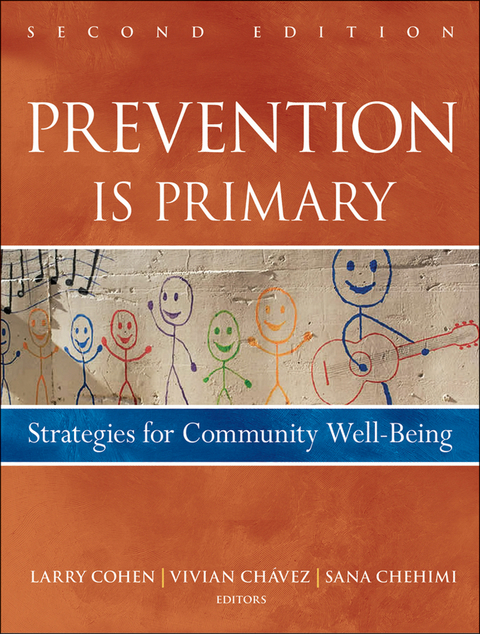
Prevention Is Primary (eBook)
John Wiley & Sons (Verlag)
978-0-470-87334-2 (ISBN)
The new edition of Prevention Is Primary provides models, methods, and approaches for building health and equity in communities. This comprehensive book includes the theory, concepts, and models needed to harness social justice and practice primary prevention of unnecessary illness and injury. Ideal for students as well as practitioners, this thoroughly revised and updated second edition combines an overview of advances in the field with effective approaches in the current economic and health care climate.
With contributions from noted experts, Prevention Is Primary shows practical applications of intervention science to social and health problems and issues facing at-risk and vulnerable groups. The book describes the overarching framework and principles guiding prevention efforts, including a focus on social justice and health equity, and community resilience. It explores the transition from prevention theory to implementation and practice and from interdisciplinary collaboration to evaluation. Highlighting the book's usefulness as a teaching and learning tool, Prevention Is Primary has real world examples, learning objectives, and review questions for each chapter.
Larry Cohen, MSW, is the founder and executive director of the Prevention Institute, Oakland, California.
Vivian Chavez, DrPH, MSW, is an associate professor in the department of health education at San Francisco State University.
Sana Chehimi, MPH, is program manager at the Prevention Institute.
The new edition of Prevention Is Primary provides models, methods, and approaches for building health and equity in communities. This comprehensive book includes the theory, concepts, and models needed to harness social justice and practice primary prevention of unnecessary illness and injury. Ideal for students as well as practitioners, this thoroughly revised and updated second edition combines an overview of advances in the field with effective approaches in the current economic and health care climate. With contributions from noted experts, Prevention Is Primary shows practical applications of intervention science to social and health problems and issues facing at-risk and vulnerable groups. The book describes the overarching framework and principles guiding prevention efforts, including a focus on social justice and health equity, and community resilience. It explores the transition from prevention theory to implementation and practice and from interdisciplinary collaboration to evaluation. Highlighting the book's usefulness as a teaching and learning tool, Prevention Is Primary has real world examples, learning objectives, and review questions for each chapter.
Larry Cohen, MSW, is the founder and executive director of the Prevention Institute, Oakland, California. Vivian Chavez, DrPH, MSW, is an associate professor in the department of health education at San Francisco State University. Sana Chehimi, MPH, is program manager at the Prevention Institute.
Prevention Is Primary: Strategies for Community Well Being, Second Edition 1
Contents 7
Tables, Figures, and Exhibits 9
Foreword 15
The Contributors 17
Introduction 31
Part One: Defining the Issues 37
Chapter 1: The Imperative for Primary Prevention 39
MOVING UPSTREAM WITH PRIMARY PREVENTION 41
THE HISTORY OF EFFECTIVE PREVENTION EFFORTS 43
EXAMPLES AND CHALLENGES OF PRIMARY PREVENTION 44
THE CASE FOR PRIMARY PREVENTION 45
PUTTING PRIMARY PREVENTION INTO PRACTICE 52
CONCLUSION 60
DISCUSSION QUESTIONS 60
NOTE 61
REFERENCES 61
Chapter 2: Achieving Health Equity and Social Justice 69
WHAT IS HEALTH EQUITY? 72
DETERMINANTS OF HEALTH DISPARITIES 76
ISSUES IN ADDRESSING RACIAL DISPARITIES 78
STRATEGIES TO REDUCE DISPARITIES 81
CONCEPTUAL FRAMEWORK 84
CONCLUSION 86
DISCUSSION QUESTIONS 86
REFERENCES 87
Chapter 3: Individual, Family, and Community Resilience 91
RISK-BASED APPROACHES 92
THE GIFT OF RESILIENCE RESEARCH 94
RESILIENCE, YOUTH DEVELOPMENT, AND COMMUNITY DEVELOPMENT 101
RECOGNIZING RESILIENCE IN COMMUNITIES 102
MAPPING COMMUNITY ASSETS 104
A FOCUS ON COMMUNITY RESILIENCE 105
A FRAMEWORK FOR RESILIENCE AND COMMUNITY AND YOUTH DEVELOPMENT 108
YOUTH DEVELOPMENT, RESILIENCE, AND PRIMARY PREVENTION 110
CREATING A RESILIENCE PERSPECTIVE 110
CONCLUSION 112
DISCUSSION QUESTIONS 113
REFERENCES 114
Part Two: Key Elements of Effective Prevention Efforts 119
Chapter 4: Community Organizing for Health and Social Justice 123
DEFINITIONS AND TERMINOLOGY 125
COMMUNITY 125
HISTORICAL CONTEXT 127
WOMEN’S HEALTH AND ORGANIZING 131
YOUTH ORGANIZING 132
CULTURE 134
THE WHEEL OF COMMUNITY ORGANIZING 137
ESSENTIAL QUALITIES 140
EMPOWERMENT 141
CONCLUSION 142
DISCUSSION QUESTIONS 143
REFERENCES 143
Chapter 5: Working Collaboratively to Advance Prevention 149
ADVANTAGES OF COALITIONS 154
EIGHT STEPS TO BUILDING AND MAINTAINING AN EFFECTIVE COALITION 156
CONCLUSION 171
DISCUSSION QUESTIONS 171
REFERENCES 172
Chapter 6: The Power of Local Communities to Foster Policy 173
COMMON STAGES IN POLICY INITIATIVE DEVELOPMENT 176
CONCLUSION 190
DISCUSSION QUESTIONS 191
REFERENCES 191
Chapter 7: Using Media Advocacy to Influence Policy 193
STEPS FOR DEVELOPING EFFECTIVE MEDIA ADVOCACY CAMPAIGNS 195
TIPS AND TECHNIQUES FOR SUCCESSFUL MEDIA ADVOCACY 206
OVERCOMING CHALLENGES IN MEDIA ADVOCACY 209
EXPECTED OUTCOMES 213
CONCLUSION 214
DISCUSSION QUESTIONS 215
REFERENCES 215
Chapter 8: The Impact of Corporate Practices on Health and Health Policy 217
TRANS FATS, VIOXX, AND SPORT UTILITY VEHICLES 220
HOW CORPORATE PRACTICES INFLUENCE HEALTH 223
CORPORATE PRACTICES AND THE SOCIAL PRODUCTION OF POPULATION HEALTH 225
BEYOND LIFESTYLE 225
A POLICY AGENDA FOR HEALTH-PROMOTING CORPORATE PRACTICES 226
CONCLUSION 235
DISCUSSION QUESTIONS 235
REFERENCES 235
Chapter 9: Primary Prevention and Evaluation 241
THE BENEFITS OF EVALUATION 243
THE EVALUATION PROCESS 244
DEVELOPING EVALUATION QUESTIONS 251
EVALUATION DATA 254
MEASURING AND EVALUATING PRIMARY PREVENTION PROGRAMS 254
ETHICAL AND LEGAL CONSIDERATIONS 259
MULTICULTURAL AND CULTURALLY COMPETENT EVALUATION 260
CHOOSING AN EXTERNAL EVALUATOR 260
CONCLUSION 262
DISCUSSION QUESTIONS 263
REFERENCES 263
Part Three: Prevention in Context 267
Chapter 10: Preventing Injustices in Environmental Health and Exposures 271
ENVIRONMENTAL HEALTH 273
THE IMPACT OF ENVIRONMENTAL EXPOSURE 274
DISPARITIES IN HEALTH OUTCOMES 276
ENVIRONMENTAL JUSTICE 277
TWO PREVENTIVE APPROACHES TO ENVIRONMENTAL HEALTH 283
PRECAUTIONARY PRINCIPLE 283
COMMUNITY-BASED PARTICIPATORY RESEARCH 286
CONCLUSION 289
DISCUSSION QUESTIONS 290
REFERENCES 291
Chapter 11: Health and the Built Environment 297
THE SMALL SCALE 298
THE INTERMEDIATE SCALE 298
FROM NEIGHBORHOOD TO METROPOLIS 300
POPULATIONS AT SPECIAL RISK 310
CONCLUSION 313
DISCUSSION QUESTIONS 314
REFERENCES 314
Chapter 12: Creating Healthy Food Environments to Prevent Chronic Disease 327
THE STATUS AND CONSEQUENCES OF CURRENT EATING HABITS 331
THE FOOD ENVIRONMENT 333
PREVENTION SOLUTIONS 340
CONCLUSION 350
DISCUSSION QUESTIONS 351
REFERENCES 351
Chapter 13: A Public Health Approach to Preventing Violence 359
UNDERSTANDING VIOLENCE 362
THE ROLE OF THE PUBLIC HEALTH FIELD IN PREVENTING VIOLENCE 378
CONCLUSION 382
DISCUSSION QUESTIONS 382
REFERENCES 382
Chapter 14: The Limits of Behavioral Interventions for HIV Prevention 387
EPIDEMIOLOGY OF HIV IN THE UNITED STATES 388
ROOTS OF HIV PREVENTION 389
TYPES OF BEHAVIORAL INTERVENTIONS AND THEIR SUCCESS 390
STRUCTURAL-LEVEL SOLUTIONS TO PREVENTING HIV 397
THE STRUCTURE OF SEXUAL NETWORKS 398
CONCLUSION 401
DISCUSSION QUESTIONS 401
REFERENCES 401
Chapter 15: Mental Health in the Realm of Primary Prevention 407
MENTAL HEALTH IN THE UNITED STATES 408
VETERANS 413
IMMIGRANT CHILDREN IN THE UNITED STATES 422
URBAN YOUTH 427
CONCLUSION 432
DISCUSSION QUESTIONS 433
REFERENCES 433
Index 443
| Erscheint lt. Verlag | 26.8.2010 |
|---|---|
| Sprache | englisch |
| Themenwelt | Medizin / Pharmazie ► Allgemeines / Lexika |
| Medizin / Pharmazie ► Gesundheitswesen | |
| Studium ► Querschnittsbereiche ► Prävention / Gesundheitsförderung | |
| Schlagworte | advances in healthcare prevention, advances in health prevention, current healthcare climate, current economic healthcare climate, concepts of preventive medicine, primary prevention, preventing health problems, onset of symptoms, populations and health prevention, communities and health prevention, asthma and prevention, tobacco use and prevention, smoking and prevention, violence and prevention, HIV and prevention, poor nutrition and prevention, physical inactivity and prevention, health disparities and p • Gesundheits- u. Sozialwesen • Health & Social Care • Public Health / Ausbildung u. Verhaltensweisen • Public Health Behavior & Education • Social Policy & Welfare • Social Work • Sozialarbeit • Sozialpolitik u. Wohlfahrt |
| ISBN-10 | 0-470-87334-5 / 0470873345 |
| ISBN-13 | 978-0-470-87334-2 / 9780470873342 |
| Informationen gemäß Produktsicherheitsverordnung (GPSR) | |
| Haben Sie eine Frage zum Produkt? |
 PDF (Adobe DRM)
Kopierschutz: Adobe-DRM
Adobe-DRM ist ein Kopierschutz, der das eBook vor Mißbrauch schützen soll. Dabei wird das eBook bereits beim Download auf Ihre persönliche Adobe-ID autorisiert. Lesen können Sie das eBook dann nur auf den Geräten, welche ebenfalls auf Ihre Adobe-ID registriert sind.
Details zum Adobe-DRM
Dateiformat: PDF (Portable Document Format)
Mit einem festen Seitenlayout eignet sich die PDF besonders für Fachbücher mit Spalten, Tabellen und Abbildungen. Eine PDF kann auf fast allen Geräten angezeigt werden, ist aber für kleine Displays (Smartphone, eReader) nur eingeschränkt geeignet.
Systemvoraussetzungen:
PC/Mac: Mit einem PC oder Mac können Sie dieses eBook lesen. Sie benötigen eine
eReader: Dieses eBook kann mit (fast) allen eBook-Readern gelesen werden. Mit dem amazon-Kindle ist es aber nicht kompatibel.
Smartphone/Tablet: Egal ob Apple oder Android, dieses eBook können Sie lesen. Sie benötigen eine
Geräteliste und zusätzliche Hinweise
Buying eBooks from abroad
For tax law reasons we can sell eBooks just within Germany and Switzerland. Regrettably we cannot fulfill eBook-orders from other countries.
aus dem Bereich