


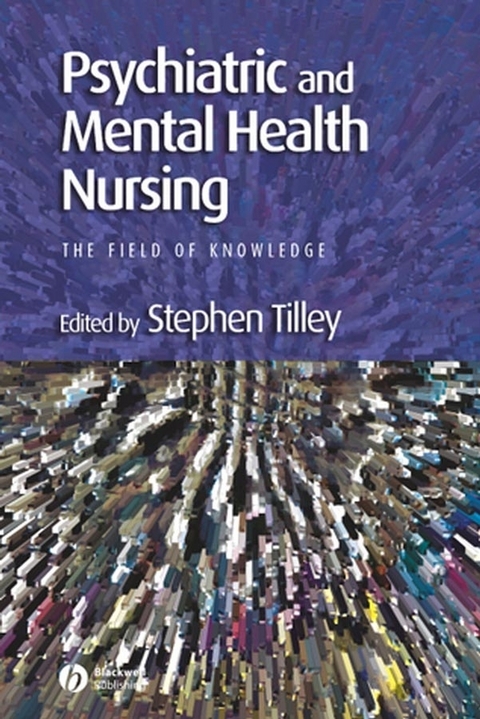
Psychiatric and Mental Health Nursing (eBook)
John Wiley & Sons (Verlag)
978-0-470-77743-5 (ISBN)
Psychiatric and Mental Health Nursing: The Field of Knowledge provides an analytical and critical introduction to the current state of knowledge in psychiatric and mental health nursing in the UK.
The first section of the book explores current professional, disciplinary and educational contexts. In the second section leading UK authors from diverse academic settings provide case studies of the knowledge and scientific traditions they draw on to inform their practice, understand patient needs, and foster different aspects of nursing practice.
In the final section the UK authors comment on each other's accounts. Those chapters and comments are then discussed by leading overseas academics to provide an invaluable international perspective. The final stage is a sociologically-informed analysis which identifies sociopolitical trends in order to make sense of the UK and international views. The editor then assesses the potential for intellectual integration and collective advance in psychiatric and mental health nursing.
Stephen Tilley is a Senior Lecturer in Nursing Studies at the University of Edinburgh.
Psychiatric and Mental Health Nursing: The Field of Knowledge provides an analytical and critical introduction to the current state of knowledge in psychiatric and mental health nursing in the UK. The first section of the book explores current professional, disciplinary and educational contexts. In the second section leading UK authors from diverse academic settings provide case studies of the knowledge and scientific traditions they draw on to inform their practice, understand patient needs, and foster different aspects of nursing practice. In the final section the UK authors comment on each other's accounts. Those chapters and comments are then discussed by leading overseas academics to provide an invaluable international perspective. The final stage is a sociologically-informed analysis which identifies sociopolitical trends in order to make sense of the UK and international views. The editor then assesses the potential for intellectual integration and collective advance in psychiatric and mental health nursing.
Stephen Tilley is a Senior Lecturer in Nursing Studies at the University of Edinburgh.
Contents 5
Dedication 11
Epigraph 12
Foreword 13
Acknowledgements 14
Contributors 15
Section 1 Background and Stance on the Problem of Knowledge in the Field 17
Chapter 1 Introduction 19
Methodology of the book – architecture of the text 22
The whole field, and nothing but the field? 24
The sociology of knowledge model adopted in this book 25
Institution 26
Discipline 27
Tradition 27
Influence 28
References 29
Section 2 Looking Across the Field: Case Studies of Institutionalisation of Knowledge of Psychiatric and Mental Health Nursing 31
Chapter 2 The Institute of Psychiatry: Nursing within the Health Services Research Department 33
Introduction 33
Current contributions to psychiatric nursing knowledge 35
High quality research 36
Research relevant to mental health policy 39
Providing assistance to Government in developing policy initiatives 39
The development of a critical mass of individuals from a psychiatric nursing background suitably trained in research 41
The development, testing and dissemination of innovative programmes of education and training 42
Providing input to service developments within local and national services 43
Framework for the future development of nursing activities within the Health Services Research Department 44
Conclusion 44
References 46
Chapter 3 Fragile Tradition: Institutionalisation of Knowledge of Psychiatric and Mental Health Nursing in the Department of Nursing Studies, the University of Edinburgh 48
Introduction 48
An emblematic story 50
The University of Edinburgh: context for the tradition 51
Teaching, supervision and research in the Department 53
Teaching 53
Supervision 58
Research 61
Sustaining the fragile tradition 68
References 70
Chapter 4 Nursing Mental Health at the Tavistock 73
Introduction 73
Historical context 73
The evolution of nursing at the Tavistock Clinic 73
Psychodynamic nursing – models of practice 76
Psychodynamic nursing – therapeutic communities 78
Psychodynamic nursing – the dissemination of ideas 80
The distinguishing features of psychodynamic knowledge in mental health nursing 82
A psychodynamic and systemic view of mental health 82
Psychodynamic features of mental health nursing 83
The role of psychodynamic nursing within the wider field of mental health nursing 86
The influence of the institutions in which we work on our role as knowledge producers 87
Work across institutional/agency boundaries 88
Form an attachment to the work content 89
Reflect on self in relation to others 90
Teach and learn in applying theory to practice 90
Work with competing and complementary paradigms 91
Conclusions 92
Acknowledgement 93
References 93
Chapter 5 Mental Health Nursing: Principles in Practice 101
Introduction 101
Principles in practice 102
Mental health nursing: theory 105
Mental health nursing: practice 107
The production of competence 108
The whole story 112
Conclusion 114
References 115
Chapter 6 Shaping Pre-Registration Mental Health Nursing Education Through User and Carer Involvement in Curriculum Design and Delivery 117
Introduction 117
Background 117
Involvement as a knowledge base for pre-registration mental health nursing education 118
The shift in approach 119
The impact of ‘the process of involvement’ on professional and personal outcomes 7
A user- and carer-informed curriculum – opportunities and contradictions 123
References 128
Chapter 7 Involving Individuals in Mental Health Nursing Education 130
Introduction 130
Writing, sharing and learning 131
A return to lecturing 132
Individualisation 134
Teaching ‘us and them’ 134
Living without barriers 136
Transforming knowledge 138
Institutions 139
User/survivor experiences of employment and education 140
The involvement of users and survivors in the curriculum 141
Becoming loud and proud – the transformative potential of experiential knowledge 142
References 143
Chapter 8 Models of Mental Health Nursing Education: Findings from a Case Study 145
Introduction 145
Background 145
The specialist–generic debate in mental health nurse education 146
The study 149
Research design and methods 149
Phase 1: Preliminaries 149
Key informant interviews 149
Selection of sites 150
Developing interview schedules 150
Phase 2: Fieldwork 150
Phase 3: Analysis and model development 150
The models 151
Model 1: The specialist model 154
Desirable structure of pre-registration training and academic progression 154
The basis of nurses’ knowledge and emphasis of the pre-registration curriculum 154
Expectations of service users 155
Shared learning and joint training 155
Advantages of specialist education and critique of genericism 156
Model 2: The generic model 157
Desirable structure of pre-registration training and academic progression 157
The basis of nurses’ knowledge and emphasis of the pre-registration curriculum 157
Expectations of service users 158
Shared learning and joint training 159
Advantages of generic preparation and critique of the specialist model 159
Variations on the main models 160
The pragmatic model 160
The unity-of-nursing model 160
Relevance of the models five years on 161
Repackaging UK pre-registration nursing programmes 161
Common core education across health care occupations 163
Conclusion 164
References 165
Section 3 Analytic and Critical Commentaries and Conclusion 167
Chapter 9 Reflective Commentaries by the Contributors to Section 2: Each Sees the Field from Within the Field 169
Commentary 9.1 Much in Common: Relationships and Knowledge in the Developing Field 171
Commentary 9.2 On Readings on the Field 174
Commentary 9.3 Are All as One Among Many and of Equal Value? 177
Commentary 9.4 Re-searching Practice: A Critical Conversation 180
Commentary 9.5 Field of Knowledge: A Critical Commentary 184
Commentary 9.6 Knowledge Camps and Difference: Critical Exploration in the Field 187
Commentary 9.7 A Tale of Two Mental Health Nursing Traditions 190
Chapter 10 International Perspectives on the State of Knowledge of Psychiatric and Mental Health Nursing in Britain 195
Commentary 10.1 Conflicting Knowledge/s: User Involvement in the Field of Knowledge 197
Commentary 10.2 Response from a Canadian Perspective 202
Commentary 10.3 An Australian Perspective on the State of Knowledge of PMHNing in the UK 205
commentary 10.4 The Field of Knowledge of Mental Health Nursing: A New Zealand Perspective 211
Commentary 10.5 A German Perspective on Paradigmatic Issues in Psychiatric Nursing 219
Commentary 10.6 An American Commentary 228
Chapter 11 Dance of Knowledge, Play of Power: Intellectual Conflict as Symptom of Policy Contradiction in the Field of Nursing Knowledge 232
Introduction 232
Level 1: power in the field of mental health nursing 233
Level 2: power over the field – when mental health knowledge is not nursing knowledge 236
Level 3: power beyond the field 240
Conclusion 245
References 248
Chapter 12 Conclusion: From the Towers to the Piazza 251
The conversation, the tower and the piazza 254
References 260
Index 261
'This book provides some very pertinent case material and, unlike
some of the international commentators, I also found that it
contained some highly relevant critical insights'
Journal of Clinical Nursing
| Erscheint lt. Verlag | 15.4.2008 |
|---|---|
| Sprache | englisch |
| Themenwelt | Pflege ► Fachpflege ► Neurologie / Psychiatrie |
| Schlagworte | academic • Analytical • Book • CASE • Clinical psychology • Current • Diverse • Explores • Field • first section • Health • Introduction • Klinische Psychologie • Knowledge • Krankenpflege • Krankenpflege i. d. Psychologie • Mental Health Nursing • nursing • Professional • provide • Psychiatric • Psychologie • Psychology • Scientific • Second • section • Settings • State • Studies • Traditions • UK |
| ISBN-10 | 0-470-77743-5 / 0470777435 |
| ISBN-13 | 978-0-470-77743-5 / 9780470777435 |
| Informationen gemäß Produktsicherheitsverordnung (GPSR) | |
| Haben Sie eine Frage zum Produkt? |
 PDF (Adobe DRM)
Kopierschutz: Adobe-DRM
Adobe-DRM ist ein Kopierschutz, der das eBook vor Mißbrauch schützen soll. Dabei wird das eBook bereits beim Download auf Ihre persönliche Adobe-ID autorisiert. Lesen können Sie das eBook dann nur auf den Geräten, welche ebenfalls auf Ihre Adobe-ID registriert sind.
Details zum Adobe-DRM
Dateiformat: PDF (Portable Document Format)
Mit einem festen Seitenlayout eignet sich die PDF besonders für Fachbücher mit Spalten, Tabellen und Abbildungen. Eine PDF kann auf fast allen Geräten angezeigt werden, ist aber für kleine Displays (Smartphone, eReader) nur eingeschränkt geeignet.
Systemvoraussetzungen:
PC/Mac: Mit einem PC oder Mac können Sie dieses eBook lesen. Sie benötigen eine
eReader: Dieses eBook kann mit (fast) allen eBook-Readern gelesen werden. Mit dem amazon-Kindle ist es aber nicht kompatibel.
Smartphone/Tablet: Egal ob Apple oder Android, dieses eBook können Sie lesen. Sie benötigen eine
Geräteliste und zusätzliche Hinweise
Buying eBooks from abroad
For tax law reasons we can sell eBooks just within Germany and Switzerland. Regrettably we cannot fulfill eBook-orders from other countries.
aus dem Bereich


