Anatomy for Anaesthetists (eBook)
John Wiley & Sons (Verlag)
978-0-470-75504-4 (ISBN)
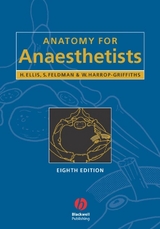
The eighth edition has fully expanded and updated text; and includes new and improved illustrations.
Harold Ellis, CBE, MA, DM, MCh, FRCS, FRCP, FRCOG FACS, is a Clinical Anatomist,at Guy's, Kings' and St. Thomas School of Biomedical Sciences. He is an Emeritus Professor of Surgery, Charing Cross and Westminster Medical School, London, UK.
Stanley Feldman, BSc, MB, FRCA, was an Emeritus Magill Professor of Anaesthesia, Chelsea and Westminster Hospital, London, UK. He created and edited the book Scientific Foundations of Anaesthesia.
William Harrop-Griffiths, Imperial College Healthcare NHS Trust, London, UK.
This book has been written to help candidates sitting their professional examination in anaesthesia in order that they may have at their disposal the detailed anatomical knowledge necessary for the day to day practice of anaesthesia. Unlike a textbook of anatomy, which must cover all parts of the body with equally exhaustive thoroughness, this book concentrates particularly on areas of special relevance to anaesthesia and points out features of practical importance to anaesthetic technique. The text is divided into nine sections; the respiratory pathway, the heart, the vertebral canal, the peripheral nerves; The Autonomic Nervous System; The Cranial Nerves; The Orbit and its contents; The Anatomy of Pain and Zones of Anaesthetic Interest. The eighth edition has fully expanded and updated text; and includes new and improved illustrations.
Harold Ellis, CBE, MA, DM, MCh, FRCS, FRCP, FRCOG FACS, is a Clinical Anatomist,at Guy's, Kings' and St. Thomas School of Biomedical Sciences. He is an Emeritus Professor of Surgery, Charing Cross and Westminster Medical School, London, UK. Stanley Feldman, BSc, MB, FRCA, was an Emeritus Magill Professor of Anaesthesia, Chelsea and Westminster Hospital, London, UK. He created and edited the book Scientific Foundations of Anaesthesia. William Harrop-Griffiths, Imperial College Healthcare NHS Trust, London, UK.
ANATOMY FOR ANAESTHETISTS 5
Contents 7
Part 1: The Respiratory Pathway 11
The Mouth 13
The Nose 17
The Pharynx 26
The Larynx 36
The Trachea 52
The Main Bronchi 58
The Pleura 60
The Lungs 63
Part 2: The Heart 81
The Pericardium 83
The Heart 85
Developmental Anatomy 96
Part 3: The Vertebral Canal and its Contents 105
The Vertebrae and Sacrum 107
The Spinal Meninges 129
The Spinal Cord 135
Part 4: The Peripheral Nerves 147
The Spinal Nerves 149
The Cervical Plexus 156
The Brachial Plexus 163
The Thoracic Nerves 190
The Lumbar Plexus 193
The Sacral and Coccygeal Plexuses 202
Part 5: The Autonomic Nervous System 223
Introduction 225
The Sympathetic System 228
The Parasympathetic System 238
Part 6: The Cranial Nerves 243
Introduction 245
The Olfactory Nerve (I) 248
The Optic Nerve (II) 249
The Oculomotor Nerve (III) 252
The Trochlear Nerve (IV) 254
The Trigeminal Nerve (V) 255
The Abducent Nerve (VI) 276
The Facial Nerve (VII) 277
The Auditory (Vestibulocochlear) Nerve (VIII) 282
The Glossopharyngeal Nerve (IX) 283
The Vagus Nerve (X) 286
The Accessory Nerve (XI) 292
The Hypoglossal Nerve (XII) 293
Part 7: The Anatomy of Pain 295
Introduction 297
Classification of Pain 298
Peripheral Receptors and Afferent Fibres 298
The Spinal Cord and Central Projections 300
Modulation of Pain 304
The Gate Control Theory of Pain 305
The Sympathetic Nervous System and Pain 306
Part 8: Zones of Anaesthetic Interest 307
The Thoracic Inlet 309
The Diaphragm 315
The Intercostal Spaces 321
The Abdominal Wall 328
The Antecubital Fossa 334
The Great Veins of the Neck 340
The Orbit and its Contents 346
Index 359
'The new edition of this popular book will be welcomed by
anaesthetists at all levels of training. It is recommended for
trainees, for department libraries...'
Anaesthesia and Intensive Care
'A strong point of this book is the excellent style in which it
is written; it flows well and is very easy to read.'
Anaesthesia and Analgesia
"I don't suppose God knows more anatomy!"
| Erscheint lt. Verlag | 15.4.2008 |
|---|---|
| Sprache | englisch |
| Themenwelt | Medizin / Pharmazie ► Allgemeines / Lexika |
| Medizin / Pharmazie ► Medizinische Fachgebiete ► Anästhesie | |
| Medizin / Pharmazie ► Pflege | |
| Studium ► 1. Studienabschnitt (Vorklinik) ► Anatomie / Neuroanatomie | |
| Schlagworte | Anästhesie • Anaesthesia • Anästhesie • anatomical • Anatomie u. Physiologie • anatomy • Anatomy & Physiology • anesthesia • Areas • Biowissenschaften • Body • Book • closely • concentrates • General • Great teachers • knowledge vital • Life Sciences • Medical Science • Medizin • particular • Practice • Preparing • professional examinations • SAFE • Teachers • two • wellknown |
| ISBN-10 | 0-470-75504-0 / 0470755040 |
| ISBN-13 | 978-0-470-75504-4 / 9780470755044 |
| Informationen gemäß Produktsicherheitsverordnung (GPSR) | |
| Haben Sie eine Frage zum Produkt? |
 PDF (Adobe DRM)
Kopierschutz: Adobe-DRM
Adobe-DRM ist ein Kopierschutz, der das eBook vor Mißbrauch schützen soll. Dabei wird das eBook bereits beim Download auf Ihre persönliche Adobe-ID autorisiert. Lesen können Sie das eBook dann nur auf den Geräten, welche ebenfalls auf Ihre Adobe-ID registriert sind.
Details zum Adobe-DRM
Dateiformat: PDF (Portable Document Format)
Mit einem festen Seitenlayout eignet sich die PDF besonders für Fachbücher mit Spalten, Tabellen und Abbildungen. Eine PDF kann auf fast allen Geräten angezeigt werden, ist aber für kleine Displays (Smartphone, eReader) nur eingeschränkt geeignet.
Systemvoraussetzungen:
PC/Mac: Mit einem PC oder Mac können Sie dieses eBook lesen. Sie benötigen eine
eReader: Dieses eBook kann mit (fast) allen eBook-Readern gelesen werden. Mit dem amazon-Kindle ist es aber nicht kompatibel.
Smartphone/Tablet: Egal ob Apple oder Android, dieses eBook können Sie lesen. Sie benötigen eine
Geräteliste und zusätzliche Hinweise
Buying eBooks from abroad
For tax law reasons we can sell eBooks just within Germany and Switzerland. Regrettably we cannot fulfill eBook-orders from other countries.
aus dem Bereich