


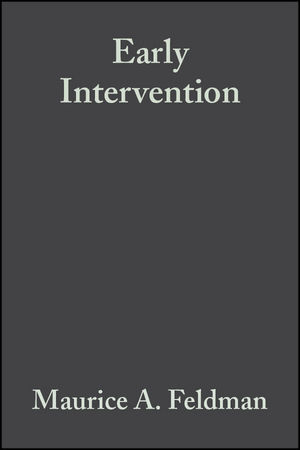
Early Intervention (eBook)
John Wiley & Sons (Verlag)
978-0-470-75483-2 (ISBN)
- A collection of the best recent papers on Early Intervention.
- Brings together current theory, research and practice in EI with young children.
- Covers a range of topics in childhood development and intervention.
- Each paper is introduced and contextualised by the editor.
Maurice A. Feldman is Professor in the Department of Child and Youth Studies, Brock University, St Catharines, Ontario, and a consultant to several service and governmental agencies.
This reader covers current theory, research and practice in Early Intervention with young children, bringing together the best recent papers by prominent researchers in the field. A collection of the best recent papers on Early Intervention. Brings together current theory, research and practice in EI with young children. Covers a range of topics in childhood development and intervention. Each paper is introduced and contextualised by the editor.
Maurice A. Feldman is Professor in the Department of Child and Youth Studies, Brock University, St Catharines, Ontario, and a consultant to several service and governmental agencies.
List of Figures.
List of Tables.
Introduction: What is Early Intervention? (Maurice A.
Feldman).
Part I: A Model of Early Intervention.
Introduction To Chapter 1.
1. Effectiveness of Early Intervention for Vulnerable Children:
A Developmental Perspective. (Michael J. Guralnick).
Part II: Early Out-of-home Programs: Primary Prevention of
Cognitive Deficits and School Failure in At-risk Children.
Introduction.
Introduction to Chapter 2.
2. Applying the findings of developmental psychology to improve
early childhood intervention. (Edward Zigler and Sally J.
Styfco).
Introduction to Chapter 3.
3. Persistent Effects of Early Childhood Education on High-risk
Children and Their Mothers. (Craig T. Ramey, Frances A.
Campbell, Margaret Burchinal, Martie L. Skinner, David M. Gardner,
and Sharon L. Ramey).
Introduction to Chapter 4.
4. Day-care Participation as a Protective Factor in the
Cognitive Development of Low-income Children. (Margaret O'Brien
Caughy, Janet A. DiPietro, and Donna M. Strobino).
Part III: Secondary and Tertiary Prevention Programs for
Children with Established Disabilities.
Introduction.
Introduction to Chapter 5.
5. The Effectiveness of Early Intervention: Examining Risk
Factors and Pathways to Enhanced Development. (Lisa J. Berlin,
Jeanne Brooks-Gunn, Cecelia McCarton, and Marie C.
McCormick).
Introduction to Chapter 6.
6. Randomized Trial of Intensive Early Intervention for Children
with Pervasive Developmental Disorder. (Tristram Smith, Annette
D. Groen, and Jacqueline W. Wynn).
Part IV: Home Visiting Programs: Primary and Secondary
Prevention in At-risk Children.
Introduction.
Introduction to Chapter 7.
7. Effectiveness of Home-based Early Intervention on the
Language Development of Children of Mothers with Mental
Retardation. (Maurice A. Feldman, Bruce Sparks, and Laurie
Case).
Introduction to Chapter 8.
8. Effects of Early Intervention on Psychiatric Symptoms of
Young Adults in Low-risk and High-risk Families. (Eeva T. Aronen
and Terttu Arajarvi).
Introduction to Chapter 9.
9. Long-term Effects of Nurse Home Visitation on
Children's Criminal an Antisocial Behavior: Fifteen-year
Follow-up of a Randomized Controlled Trial. (David Olds, Charles
R. Henderson, Jr. Robert Cole, John Eckenrode, Harriet Kitzman,
Dennis Luckey, Lisa Pettitt, Kimberly Sidora, Pamela Morris, and
Jane Powers).
Part V. Family Aspects.
Introduction.
Introduction to Chapter 10.
10. Revisiting "Rethinking Early Intervention". (Carl J.
Dunst).
Introduction to Chapter 11.
11. The Effect of Early Intervention Services on Maternal
Well-being. (Marji Erickson Warfield, Penny Hauser-Cram, Marty
Wyngaarden Krauss, Jack P. Shonkoff, Carole C. Upshur).
Introduction to Chapter 12.
12. Family Predictors of Maternal and Paternal Involvement in
Programs for Young Children with Disabilities. (Susana
Gavidia-Payne and Zolinda Stoneman).
Part VI. Future Directions.
Introduction.
13. Conclusion: The future of Early Intervention Research and
Practice. (Maurice A. Feldman).
Index.
"A fantastic book that provides further validation for the early
intervention model. Readers who are not specialists in early
intervention will find the theoretical review and its influence on
practice particularly helpful. Experienced clinicians will gain new
perspectives from the coverage of advances in intervention programs
and the critique of research projects currently underway.
Altogether, it is a well edited and integrated book, written in an
accessible and balanced style that will have wide appeal. A great
book!" Dr Sue McGaw, Consultant Clinical Psychologist, Head of
Special Parenting Service, Cornwall Partnership (NHS) Trust, UK
"The strength of Early Intervention: The Essential
Readings lies in bringing together in one place recent landmark
studies in the field of early intervention. The breadth of the
collection provides an excellent introduction for those new to
early intervention; the depth will delight the discerning reader. I
feel certain teachers from the many disciplines represented in
early intervention will include this bookas their standard
recommended reference text for years to come." Gwynnyth
Llewellyn, PhD, Sesquicentenary Professor of Occupation and Leisure
Sciences, University of Sydney, Australia
"This collection provides the theoretical and empirical
background that is essential reading for anyone who wants to be
well informed about recent and current knowledge in the Early
Intervention field, and makes an excellent supplement to a textbook
or indeed could stand alone as the primary readings for a course on
Early Intervention. The volume will be of great value to advanced
undergraduate students, graduate students and direct care workers
in the field." Peter Vietze, Ph.D., Institute for Basic Research
in Developmental Disabilities, USA
"Throughout the book effective relationships are drawn between
theory and practice and the practical implications of various
research studies identified. Many key issues facing early
intervention programmes such as exaggerated expectations, quality
assurance and best-fit models are teased-out and discussed,
providing interesting food for thought." Aine de Roiste, Cork
Institute of Technology, Ireland
| Erscheint lt. Verlag | 15.4.2008 |
|---|---|
| Reihe/Serie | Essential Readings in Developmental Psychology | Essential Readings in Developmental Psychology |
| Sprache | englisch |
| Themenwelt | Geisteswissenschaften ► Psychologie ► Entwicklungspsychologie |
| Geisteswissenschaften ► Psychologie ► Klinische Psychologie | |
| Medizin / Pharmazie ► Medizinische Fachgebiete ► Pädiatrie | |
| Medizin / Pharmazie ► Medizinische Fachgebiete ► Psychiatrie / Psychotherapie | |
| Schlagworte | attempt • behavioral • Best • biological • Birth • Child & Adolescent Clinical Psychology • children • Cognitive • Educational & School Psychology • Ei • Erziehungs- u. Schulpsychologie • Factors • Field • Future directions • Intervention • Klinische Psychologie / Kinder u. Jugendliche • Low • Overview • Papers • Poverty • Problems • Prominent • Psychologie • Psychology • Reader • Researchers • Risk • SIX • theory • weight |
| ISBN-10 | 0-470-75483-4 / 0470754834 |
| ISBN-13 | 978-0-470-75483-2 / 9780470754832 |
| Informationen gemäß Produktsicherheitsverordnung (GPSR) | |
| Haben Sie eine Frage zum Produkt? |
 PDF (Adobe DRM)
Kopierschutz: Adobe-DRM
Adobe-DRM ist ein Kopierschutz, der das eBook vor Mißbrauch schützen soll. Dabei wird das eBook bereits beim Download auf Ihre persönliche Adobe-ID autorisiert. Lesen können Sie das eBook dann nur auf den Geräten, welche ebenfalls auf Ihre Adobe-ID registriert sind.
Details zum Adobe-DRM
Dateiformat: PDF (Portable Document Format)
Mit einem festen Seitenlayout eignet sich die PDF besonders für Fachbücher mit Spalten, Tabellen und Abbildungen. Eine PDF kann auf fast allen Geräten angezeigt werden, ist aber für kleine Displays (Smartphone, eReader) nur eingeschränkt geeignet.
Systemvoraussetzungen:
PC/Mac: Mit einem PC oder Mac können Sie dieses eBook lesen. Sie benötigen eine
eReader: Dieses eBook kann mit (fast) allen eBook-Readern gelesen werden. Mit dem amazon-Kindle ist es aber nicht kompatibel.
Smartphone/Tablet: Egal ob Apple oder Android, dieses eBook können Sie lesen. Sie benötigen eine
Geräteliste und zusätzliche Hinweise
Buying eBooks from abroad
For tax law reasons we can sell eBooks just within Germany and Switzerland. Regrettably we cannot fulfill eBook-orders from other countries.
aus dem Bereich


