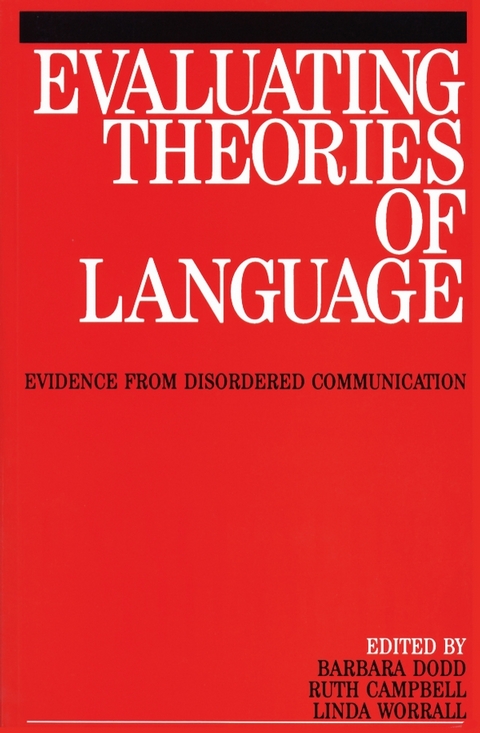
Evaluating Theories of Language (eBook)
John Wiley & Sons (Verlag)
978-0-470-69855-6 (ISBN)
This volume reflects the problems of constructing theory of how the normal brain deals with language from data from impaired individuals from the perspective of a range of disciplines: psycholinguistics, linguistics, neurophysiology and speech-language pathology. The chapters include critiques of methodology; application of new technology; the study of bilingual people; and cross-linguistic studies. A range of language skills is discussed (phonology, prosody, syntax, semantics, reading and spelling) in the context of both developmental and acquired impairments (hearing loss, cerebellar dysarthria, sub-cortical aphasia, cortical aphasia, phonological disorder, and dyslexia).
This book icludes contributions from researchers and clinicians on both sides of the Atlantic as well as from Australia and Hong Kong.
Karen Dodd is known for her research into the effects of therapeutic exercise for people with chronic disabilities, particularly neurological disabilities. She has published and presented extensively on this topic. She co-produced an innovative instructional DVD on strength training for people with cerebral palsy that won the Fred P. Sage award for the best audiovisual product at the American Academy for Cerebral Palsy and Developmental Medicine 60th Annual Meeting.
Ruth Campbell is Professor of Psychology at Goldsmiths College, University of London.
Linda Worralk is the editor of Evaluating Theories of Language: Evidence from Disordered Communication, published by Wiley.
One approach to the study of language has been to describe people whose ability to communicate is impaired. Some researchers have argued that it is possible to identify the component mental processes that contribute to the ability to communicate by describing the ways in which language can break down. Other researchers have expressed doubts about the extent to which data from impairment reflects normal language function. This volume reflects the problems of constructing theory of how the normal brain deals with language from data from impaired individuals from the perspective of a range of disciplines: psycholinguistics, linguistics, neurophysiology and speech-language pathology. The chapters include critiques of methodology; application of new technology; the study of bilingual people; and cross-linguistic studies. A range of language skills is discussed (phonology, prosody, syntax, semantics, reading and spelling) in the context of both developmental and acquired impairments (hearing loss, cerebellar dysarthria, sub-cortical aphasia, cortical aphasia, phonological disorder, and dyslexia). This book icludes contributions from researchers and clinicians on both sides of the Atlantic as well as from Australia and Hong Kong.
Karen Dodd is known for her research into the effects of therapeutic exercise for people with chronic disabilities, particularly neurological disabilities. She has published and presented extensively on this topic. She co-produced an innovative instructional DVD on strength training for people with cerebral palsy that won the Fred P. Sage award for the best audiovisual product at the American Academy for Cerebral Palsy and Developmental Medicine 60th Annual Meeting. Ruth Campbell is Professor of Psychology at Goldsmiths College, University of London. Linda Worralk is the editor of Evaluating Theories of Language: Evidence from Disordered Communication, published by Wiley.
Evaluating Theories of Language: Evidence from Disordered Communication 1
Contents 7
Preface 9
Acknowledgements 11
Contributors 13
Introduction Words and nature 15
Chapter 1 Computational cognitive neuropsychology and acquired dyslexia 23
Chapter 2 From snarks to boojums: why are prosodic disabilities so rare? 51
Chapter 3 Underlying representations in the acquisition of phonology: evidence from ‘before and after’ speech 69
Chapter 4 Insights into language structure and function: some consequences of prelingual hearing loss 88
Chapter 5 Individual differences in cognitive function among normal subjects and their implications for cognitive neuropsychology 111
Chapter 6 Symptoms of disorder without impairment: the written and spoken errors of bilinguals 133
Chapter 7 The role of subcortical structures in language: clinico-neuroradiological studies of brain-damaged subjects 151
Chapter 8 Cognitive neuropsychology and aphasia: a critical analysis 175
Chapter 9 Limitations of models of sentence production: evidence from Cantonese data of normal and aphasic speakers 198
Synthesis 208
Index 213
| Erscheint lt. Verlag | 30.4.2008 |
|---|---|
| Sprache | englisch |
| Themenwelt | Geisteswissenschaften ► Sprach- / Literaturwissenschaft ► Sprachwissenschaft |
| Medizin / Pharmazie ► Gesundheitsfachberufe ► Logopädie | |
| Medizin / Pharmazie ► Medizinische Fachgebiete | |
| Schlagworte | Ability • communicate • Component • constructing • Contribute • Data • Deals • extent • Gesundheits- u. Sozialwesen • Health & Social Care • Impairment • language • language function • Mental • Normal • normal brain • one approach • People • possible • Problems • processes • reflects • Researchers • Speech therapy • Sprachtherapie • Study |
| ISBN-10 | 0-470-69855-1 / 0470698551 |
| ISBN-13 | 978-0-470-69855-6 / 9780470698556 |
| Informationen gemäß Produktsicherheitsverordnung (GPSR) | |
| Haben Sie eine Frage zum Produkt? |
 PDF (Adobe DRM)
Kopierschutz: Adobe-DRM
Adobe-DRM ist ein Kopierschutz, der das eBook vor Mißbrauch schützen soll. Dabei wird das eBook bereits beim Download auf Ihre persönliche Adobe-ID autorisiert. Lesen können Sie das eBook dann nur auf den Geräten, welche ebenfalls auf Ihre Adobe-ID registriert sind.
Details zum Adobe-DRM
Dateiformat: PDF (Portable Document Format)
Mit einem festen Seitenlayout eignet sich die PDF besonders für Fachbücher mit Spalten, Tabellen und Abbildungen. Eine PDF kann auf fast allen Geräten angezeigt werden, ist aber für kleine Displays (Smartphone, eReader) nur eingeschränkt geeignet.
Systemvoraussetzungen:
PC/Mac: Mit einem PC oder Mac können Sie dieses eBook lesen. Sie benötigen eine
eReader: Dieses eBook kann mit (fast) allen eBook-Readern gelesen werden. Mit dem amazon-Kindle ist es aber nicht kompatibel.
Smartphone/Tablet: Egal ob Apple oder Android, dieses eBook können Sie lesen. Sie benötigen eine
Geräteliste und zusätzliche Hinweise
Buying eBooks from abroad
For tax law reasons we can sell eBooks just within Germany and Switzerland. Regrettably we cannot fulfill eBook-orders from other countries.
aus dem Bereich