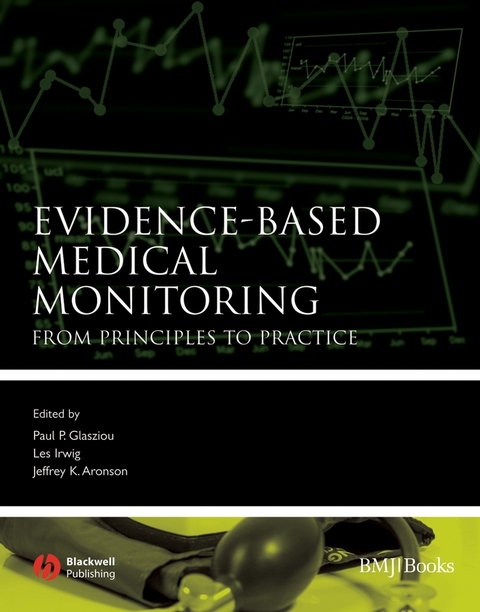
Evidence-Based Medical Monitoring (eBook)
John Wiley & Sons (Verlag)
978-0-470-69561-6 (ISBN)
This book discusses how monitoring principles adopted in other spheres such as clinical pharmacology and evidence-based medicine can be applied to chronic disease in the global setting. With contributions from leading experts in evidence-based medicine, it is a ground-breaking text for all involved in delivery of better and more effective management of chronic illnesses.
Professor Paul Glasziou, University of Oxford, Department of Primary Health Care and Director of the Centre for Evidence-based Medicine, Oxford. Paul is a leading figure in evidence-based medicine. He teaches courses and organises workshops both at the Centre in Oxford and the other centres around the world (eg McMaster, Bond University- Australia).
Les Irwig, Professor in the School of Public Health, University of Sydney He teaches courses on diagnostic test assessment, meta-analysis and guideline development, and advanced epidemiological methods. He is especially interested in the application of epidemiological methods to provide the evidence on which to base public health and clinical decisions.
Dr Jeffery Aronson, Clinical Reader in Pharmacology, University of Oxford, UK.
Monitoring is a major component of management of chronic diseases such as diabetes, cardiovascular disease, arthritis and depression. Yet poor monitoring means healthcare costs are rising. This book discusses how monitoring principles adopted in other spheres such as clinical pharmacology and evidence-based medicine can be applied to chronic disease in the global setting. With contributions from leading experts in evidence-based medicine, it is a ground-breaking text for all involved in delivery of better and more effective management of chronic illnesses.
Professor Paul Glasziou, University of Oxford, Department of Primary Health Care and Director of the Centre for Evidence-based Medicine, Oxford. Paul is a leading figure in evidence-based medicine. He teaches courses and organises workshops both at the Centre in Oxford and the other centres around the world (eg McMaster, Bond University- Australia). Les Irwig, Professor in the School of Public Health, University of Sydney He teaches courses on diagnostic test assessment, meta-analysis and guideline development, and advanced epidemiological methods. He is especially interested in the application of epidemiological methods to provide the evidence on which to base public health and clinical decisions. Dr Jeffery Aronson, Clinical Reader in Pharmacology, University of Oxford, UK.
Contributors.
Part 1 The Theory of Monitoring.
INTRODUCTORY MATERIAL.
1 An introduction to monitoring therapeutic interventions in
clinical practice (Paul P. Glasziou, University of Oxford; Jeffrey
K. Aronson, University of Oxford).
2 A framework for developing and evaluating a monitoring
strategy (David Mant, University of Oxford).
THE MEASUREMENT.
3 Developing monitoring tools: integrating the pathophysiology
of disease and the mechanisms of action of therapeutic
interventions (Jeffrey K. Aronson, University of Oxford; Susan
Michie, University College London).
4 Biomarkers and surrogate endpoints in monitoring therapeutic
interventions (Jeffrey K. Aronson, University of Oxford).
5 Choosing the best monitoring tests (Les Irwig, University of
Sydney; Paul P. Glasziou, University of Oxford).
THE CONTROL PHASES.
6 Monitoring the initial response to treatment (Katy Bell,
University of Sydney; Jonathan Craig, University of Sydney; Les
Irwig, University of Sydney).
7 Control charts and control limits in long-term monitoring
(Petra Macaskill, University of Sydney).
8 Developing a monitoring schedule: frequency of measurement
(Andrew J. Farmer, University of Oxford).
9 How should we adjust treatment? (Paul P. Glasziou, University
of Oxford).
THE PSYCHOLOGY OF MONITORING.
10 Monitoring as a learning and motivational tool (Susan Michie,
University College London; Kirsten McCaffery, University of
Sydney); Carl Heneghan, University of Oxford).
11 Monitoring from the patient's perspective: the social and
psychological implications (Kirsten McCaffery, University of
Sydney; Susan Michie, University College London).
THE EVALUATION OF MONITORING TECHNIQUES.
12 Evaluating the effectiveness and costs of monitoring (Patrick
M.M. Bossuyt, University of Amsterdam).
13 Good practice in delivering laboratory monitoring (W. Stuart
A. Smellie, Bishop Auckland Hospital, County Durham).
14 Point-of-care testing in monitoring (Christopher P. Price,
University of Oxford).
15 Monitoring for the adverse effects of drugs (Jamie J.
Coleman, Queen Elizabeth Hospital, Birmingham; Robin E. Ferner,
City Hospital, Birmingham; Jeffrey K. Aronson, University of
Oxford).
Part 2 The Practice of Monitoring.
16 Monitoring diabetes mellitus across the lifetime of illness
(Andrew J. Farmer, University of Oxford).
17 Oral anticoagulation therapy (OAT) (Carl Heneghan, University
of Oxford; Rafael Perera, University of Oxford).
18 Monitoring cholesterol-modifying interventions (Paul P.
Glasziou, University of Oxford; Les Irwig, University of Sydney;
Stephane Heritier, (University of Sydney).
19 Monitoring levothyroxine replacement in primary
hypothyroidism (Andrea Rita Horvath, University of Szeged).
20 Monitoring in renal transplantation (Nicholas B. Cross,
University of Sydney; Jonathan Craig, University of Sydney).
21 Monitoring in pre-eclampsia (Pisake Lumbiganon, Khon Kaen
University; Malinee Laopaiboon, Khon Kaen University).
22 Monitoring in intensive care (Jan M. Binnekade, University of
Amsterdam; Patrick M.M. Bossuyt, University of Amsterdam).
23 Monitoring intraocular pressure in glaucoma (Les Irwig,
University of Sydney; Paul R. Healey, University of Sydney;
Jefferson D'Assunsao, University of Sydney; Petra
Macaskill, University of Sydney).
24 Monitoring in osteoarthritis (George Peat, Keele University;
Mark Porcheret, Keele University; John Bedson, Keele University;
Alison M. Ward, University of Oxford).
Index.
"Evidenced-based Medical Monitoring would be valuable
addition to academic and health sciences library collections and is
therefore highly recommended." (E-Streams, December 2008)
"This should be mandatory reading for medical students,
perhaps the basis for an entire course of study ... .The book
is that valuable!" (Doody's Book Reviews)
| Erscheint lt. Verlag | 30.4.2008 |
|---|---|
| Reihe/Serie | Evidence-Based Medicine | Evidence-Based Medicine |
| Sprache | englisch |
| Themenwelt | Medizin / Pharmazie ► Allgemeines / Lexika |
| Medizin / Pharmazie ► Medizinische Fachgebiete | |
| Schlagworte | Better • Book • Chronic • Clinical • Contributions • costs • Delivery • Diabetes • Diseases • evidencebased • Evidence-based Health Care • Evidenzbasierte Forschung im Gesundheitswesen • Experts • groundbreaking • Healthcare • illnesses • leading • major component • Management • Medical Science • Medizin • pharmacology • Poor • Principles • Spheres • Text |
| ISBN-10 | 0-470-69561-7 / 0470695617 |
| ISBN-13 | 978-0-470-69561-6 / 9780470695616 |
| Informationen gemäß Produktsicherheitsverordnung (GPSR) | |
| Haben Sie eine Frage zum Produkt? |
 PDF (Adobe DRM)
Kopierschutz: Adobe-DRM
Adobe-DRM ist ein Kopierschutz, der das eBook vor Mißbrauch schützen soll. Dabei wird das eBook bereits beim Download auf Ihre persönliche Adobe-ID autorisiert. Lesen können Sie das eBook dann nur auf den Geräten, welche ebenfalls auf Ihre Adobe-ID registriert sind.
Details zum Adobe-DRM
Dateiformat: PDF (Portable Document Format)
Mit einem festen Seitenlayout eignet sich die PDF besonders für Fachbücher mit Spalten, Tabellen und Abbildungen. Eine PDF kann auf fast allen Geräten angezeigt werden, ist aber für kleine Displays (Smartphone, eReader) nur eingeschränkt geeignet.
Systemvoraussetzungen:
PC/Mac: Mit einem PC oder Mac können Sie dieses eBook lesen. Sie benötigen eine
eReader: Dieses eBook kann mit (fast) allen eBook-Readern gelesen werden. Mit dem amazon-Kindle ist es aber nicht kompatibel.
Smartphone/Tablet: Egal ob Apple oder Android, dieses eBook können Sie lesen. Sie benötigen eine
Geräteliste und zusätzliche Hinweise
Buying eBooks from abroad
For tax law reasons we can sell eBooks just within Germany and Switzerland. Regrettably we cannot fulfill eBook-orders from other countries.
aus dem Bereich