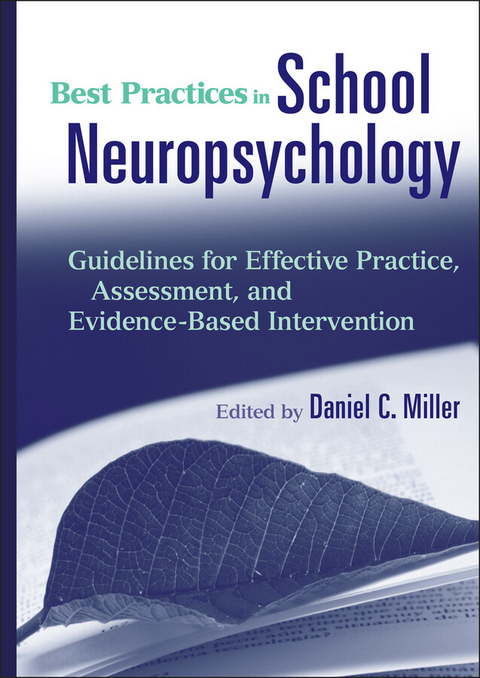
Best Practices in School Neuropsychology (eBook)
896 Seiten
John Wiley & Sons (Verlag)
978-0-470-53574-5 (ISBN)
It is an exciting time to specialize in school neuropsychology, with countless theoretically and psychometrically sound assessment instruments available for practitioners to use in their evaluations of children with special needs. Yet the field faces the challenges of establishing evidence-based linkages between assessment and interventions and of broadening its approaches to culturally diverse populations.
Edited by a leading expert in school neuropsychology, Best Practices in School Neuropsychology: Guidelines for Effective Practice, Assessment, and Evidence-Based Intervention addresses these challenges and their solutions and provides learning specialists and school psychologists with clear coverage and vital information on this burgeoning area of practice within school psychology.
This insightful reference features comprehensive discussion of:
* Current school neuropsychological assessment and intervention models
* Best practices in assessing cognitive processes
* An overview of what neuroscience offers to the practice of school neuropsychology
* How school neuropsychology fits within a Response to Intervention (RTI) model
* The rationale for the importance of school psychologists' collaboration with parents, educators, and other professionals to maximize services to children
* Clinical applications of school neuropsychology with special populations, academic disabilities, processing deficits, and medical disorders
* Unique challenges in working with culturally diverse populations
Featuring contributions from internationally renowned school psychologists, neuropsychologists, clinicians, and academics, Best Practices in School Neuropsychology is the first book of its kind to present best practices and evidence-informed guidelines for the assessment and intervention of children with learning disabilities, as well as other issues practitioners working with children encounter in school settings.
DANIEL C. MILLER, PhD, is a Professor and Chair of the Department of Psychology and Philosophy at Texas Woman's University in Denton, Texas. He is a former director of the School Psychology Graduate Training Programs and past president of the National Association of School Psychologists. He is the author of Essentials of School Neuropsychological Assessment. Dr. Miller is also the President and founder of KIDS, Inc., a company that specializes in early childhood education and screening products.
DANIEL C. MILLER, PHD, is a Professor and Chair of the Department of Psychology and Philosophy at Texas Woman's University in Denton, Texas. He is a former director of the School Psychology Graduate Training Programs and past president of the National Association of School Psychologists. He is the author of Essentials of School Neuropsychological Assessment. Dr. Miller is also the President and founder of KIDS, Inc., a company that specializes in early childhood education and screening products.
Section I: Professional Issues in School Neuropsychology.
Chapter 1: Best Practices in School Neuropsychology, an Emerging Specialization
Chapter 2: Best Practices in School Neuropsychology Training and Credentialing.
Chapter 3: Best Practices in Ethical and Legal Issues Related to School Neuropsychology.
Chapter 4: Best Practices in Multicultural School Neuropsychology.
Section II: Practice Issues in School Neuropsychology.
Chapter 5: Best Practices in School Neuropsychological Assessment and Intervention.
Chapter 6: Best Practices in Integrating Cognitive Assessment in School Neuropsychological Evaluations.
Chapter 7: Best Practices in the Application of Neuroscience to the Practice of School Neuropsychology.
Chapter 8: Best Practices in Linking School Neuropsychology with Response-to-Intervention Models.
Chapter 9: Best Practices in School Neuropsychology Collaboration with Home, School, and Outside Professionals.
Chapter 10: Best Practices in School Re-entry for Children Recovering from Neurological Conditions.
Section III: Clinical Applications of School Neuropsychology: Special Populations.
Chapter 11: Best Practices in Assessing and Intervening with ADD/ADHD Children and Children with Other Frontal-Striatal Circuit Disorders.
Chapter 12: Best Practices in Assessing and Intervening with Children with Autism Spectrum Disorders.
Chapter 13: Best Practices in Assessing and Intervening with Children with Asperger's Disorder.
Chapter 14: Best Practices in Assessing and Intervening with Children with Developmental Delays.
Chapter 15: Best Practices in Assessing and Intervening with Children with Externalizing Disorders.
Chapter 16: Best Practices in Assessing and Intervening with Children with Internalizing Disorders.
Chapter 17: Best Practices in Assessing Children Who are Deaf or Hard of Hearing.
Chapter 18: Best Practice in Assessing and Intervening with Visually-Impaired Children and Adolescent.
Section IV: Clinical Applications of School Neuropsychology: Academic Disabilities.
Chapter 19: Best Practices in Assessing and Intervening with Children with Reading Disorders.
Chapter 20: Best Practices in Assessing and Intervening with Children with Written Language Disorders.
Chapter 21: Best Practices in Assessing and Intervening with Children with Math Disorders.
Chapter 22: Best Practices in Assessing and Intervening with Children with Speech and Language Disorders.
Chapter 23: Best Practices in Assessing and Intervening with Children with Nonverbal Learning Disabilities.
Section V: Clinical Applications of School Neuropsychology: Processing Deficits.
Chapter 24: Best Practices in Assessing and Intervening in Children with Executive Function Disorders.
Chapter 25: Best Practice in Assessing and Intervening with Children with Memory and Learning Disorders.
Chapter 26: Best Practices in Assessing and Intervening with Children with Sensory-Motor Impairment.
Section VI: Clinical Applications of School Neuropsychology: Medical Disorders.
Chapter 27: Best Practices in Assessing and Intervening with Chronically Ill Children.
Chapter 28: Best Practices in Assessing and Intervening with Children with Brain Tumors.
Chapter 29: Best Practices in Assessing and Intervening with Children with Seizure Disorders.
Chapter 30: Best Practices in Assessing and Intervening with Children with Traumatic Brain Injury.
| Erscheint lt. Verlag | 8.10.2009 |
|---|---|
| Sprache | englisch |
| Themenwelt | Geisteswissenschaften ► Psychologie |
| Medizin / Pharmazie ► Medizinische Fachgebiete ► Neurologie | |
| Medizin / Pharmazie ► Medizinische Fachgebiete ► Pädiatrie | |
| Sozialwissenschaften ► Pädagogik | |
| Schlagworte | Bildungswesen • clinical neuropsychology • Education • Educational & School Psychology • Erziehungs- u. Schulpsychologie • K-12 / Schulpsychologie u. Beratung • Klinische Neuropsychologie • Psychologie • Psychology • School Psychology & Counseling (K-12) |
| ISBN-10 | 0-470-53574-1 / 0470535741 |
| ISBN-13 | 978-0-470-53574-5 / 9780470535745 |
| Informationen gemäß Produktsicherheitsverordnung (GPSR) | |
| Haben Sie eine Frage zum Produkt? |
 PDF (Adobe DRM)
Kopierschutz: Adobe-DRM
Adobe-DRM ist ein Kopierschutz, der das eBook vor Mißbrauch schützen soll. Dabei wird das eBook bereits beim Download auf Ihre persönliche Adobe-ID autorisiert. Lesen können Sie das eBook dann nur auf den Geräten, welche ebenfalls auf Ihre Adobe-ID registriert sind.
Details zum Adobe-DRM
Dateiformat: PDF (Portable Document Format)
Mit einem festen Seitenlayout eignet sich die PDF besonders für Fachbücher mit Spalten, Tabellen und Abbildungen. Eine PDF kann auf fast allen Geräten angezeigt werden, ist aber für kleine Displays (Smartphone, eReader) nur eingeschränkt geeignet.
Systemvoraussetzungen:
PC/Mac: Mit einem PC oder Mac können Sie dieses eBook lesen. Sie benötigen eine
eReader: Dieses eBook kann mit (fast) allen eBook-Readern gelesen werden. Mit dem amazon-Kindle ist es aber nicht kompatibel.
Smartphone/Tablet: Egal ob Apple oder Android, dieses eBook können Sie lesen. Sie benötigen eine
Geräteliste und zusätzliche Hinweise
Buying eBooks from abroad
For tax law reasons we can sell eBooks just within Germany and Switzerland. Regrettably we cannot fulfill eBook-orders from other countries.
aus dem Bereich