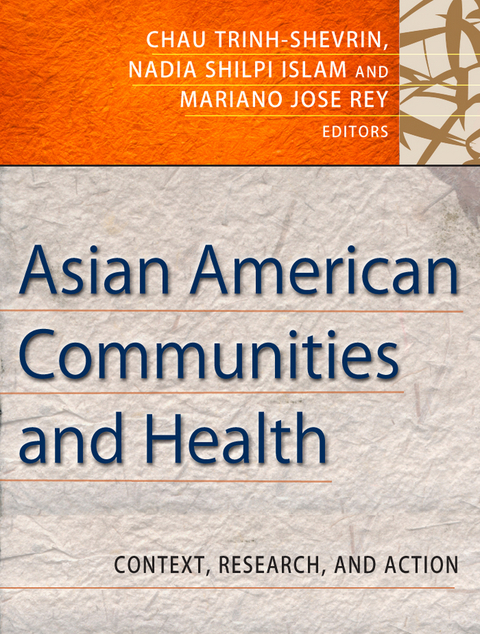
Asian American Communities and Health (eBook)
John Wiley & Sons (Verlag)
978-0-470-50565-6 (ISBN)
Chau Trinh-Shevrin, DrPH, is the director of the New York University (NYU) Center for the Study of Asian American Health and assistant professor at the NYU School of Medicine.
Nadia Shilpi Islam, PhD, is the deputy director of research within the Center for the Study of Asian American Health at the New York University.
Mariano Jose Rey, MD, is the director of the New York University Institute for Community Health and Research and senior associate dean for Community Affairs at the NYU School of Medicine.
This ground-breaking textbook examines Asian American health from a public health perspective. It provides an overview of the social, political, economic, and cultural forces that influence the distribution of disease and illness in Asian American communities. The book explores the diversity within the Asian community with respect to health seeking behavior and knowledge, socioeconomic status, educational level, cultural traditions, and specific health care needs and issues. By examining the contextual factors that impact health, the book seeks to facilitate a meaningful dialogue and identify creative solutions for health disparities faced by racial and ethnic minority communities.
Chau Trinh-Shevrin, DrPH, is the director of the New York University (NYU) Center for the Study of Asian American Health and assistant professor at the NYU School of Medicine. Nadia Shilpi Islam, PhD, is the deputy director of research within the Center for the Study of Asian American Health at the New York University. Mariano Jose Rey, MD, is the director of the New York University Institute for Community Health and Research and senior associate dean for Community Affairs at the NYU School of Medicine.
Asian American Communities and Health: Context, Research, Policy, and Action 1
CONTENTS 5
FIGURES AND TABLES 9
FOREWORD 15
THE EDITORS 19
THE CONTRIBUTORS 23
ACKNOWLEDGMENTS 39
PART 1: SETTING THE CONTEXT: Asian Americans and Pacific Islanders in the United States 43
CHAPTER 1: TOWARD A CONTEXTUAL UNDERSTANDING OF ASIAN AMERICAN HEALTH 45
LEARNING OBJECTIVES 45
INTRODUCTION 46
HISTORICAL BACKGROUND ON THE STUDY OF ASIAN AMERICAN HEALTH 47
ISSUES CURRENTLY FACING ASIAN AMERICAN HEALTH RESEARCH 52
FOCUS ON CONTEXT: A NEW LENS TO UNDERSTAND ASIAN AMERICAN HEALTH 56
RELEVANCE OF ASIAN AMERICAN COMMUNITIES AND HEALTH 57
STRUCTURE OF ASIAN AMERICAN COMMUNITIES AND HEALTH 58
USING ASIAN AMERICAN COMMUNITIES AND HEALTH AS A TEACHING AND EDUCATIONAL TOOL 59
TERMINOLOGY AND PRESENTATION OF DATA IN ASIAN AMERICAN COMMUNITIES AND HEALTH 60
NOTES 62
REFERENCES 62
CHAPTER 2: SOCIAL, DEMOGRAPHIC, AND CULTURAL CHARACTERISTICS OF ASIAN AMERICANS 65
LEARNING OBJECTIVES 65
INTRODUCTION 66
BACKGROUND AND HISTORY OF ASIAN AMERICANS 66
MAJOR ASIAN AMERICAN ISSUES 79
SUMMARY 86
DISCUSSION QUESTIONS 88
REFERENCES 88
CHAPTER 3: SOCIAL, DEMOGRAPHIC, AND CULTURAL CHARACTERISTICS OF U.S. PACIFIC ISLANDERS 92
LEARNING OBJECTIVES 92
INTRODUCTION 93
BACKGROUND 94
DEMOGRAPHIC CHARACTERISTICS 97
SUMMARY 111
DISCUSSION QUESTIONS 112
REFERENCES 112
CHAPTER 4: ASIAN AMERICAN HEALTH RESEARCH: Baseline Data and Funding 115
LEARNING OBJECTIVES 115
INTRODUCTION 116
DOCUMENTING HEALTH DISPARITIES 116
QUEST FOR BASELINE ASIAN AMERICAN HEALTH DATA 119
FUNDING FOR ASIAN AMERICAN HEALTH RESEARCH 133
THE FUTURE OF ASIAN AMERICAN HEALTH RESEARCH AND FUNDING 139
SUMMARY 143
DISCUSSION QUESTIONS 144
REFERENCES 144
PART 2: PERSPECTIVES: Health Across the Life Span and Special Populations 147
CHAPTER 5: THE HEALTH OF CHILDREN AND ADOLESCENTS 149
LEARNING OBJECTIVES 149
INTRODUCTION 150
DEMOGRAPHIC CHARACTERISTICS 150
HEALTH STATUS AND ACCESS 150
CONTEXTUAL ISSUES 160
SUMMARY 168
DISCUSSION QUESTIONS 169
REFERENCES 169
CHAPTER 6: THE HEALTH OF WOMEN 174
LEARNING OBJECTIVES 174
INTRODUCTION 175
DEMOGRAPHIC CHARACTERISTICS 175
HEALTH STATUS: SELECTED EMPIRICAL EVIDENCE 179
HEALTH BEHAVIORS CONTRIBUTING TO DISPARATE HEALTH STATUS: SELECTED EMPIRICAL EVIDENCE 184
CONTEXTUAL ISSUES 188
CROSS-CUTTING ISSUES 190
SUMMARY 195
DISCUSSION QUESTIONS 197
REFERENCES 197
CHAPTER 7: THE HEALTH OF MEN 204
LEARNING OBJECTIVES 204
INTRODUCTION 205
DEMOGRAPHIC CHARACTERISTICS OF ASIAN AMERICAN AND PACIFIC ISLANDER MEN 205
HEALTH STATUS 209
SUMMARY 233
DISCUSSION QUESTIONS 234
REFERENCES 234
CHAPTER 8: THE HEALTH OF THE ELDERLY 241
LEARNING OBJECTIVES 241
INTRODUCTION 242
DEMOGRAPHIC CHARACTERISTICS 242
MAJOR HEALTH ISSUES 248
CONTEXTUAL ISSUES 254
HELP-SEEKING AND SERVICE UTILIZATION 256
SUMMARY 259
DISCUSSION QUESTIONS 261
NOTE 263
REFERENCES 263
CHAPTER 9: THE HEALTH OF LESBIAN, GAY, BISEXUAL, TRANS-GENDER, QUEER, AND QUESTIONING PEOPLE 268
LEARNING OBJECTIVES 268
INTRODUCTION 269
WOMEN WHO HAVE SEX WITH WOMEN 283
MEN WHO HAVE SEX WITH MEN 287
GENDER-VARIANT PEOPLE 297
SUMMARY 304
DISCUSSION QUESTIONS 308
NOTES 309
REFERENCES 315
PART 3: FROM THE INDIVIDUAL TO THE INSTITUTIONAL: Critical Factors Influencing Health Disparities 325
CHAPTER 10: COMPLEMENTARY AND ALTERNATIVE MEDICINES 327
LEARNING OBJECTIVES 327
INTRODUCTION 328
DEFINING TRADITIONAL MEDICINE AND COMPLEMENTARY ALTERNATIVE MEDICINE 328
PREVALENCE OF CAM IN ASIAN AMERICANS 329
CAM AND CULTURAL COMPETENCE 344
CAM SYSTEMS AND MODALITIES 345
CAM-RELATED SAFETY ISSUES 358
SUMMARY 359
DISCUSSION QUESTIONS 360
REFERENCES 361
CHAPTER 11: LANGUAGE ACCESS 365
LEARNING OBJECTIVES 365
INTRODUCTION 366
WHO MAY REQUIRE LANGUAGE ACCESS? 366
IMPACT OF LANGUAGE ACCESS SERVICES 368
FEDERAL STATUTES AND REGULATIONS REGARDING LANGUAGE ACCESS 370
LANGUAGE ACCESS IN PRACTICE: CASE STUDY IN THE NEW YORK KOREAN AMERICAN COMMUNITY 375
SUMMARY 383
DISCUSSION QUESTIONS 384
NOTES 384
REFERENCES 384
CHAPTER 12: HEALTH INSURANCE 386
LEARNING OBJECTIVES 386
INTRODUCTION 387
NATIONAL TRENDS IN UNINSURANCE, 1992–2006 388
CASE STUDY: THE CALIFORNIA HEALTH INTERVIEW SURVEY 396
SUMMARY 401
DISCUSSION QUESTIONS 402
NOTES 403
REFERENCES 403
CHAPTER 13: RACISM AND DISCRIMINATION 406
LEARNING OBJECTIVES 406
INTRODUCTION 407
DEFINITIONS AND A MODEL 407
HISTORY OF DISCRIMINATION IN PUBLIC HEALTH 410
CONTEMPORARY ANTI–ASIAN AMERICAN AND PACIFIC ISLANDER DISCRIMINATION 412
DISCRIMINATION AND HEALTH 419
MODERATORS OF DISCRIMINATION 427
DISCRIMINATION AND ACCULTURATION 428
SUMMARY 431
DISCUSSION QUESTIONS 433
NOTES 434
REFERENCES 436
CHAPTER 14: OCCUPATIONAL AND ENVIRONMENTAL HEALTH 445
LEARNING OBJECTIVES 445
INTRODUCTION 446
HISTORICAL BACKGROUND 446
ASIAN AMERICAN WORKERS TODAY 447
EMPIRICAL EVIDENCE ON OCCUPATIONAL AND ENVIRONMENTAL HEALTH DISPARITIES 448
SUMMARY 470
DISCUSSION QUESTIONS 473
NOTES 476
REFERENCES 477
PART 4: BUILDING THE FOUNDATION FOR ACTION: Community-Based Research 483
CHAPTER 15: HEALTH INTERVENTIONS 485
LEARNING OBJECTIVES 485
INTRODUCTION 486
AN ECOLOGICAL PERSPECTIVE 486
THE ECOLOGY OF ASIAN AMERICANS 487
CASE STUDIES: USING THE ECOLOGICAL FRAMEWORK FOR ASIAN AMERICAN HEALTH INTERVENTIONS 492
PARTICIPATORY APPROACHES 494
IMPORTANCE OF PROCESS TO PARTICIPATORY INTERVENTIONS 498
CHALLENGES TO PARTICIPATORY HEALTH INTERVENTIONS 500
SUMMARY 502
DISCUSSION QUESTIONS 503
NOTE 503
REFERENCES 503
CHAPTER 16: COMMUNITY-BASED PARTICIPATORY RESEARCH 506
LEARNING OBJECTIVES 506
INTRODUCTION 507
COMMUNITY-BASED PARTICIPATORY RESEARCH 507
A REVIEW OF CBPR IN ASIAN AMERICAN HEALTH RESEARCH 514
CHALLENGES IN USING CBPR FOR STUDYING ASIAN AMERICAN HEALTH 535
SUMMARY 538
DISCUSSION QUESTIONS 539
NOTE 540
REFERENCES 540
CHAPTER 17: PROMOTING COMMUNITY-BASED PARTICIPATORY RESEARCH AT THE INSTITUTIONAL LEVEL 546
LEARNING OBJECTIVES 546
INTRODUCTION 547
SHIFT IN PUBLIC AND PRIVATE FUNDING FOR RESEARCH USING COMMUNITY PARTICIPATORY APPROACHES 548
FEDERALLY FUNDED CENTERS USING COMMUNITY PARTICIPATORY APPROACHES 549
CASE STUDIES 556
LESSONS LEARNED 561
SUMMARY 569
DISCUSSION QUESTIONS 570
NOTES 571
REFERENCES 571
CHAPTER 18: MULTICULTURAL EVALUATION: A Paradigm Shift to Promote Asian American Health 573
LEARNING OBJECTIVES 573
INTRODUCTION 574
HISTORICAL LIMITATIONS TO TRADITIONAL EVALUATION 574
A SHIFT TO MULTICULTURAL EVALUATION 575
THE POWER AND POTENTIAL OF MULTICULTURAL EVALUATION 578
THE HMONG HEALTH PROJECT: A CASE STUDY 580
SUMMARY 584
DISCUSSION QUESTIONS 585
REFERENCES 586
PART 5: COLLABORATIVE STRATEGIES FOR IMPROVING HEALTH 589
CHAPTER 19: THE WORKFORCE 591
LEARNING OBJECTIVES 591
INTRODUCTION 592
BACKGROUND 592
DIVERSITY IN THE WORKFORCE: EMPIRICAL EVIDENCE 592
NEED FOR CULTURALLY AND LINGUISTICALLY COMPETENT CARE: EMPIRICAL EVIDENCE 602
ACHIEVING DIVERSITY IN THE HEALTH CARE WORKFORCE 603
SUMMARY 605
DISCUSSION QUESTIONS 606
REFERENCES 607
CHAPTER 20: COMMUNITY HEALTH CENTERS 609
LEARNING OBJECTIVES 609
INTRODUCTION 610
HISTORICAL DEVELOPMENT OF CHCs 610
IMPROVING ACCESS TO HEALTH CARE FOR THE MEDICALLY UNDERSERVED 612
ASSOCIATION OF ASIAN PACIFIC COMMUNITY HEALTH ORGANIZATIONS 613
CHARLES B. WANG COMMUNITY HEALTH CENTER: CASE STUDY 620
CHALLENGES 625
SUMMARY 628
DISCUSSION QUESTIONS 628
NOTE 628
REFERENCES 628
CHAPTER 21: HEALTH POLICY ADVOCACY 631
LEARNING OBJECTIVES 631
INTRODUCTION 632
HISTORICAL BASIS OF ASIAN AMERICAN HEALTH ADVOCACY 632
RESPONDING TO NEW BARRIERS TO ACCESS 641
LESSONS LEARNED FROM SUCCESSFUL ADVOCACY EFFORTS 643
CHALLENGES TO FUTURE ADVOCACY EFFORTS TO DEFINE A NATIONAL ASIAN AMERICAN HEALTH AGENDA 647
SUMMARY 650
DISCUSSION QUESTIONS 650
REFERENCES 650
PART 6: EMERGING HEALTH ISSUES AND RESEARCH PRIORITIES 653
CHAPTER 22: DISABILITY 655
LEARNING OBJECTIVES 655
INTRODUCTION 656
RESEARCH GAP ON DISABLED ASIAN AMERICANS’ AND PACIFIC ISLANDERS’ JOB GAP 657
POSSIBLE EXPLANATIONS FOR LOW EMPLOYMENT AMONG DISABLED ASIAN AMERICANS AND PACIFIC ISLANDERS 657
SUMMARY 658
DISCUSSION QUESTIONS 659
NOTES 659
REFERENCES 659
CHAPTER 23: ORAL HEALTH 661
LEARNING OBJECTIVES 661
INTRODUCTION 662
ORAL HEALTH AMONG ASIAN AMERICANS: EMERGING RESEARCH 662
SUMMARY 667
DISCUSSION QUESTIONS 667
REFERENCES 668
CHAPTER 24: GAMBLING ADDICTION 669
LEARNING OBJECTIVES 669
INTRODUCTION 670
EPIDEMIOLOGY 670
REASONS FOR ELEVATED RISK AMONG ASIAN AMERICANS 671
SUMMARY 672
DISCUSSION QUESTIONS 672
REFERENCES 673
CHAPTER 25: GENETIC TESTING AND PROFILING 674
LEARNING OBJECTIVES 674
INTRODUCTION 675
UTILITY, USE, AND IMPLICATIONS OF GENETIC TESTS FOR ASIAN AMERICANS 676
SUMMARY 677
DISCUSSION QUESTIONS 677
REFERENCES 677
AFTERWORD: THE RECIPROCITY OF TIME 681
NAME INDEX 683
SUBJECT INDEX 705
"...a recently published book that not only focuses on a
growing and hugely diverse cultural group in the United States but
also underscores the importance of context in any relationship
between a clinician and patient." (New York Times, July 16,
2009)
"This commentary provides an in-depth and comprehensive
contextual understanding of key issues influencing health in Asian
American communities. It is a valuable resource addressing health
disparities through ecological lenses and multilevel analyses and
is congruent with the current movement toward a better
understanding of the social determinants of health. The chapters
are groundbreaking work of more than 40 leading researchers and
community advocates. The book's emphasis on understanding the
social, cultural, and political context of the health of Asian
Americans is relevant for a wide range of health professionals,
social scientists, community advocates, and policy makers. It is
also an excellent resource for faculty members and students
interested not only in Asian American--related issues but also
broader issues in vulnerable populations, public health, and social
justice."
-- Health Promotion Practice
"The research literature regarding Asian-American health
issues remains thin, funding agencies have been little forthcoming,
and general understanding has been hampered by stereotypes and
misunderstanding. These reasons make the new text Asian American
Communities and Health: Context, Research, Policy, and Action a
timely and important contributor to the understanding of
Asian-American health concerns. The editors have a sophisticated
view of Asian-American health issues and they have drawn together a
collection of chapters impressive in their scope and depth. As a
whole, the book addresses community health on multiple levels,
including institutional and social factors affecting health,
collaborative efforts for health improvement, and how age, gender,
and sexual orientation factor into Asian-American
health."
-- The Journal of Immigrant and Minority Health
| Erscheint lt. Verlag | 3.4.2009 |
|---|---|
| Reihe/Serie | Public Health/Vulnerable Populations |
| Public Health/Vulnerable Populations | Public Health/Vulnerable Populations |
| Sprache | englisch |
| Themenwelt | Medizin / Pharmazie ► Allgemeines / Lexika |
| Medizin / Pharmazie ► Gesundheitswesen | |
| Studium ► Querschnittsbereiche ► Prävention / Gesundheitsförderung | |
| Sozialwissenschaften ► Ethnologie | |
| Sozialwissenschaften ► Soziologie | |
| Schlagworte | Gesundheits- u. Sozialwesen • Health & Social Care • Health in the Asian Community, Asian health in America, Asian American healthcare, Health care in the Asian American Community • Public Health / Ausbildung u. Verhaltensweisen • Public Health Behavior & Education |
| ISBN-10 | 0-470-50565-6 / 0470505656 |
| ISBN-13 | 978-0-470-50565-6 / 9780470505656 |
| Informationen gemäß Produktsicherheitsverordnung (GPSR) | |
| Haben Sie eine Frage zum Produkt? |
 PDF (Adobe DRM)
Größe: 4,4 MB
Kopierschutz: Adobe-DRM
Adobe-DRM ist ein Kopierschutz, der das eBook vor Mißbrauch schützen soll. Dabei wird das eBook bereits beim Download auf Ihre persönliche Adobe-ID autorisiert. Lesen können Sie das eBook dann nur auf den Geräten, welche ebenfalls auf Ihre Adobe-ID registriert sind.
Details zum Adobe-DRM
Dateiformat: PDF (Portable Document Format)
Mit einem festen Seitenlayout eignet sich die PDF besonders für Fachbücher mit Spalten, Tabellen und Abbildungen. Eine PDF kann auf fast allen Geräten angezeigt werden, ist aber für kleine Displays (Smartphone, eReader) nur eingeschränkt geeignet.
Systemvoraussetzungen:
PC/Mac: Mit einem PC oder Mac können Sie dieses eBook lesen. Sie benötigen eine
eReader: Dieses eBook kann mit (fast) allen eBook-Readern gelesen werden. Mit dem amazon-Kindle ist es aber nicht kompatibel.
Smartphone/Tablet: Egal ob Apple oder Android, dieses eBook können Sie lesen. Sie benötigen eine
Geräteliste und zusätzliche Hinweise
Zusätzliches Feature: Online Lesen
Dieses eBook können Sie zusätzlich zum Download auch online im Webbrowser lesen.
Buying eBooks from abroad
For tax law reasons we can sell eBooks just within Germany and Switzerland. Regrettably we cannot fulfill eBook-orders from other countries.
 EPUB (Adobe DRM)
Kopierschutz: Adobe-DRM
Adobe-DRM ist ein Kopierschutz, der das eBook vor Mißbrauch schützen soll. Dabei wird das eBook bereits beim Download auf Ihre persönliche Adobe-ID autorisiert. Lesen können Sie das eBook dann nur auf den Geräten, welche ebenfalls auf Ihre Adobe-ID registriert sind.
Details zum Adobe-DRM
Dateiformat: EPUB (Electronic Publication)
EPUB ist ein offener Standard für eBooks und eignet sich besonders zur Darstellung von Belletristik und Sachbüchern. Der Fließtext wird dynamisch an die Display- und Schriftgröße angepasst. Auch für mobile Lesegeräte ist EPUB daher gut geeignet.
Systemvoraussetzungen:
PC/Mac: Mit einem PC oder Mac können Sie dieses eBook lesen. Sie benötigen eine
eReader: Dieses eBook kann mit (fast) allen eBook-Readern gelesen werden. Mit dem amazon-Kindle ist es aber nicht kompatibel.
Smartphone/Tablet: Egal ob Apple oder Android, dieses eBook können Sie lesen. Sie benötigen eine
Geräteliste und zusätzliche Hinweise
Buying eBooks from abroad
For tax law reasons we can sell eBooks just within Germany and Switzerland. Regrettably we cannot fulfill eBook-orders from other countries.
aus dem Bereich