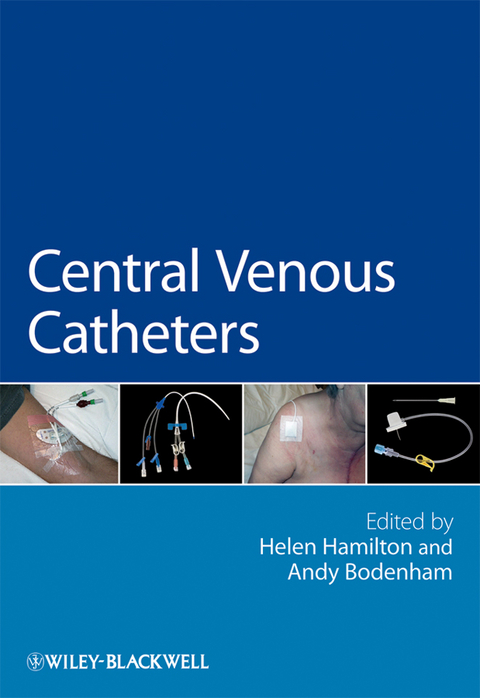
Central Venous Catheters (eBook)
John Wiley & Sons (Verlag)
978-0-470-31921-5 (ISBN)
Helen Hamilton, Clinical Director, Department of Parenteral Nutrition and Vascular Access, Oxford Radcliffe Hospitals Trust, Headington. Oxford.
This book addresses all the issues a patient may experience prior to receiving a VAD. Selection of equipment, practical aspects of technique, the pros and cons of the various veins, and modifications of technique for certain circumstances are examined. Covereage also includes the roles played by radiologists, anaesthetists, surgeons, nurses, and other team memebers. Throughout the chapters a reference is made to the IV Therapy Standards published by the Royal College of Nursing IV Therapy Forum in 2003. Each chapter is evidence based and fully referenced.
Helen Hamilton, Clinical Director, Department of Parenteral Nutrition and Vascular Access, Oxford Radcliffe Hospitals Trust, Headington. Oxford.
Central Venous Catheters 3
Contents 7
Contributors 13
Preface 15
1 The history of central venous access 17
Introduction 17
The origins of venous access 17
Venous access and the development of parenteral nutrition 21
Venous access and chemotherapy 24
Routes of insertion 25
Percutaneous infraclavicular subclavian vein catheterisation 25
A supraclavicular approach to subclavian vein catheterisation 25
Conclusion 26
2 Applied anatomy of the central veins 30
Introduction 30
What is a central vein? 30
Routes of access to a central vein 35
Anatomical variations of central veins 35
Where should the catheter tip lie? 39
Microanatomy 42
Adjacent structures 42
Choosing the best approach to the best vein 44
The best approach 47
Conclusion 48
3 Patient examination and assessment: choice of devices 50
Introduction 50
Information and informed consent 51
Choice of anaesthetic techniques 52
Physical examination and assessment 52
Vascular assessment 53
Cardiovascular 55
Infection issues 59
Radiological assessment 61
Laboratory assessments 62
Conclusion 70
4 Catheter design and materials 73
Introduction 73
Material differences 73
Thrombosis: the relative risks between materials 74
Infection 74
Catheter design 75
Insertion techniques 77
Needle design 78
Catheter size 79
Common types of catheters 80
Tunnelled cuffed catheters 85
Apheresis and Haemodialysis catheters 87
Totally implanted ports 87
Anchorage devices 87
Conclusion 91
5 Cannulation of the jugular veins 94
Introduction 94
The internal jugular vein 94
Applied anatomy of the IJV 94
Insertion techniques 98
Basic technique for IJV cannulation 100
Specific considerations 102
Factors influencing success 103
Complications 103
The external jugular vein 105
Conclusions 106
6 Venous access via the femoral vein 108
Introduction 108
Anatomy of the femoral vein 108
Use of the femoral vein 110
Vascular access devices for the femoral approach 110
Landmark technique 111
Use of ultrasound 111
Technical considerations 112
Temporary use of the femoral vein 112
Long-term use of the femoral vein 114
Catheter tip position 114
Advantages and disadvantages of femoral venous access 115
Removal 116
Conclusion 116
7 Central venous access via the subclavian and axillary veins 117
Introduction 117
Applied anatomy 117
Insertion techniques 123
Conclusion 128
8 Peripherally inserted central catheters 130
Introduction 130
Objectives 130
Peripherally inserted central catheters 130
Midline catheters 131
Patient assessment 131
Selection of patients 133
Benefits of PICCs 135
Consent and patient information 136
Measurements 136
Insertion procedures 136
Ultrasound 137
Power injection 138
Catheter rupture/damage 138
Conclusion 138
Appendix 139
9 Ultrasound-guided venous access 143
Introduction 143
Rationale for the use of ultrasound 144
Limitations of ultrasound guidance 145
What is the evidence that ultrasound is helpful? 147
Ultrasound probe selection 148
Applied ultrasound anatomy 149
Verification of needle-tip placement 155
Conclusion 156
10 The role of diagnostic and interventional radiology in the placement and management of central venous catheters 158
Introduction 158
Imaging modalities 158
Imaging venous anatomy 159
Image-guided CVC placement 160
Management of CVC-related complications: the radiologist’s role 165
Conclusion 171
11 Problems and practical solutions during insertion of catheters 173
Needlephobia 173
Symptom management 174
Confused patients 176
Respiratory disease 176
Coughing 177
Snoring 177
Cardiovascular disease 178
Venous stenosis 178
Problems with venous access 179
Needles 184
Arterial puncture 186
Problems with tunnelling catheters 187
Port insertion 187
Conclusion 189
12 Complications of central venous access 191
Introduction 191
Pneumothorax 191
Air embolism 193
Pleural effusions 195
Arterial puncture/catheterisation 197
Great vein perforation 201
Damage to other neighbouring structures 203
Cardiac arrhythmias 204
Catheter-related sepsis 206
Catheter-related vein thrombosis 208
Mechanical phlebitis 211
Incorrect catheter tip position 212
Embolised, fractured or irretrievable guidewires and catheters 214
Extravasation injury 217
Conclusion 217
13 The pathogenesis and prevention of intravascular catheter-related infections 222
Introduction 222
Types of intravascular catheter-related infections 222
Sources of microorganisms resulting in catheter-related infections 223
Development of catheter-related sepsis 225
Causative microorganisms of catheter-related infections 225
Prevention of intravascular catheter-related infections 226
Conclusion 231
14 Aftercare and management of central venous access devices 237
Introduction 237
Immediate patient care post-catheter insertion 238
Long-term care of CVADs 239
Conclusion 250
15 Removal of central venous access devices 254
Introduction 254
Assessment of patients before removal 254
Positioning and breathing during CVC removal 257
Basic principles for removal of any CVC 257
Complications of removal 258
Removal procedures 259
Conclusion 262
Index 265
| Erscheint lt. Verlag | 8.12.2008 |
|---|---|
| Reihe/Serie | Wiley Series in Nursing |
| Wiley Series in Nursing | Wiley Series in Nursing |
| Sprache | englisch |
| Themenwelt | Medizinische Fachgebiete ► Innere Medizin ► Kardiologie / Angiologie |
| Medizin / Pharmazie ► Medizinische Fachgebiete ► Radiologie / Bildgebende Verfahren | |
| Medizin / Pharmazie ► Pflege | |
| Schlagworte | ACCESS • Anästhesie u. Schmerzbehandlung • Anästhesie u. Schmerzbehandlung • anatomy • Anesthesia & Pain Management • axillary • Cannulation • Cardiac Surgery • Central • central veins • Choice • devices • Examination • Femoral • Guided • Herzchirurgie • History • Jugular • Medical Science • Medizin • Patient • Practical • subclavian • Vein • Veins • venous • venous access |
| ISBN-10 | 0-470-31921-6 / 0470319216 |
| ISBN-13 | 978-0-470-31921-5 / 9780470319215 |
| Informationen gemäß Produktsicherheitsverordnung (GPSR) | |
| Haben Sie eine Frage zum Produkt? |
 PDF (Adobe DRM)
Kopierschutz: Adobe-DRM
Adobe-DRM ist ein Kopierschutz, der das eBook vor Mißbrauch schützen soll. Dabei wird das eBook bereits beim Download auf Ihre persönliche Adobe-ID autorisiert. Lesen können Sie das eBook dann nur auf den Geräten, welche ebenfalls auf Ihre Adobe-ID registriert sind.
Details zum Adobe-DRM
Dateiformat: PDF (Portable Document Format)
Mit einem festen Seitenlayout eignet sich die PDF besonders für Fachbücher mit Spalten, Tabellen und Abbildungen. Eine PDF kann auf fast allen Geräten angezeigt werden, ist aber für kleine Displays (Smartphone, eReader) nur eingeschränkt geeignet.
Systemvoraussetzungen:
PC/Mac: Mit einem PC oder Mac können Sie dieses eBook lesen. Sie benötigen eine
eReader: Dieses eBook kann mit (fast) allen eBook-Readern gelesen werden. Mit dem amazon-Kindle ist es aber nicht kompatibel.
Smartphone/Tablet: Egal ob Apple oder Android, dieses eBook können Sie lesen. Sie benötigen eine
Geräteliste und zusätzliche Hinweise
Buying eBooks from abroad
For tax law reasons we can sell eBooks just within Germany and Switzerland. Regrettably we cannot fulfill eBook-orders from other countries.
aus dem Bereich