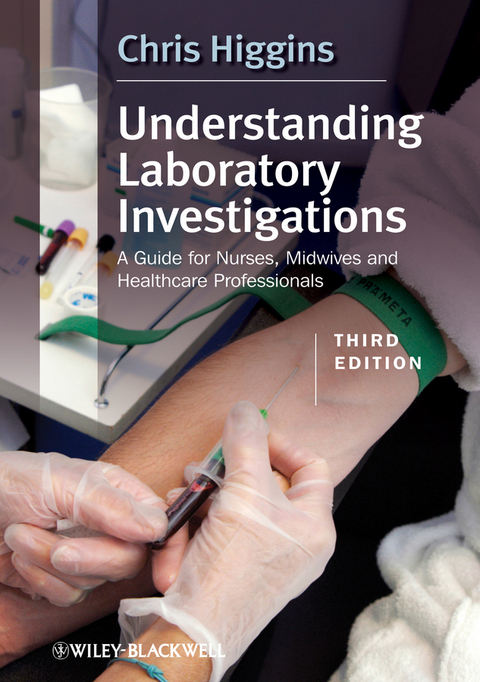
Understanding Laboratory Investigations (eBook)
John Wiley & Sons (Verlag)
978-1-118-48013-7 (ISBN)
The purpose of this book is to help nurses, midwives and health professionals to better understand how the work of clinical laboratories contributes to patient care. It answers the following questions:
- Why is this test being ordered on my patient?
- What sort of sample is required?
- How is that sample obtained?
And most importantly:
- What is the significance of the test result for my patient?
Retaining its accessible and user-friendly style, the aim of this book remains the same: to provide nurses with as much relevant information as possible about the most commonly requested laboratory rests. This is not a book about laboratory technique - its focus is on the clinical significance of test results, and therefore the patient. The third edition is more comprehensive in terms of the number of tests discussed, incorporates colour to aid the accessibility, and includes more paediatric content.
Chris Higgins worked for 16 years as a medical laboratory senior office. He now works as a freelance writer, and has written a series of articles for both the Nursing Times and the British Journal of Nursing.
The purpose of this book is to help nurses, midwives and health professionals to better understand how the work of clinical laboratories contributes to patient care. It answers the following questions: Why is this test being ordered on my patient? What sort of sample is required? How is that sample obtained? And most importantly: What is the significance of the test result for my patient? Retaining its accessible and user-friendly style, the aim of this book remains the same: to provide nurses with as much relevant information as possible about the most commonly requested laboratory rests. This is not a book about laboratory technique - its focus is on the clinical significance of test results, and therefore the patient. The third edition is more comprehensive in terms of the number of tests discussed, incorporates colour to aid the accessibility, and includes more paediatric content.
Chris Higgins worked for 16 years as a medical laboratory senior office. He now works as a freelance writer, and has written a series of articles for both the Nursing Times and the British Journal of Nursing.
Understanding Laboratory Investigations: A Guide for Nurses, Midwives and Healthcare Professionals 5
Copyright 6
Contents 7
Preface 9
Acknowledgements 10
Part 1 Introduction 11
Chapter 1 Introduction to Clinical Laboratories 13
The clinical chemistry laboratory 16
The haematology laboratory 16
The clinical microbiology laboratory 17
The blood transfusion laboratory 18
The histopathology laboratory 19
The immunology laboratory 20
Laboratory staffing 21
Scope, workload and costs 21
Chapter 2 Some Principles of Laboratory Testing 23
Pre-testing procedures 23
Topics relating to interpretation of laboratory results 31
Units of measurement used in clinical laboratories 31
The reference (normal) range 35
Sensitivity and specificity 38
Critical values 38
Difference between serum and plasma 38
Part 2 Clinical Biochemistry Tests 41
Chapter 3 Blood Glucose and HbA1c 43
Normal physiology 44
Laboratory measurement of blood or plasma glucose 49
Causes of abnormal blood glucose 50
Hyperglycaemia in the non-diabetic 59
Hypoglycaemia 59
Chapter 4 Plasma/Serum Sodium and Potassium 64
Physiology – sodium and water balance 64
Normal physiology – potassium 72
Laboratory measurement of sodium and potassium 73
Interpretation of results 74
Consequence of abnormal plasma/serum sodium potassium concentration 80
Chapter 5 Plasma/Serum Urea and Creatinine and e-GFR
Normal physiology 86
Laboratory measurement of plasma/serum urea and creatinine 89
Interpretation of results 90
Effects of increased plasma urea and creatinine concentration 95
Chapter 6 Plasma/Serum Calcium and Phosphate 100
Normal physiology 101
Measurement of calcium and phosphate 105
Causes of raised plasma/serum calcium 108
Causes of reduced plasma/serum calcium 109
Causes of raised plasma/serum phosphate 112
Consequences of abnormal plasma/serum calcium and phosphate 113
Chapter 7 Arterial Blood Gases 118
Normal physiology 119
Respiratory physiology 119
Acid-base balance: the maintenance of normal blood pH 123
Measurement of blood gases 128
Interpretation of blood gas results 130
Clinical disturbances of acid-base balance 131
Chapter 8 Plasma/Serum Cholesterol and Triglycerides 144
Normal physiology 145
Laboratory measurement of plasma/serum cholesterol and triglyceride 148
Consequences of raised cholesterol or triglyceride cardiovascular disease 150
Causes of raised cholesterol and/or triglycerides 154
Chapter 9 Cardiac Markers – Troponin, Creatine Kinase (MB) and Brain Natriuretic Peptide (BNP) 158
Normal physiology 159
Laboratory measurement of troponins (cTnT cTnI) and CK (MB) 161
Interpretation of results 161
Laboratory measurement of BNP 165
Interpretation of results 165
Chapter 10 Tests of Thyroid Function –Thyroxine (T4), Triiodothyronine (T3) and Thyroid Stimulating Hormone (TSH) 170
Normal anatomy and physiology 171
Laboratory assessment of thyroid function 175
Interpretation of test results 176
Causes of abnormal thyroid function test results 176
Monitoring treatment of thyroid disease 182
Thyroid testing in pregnancy 183
Chapter 11 Liver Function Tests: Alanine Transferase (ALT), Gamma Glutamyl Transferase (GGT), Alkaline Phosphatase (AP), Bilirubin and Albumin 186
Normal anatomy and physiology 187
Laboratory measurement of liver function tests (LFTs) 192
Interpretation of results 193
Specific clinical effects of abnormal liver function tests 200
Chapter 12 Plasma/Serum Amylase 206
Normal physiology 206
Laboratory measurement of serum amylase 209
Interpretation of results 210
Chapter 13 Drug Overdose: Paracetamol and Salicylate 215
Clinical use of aspirin and paracetamol safety of therapeutic dose
Laboratory measurement of salicylate and paracetamol 220
Interpretation of paracetamol result 221
Interpretation of salicylate result 221
Chapter 14 Therapeutic Drug Monitoring: Lithium, Digoxin and Theophylline 225
Lithium 225
Digoxin 227
Theophylline 228
Laboratory measurement of serum lithium, digoxin or theophylline 230
Interpretation of results 231
Part 3 Haematology Tests 235
Chapter 15 Full Blood Count – 1: Red Blood Cell Count, Haemoglobin and Other Red Cell Indices 237
Normal physiology 239
Laboratory measurement of FBC 244
Interpretation of Hb RBC and red cell indices results 244
The reticulocyte count 250
Chapter 16 Full Blood Count – 2: White Cell Count and Differential 253
Normal physiology 253
Laboratory measurement of full blood count 256
Chapter 17 Tests of Haemostasis: Platelet Count, Prothrombin Time (PT), Activated Partial Thromboplastin Time (APPT), Thrombin Time (TT) and D-dimer 265
Normal physiology 266
Laboratory measurement of platelet count, PT, APPT, TT and D-dimer 271
Interpretation of results 272
Chapter 18 Laboratory Investigation of Anaemia: Serum Iron, Total Iron Binding Capacity, Serum Ferritin, Serum B12 and Folate 284
Normal physiology 285
Laboratory measurement 288
Interpretation of results 289
Conditions associated with abnormal results of either serum iron, TIBC or ferritin 290
Conditions associated with reduced B12 and folate results 294
Chapter 19 Erythrocyte Sedimentation Rate (ESR) and Plasma C-Reactive Protein (CRP) 300
Erythrocyte sedimentation rate (ESR) 300
Laboratory measurement 302
Interpretation of results 302
C-reactive protein (CRP) 304
Laboratory measurment 305
Interpretation of results 305
Part 4 Blood Transfusion Testing 309
Chapter 20 Blood Group, Antibody Screen and Crossmatch 311
Laboratory testing: blood group, antibody screen and crossmatch 317
Pre-transfusion checks on the ward 323
Haemolytic disease of the new born (HDN) 327
Part 5 Microbiology Testing 333
Chapter 21 Urine Microscopy, Culture and Sensitivity (M,C& S)
Normal physiology 335
Urinary tract infection 337
Microbiological examination of urine 340
Interpretation of results 345
Chapter 22 Blood Culture 349
Normal physiology 350
Bacteraemia and fungaemia 351
Part 6 Screening Tests 363
Chapter 23 Newborn Screening Blood Tests 365
Screening tests and national screening programmes 367
Chapter 24 Cervical Screening Test 380
The cervix 380
Cancer of the cervix 383
Cervical screening 386
The cervical screening test 388
Chapter 25 Dipstick Testing of Urine 394
Urine sample collection 394
Physical inspection of urine 395
Dipstick testing 396
Interpretation of results 398
Glossary of Some Terms Used in Laboratory Medicine 405
Abbreviations 410
Appendix: Adult Reference Ranges 412
Alphabetical Index of Tests 415
Index 417
Reviews of previous editions:
"This is a really useful book for midwives. I expected it to be
a textbook which I could recommend to students--and indeed
that is true. However, when I picked this up I realised how useful
it can be qualified staff, no matter how familiar the topics may be
to those in practice ... . I would recommend this for any team or
ward reference library." (Practising Midwife, January
2009)
"If you have not come across this book before then I would
certainly recommend this new improved edition." (Heather Jarman
in Accident and Emergency Nursing, Volume 15, 2007)
| Erscheint lt. Verlag | 7.12.2012 |
|---|---|
| Sprache | englisch |
| Themenwelt | Pflege ► Fachpflege ► Anästhesie / Intensivmedizin |
| Schlagworte | Care • Clinical • contributes • Edition • General Clinical Nursing • Healthcare • importantly • Investigations • Klinische Krankenpflege • Krankenpflege • Laboratories • Laboratory • nurses • nursing • Patient • Professionals • Purpose • questions • result • Sample • significance • SORT • Style • Third • Understanding • Work |
| ISBN-10 | 1-118-48013-9 / 1118480139 |
| ISBN-13 | 978-1-118-48013-7 / 9781118480137 |
| Informationen gemäß Produktsicherheitsverordnung (GPSR) | |
| Haben Sie eine Frage zum Produkt? |
 PDF (Adobe DRM)
Kopierschutz: Adobe-DRM
Adobe-DRM ist ein Kopierschutz, der das eBook vor Mißbrauch schützen soll. Dabei wird das eBook bereits beim Download auf Ihre persönliche Adobe-ID autorisiert. Lesen können Sie das eBook dann nur auf den Geräten, welche ebenfalls auf Ihre Adobe-ID registriert sind.
Details zum Adobe-DRM
Dateiformat: PDF (Portable Document Format)
Mit einem festen Seitenlayout eignet sich die PDF besonders für Fachbücher mit Spalten, Tabellen und Abbildungen. Eine PDF kann auf fast allen Geräten angezeigt werden, ist aber für kleine Displays (Smartphone, eReader) nur eingeschränkt geeignet.
Systemvoraussetzungen:
PC/Mac: Mit einem PC oder Mac können Sie dieses eBook lesen. Sie benötigen eine
eReader: Dieses eBook kann mit (fast) allen eBook-Readern gelesen werden. Mit dem amazon-Kindle ist es aber nicht kompatibel.
Smartphone/Tablet: Egal ob Apple oder Android, dieses eBook können Sie lesen. Sie benötigen eine
Geräteliste und zusätzliche Hinweise
Buying eBooks from abroad
For tax law reasons we can sell eBooks just within Germany and Switzerland. Regrettably we cannot fulfill eBook-orders from other countries.
aus dem Bereich