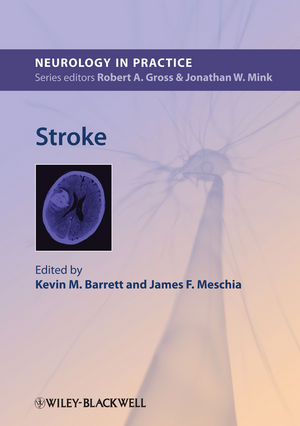
Stroke is a leading cause of disability and death
Early and rapid diagnosis of stroke is essential for identifying the optimum treatment strategy. Recurrence can be prevented if the underlying mechanism is understood. The earlier appropriate rehabilitation programmes can be started, the better the chance of a strong recovery.
Stroke provides the foundations for practice that will enhance your patient's chances of recovery. The expert authors provide the evidence-based roadmap you need to provide the best bedside care including:
Bedside evaluation of the stroke patient
- Neurovascular imaging
- Treatment of acute ischemic stroke and hemorrhagic stroke
- Diagnosis of stroke mechanism and secondary prevention
- Post stroke recovery
- Telemedicine for the acute stroke patient
Clinical in approach, practical in execution, Stroke will help you diagnose and manage your patients more effectively.
EDITED BY
Kevin M. Barrett, MD, MSc, Department of Neurology, Mayo Clinic, Jacksonville, FL, USA
James F. Meschia, MD, Department of Neurology, Mayo Clinic, Jacksonville, FL, USA
Stroke is a leading cause of disability and death Early and rapid diagnosis of stroke is essential for identifying the optimum treatment strategy. Recurrence can be prevented if the underlying mechanism is understood. The earlier appropriate rehabilitation programmes can be started, the better the chance of a strong recovery. Stroke provides the foundations for practice that will enhance your patient s chances of recovery. The expert authors provide the evidence-based roadmap you need to provide the best bedside care including: Bedside evaluation of the stroke patient Neurovascular imaging Treatment of acute ischemic stroke and hemorrhagic stroke Diagnosis of stroke mechanism and secondary prevention Post stroke recovery Telemedicine for the acute stroke patient Clinical in approach, practical in execution, Stroke will help you diagnose and manage your patients more effectively.
EDITED BY Kevin M. Barrett, MD, MSc, Department of Neurology, Mayo Clinic, Jacksonville, FL, USA James F. Meschia, MD, Department of Neurology, Mayo Clinic, Jacksonville, FL, USA
Stroke 5
Copyright 6
Contents 7
Contributors 8
Series Foreword 10
Preface 11
1 Bedside Evaluation of the Acute Stroke Patient 13
Introduction 13
Is it a stroke? 13
Cortical syndromes 15
Small vessel (lacunar) syndromes 17
Brainstem syndromes 18
Stroke versus TIA? 19
Stroke mimics 20
The history – guessing the age of a stroke and more 22
Rapid examination of the acute stroke patient 23
Diagnostic data 24
The all important head CT 24
Laboratory and ancillary studies 25
Biomarkers in acute stroke diagnosis? 25
The decision to treat 26
Conclusion 27
Selected bibliography 27
2 Neurovascular Imaging of the Acute Stroke Patient 28
Introduction 28
Technical considerations 28
Noncontrast computed tomography (NCCT) scan 28
Computed tomography angiography (CTA) 31
Computed tomography perfusion (CTP) 33
Diffusion-weighted imaging (DWI) 35
Gradient echo (GRE) T2*-weighted imaging 36
Magnetic resonance angiography (MRA) 37
Magnetic resonance perfusion weighted imaging (MRP) 37
Clinical considerations 38
Imaging evaluation of acute cerebral ischemia 38
Imaging evaluation of acute nontraumatic intracranial hemorrhage 40
Conclusion 46
Selected bibliography 47
3 Treatment of Acute Ischemic Stroke 49
Introduction 49
Intravenous thrombolysis 49
Key clinical trials 49
Optimizing clinical outcomes following intravenous thrombolysis 54
Post-thrombolysis care 56
Treating complications of rt-PA 56
Special patient circumstances 57
Endovascular arterial reperfusion 58
Key clinical trials of intra-arterial thrombolysis 58
Special clinical scenario: acute basilar artery occlusion 60
Mechanical thrombectomy 61
Postprocedural care 64
Decision making 66
Future directions 66
Selected bibliography 66
4 Diagnosis of Stroke Mechanisms and Secondary Prevention 67
Introduction to diagnostic evaluation 67
Do the symptoms represent cerebral ischemia (versus nonischemic pathology)? 67
Where does the process localize? 67
What are the potential etiologies and mechanisms of cerebral infarction and TIA? 69
What is the prevalence (pretest probability) of each potential etiology? 69
What test modalities exist and what is the sensitivity and specificity of such? 69
What are the potential treatment options? 70
General approach 70
The utility of cross-sectional imaging 71
Diagnostic evaluation and treatment by etiology 75
Cardioembolic 75
Large vessel extracranial 78
Large vessel intracranial 82
Small vessel disease 83
Coagulation disorders 84
Risk factors 85
Conclusion 88
Selected bibliography 88
5 Treatment of Hemorrhagic Stroke 90
Intracerebral hemorrhage 90
Introduction 90
Epidemiology 90
Etiology 90
Pathophysiology 93
Manifestations 94
Diagnostic considerations 95
Treatment 96
Subarachnoid hemorrhage 102
Introduction 102
Epidemiology 102
Etiology 102
Pathophysiology 103
Clinical manifestations 103
Diagnostic considerations 103
Treatment 105
Conclusion 113
Selected bibliography 113
6 Prevention and Management of Poststroke Complications 115
Medical complications in stroke patients 115
Venous thromboembolism 115
Urinary tract complications 117
Aspiration pneumonia 118
Nonbleeding complications of recombinant tissue plasminogen activator 118
Pressure sores and ulceration 119
Falls 119
Malnutrition 120
Pain 121
Miscellaneous medical complications 121
Cardiac complications 121
Gastrointestinal (GI) complications 121
Neuropsychiatric disturbances 121
Neurological complications in stroke patients 122
Cerebral edema 123
Hemorrhagic transformation 125
Seizures 126
Miscellaneous neurological complications 127
Headache 127
Sleep disorders 128
Conclusion 129
Selected bibliography 129
7 Poststroke Recovery 131
Introduction 131
Natural history of stroke recovery 133
Phases of stroke: implications for rehabilitation 135
Hyperacute phase (< 24 hours after stroke onset)
Acute phase (24 hours to 4 weeks after stroke onset) 137
Subacute phase (1 month to 3 months after stroke onset) 139
Chronic phase (> 3 months after stroke onset)
Mechanisms of stroke recovery 141
Emerging technology 141
Predicting motor recovery of the upper limb after stroke rehabilitation with emerging technology 141
Emerging treatments and technology for stroke rehabilitation 143
Summary 146
Selected bibliography 147
8 Telemedicine Networks and Remote Evaluation of the Acute Stroke Patient 149
Introduction 149
Strategies for telestroke network building 149
Summary of the evidence supporting telemedicine use in acute stroke diagnosis and management 149
Strategies for funding the development of a telestroke network 152
Economic sustainability, cost effectiveness, and the status of reimbursement for telestroke 152
Fundamentals of telestroke networks 154
Implementation of telemedicine within stroke systems of care 154
Incorporating evidence-based practice guidelines and care pathways into a telestroke network 154
Engaging stakeholders 156
Administrative infrastructure 156
Telestroke technology options 156
Metrics to track performance, outcomes, and quality of a telestroke network 157
Telestroke networks 157
Overcoming challenges to sustain a telestroke network 158
Identifying and overcoming obstacles (licensing, credentialing, privileging, medicolegal, financial, and reimbursement issues) 158
Tips and tools for sustaining a telestroke network 162
Getting buy-in from referring physicians, administrative leadership, and telemedicine providers 162
Telestroke staff education 163
Keeping hub and spoke partners engaged how to combat telemedicine fatigue
Conclusion 163
Selected bibliography 163
9 Appendix: Practical Clinical Stroke Scales 165
Introduction 165
Stroke clinical outcome scales 165
Clinical risk stratification scores 168
Hemorrhagic stroke severity scales 169
Eligibility criteria for intravenous rt-PA 0–4.5 hours 170
Internet resources 170
Index 171
Supplemental Images 177
"It was a pleasure to review this book, particularly after
going through many stroke books as a recent trainee, and I found
its scope and content refreshing. I will certainly pass this
along to other trainees and I recommend it highly."
(Doody's, 30 August 2013)
| Erscheint lt. Verlag | 28.1.2013 |
|---|---|
| Reihe/Serie | NIP- Neurology in Practice |
| NIP- Neurology in Practice | NIP- Neurology in Practice |
| Sprache | englisch |
| Themenwelt | Medizin / Pharmazie ► Medizinische Fachgebiete ► Neurologie |
| Schlagworte | appropriate • Chance • chances • Death • Diagnosis • Disability • Essential • Foundations • leading cause • Mechanism • Medical Science • Medizin • Neurologie • Neurology • patients • Practice • Programmes • Recovery • recurrence • Rehabilitation • stroke • strong recovery • Underlying • understood |
| ISBN-10 | 1-118-56041-8 / 1118560418 |
| ISBN-13 | 978-1-118-56041-9 / 9781118560419 |
| Informationen gemäß Produktsicherheitsverordnung (GPSR) | |
| Haben Sie eine Frage zum Produkt? |
 PDF (Adobe DRM)
Kopierschutz: Adobe-DRM
Adobe-DRM ist ein Kopierschutz, der das eBook vor Mißbrauch schützen soll. Dabei wird das eBook bereits beim Download auf Ihre persönliche Adobe-ID autorisiert. Lesen können Sie das eBook dann nur auf den Geräten, welche ebenfalls auf Ihre Adobe-ID registriert sind.
Details zum Adobe-DRM
Dateiformat: PDF (Portable Document Format)
Mit einem festen Seitenlayout eignet sich die PDF besonders für Fachbücher mit Spalten, Tabellen und Abbildungen. Eine PDF kann auf fast allen Geräten angezeigt werden, ist aber für kleine Displays (Smartphone, eReader) nur eingeschränkt geeignet.
Systemvoraussetzungen:
PC/Mac: Mit einem PC oder Mac können Sie dieses eBook lesen. Sie benötigen eine
eReader: Dieses eBook kann mit (fast) allen eBook-Readern gelesen werden. Mit dem amazon-Kindle ist es aber nicht kompatibel.
Smartphone/Tablet: Egal ob Apple oder Android, dieses eBook können Sie lesen. Sie benötigen eine
Geräteliste und zusätzliche Hinweise
Buying eBooks from abroad
For tax law reasons we can sell eBooks just within Germany and Switzerland. Regrettably we cannot fulfill eBook-orders from other countries.
aus dem Bereich