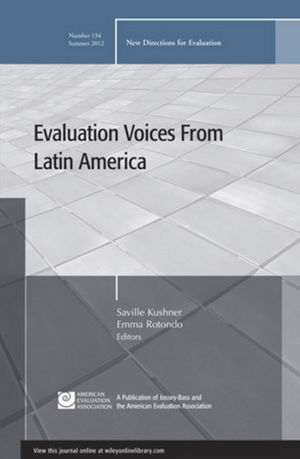
Evaluation Voices from Latin America (eBook)
128 Seiten
Wiley (Verlag)
978-1-118-40228-3 (ISBN)
Saville Kushner and Emma Rotondo are the authors of Evaluation Voices from Latin America: New Directions for Evaluation, Number 134, published by Wiley.
EDITORS' NOTES 1
Saville Kushner, Emma Rotondo
1. Evaluation in Latin America: Paradigms and Practices7
Nerio Neirotti
This chapter looks at the emergence and development of programevaluation through successive waves of political and economicreform across Latin America, including the imposition andwithdrawal of the Washington Consensus.
2. Emergent Evaluation and Educational Reforms in LatinAmerica 17
Sergio Martinic
This chapter has a particular focus on educational evaluation. Theauthor shows how the discipline and methodology of evaluation haschanged in response to waves of school reform in the region.
3. Evaluation, Public Policies, and Human Rights 29
Ludwig Guendel
Continuing the theme of evaluation in Latin America responding tosociopolitical contexts, this chapter focuses on how evaluationreflects international policy for human rights. The author looks athow the rights agenda is written into policy and the essentialacknowledgment of subjectivities.
4. Moving Toward a Gender Equality and Human RightsPerspective in Evaluation 39
Alejandra Faúndez Meléndez
Gender and equity issues are not uncommon themes in evaluationdiscourse, but in this chapter we hear about how they are playedout in the context of Latin America. The place of the woman indevelopment and the particular cases of indigenous peoples providesome of the context.
5. Youth Participation in Evaluation: The Pró-MeninoProgram in Brazil 49
Daniel Braga Brandão, Rogério Renato Silva, RenataCodas
Focusing at the level of method, this chapter looks at a case of aparticipatory evaluation with adolescents, and the use ofcomic-book-type storyboarding as an evaluative tool.
6. Evaluating With At-Risk Communities: Learning From aSocial Program in a Brazilian Slum 61
Ana Carolina Letichevsky, Thereza Penna Firme
In this chapter, the authors give an account of an evaluationconducted as "appreciative enquiry" in collaboration with acommunity in a poor area. "Appreciation" was a methodologicalresponse to previously failed attempts to secure the trust of thiscommunity.
7. Performance Measurement and Evaluation Systems:Institutionalizing Accountability for Governmental Results in LatinAmerica 77
Nuria Cunill-Grau, Sonia M. Ospina
Returning to the opening themes of how evaluation responds topolitical and economic change, this chapter looks at the dominantinternational methodology of results-based management and raisesissue for the practice of evaluation in Latin America.
8. Lessons Learned From Evaluation Capacity Building93
Emma Rotondo
Struggling to meet contemporary innovation and reform demandscapacity development for evaluation is a prominent dimension ofexperience in the region. This chapter documents the work ofPREVAL, a UN-funded evaluation network dedicated to capacitydevelopment in qualitative approaches to program evaluation.
9. Evaluation as a Learning Tool 103
Osvaldo Néstor Feinstein
This chapter discusses the commonly-expressed dualism betweenevaluation for learning and evaluation for accountability. In aLatin American context, the author argues that the two can andshould be seen as complementary.
INDEX 113
| Erscheint lt. Verlag | 13.6.2012 |
|---|---|
| Reihe/Serie | J-B PE Single Issue (Program) Evaluation |
| Sprache | englisch |
| Themenwelt | Geisteswissenschaften |
| Medizin / Pharmazie ► Gesundheitsfachberufe | |
| Medizin / Pharmazie ► Medizinische Fachgebiete ► Psychiatrie / Psychotherapie | |
| Sozialwissenschaften ► Pädagogik | |
| Schlagworte | Allg. Bildungswesen (Hochschulen) • Bildungswesen • Education • Education Special Topics • Higher Education General • Spezialthemen Bildungswesen |
| ISBN-10 | 1-118-40228-6 / 1118402286 |
| ISBN-13 | 978-1-118-40228-3 / 9781118402283 |
| Informationen gemäß Produktsicherheitsverordnung (GPSR) | |
| Haben Sie eine Frage zum Produkt? |
 PDF (Adobe DRM)
Kopierschutz: Adobe-DRM
Adobe-DRM ist ein Kopierschutz, der das eBook vor Mißbrauch schützen soll. Dabei wird das eBook bereits beim Download auf Ihre persönliche Adobe-ID autorisiert. Lesen können Sie das eBook dann nur auf den Geräten, welche ebenfalls auf Ihre Adobe-ID registriert sind.
Details zum Adobe-DRM
Dateiformat: PDF (Portable Document Format)
Mit einem festen Seitenlayout eignet sich die PDF besonders für Fachbücher mit Spalten, Tabellen und Abbildungen. Eine PDF kann auf fast allen Geräten angezeigt werden, ist aber für kleine Displays (Smartphone, eReader) nur eingeschränkt geeignet.
Systemvoraussetzungen:
PC/Mac: Mit einem PC oder Mac können Sie dieses eBook lesen. Sie benötigen eine
eReader: Dieses eBook kann mit (fast) allen eBook-Readern gelesen werden. Mit dem amazon-Kindle ist es aber nicht kompatibel.
Smartphone/Tablet: Egal ob Apple oder Android, dieses eBook können Sie lesen. Sie benötigen eine
Geräteliste und zusätzliche Hinweise
Buying eBooks from abroad
For tax law reasons we can sell eBooks just within Germany and Switzerland. Regrettably we cannot fulfill eBook-orders from other countries.
aus dem Bereich