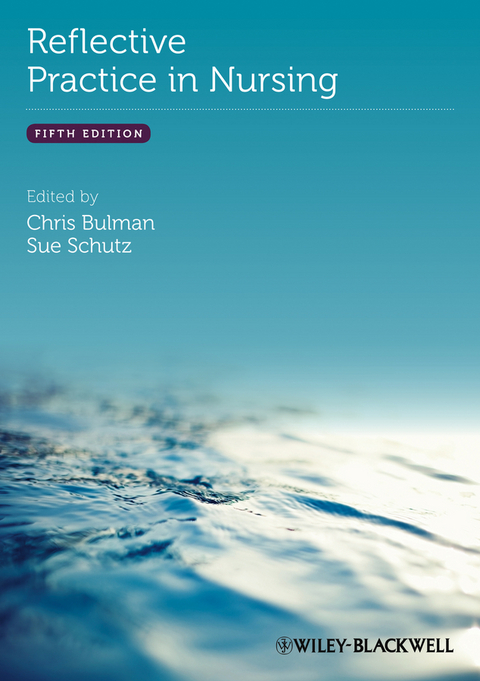
Reflective Practice in Nursing (eBook)
John Wiley & Sons (Verlag)
978-1-118-30776-2 (ISBN)
From reviews of previous editions:
'This excellent book provides useful guidance on the use of reflection in practice.... a helpful addition to any nursing library.' Primary Health Care
'...an excellent investment in any nurses' library portfolio.' Journal of Advanced Nursing
'An extremely welcome addition to nursing's literature on thoughtful, knowledgeable practice.' Nursing Times
'This is an excellent practical guide to reflective practice...I would highly recommend this book to all practice teachers and students.' Journal of Practice Nursing
The ability to reflect on practice has become a competency demanded of every healthcare professional in recent years. It can be a daunting prospect- but this practical and accessible text guides the way, using the latest research and evidence to support the development of skills in reflective practice and provides help and advice on how to get started, how to write reflectively and how to continue to use reflective practice in everyday situations.
This fifth edition of Reflective Practice in Nursing is an indispensable guide for students and practitioners alike who wish to learn more about reflective practice, as well as containing essential information for teachers and lecturers.
Chris Bulman and Sue Schutz are both Senior Lecturers within the Faculty of Health and Life Sciences, Oxford Brookes University, Oxford, UK.
From reviews of previous editions: 'This excellent book provides useful guidance on the use of reflection in practice.... a helpful addition to any nursing library. Primary Health Care ' an excellent investment in any nurses library portfolio.' Journal of Advanced Nursing 'An extremely welcome addition to nursing's literature on thoughtful, knowledgeable practice.' Nursing Times 'This is an excellent practical guide to reflective practice I would highly recommend this book to all practice teachers and students.' Journal of Practice Nursing The ability to reflect on practice has become a competency demanded of every healthcare professional in recent years. It can be a daunting prospect- but this practical and accessible text guides the way, using the latest research and evidence to support the development of skills in reflective practice and provides help and advice on how to get started, how to write reflectively and how to continue to use reflective practice in everyday situations. This fifth edition of Reflective Practice in Nursing is an indispensable guide for students and practitioners alike who wish to learn more about reflective practice, as well as containing essential information for teachers and lecturers.
Chris Bulman and Sue Schutz are both Senior Lecturers within the Faculty of Health and Life Sciences, Oxford Brookes University, Oxford, UK.
Reflective Practice in Nursing 5
Copyright 6
Contents 7
List of Contributors 8
Preface 11
Chapter 1 An introduction to reflection 13
Introduction 13
Contemporary challenges for reflective nursing practice and education 13
Explaining the concept of reflection 14
Starting with Aristotle 14
Dewey 14
Schön 15
Contemporary descriptions of reflection 16
The influence of critical theory 16
Similarities and differences in explanations of reflection 17
Some key points about the concept of reflection 18
Noteworthy concepts for a deeper understanding of reflection 18
Praxis 18
Critical being 19
‘Knowing more than we can tell’ 20
The ‘dangers’ of reflection 21
Evidence-based practice and reflection 24
Reflection for communicating practice knowledge 26
Empowerment and change 28
Nurse education and knowledge tensions 29
Nurse education and reflection 30
Liberating and using practice experience 30
Conclusion 31
References 32
Chapter 2 Developing skills for reflective practice 35
Introduction 35
The importance of underlying skills 36
Limitations of a skills-based approach to developing reflective practice 37
An alternative approach to developing reflective practice 38
Guidance on using the exercises in this chapter 39
Issues for facilitators 39
Self-awareness 40
Description 45
Critical analysis 48
Identifying your existing knowledge 49
Exploring feelings related to the situation 50
Identifying and challenging assumptions 50
Imagining and exploring alternative courses of action 51
Synthesis 54
Evaluation 57
A more wide-ranging approach to developing reflective practice 58
Attributes of the reflective practitioner 59
Possessing a repertoire of experience 59
Demonstrating artistic practice 59
Being able to frame problems and experiment in practice 59
Having an ability to articulate your reflective practice 60
Having a transactional and constructivist relationship with practice 60
Possessing tacit knowledge 60
Conclusion 62
Acknowledgements 62
References 62
Chapter 3 Writing to learn: writing reflectively 65
Introduction 65
Your personal journal 66
Where does your personal journal fit into your reflective learning? 67
The purpose of a personal journal 68
Starting your journal 71
Blocks to writing 73
Content 75
To provide evidence to meet assessment criteria 75
To research self 78
For personal development 83
What is reflective writing? 89
Models of reflection 95
Professional responsibilities 96
Ethical considerations 98
Conclusion 99
References 100
Useful websites 101
Appendix 1 The park: comments on the quality of reflection (Adapted from Moon 2004) 101
The park (1) 101
The park (4) 102
Appendix 2 Gibbs’ reflective cycle (Gibbs 1998, adapted by Tate) 102
Description of the experience (what happened?) 102
Recording your feelings (what were you feeling?) 103
Evaluating the experience 103
Analysis of the experience 103
Conclusion about the experience 104
Action plan 104
Chapter 4 Reflecting in groups 105
Introduction 105
Work-based learning, organisational learning and learning organisations 106
Groups to support reflection, learning and supervision 108
Online reflective groups 108
Reflecting face to face 109
Group working: challenges and benefits 110
Creating fruitful conditions 110
Power, groups and facilitation 113
Benefits of reflective group work 114
Challenges to group reflection 116
Running a group: ground rules and other pragmatic issues 118
Membership, micro-politics and the need to be accommodating 120
Group time and commitment to the group 121
Explaining the purpose of a reflective group 122
Eliciting reflections: dialogue and other approaches 123
The need to challenge, the need to support 124
Reflecting on people and situations 125
Facilitation and ‘flying solo’ 126
Supporting facilitators 126
Conclusion: many hands or too many cooks? 127
References 127
Chapter 5 An exploration of the student and mentor journey into reflective practice 133
Introduction 133
Changes and pressures on nursing and education – why reflection is increasingly important for students and mentors 133
The student’s journey into reflection 135
How we introduce reflection to our students 135
Developing self-awareness in practice and the simulated environment 138
Developing descriptive skills 142
Developing critical analysis and evaluation 143
The mentor’s journey into reflection 144
Roles and responsibilities 144
The role of reflection in mentor development 146
Mentor preparation and reflection 147
Reflective trigger questions based on the Nursing and Midwifery Council eight domains 148
Additional reflective approaches that can be used by mentors 150
Reflection and its place in student assessment 155
Conclusion 156
References 156
Chapter 6 Supervision for supervisors: icing on the cake or a basic ingredient for the development of clinical supervision in nursing? 162
Introduction 162
Making connections between reflective practice and clinical supervision 163
Background to team supervision as the focus for supervision on supervisory practice 169
Establishing the relationship for supervision on supervision 169
The use of the telephone as a method of clinical supervision 171
Using reflection for supervision on (John’s) supervision 173
Focusing on the supervisory process to identify ‘blind spots’ 176
The use of parallel process 176
Game playing in supervision 178
Supervisory preferences and styles 179
Just like supervision for supervisors: more questions than answers? 182
Acknowledgements 184
References 185
Chapter 7 A personal exploration of reflective and clinical expertise 189
Back to the beginning 189
Step 1 Return to the experience: finding what is at the heart of your experience 190
Finding Edna 190
Finding a diagnosis 191
Finding care 191
Family finding me 192
Side-step: the art of finding knowledge in experience 192
Finding knowledge in experience in education practice 193
Finding the point: start with the text 193
Finding the point: listen to your emotional response 195
Finding the point: preserve the wholeness of the text 196
Finding the point: find what’s in the text 196
Finding the point: put the story together 199
Step 2 Attend to the feelings – finding what is in your heart 199
Step 3 Re-evaluate the experience – putting my heart and mind into knowing my practice 201
Association – making links 201
Integration – understanding the importance of links 202
Validation – testing out the links 204
What can be known about expertise from my encounter with Edna? 206
Appropriation – embracing my learning from my encounter with Edna 208
Concluding reflections 209
References 210
Chapter 8 Assessing and evaluating reflection 213
Introduction 213
Definitions 214
Attributes 215
Correlates 215
The assessment of reflection 216
The healthcare context 216
Issues in assessing reflection 217
Problems with the assessment of reflection 219
Tools for assessing reflection 222
Verbal strategies 223
Written strategies 225
Grading reflection 228
Issues for students and teaching staff in the assessment of reflection 229
Evaluating reflection 231
Conclusion 233
References 234
Chapter 9 Getting started on a journey with reflection 237
Contemplating the journey 237
Having, and drawing on, a repertoire of experience 238
Reflection, change and challenge 239
Key suggestions for your journey with reflection 241
Working on your skills for reflection 241
Some useful frameworks for reflection 242
Finding someone to reflect with 250
Developing your reflective writing 253
Reading the literature 262
Having the courage to change and challenge 262
Conclusion 262
References 263
Index 266
| Erscheint lt. Verlag | 10.1.2013 |
|---|---|
| Sprache | englisch |
| Themenwelt | Medizin / Pharmazie ► Pflege ► Ausbildung / Prüfung |
| Schlagworte | Ability • accessible • Ausbildung u. Perspektiven i. d. Krankenpflege • Competency • daunting prospect • demanded • Development • Einführungen in die Krankenpflege • Einführungen in die Krankenpflege • every • Healthcare • Introductions to Nursing • Krankenpflege • Latest • nursing • Nursing Education & Professional Development • Order • Practical • Practice • Professional • provides • Reflect • reflection • reflective • reflectively • Research • Skills • Way • years |
| ISBN-10 | 1-118-30776-3 / 1118307763 |
| ISBN-13 | 978-1-118-30776-2 / 9781118307762 |
| Informationen gemäß Produktsicherheitsverordnung (GPSR) | |
| Haben Sie eine Frage zum Produkt? |
 PDF (Adobe DRM)
Kopierschutz: Adobe-DRM
Adobe-DRM ist ein Kopierschutz, der das eBook vor Mißbrauch schützen soll. Dabei wird das eBook bereits beim Download auf Ihre persönliche Adobe-ID autorisiert. Lesen können Sie das eBook dann nur auf den Geräten, welche ebenfalls auf Ihre Adobe-ID registriert sind.
Details zum Adobe-DRM
Dateiformat: PDF (Portable Document Format)
Mit einem festen Seitenlayout eignet sich die PDF besonders für Fachbücher mit Spalten, Tabellen und Abbildungen. Eine PDF kann auf fast allen Geräten angezeigt werden, ist aber für kleine Displays (Smartphone, eReader) nur eingeschränkt geeignet.
Systemvoraussetzungen:
PC/Mac: Mit einem PC oder Mac können Sie dieses eBook lesen. Sie benötigen eine
eReader: Dieses eBook kann mit (fast) allen eBook-Readern gelesen werden. Mit dem amazon-Kindle ist es aber nicht kompatibel.
Smartphone/Tablet: Egal ob Apple oder Android, dieses eBook können Sie lesen. Sie benötigen eine
Geräteliste und zusätzliche Hinweise
Buying eBooks from abroad
For tax law reasons we can sell eBooks just within Germany and Switzerland. Regrettably we cannot fulfill eBook-orders from other countries.
aus dem Bereich