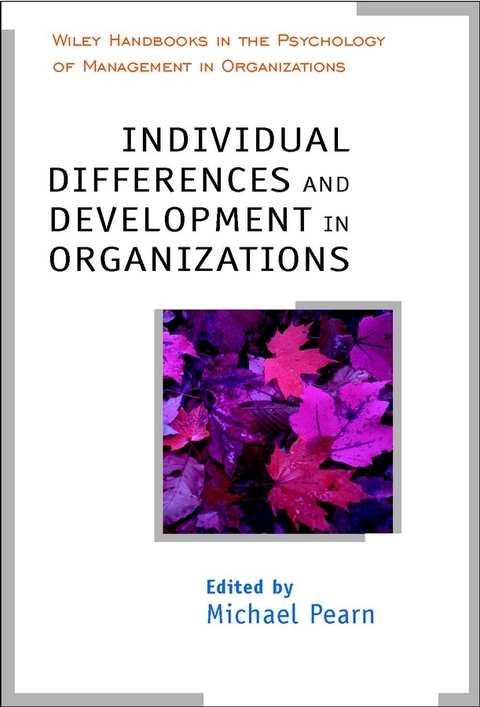
Individual Differences and Development in Organisations (eBook)
John Wiley & Sons (Verlag)
978-0-470-85656-7 (ISBN)
Organisations, of all kinds, are facing the challenge of rapidly advancing technologies, and ever-increasing levels of competition, both nationally and globally. They are also seeking to operate in an environment where the traditional relationships between employer and employee are rapidly changing.
Learning to harness the talents of everyone comprising an organisation is critical to sustainable organisational effectiveness. Successfully developing the talents of all members of an organization is, arguably, the only lasting source of competitive advantage.
This handbook provides a unique and authoritative review of relevant research, theoretical developments, and current best practice in the management of individual development.
Drawing on the expertise of both renowned academic specialists and leading practitioners, the book is designed to be a practical resource for the guidance and support of those whose role is to bring about the development of people at work.
- Authoritative reviews of relevant evaluation research, and best-practice descriptions of key assessment and development tools
- Editor with excellent psychological and consultancy knowledge, experience and contacts
- Written by International contributors within a strong conceptual structure
- Part of a new series - Wiley Handbooks in the Psychology of Management in Organizations
Michael Pearn, Senior Consultant, Saville & Holdsworth Ltd, 1981-1984; Founding Partner of Pearn Kandola, Occupational Psychologists, 1984, retired 1999; Fellow of BPS, The Institute for Personnel and Development, The Royal Society for Arts; Member of Board of Examiners in Occupational Psychology, The British Psychological Society, Executive Board, Trinity Institute for Management Education, Association for Management Education and Development, European Association of Work and Organisational Psychology Books authored: Job Analysis for Managers (1987), Learning Organisations in Practice (1995), Tools for a Learning Organisation (1995), Ending the Blame Culture (1998), Empowering Team Learning (1998).
Michael Pearn, Senior Consultant, Saville & Holdsworth Ltd, 1981-1984; Founding Partner of Pearn Kandola, Occupational Psychologists, 1984, retired 1999; Fellow of BPS, The Institute for Personnel and Development, The Royal Society for Arts; Member of Board of Examiners in Occupational Psychology, The British Psychological Society, Executive Board, Trinity Institute for Management Education, Association for Management Education and Development, European Association of Work and Organisational Psychology Books authored: Job Analysis for Managers (1987), Learning Organisations in Practice (1995), Tools for a Learning Organisation (1995), Ending the Blame Culture (1998), Empowering Team Learning (1998).
About the Editor.
About the Contributors.
Series Preface.
Preface.
Part I: Approaches, Concepts and Theory.
Learning Theory and the Construction of Self: What Kinds of People
Do We Create through the Theories of Learning that We Apply to
Their Development (J. Burgoyne).
Who Am I? Self-development in Organisations (M. Lee).
Cognitive Science and Individual Development (J. Henry).
Individual Differences Can Both Facilitate and Limit Individual
Development (K. Murphy).
Part II: Individual Differences.
Old and New Models of Cognitive Abilities: the Assessment Conundrum
(B. Torff and E. Warburton).
Personality, Style Preference and Individual Development (A.
Furnham).
To Use Competencies or Not to Use Competencies? That Is the
Question (P. Sparrow).
Emotional Intelligence and the Development of Managers and Leaders
(V. Dulewicz and M. Higgs).
Part III: Assessment Tools and Processes.
Assessing Individual Development Needs (K. Van Dam).
Individual Asessement as a Integrated Tool in a Systematic
Management Process (J. Iten).
Development Centres: a Neglected Perspective (J. Zaal).
Part IV: Development Methods and Processes.
Choosing a Development Method (A. Mumford).
Team-working and the Implications for Individual Development (R.
Mottram).
Informal and Incidental Learning in the New Millennium: the
Challenge of Being Rapid and/or Being Accurate! (V. Marsick, K.
Watkins and J. Wilson).
Individual Development and Self-management Learning (I.
Cunningham).
Using Social Networks in Organisations to Facilitate Learning (R.
Poell and F. Van der Krogt).
Online Networking and Individual Development (G. Salmon).
Part V: Organisational Context.
Developing Individuals for Leadership Roles (C. McCauley).
Developing Innovations in Organisations (N. King).
Diversity and Individual Development (R. Kandola and S.
Kartara).
Author Index.
Subject Index.
| Erscheint lt. Verlag | 13.6.2003 |
|---|---|
| Reihe/Serie | Wiley Handbooks in Work & Organizational Psychology | Wiley Handbooks in Work & Organizational Psychology |
| Sprache | englisch |
| Themenwelt | Geisteswissenschaften ► Psychologie |
| Medizin / Pharmazie ► Medizinische Fachgebiete ► Psychiatrie / Psychotherapie | |
| Sozialwissenschaften ► Pädagogik | |
| Wirtschaft ► Betriebswirtschaft / Management ► Personalwesen | |
| Wirtschaft ► Betriebswirtschaft / Management ► Planung / Organisation | |
| Schlagworte | advantage • Business & Management • challenges • Competition • Competitive • Consultants • differences • Effectiveness • Environment • Human Resource Management • Individual • Key • levels • Members • organisations • Organizational & Industrial Psychology • Personalmanagement • Psychologie • Psychologie i. d. Arbeitswelt • Psychology • rapidly • Research • Review • sustain • Talents • Time • Twin • wideranging • Wirtschaft u. Management |
| ISBN-10 | 0-470-85656-4 / 0470856564 |
| ISBN-13 | 978-0-470-85656-7 / 9780470856567 |
| Informationen gemäß Produktsicherheitsverordnung (GPSR) | |
| Haben Sie eine Frage zum Produkt? |
 PDF (Adobe DRM)
Kopierschutz: Adobe-DRM
Adobe-DRM ist ein Kopierschutz, der das eBook vor Mißbrauch schützen soll. Dabei wird das eBook bereits beim Download auf Ihre persönliche Adobe-ID autorisiert. Lesen können Sie das eBook dann nur auf den Geräten, welche ebenfalls auf Ihre Adobe-ID registriert sind.
Details zum Adobe-DRM
Dateiformat: PDF (Portable Document Format)
Mit einem festen Seitenlayout eignet sich die PDF besonders für Fachbücher mit Spalten, Tabellen und Abbildungen. Eine PDF kann auf fast allen Geräten angezeigt werden, ist aber für kleine Displays (Smartphone, eReader) nur eingeschränkt geeignet.
Systemvoraussetzungen:
PC/Mac: Mit einem PC oder Mac können Sie dieses eBook lesen. Sie benötigen eine
eReader: Dieses eBook kann mit (fast) allen eBook-Readern gelesen werden. Mit dem amazon-Kindle ist es aber nicht kompatibel.
Smartphone/Tablet: Egal ob Apple oder Android, dieses eBook können Sie lesen. Sie benötigen eine
Geräteliste und zusätzliche Hinweise
Buying eBooks from abroad
For tax law reasons we can sell eBooks just within Germany and Switzerland. Regrettably we cannot fulfill eBook-orders from other countries.
aus dem Bereich