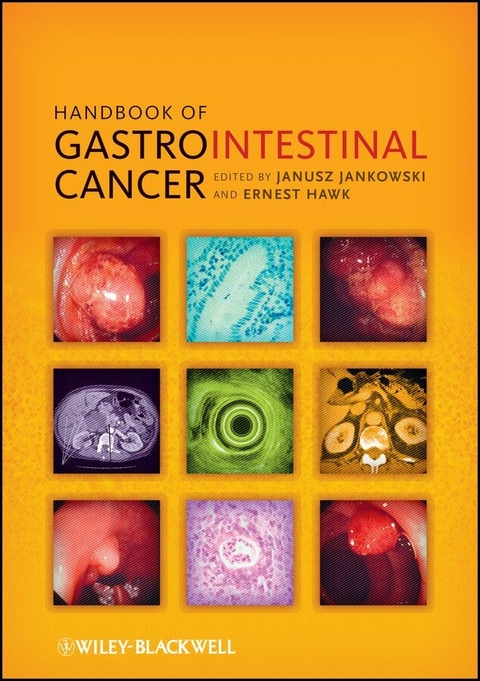
Handbook of Gastrointestinal Cancer (eBook)
John Wiley & Sons (Verlag)
978-1-118-42337-0 (ISBN)

Do you need a rapid reference handbook to guide you through your diagnosis and management options?
If so, then Handbook of Gastrointestinal Cancer is the book for you, providing clear, practical guidance to the diagnosis and clinical management of all forms of GI cancer, in a highly accessible format. Perfect for GI/Oncology trainees and junior gastroenterologists/oncologists and designed for point-of-care consultation, each chapter is structured in a uniform way and contains a variety of handy text features to help the reader such as case histories, key practice points, key weblinks and potential pitfalls
The authors emphasize the best clinical assessment and management methods of patients and dedicate an entire chapter to each cancer, from esophageal to lower GI, and from biliary to pancreatic cancer.
This attractive new book features:
- Comprehensive yet quick and easy display of key points
- Case studies to illustrate cardinal lessons or dilemmas
- A fully integrated GI/oncologic approach
- An outstanding and international editor and author team of great experience
- Illustrations of key clinical or investigative features
Handbook of Gastrointestinal Cancer answers all your clinical needs and is a must-have tool on the ward for all trainee and junior gastroenterologists and oncologists.
'Handbook of GI Cancer ... does an excellent job of indicating which clinical recommendations are solidly evidence-based, and highlighting those that would benefit from further research.'
-Monica M. Bertagnolli, MD, Chief, Division of Surgical Oncology, Dana Farber/Brigham and Women's Cancer Center, Boston, USA
'Handbook of Gastrointestinal Cancer is a comprehensive text that should be on the bookshelf of every physician and surgeon who deals with GI malignancies. The editors, who are internationally renowned, have assembled an all-star cast of contributing authors from around the world. The inclusion of key points and case studies, and the use of an evidence-based approach, make this a stand-out reference.'
-Mark K. Ferguson, MD,Professor, Department of Surgery and The Cancer Research Center, The University of Chicago Medicine & Biological Sciences, Chicago, USA
Janusz Jankowski, Sir James Black Professor Centre for Digestive Diseases, Queen Mary University of London, UK
Ernest Hawk, Vice President and Head, Division of Cancer Prevention & Population Sciences, and Boone Pickens Distinguished Chair for Early Prevention of Cancer, The University of Texas MD Anderson Cancer Center, USA
Do you manage patients with gastrointestinal cancer?Do you need a rapid reference handbook to guide you through your diagnosis and management options? If so, then Handbook of Gastrointestinal Cancer is the book for you, providing clear, practical guidance to the diagnosis and clinical management of all forms of GI cancer, in a highly accessible format. Perfect for GI/Oncology trainees and junior gastroenterologists/oncologists and designed for point-of-care consultation, each chapter is structured in a uniform way and contains a variety of handy text features to help the reader such as case histories, key practice points, key weblinks and potential pitfalls The authors emphasize the best clinical assessment and management methods of patients and dedicate an entire chapter to each cancer, from esophageal to lower GI, and from biliary to pancreatic cancer. This attractive new book features: Comprehensive yet quick and easy display of key points Case studies to illustrate cardinal lessons or dilemmas A fully integrated GI/oncologic approach An outstanding and international editor and author team of great experience Illustrations of key clinical or investigative features Handbook of Gastrointestinal Cancer answers all your clinical needs and is a must-have tool on the ward for all trainee and junior gastroenterologists and oncologists. "e;Handbook of GI Cancer ... does an excellent job of indicating which clinical recommendations are solidly evidence-based, and highlighting those that would benefit from further research."e; Monica M. Bertagnolli, MD, Chief, Division of Surgical Oncology, Dana Farber/Brigham and Women's Cancer Center, Boston, USA "e;Handbook of Gastrointestinal Cancer is a comprehensive text that should be on the bookshelf of every physician and surgeon who deals with GI malignancies. The editors, who are internationally renowned, have assembled an all-star cast of contributing authors from around the world. The inclusion of key points and case studies, and the use of an evidence-based approach, make this a stand-out reference."e; Mark K. Ferguson, MD,Professor, Department of Surgery and The Cancer Research Center, The University of Chicago Medicine & Biological Sciences, Chicago, USA
Janusz Jankowski, Sir James Black Professor Centre for Digestive Diseases, Queen Mary University of London, UK Ernest Hawk, Vice President and Head, Division of Cancer Prevention & Population Sciences, and Boone Pickens Distinguished Chair for Early Prevention of Cancer, The University of Texas MD Anderson Cancer Center, USA
Handbook of Gastrointestinal Cancer 3
Contents 7
List of Contributors 8
1 Esophageal Squamous Cell Carcinoma 13
Epidemiology 14
Diagnosis 16
Staging 20
Prognostication 21
Prevention 23
Cancer management 26
Family screening 33
References 35
2 Esophageal Adenocarcinoma 37
Screening for Barrett’s esophagus and esophagus cancer 38
GERD symptoms 40
Hiatal hernia, reflux esophagitis, Barrett’s esophagus and esophageal adenocarcinoma 40
Esophageal squamous cell carcinoma 42
Staging 44
Pathological features 44
Patient factors 45
Future 45
Barrett’s esophagus with high-grade dysplasia and early esophageal adenocarcinoma (T1m) 46
Esophageal adenocarcinoma 46
References 48
3 Gastric Cancer 53
Epidemiology 54
Diagnosis 55
Prevention 60
Cancer management 62
Resectable gastric cancer 62
Surgery 62
Perioperative chemotherapy 63
Adjuvant chemoradiotherapy 64
Adjuvant chemotherapy 64
Locally advanced and metastatic gastric cancer 65
Surgery 66
Radiotherapy 66
First-line chemotherapy 66
Targeted agents 68
Second-line chemotherapy 69
Family screening 69
Key patient consent issues 70
Acknowledgments 70
References 73
4 Small Intestinal Cancers 79
Epidemiology 80
Adenocarcinoma of the small bowel 80
Risk factors 81
Neuroendocrine tumors 82
Lymphomas 83
Sarcomas 84
Gastrointestinal stromal tumors 85
Clinical features 85
Diagnosis 85
Imaging modalities 86
Cancer management 88
Carcinoid tumors 89
Lymphoma 89
GIST and sarcoma 89
Prognosis 90
Prevention 90
Conclusions 91
References 91
5 Colorectal Cancer 98
Introduction 99
Incidence 100
Mortality 100
Research funding 100
Cancer distribution 101
Molecular types 102
Nonmodifiable risk factors 102
Genetic patterns of CRC 103
FAP 103
HNPCC/lynch syndrome 103
Amsterdam criteria II for diagnosis of HNPCC 104
MYH-associated polyposis 104
Peutz–Jeghers syndrome 104
Juvenile polyposis syndrome 104
Inflammatory bowel disease 104
Metabolic environment and neoangiogenesis 105
Epithelial–mesenchymal transition 105
Histological variants of colorectal cancer 108
Physical 110
Digital rectal exam 110
Imaging 111
X-ray 111
CT 113
MRI 114
EUS 114
Indications for EUS in rectal cancer 114
Potential impact of EUS staging on rectal cancer management 114
FDG-PET 114
Procedures 116
Sentinel node mapping 116
Medical therapy 117
The concept of personalized therapy 123
Proposed single agent treatment markers 123
AJCC7 recommendations 126
Metastatic disease 128
Prognostic factors 128
Colonoscopy 129
CEA 130
CT 130
Recent issues 131
Quality-of-life issues 132
Consent issues 132
Awareness 132
Acknowledgments 135
References 135
6 Anal Cancer 149
Epidemiology 150
Diagnosis 152
Prevention 154
Cancer management 154
Perianal skin tumors 154
Anal canal adenocarcinoma 155
Anal canal melanomas 155
Anal canal squamous cell cancer 156
References 166
7 Primary Hepatic Cancer 173
Epidemiology 174
Diagnosis 175
Clinical features 175
Imaging studies 176
Biopsy 176
Serology 177
Surveillance 177
Prognosis and staging 179
Cancer management 181
Surgery 181
Liver transplantation 182
Percutaneous ablation 183
Transarterial embolization 183
Molecular therapy 184
Prevention 185
References 189
8 Pancreatic and Biliary Cancer 194
Pancreatic cancer 194
Epidemiology 194
Histology of pancreatic tumors 195
Molecular biology of pancreatic carcinomas 195
Adenocarcinoma of the pancreas 196
Risk factors and prevention 196
Presentation and diagnosis 197
Cancer management 198
Neoadjuvant and adjuvant treatment of pancreatic cancer 200
Cystic tumors of the pancreas 201
Intraductal papillary mucinous neoplasms 201
Mucinous cystic neoplasms 202
Endocrine carcinomas of the pancreas 203
Presentation 203
Investigations 203
Treatment 204
Biliary cancer 204
Epidemiology 204
Histology of bile duct tumors 204
Risk factors and prevention 205
Presentation and diagnosis 206
Cancer management 207
Gallbladder carcinoma 209
Epidemiology 209
Risk factors and prevention 209
Presentation and diagnosis 209
Cancer management 209
Neoadjuvant and adjuvant treatment of gallbladder cancer 210
References 213
9 Gastrointestinal Endocrine Cancer 223
Epidemiology 223
Diagnosis 224
Blood and urine investigations 226
Radiology and endoscopy 228
Nuclear medicine imaging 228
Pathology 230
Prevention 230
Cancer management 230
General objectives 230
Surgery 231
Biotherapy 235
Embolization and ablative methods 238
Emerging therapies 239
Surveillance 239
Family screening 240
References 245
10 Gastrointestinal Lymphoma 251
Introduction 252
Extranodal marginal zone lymphoma of mucosa-associated lymphoid tissue 255
Epidemiology 255
Diagnosis and staging 255
Treatment 258
Immunoproliferative small intestinal disease 261
Enteropathy-associated T-cell lymphoma 261
Epidemiology 261
Diagnosis and staging 262
Treatment 264
Diffuse large B-cell lymphoma 265
Epidemiology 265
Diagnosis and staging 266
Treatment 268
Other lymphoma subtypes involving the GI tract 268
Burkitt lymphoma 269
Mantle cell lymphoma (lymphomatous polyposis) 270
Follicular lymphoma 271
Acknowledgments 272
References 272
Index 281
"Fellows in gastroenterology, oncology, and radiotherapy
looking to quickly refresh or update their understanding of a
specific form of gastrointestinal cancer will find this book
helpful. As such, this handbook would be a useful addition to every
departmental and institutional library."
(Gastroenterology, 20 September 2013)
| Erscheint lt. Verlag | 9.10.2012 |
|---|---|
| Sprache | englisch |
| Themenwelt | Medizin / Pharmazie ► Allgemeines / Lexika |
| Medizinische Fachgebiete ► Innere Medizin ► Gastroenterologie | |
| Medizin / Pharmazie ► Medizinische Fachgebiete ► Onkologie | |
| Schlagworte | accessible • Book • Cancer • Clinical • Diagnosis • features • Format • forms • Gastroenterologie u. Hepatologie • Gastroenterology & Hepatology • gastrointestinal • Gastrointestinaler Krebs • Gastrointestinal surgery • GI • Handbook • highly • Magen-Darm-Chirurgie • Medical Science • Medizin • Oncology & Radiotherapy • Onkologie • Onkologie u. Strahlentherapie • patients • perfect • pointofcare • Practical • Rapid • Reader • reference handbook • Uniform |
| ISBN-10 | 1-118-42337-2 / 1118423372 |
| ISBN-13 | 978-1-118-42337-0 / 9781118423370 |
| Informationen gemäß Produktsicherheitsverordnung (GPSR) | |
| Haben Sie eine Frage zum Produkt? |
 PDF (Adobe DRM)
Kopierschutz: Adobe-DRM
Adobe-DRM ist ein Kopierschutz, der das eBook vor Mißbrauch schützen soll. Dabei wird das eBook bereits beim Download auf Ihre persönliche Adobe-ID autorisiert. Lesen können Sie das eBook dann nur auf den Geräten, welche ebenfalls auf Ihre Adobe-ID registriert sind.
Details zum Adobe-DRM
Dateiformat: PDF (Portable Document Format)
Mit einem festen Seitenlayout eignet sich die PDF besonders für Fachbücher mit Spalten, Tabellen und Abbildungen. Eine PDF kann auf fast allen Geräten angezeigt werden, ist aber für kleine Displays (Smartphone, eReader) nur eingeschränkt geeignet.
Systemvoraussetzungen:
PC/Mac: Mit einem PC oder Mac können Sie dieses eBook lesen. Sie benötigen eine
eReader: Dieses eBook kann mit (fast) allen eBook-Readern gelesen werden. Mit dem amazon-Kindle ist es aber nicht kompatibel.
Smartphone/Tablet: Egal ob Apple oder Android, dieses eBook können Sie lesen. Sie benötigen eine
Geräteliste und zusätzliche Hinweise
Buying eBooks from abroad
For tax law reasons we can sell eBooks just within Germany and Switzerland. Regrettably we cannot fulfill eBook-orders from other countries.
aus dem Bereich