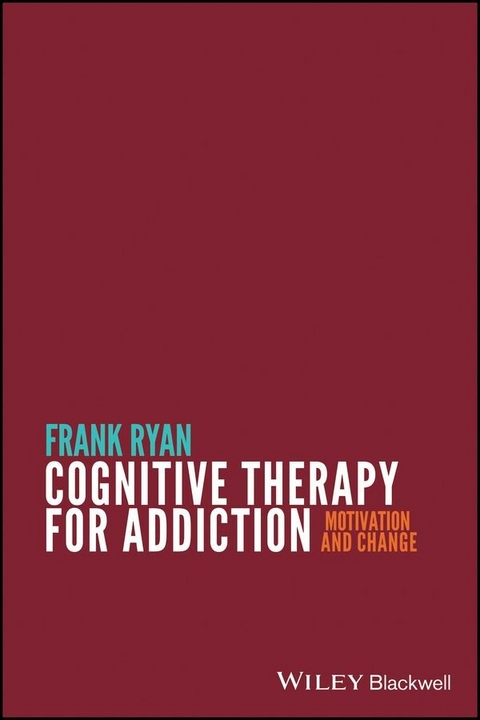
Cognitive Therapy for Addiction (eBook)
John Wiley & Sons (Verlag)
978-1-118-31655-9 (ISBN)
- Offers a focus on addiction that is lacking in existing cognitive therapy accounts
- Utilizes various approaches, including mindfulness, 12-step facilitation, cognitive bias modification, motivational enhancement and goal-setting and, to combat common road blocks on the road to addiction recovery
- Uses neuroscientific findings to explain how willpower becomes compromised-and how it can be effectively utilized in the clinical arena
Frank Ryan is a consultant clinical psychologist in Camden and Islington NHS Foundation Trust in London, UK. An Honorary Senior Lecturer in Faculty of Medicine at Imperial College and an Honorary Research Fellow at Birkbeck, University of London, he is a practicing cognitive therapist and an active trainer, lecturer and researcher.
Frank Ryan is a consultant clinical psychologist in Camden and Islington NHS Foundation Trust in London, UK. An Honorary Senior Lecturer in the Faculty of Medicine at Imperial College and an Honorary Research Fellow at Birkbeck, University of London, he is a practicing cognitive therapist and an active trainer, lecturer and researcher.
"Nevertheless, I would recommend this book to practitioners in the alcohol and other drugs, and gambling treatment field, and to postgraduate students in health sciences." (Drug And Alcohol Review, 1 May 2015
"It is refreshing to read a book of quality that is not only relevant to the UK but is also authored by a UK clinical practitioner." (DrugLink, 1 September 2013)
"There has been much growth in forms of therapy to treat
addiction in recent years. In this book, Frank Ryan has done a
truly excellent job of demonstrating the enormous value of
cognitive therapy as an effective treatment for addiction. It is a
tour de force."--Michael Eysenck, Emeritus Professor
of Psychology,Royal Holloway, London
"Frank Ryan's Cognitive Therapy for Addiction
makes a unique contribution to the field of treatment for addictive
disorders. The book includes a comprehensive, up-to-date
review of the latest research on cognitive-motivational principles
and goes on to show how these principles can be applied to the
treatment of addictive disorders. Dr Ryan illustrates these
principles through case examples drawn from his own extensive
clinical practice. He has a unique way of bringing hard
science to life, showing how practitioners can apply
cognitive-motivational principles in order to help real clients
overcome their entrenched, maladaptive patterns of substance
misuse."--W. Miles Cox, Professor of Psychology of
Addictive Behaviours, School of Psychology, Bangor
University
"Frank Ryan is in a unique position to bridge the exciting
new findings in research on cognitive bias modification in
addiction and cognitive therapy for addiction, because he has been
active as a researcher and as a clinician. He writes in an
enthusiastic and clear manner about both too separate worlds and
provides the highly needed integration."--Reinout W.
Wiers, Ph.D., Professor of Developmental Psychopathology,
University of Amsterdam
Chapter 2
Existing Cognitive Behavioural Accounts of Addiction and Substance Misuse
Cognitive behavioural approaches to addictive behaviours are grounded in cognitive and social learning approaches. Predictably, definitive features include an emphasis on functional analysis of addictive behaviour. This provides a framework for more sharply focused therapeutic intervention use. The so-called ‘ABC’ convention specifies the antecedents, behaviour and consequences of a given sequence of addictive behaviour. For example, a client recently described how he resumed drinking after having remained abstinent from alcohol for 10 weeks. The antecedents were an argument with his partner that led to him become angry and the thought ‘She doesn't know how hard it's been’. The behaviour was buying 10 cans of lager and drinking them. The consequences were intoxication, apparently unaccompanied by any feeling of pleasure, feeling ill and experiencing high levels of guilt and remorse. A further definitive feature is the emphasis on teaching coping skills in an effort to forestall the default response of drug seeking and drug taking. The functional analysis thus enables the individual to recognize the situations or emotional states in which he or she is most vulnerable to substance use. The influential ‘Relapse Prevention Skills Training’ model (Marlatt and Gordon, 1985) and allied accounts (e.g. Annis and Davis, 1988) thus aim to tackle addiction by equipping the addicted person with a range of cognitive and behavioural coping skills to deploy when in these so-called ‘high-risk situations’. The experienced clinician tends to focus on situations previously associated with lapsing, viewed as a short-term reversal of restraint, or relapsing, characterized as a return to pre-treatment levels of the problem behaviour. Marlatt and Gordon categorized the determinants of high-risk situations as intrapersonal, such as positive or negative emotions or urges, and interpersonal, such as conflict or social pressure. A re-conceptualization of the Marlatt and Gordon (1985) model (Witkiewitz and Marlatt, 2004) characterized relapse as a dynamic or multi-factorial process that is inherently difficult to predict, and hence prevent.
Beck et al. (1993) proposed a cognitive developmental model of addiction derived from extant accounts of emotional disorders such as depression and anxiety. Accordingly, susceptible individuals' core beliefs about substances and their effects are formed in response to critical life experiences. Thus, alcohol could be used initially to combat aversive emotional states linked to negative core beliefs about self, world or others (see Figure 2.1). In the event of a critical incident, essentially a type of high-risk situation, these beliefs are reactivated and generate automatic thoughts that trigger urges that enable acquisitive behaviour. For example, a core belief such as ‘I am not a likeable person’ could become associated with the belief ‘I am more likeable when I drink alcohol’. In a given critical incident, automatic thoughts such as ‘I need a drink’ or ‘I can't socialize without a drink’ can influence behaviour.
Figure 2.1 A cognitive developmental model of addiction.
The Evidential Basis of CBT for Addiction
CBT has brought key mechanisms of addiction into much sharper focus. This has allowed for the development of more precise therapeutic interventions that target aspects of the dynamic interaction between person, situation and appetitive impulse. The present text is a consolidation or evolution of CBT theory and practice. One of the strengths of CBT approach is its capacity to accommodate innovations. The formulation-based approach is crucial in this regard, as it enables the deployment of novel techniques to target psychological processes. The development of mindfulness-based cognitive therapy (MBCT), for example, illustrates this ethos. Mindfulness-based meditation comes from a very different tradition to that of CBT but has demonstrably brought added value to certain clinical populations such as those with chronic depression and high propensity to relapse (Segal et al., 2002). As yet, mindfulness protocols have rarely been subjected to the rigours of controlled clinical trials with addicted populations. An exception to this is a single-site randomized controlled trial of mindfulness training for people trying to give up smoking. Brewer et al. (2011) found a greater point prevalence abstinence rate at the end of 17-week follow-up (31% versus 6%, p = 0.012) among a group of smokers were taught mindfulness compared with those who received a standard package of care.
Meta-analytic Findings
First, consider the findings of clinical trials reflected in meta-analytic studies. Dutra et al. (2008), for example, found cognitive behavioural therapy alone and relapse prevention produced low to moderate effect sizes (Cohen's d = 0.28 and 0.32) respectively. This contrasts unfavourably with median effect sizes of d = 0.8 and 0.9 observed with panic disorder and generalized disorder respectively, although an effect size of 0.3 was noted with depression (Westen and Morrison, 2001), based on data from 34 studies. This rather mixed message receives support from an earlier review. Irwin et al. (1999) found in their meta-analysis of 26 comparative treatment studies involving 9504 participants that the overall treatment effect of group-based relapse-prevention interventions for substance misuse was indeed small (r = 0.14), but statistically reliable. This modest figure reflects the relatively greater response on the part of individuals recruited to studies investigating alcohol dependence but disguises the negligible effect size noted with, for example, cocaine or nicotine addiction. However, the effect of relapse prevention on improving overall psychosocial adjustment was significantly larger (r = 0.48).
Behavioural Approaches
Specific behavioural techniques such as contingency management, based on operant conditioning, appear to deliver greater effect sizes than observed with broader CBT approaches. Variants of this approach include Behavioural Couples Therapy (O'Farrell and Fals-Stewart, 2006) and Social Behaviour Network Therapy (Copello et al., 2006). They share an emphasis on reinforcing abstinence or adherence to the treatment goal by using either social or monetary reinforcements or combination of both. Clearly, these exemplify effective behaviour modification. From a cognitive control perspective, behavioural approaches that alter contingencies also directly influence the contents of working memory. The systematic and repetitious nature of reinforcement approaches is in effect a form of rehearsal or goal maintenance. From the model depicted in Figure 2.2, it is clear that whatever occupies the ‘high ground’ of working memory or executive control can exert influence over the surrounding cognitive terrain. Hypothetically, the maintenance and rehearsal of a clear behavioural goal should influence top-down processes such as the allocation of attentional resources. Moreover, by occupying a system that has limited capacity, these recovery orientated goals can reduce the likelihood of the working memory system defaulting to appetitive goals. These variants are limited to some extent, because they require the active participation of a non-substance-misusing partner or the cooperation of others in the addicted person's social network. A recent review of treatments using contingency management alone (Prendergast et al., 2006) indicated moderate–high effect sizes (d = 0.42). Contingency management appeared more effective in treating opiate use (d = 0.65) and cocaine use (d = 0.66) compared with tobacco (d = 0.31) or polydrug misuse (d = 0.42).
Figure 2.2 Two routes to addictive behaviour: a fast route triggered by preferential detection of potential drug cues; a slow route reliant on reflective or conscious deliberation.
Calibrating and comparing effect sizes calculated using different statistical analyses has its limitations. The data quoted here nonetheless illustrate that treatment effect sizes tend to be smaller and more varied with addictive disorders than with emotional disorders such as anxiety and depression. These meta-analytic findings appear to be telling us two things about responding therapeutically to addiction and coexisting mental health problems. On a positive note, we can advise our clients with concomitant panic disorder or generalized anxiety disorder that treatment can be very effective, and people with depression will also benefit to a significant degree. This will contribute to overcoming addictive impulses insofar as negative affect can be a powerful motivator. Second, and perhaps less positively, we would have to inform our clients that their addictive behaviour might prove more resistant to treatment, and will therefore require more intervention, probably over a longer timeframe. An important exception to this is that contingency management can change addictive behaviour, at least in the short term. Overall, however, this pattern of results suggests key mechanisms of change are being overlooked in conventional cognitive therapy applications.
Diverse Treatments Mostly Deliver Equivalent Outcomes
Findings from clinical outcome studies indicate...
| Erscheint lt. Verlag | 27.12.2012 |
|---|---|
| Sprache | englisch |
| Themenwelt | Geisteswissenschaften ► Psychologie ► Klinische Psychologie |
| Medizin / Pharmazie ► Medizinische Fachgebiete ► Psychiatrie / Psychotherapie | |
| Medizin / Pharmazie ► Medizinische Fachgebiete ► Suchtkrankheiten | |
| Schlagworte | addiction • Behaviour • behavioural • Clinical • Clinical psychology • Cognitive • Cognitive behavioral therapy (CBT) • Control • elegant • engagement manage • enhance • Framework • Frank • Klinische Psychologie • Kognitive Verhaltenstherapie • Motivational • prevention • Programme • Psychologie • Psychology • Ryan • Selfregulation • Simple • Specialist • stage • Strategies • Theoretical • Treatment |
| ISBN-10 | 1-118-31655-X / 111831655X |
| ISBN-13 | 978-1-118-31655-9 / 9781118316559 |
| Informationen gemäß Produktsicherheitsverordnung (GPSR) | |
| Haben Sie eine Frage zum Produkt? |
 EPUB (Adobe DRM)
Kopierschutz: Adobe-DRM
Adobe-DRM ist ein Kopierschutz, der das eBook vor Mißbrauch schützen soll. Dabei wird das eBook bereits beim Download auf Ihre persönliche Adobe-ID autorisiert. Lesen können Sie das eBook dann nur auf den Geräten, welche ebenfalls auf Ihre Adobe-ID registriert sind.
Details zum Adobe-DRM
Dateiformat: EPUB (Electronic Publication)
EPUB ist ein offener Standard für eBooks und eignet sich besonders zur Darstellung von Belletristik und Sachbüchern. Der Fließtext wird dynamisch an die Display- und Schriftgröße angepasst. Auch für mobile Lesegeräte ist EPUB daher gut geeignet.
Systemvoraussetzungen:
PC/Mac: Mit einem PC oder Mac können Sie dieses eBook lesen. Sie benötigen eine
eReader: Dieses eBook kann mit (fast) allen eBook-Readern gelesen werden. Mit dem amazon-Kindle ist es aber nicht kompatibel.
Smartphone/Tablet: Egal ob Apple oder Android, dieses eBook können Sie lesen. Sie benötigen eine
Geräteliste und zusätzliche Hinweise
Buying eBooks from abroad
For tax law reasons we can sell eBooks just within Germany and Switzerland. Regrettably we cannot fulfill eBook-orders from other countries.
aus dem Bereich