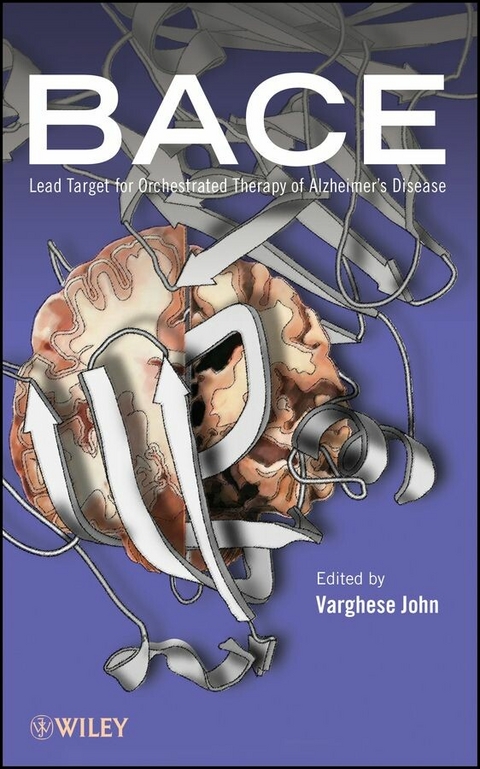
BACE (eBook)
John Wiley & Sons (Verlag)
978-0-470-59407-0 (ISBN)
BACE (β-site of APP cleaving enzyme) is a critical component in Alzheimer's Disease (AD), and the development of BACE inhibitors shows great potential as a therapy for the disease. BACE: Lead Target for Orchestrated Therapy of Alzheimer's Disease covers virtually all aspects of BACE from initial identification, discovery of inhibitors, and challenges in clinical development, while providing a global understanding essential for productive and successful drug discovery.
This book details the story of the discovery of BACE and its role in AD and comprehensively discusses:
The development of BACE inhibitors as therapeutics for Alzheimer's disease
The research that led to the identification of BACE
New BACE inhibitors currently being clinically tested
ADME (absorption, distribution, metabolism, excretion) and clinical trial design—topics not addressed in current field literature
Cutting-edge technology such as high-throughput screening, structure-based drug design, and QSAR in context of BACE inhibitors and Alzheimer's drug discovery
Other approaches to BACE inhibition based on interaction with the precursor protein APP
By enhancing the reader's understanding of the various aspects of the BACE drug-discovery process, this much-needed reference will serve as a key resource for all scientists involved in Alzheimer's research—and inspire new approaches to treatment of AD.
VARGHESE JOHN is Director of Alzheimer's Drug Discovery at the Buck Institute for Age Research. He is a chemist with many years of pharmaceutical industry experience in discovery and development of drugs for CNS diseases with a primary focus on Alzheimer's disease (AD). Dr. John has many publications and patents to his credit.
BACE inhibitors and their use in the treatment of Alzheimer's Disease BACE ( -site of APP cleaving enzyme) is a critical component in Alzheimer's Disease (AD), and the development of BACE inhibitors shows great potential as a therapy for the disease. BACE: Lead Target for Orchestrated Therapy of Alzheimer's Disease covers virtually all aspects of BACE from initial identification, discovery of inhibitors, and challenges in clinical development, while providing a global understanding essential for productive and successful drug discovery. This book details the story of the discovery of BACE and its role in AD and comprehensively discusses: The development of BACE inhibitors as therapeutics for Alzheimer's disease The research that led to the identification of BACE New BACE inhibitors currently being clinically tested ADME (absorption, distribution, metabolism, excretion) and clinical trial design topics not addressed in current field literature Cutting-edge technology such as high-throughput screening, structure-based drug design, and QSAR in context of BACE inhibitors and Alzheimer's drug discovery Other approaches to BACE inhibition based on interaction with the precursor protein APP By enhancing the reader's understanding of the various aspects of the BACE drug-discovery process, this much-needed reference will serve as a key resource for all scientists involved in Alzheimer's research and inspire new approaches to treatment of AD.
VARGHESE JOHN is Director of Alzheimer's Drug Discovery at the Buck Institute for Age Research. He is a chemist with many years of pharmaceutical industry experience in discovery and development of drugs for CNS diseases with a primary focus on Alzheimer's disease (AD). Dr. John has many publications and patents to his credit.
BACE 3
CONTENTS 9
PREFACE 13
ACKNOWLEDGMENTS 15
CONTRIBUTORS 17
CHAPTER 1 BACE, APP PROCESSING, AND SIGNAL TRANSDUCTION IN ALZHEIMER’S DISEASE 19
1.1 Introduction 19
1.2 BACE Cleavage of APP as a Molecular Switching Mechanism 20
1.3 AD: An Imbalance in Cellular Dependence? 21
1.4 BACE Cleavage, Caspase Cleavage, and Neuronal Trophic Dependence 22
1.5 BACE Cleavage of APP, Dependence Receptors, and Alzheimer Pathology 23
1.6 Key Mutations Proximal of APP Processing to A? 27
1.7 Final Remarks 28
CHAPTER 2 IDENTIFICATION OF BACE AS A TARGET IN ALZHEIMER’S DISEASE 33
2.1 Introduction 33
2.2 The Search for ?-Secretase 35
2.3 Validation of the BACE Target 45
2.4 Final Remarks 46
CHAPTER 3 BACE BIOLOGICAL ASSAYS 53
3.1 Introduction 53
3.2 Clinical and Physiological Hallmarks of Alzheimer’s Disease (AD) 54
3.3 APP Processing 54
3.4 Aspartyl Protease Classification 55
3.5 BACE Structure 56
3.6 Mechanism, Kinetics, Inhibition, and Specificity 57
3.7 Assay Strategies for Inhibitor Finding and Development 63
3.8 Common Assays Used to Identify and Study Inhibitors 66
3.9 BACE Assays 68
3.10 Final Remarks 72
CHAPTER 4 PEPTIDIC, PEPTIDOMIMETIC, AND HTS-DERIVED BACE INHIBITORS 77
4.1 Introduction 77
4.2 Elan/Pharmacia (Pfizer) 77
4.3 Oklahoma Medical Research Foundation (OMRF)/Multiple Collaborators 88
4.4 Eli Lilly 90
4.5 Merck 92
4.6 GlaxoSmithKline 98
4.7 Schering Plough 100
4.8 Bristol-Myers Squibb 103
4.9 Novartis 105
4.10 Amgen 106
4.11 Wyeth 108
4.12 Final Remarks 112
CHAPTER 5 FRAGMENT-BASED APPROACHES FOR IDENTIFICATION OF BACE INHIBITORS 125
5.1 Introduction 125
5.2 Biophysical Methods Applied to BACE Fragment Screens 126
5.3 BACE Inhibitors Identified by Fragment Screening 128
5.4 Final Remarks 137
CHAPTER 6 STRUCTURE-BASED DESIGN OF BACE INHIBITORS: TECHNICAL AND PRACTICAL ASPECTS OF PREPARATION, 3-DIMENSIONAL STRUCTURE, AND COMPUTATIONAL ANALYSIS 141
6.1 Introduction 141
6.2 Preparation of BACE for Structural Studies 144
6.3 Crystallographic Studies of BACE 148
6.4 Structural Studies with BACE Inhibitors: Peptidomimetics and Nonpeptidomimetics 153
6.5 Computational Approaches 163
6.6 Final Remarks 168
CHAPTER 7 PHARMACOLOGICAL MODELS FOR PRECLINICAL TESTING: FROM MOUSE TO DOG TO NONHUMAN PRIMATES 177
7.1 Introduction 177
7.2 BACE1 and Mouse Models of AD 179
7.3 Testing BACE Inhibitors in the Canine Model of Human Aging and AD 181
7.4 BACE Inhibitors and Nonhuman Primates 185
7.5 Final Remarks 186
CHAPTER 8 ADSORPTION, DISTRIBUTION, METABOLISM, EXCRETION (ADME), EFFICACY, AND TOXICOLOGY FOR BACE INHIBITORS 195
8.1 Introduction 195
8.2 Development of BACE Inhibitors with Optimized ADME Properties 198
8.3 In Vivo Efficacy of BACE Inhibitors 206
8.4 Toxicology of BACE Inhibitors 210
8.5 Final Remarks 211
CHAPTER 9 CLINICAL TRIALS FOR DISEASE-MODIFYING DRUGS SUCH AS BACE INHIBITORS 215
9.1 Introduction 215
9.2 Update on Beta-Amyloid Therapies in Clinical Development 216
9.3 Clinical Development of BACE Inhibitors and Other Disease-Modifying Drugs 221
9.4 Final Remarks 230
CHAPTER 10 FUTURE STRATEGIES FOR DEVELOPMENT OF NOVEL BACE INHIBITORS: ANTI-APP ?-SITE ANTIBODY AND APP BINDING SMALL MOLECULE APPROACHES FOR ALZHEIMER’S DISEASE 235
10.1 Introduction 235
10.2 ?-Secretase: Discovery, Function, and Inhibitors 236
10.3 Generation of A? Peptides via the Endocytic Pathway 238
10.4 Generation of Anti-APP ?-Site Antibodies 239
10.5 Antibody Interference with A? Production in Cellular Model 241
10.6 Antibody Interference with A? Production in Animal Models 244
10.7 Identification of APP Binding Small Molecules that Block ß-Site Cleavage of APP 246
10.8 Final Remarks 248
AFTERWORD 253
Introduction 253
Artwork as a Measure of the Progression of AD 254
INDEX 261
"Overall this book is a timely and comprehensive resource covering
developments in BACE-targeted therapeutic agents from infancy to
the present time. It will prove to be valuable to researchers
working in the AD field, as well as to medicinal chemists seeking
to learn more about rational design of aspartyl protease
inhibitors." (ChemMedChem, November 2010)
| Erscheint lt. Verlag | 5.3.2010 |
|---|---|
| Sprache | englisch |
| Themenwelt | Medizin / Pharmazie ► Medizinische Fachgebiete ► Geriatrie |
| Naturwissenschaften ► Chemie | |
| Schlagworte | Alzheimersche Krankheit • Alzheimer's drug discovery • Alzheimer's drugs • Alzheimer's research • Alzheimer's treatments • BACE • BACE inhibitors • BACE targets • beta secretase • Biowissenschaften • Chemie • Chemistry • Drug Discovery & Development • Life Sciences • Medical Science • Medizin • neurodegenerative diseases • Neuroscience • Neurowissenschaften • Pharmacology & Pharmaceutical Medicine • Pharmakologie u. Pharmazeutische Medizin • Wirkstoffforschung • Wirkstoffforschung u. -entwicklung |
| ISBN-10 | 0-470-59407-1 / 0470594071 |
| ISBN-13 | 978-0-470-59407-0 / 9780470594070 |
| Informationen gemäß Produktsicherheitsverordnung (GPSR) | |
| Haben Sie eine Frage zum Produkt? |
 PDF (Adobe DRM)
Kopierschutz: Adobe-DRM
Adobe-DRM ist ein Kopierschutz, der das eBook vor Mißbrauch schützen soll. Dabei wird das eBook bereits beim Download auf Ihre persönliche Adobe-ID autorisiert. Lesen können Sie das eBook dann nur auf den Geräten, welche ebenfalls auf Ihre Adobe-ID registriert sind.
Details zum Adobe-DRM
Dateiformat: PDF (Portable Document Format)
Mit einem festen Seitenlayout eignet sich die PDF besonders für Fachbücher mit Spalten, Tabellen und Abbildungen. Eine PDF kann auf fast allen Geräten angezeigt werden, ist aber für kleine Displays (Smartphone, eReader) nur eingeschränkt geeignet.
Systemvoraussetzungen:
PC/Mac: Mit einem PC oder Mac können Sie dieses eBook lesen. Sie benötigen eine
eReader: Dieses eBook kann mit (fast) allen eBook-Readern gelesen werden. Mit dem amazon-Kindle ist es aber nicht kompatibel.
Smartphone/Tablet: Egal ob Apple oder Android, dieses eBook können Sie lesen. Sie benötigen eine
Geräteliste und zusätzliche Hinweise
Buying eBooks from abroad
For tax law reasons we can sell eBooks just within Germany and Switzerland. Regrettably we cannot fulfill eBook-orders from other countries.
aus dem Bereich