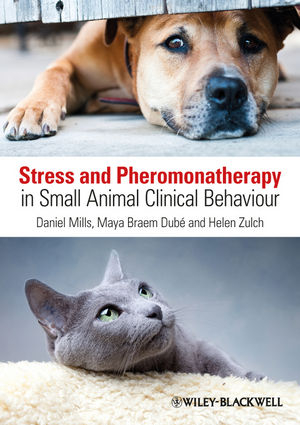
Stress and Pheromonatherapy in Small Animal Clinical Behaviour (eBook)
John Wiley & Sons (Verlag)
978-1-118-45881-5 (ISBN)
Stress and Pheromonatherapy in Small Animal Clinical Behaviour is about how stress impacts on animal behaviour and welfare and what we can do about it, especially by using chemical signals more effectively. This readily accessible text starts from first principles and is useful to both academics and practitioners alike. It offers a framework for understanding how pheromonatherapy can be used to encourage desirable behaviour in dogs and cats and also a fresh approach to understanding the nature of clinical animal behaviour problems.
The authors have pioneered the use of pheromone therapy within the field of clinical animal behaviour. As the culmination of many years of research and experience, they offer sound evidence-based advice on how and when pheromones can be used most effectively.
The first part of the book deals with some fundamental concepts, focusing on the key concepts of stress, communication and perception. It then provides a framework for the evaluation of problem behaviour to allow consideration of the possible role or not of pheromonatherapy. Part 2 covers the application of these concepts to a range of specific situations, concentrating on conditions in which there has been most research to support the efficacy of pheromonatherapy.
Suitable for veterinarians in small animal practice, students of clinical animal behaviour, veterinary nurses and technicians, as well as specialists and researchers in animal behaviour therapy.
Daniel Mills is Professor of Veterinary Behavioural Medicine at the University of Lincoln, UK and is a European and RCVS Recognised Specialist in Veterinary Behavioural Medicine. He offers a referral clinic for animals with behaviour problems, as well as providing consultancy to a range of organisations in the animal care and science industries. He has conducted extensive research in this field over the last 15 years and co-ordinates independent trials of potential new products in addition to developing his own initiatives which focus on improving behaviour while safeguarding welfare. He lectures internationally on companion animal behavioural medicine, as well as teaching the management of animal behaviour problems at both the University of Lincoln and Nottingham Vet School.
Dr. Maya Braem Dube is a veterinary behaviourist who completed her veterinary studies and a doctorate at the University of Bern, Switzerland. She did a post-doc with Professor Daniel Mills at the University of Lincoln where she was also a guest researcher and worked in the behaviour clinic. Since moving back to Switzerland in 2008, she has been working in her private practice for veterinary behaviour and herbal medicine in both the German and French parts of Switzerland and offers behaviour consultations at the Veterinary Hospital of the University of Zürich.
Helen Zulch is a veterinarian who worked in a number of areas of veterinary science before moving into the field of clinical animal behaviour over 10 years ago. She lectures on both undergraduate and postgraduate programmes at the University of Lincoln and contributes to the programme at Nottingham Vet School. In addition she consults in the Animal Behaviour Clinic at the University of Lincoln and is engaged in research in a number of areas within the discipline. Her chief interests include problem prevention, learning and training, olfaction and the integration of behaviour into the care of patients in general practice.
Stress and Pheromonatherapy in Small Animal Clinical Behaviour is about how stress impacts on animal behaviour and welfare and what we can do about it, especially by using chemical signals more effectively. This readily accessible text starts from first principles and is useful to both academics and practitioners alike. It offers a framework for understanding how pheromonatherapy can be used to encourage desirable behaviour in dogs and cats and also a fresh approach to understanding the nature of clinical animal behaviour problems. The authors have pioneered the use of pheromone therapy within the field of clinical animal behaviour. As the culmination of many years of research and experience, they offer sound evidence-based advice on how and when pheromones can be used most effectively. The first part of the book deals with some fundamental concepts, focusing on the key concepts of stress, communication and perception. It then provides a framework for the evaluation of problem behaviour to allow consideration of the possible role or not of pheromonatherapy. Part 2 covers the application of these concepts to a range of specific situations, concentrating on conditions in which there has been most research to support the efficacy of pheromonatherapy. Suitable for veterinarians in small animal practice, students of clinical animal behaviour, veterinary nurses and technicians, as well as specialists and researchers in animal behaviour therapy.
Daniel Mills is Professor of Veterinary Behavioural Medicine at the University of Lincoln, UK and is a European and RCVS Recognised Specialist in Veterinary Behavioural Medicine. He offers a referral clinic for animals with behaviour problems, as well as providing consultancy to a range of organisations in the animal care and science industries. He has conducted extensive research in this field over the last 15 years and co-ordinates independent trials of potential new products in addition to developing his own initiatives which focus on improving behaviour while safeguarding welfare. He lectures internationally on companion animal behavioural medicine, as well as teaching the management of animal behaviour problems at both the University of Lincoln and Nottingham Vet School. Dr. Maya Braem Dube is a veterinary behaviourist who completed her veterinary studies and a doctorate at the University of Bern, Switzerland. She did a post-doc with Professor Daniel Mills at the University of Lincoln where she was also a guest researcher and worked in the behaviour clinic. Since moving back to Switzerland in 2008, she has been working in her private practice for veterinary behaviour and herbal medicine in both the German and French parts of Switzerland and offers behaviour consultations at the Veterinary Hospital of the University of Zürich. Helen Zulch is a veterinarian who worked in a number of areas of veterinary science before moving into the field of clinical animal behaviour over 10 years ago. She lectures on both undergraduate and postgraduate programmes at the University of Lincoln and contributes to the programme at Nottingham Vet School. In addition she consults in the Animal Behaviour Clinic at the University of Lincoln and is engaged in research in a number of areas within the discipline. Her chief interests include problem prevention, learning and training, olfaction and the integration of behaviour into the care of patients in general practice.
Stress and Pheromonatherapy in Small Animal Clinical Behaviour 5
Copyright 6
Contents 7
Preface 9
PART I Principles and Concepts Underpinning the Management of Stress-related Behaviour Problems 13
Chapter 1 How Animals Respond to Change 15
1.1 UNDERPINNING PRINCIPLES RELATING TO STRESS IN COMPANION ANIMALS 15
1.2 THE EFFECTS OF PERSISTENT STRESS, OR ‘WHY STRESS CAN BE SO STRESSFUL’ 32
1.3 OTHER CONSIDERATIONS FOR ASSESSING WELFARE 41
1.4 STRESS AUDITING 44
1.5 CONCLUSION 47
Chapter 2 Affective Processes and the Organisation of Behaviour 49
2.1 INTRODUCTION 49
2.2 BEYOND BEHAVIORISM 50
2.3 SELECTIVE ATTENTION AND PERCEPTION: BUILDING A PERSONAL WORLD VIEW 52
2.4 INCENTIVES AND AVERSIVES 59
2.5 MOTIVATIONAL–EMOTIONAL PREDISPOSITIONS AND BEHAVIOURAL CONTROL 64
2.6 OTHER CONSIDERATIONS RELATING TO EMOTIONAL AROUSAL 72
2.7 CONCLUSION 77
Chapter 3 Communication and Information Transfer 81
3.1 INTRODUCTION 81
3.2 COMMUNICATION 81
3.3 SIGNAL CONTENT 92
3.4 CONCLUSION 102
Chapter 4 Assessment of the Problem-behaviour Patient 104
4.1 INTRODUCTION 104
4.2 RECOGNISING THE NATURE OF A PROBLEM BEHAVIOUR 104
4.3 THE CONSULTATION 105
4.4 MEDICAL VERSUS BEHAVIOURAL PROBLEMS 115
4.5 CONCLUSION 121
Chapter 5 An Approach to the Management of Problem Behaviour 123
5.1 INTRODUCTION 123
5.2 BEHAVIOUR-MANAGEMENT OPTIONS: STRATEGIES AND TECHNIQUES 124
5.3 IMPLEMENTATION OF A MANAGEMENT STRATEGY AND ITS WELFARE IMPLICATIONS 127
5.4 MANAGEMENT OPTIONS SHEET 133
5.5 BRINGING ABOUT BEHAVIOURAL CHANGE IN THE CLIENT 134
5.6 CONCLUSION 136
Chapter 6 Principles of Pheromonatherapy 139
6.1 INTRODUCTION 139
6.2 DEFINITIONS OF PHEROMONES AND PHEROMONATHERAPY 139
6.3 PHEROMONES: CREATING BIAS RATHER THAN TRIGGERING BEHAVIOUR 143
6.4 CHARACTERISTICS OF SIGNALS USED IN PHEROMONATHERAPY 144
6.5 SOURCES OF PHEROMONES IN THE CAT AND DOG 145
6.6 COMMERCIAL PHEROMONATHERAPY 148
6.7 PHEROMONATHERAPY VERSUS PHARMACOTHERAPY AND AROMATHERAPY 149
6.8 PHEROMONE FRACTIONS USED IN DIFFERENT CONTEXTS 154
6.9 CONCLUSION 156
PART II Clinical Scenarios Involving the Management of Stress-related Behaviour Problems 159
Chapter 7 Feline House-soiling Problems 161
7.1 INTRODUCTION 161
7.2 WELFARE CONSIDERATIONS 161
7.3 THE BIOLOGY OF HOUSE SOILING AND EVALUATION OF THE PROBLEM 164
7.4 IDENTIFYING IMPORTANT CONTINGENCIES 165
7.5 DIFFERENTIAL DIAGNOSES FOR HOUSE SOILING 168
7.6 TREATMENT 172
7.7 CONCLUSION 180
Chapter 8 Separation-related Behaviour Problems in Dogs 182
8.1 INTRODUCTION 182
8.2 SEPARATION-RELATED BEHAVIOUR PROBLEMS 182
8.3 EMOTIONAL PROBLEMS RELATED TO SEPARATION (SEPARATION-RELATED PROBLEMS) 186
8.4 PREVENTION OF SEPARATION-RELATED PROBLEMS 189
8.5 DIFFERENTIAL DIAGNOSIS 190
8.6 TREATMENT 192
8.7 PROGNOSIS 200
8.8 CONCLUSION 201
Chapter 9 Sound Sensitivity 203
9.1 INTRODUCTION 203
9.2 THE NATURE OF SOUND SENSITIVITY 204
9.3 EVALUATION OF NOISE FEARS 206
9.4 DIFFERENTIAL DIAGNOSIS 212
9.5 MANAGEMENT OF NOISE FEARS 212
9.6 PROGNOSIS 225
9.7 CONCLUSION 225
Chapter 10 Travel-related Problems in Pets 227
10.1 INTRODUCTION 227
10.2 THE NATURE OF TRAVEL-RELATED PROBLEMS 228
10.3 TREATMENT OF TRAVEL-RELATED PROBLEMS 231
10.4 TRAVEL-RELATED PROBLEMS IN CATS 235
10.5 CONCLUSION 235
Chapter 11 Introducing the New Dog or Cat into the Home 237
11.1 INTRODUCTION 237
11.2 POTENTIAL STRESSORS IN THE INITIAL SETTLING IN PERIOD 238
11.3 DOS AND DON’TS FOR FIRST ENCOUNTERS WITH A NEW PET 245
11.4 PROBLEM PREVENTION THROUGH EDUCATION 248
11.5 CONCLUSION 252
Chapter 12 Stress and Pheromonatherapy in the Veterinary Clinic 254
12.1 INTRODUCTION 254
12.2 THE VETERINARY VISIT 255
12.3 MANAGEMENT OF CLINIC-RELATED PROBLEMS 260
12.4 CONCLUSION 267
Appendix A EDED (Evaluation of a Dog’s Emotional Disorder) Scale 269
CENTRIPETAL BEHAVIOUR 269
CENTRIFUGAL BEHAVIOUR 269
Appendix B The Lincoln Sound-sensitivity Scale 271
Glossary 276
Index 283
| Erscheint lt. Verlag | 5.10.2012 |
|---|---|
| Sprache | englisch |
| Themenwelt | Medizin / Pharmazie |
| Veterinärmedizin ► Klinische Fächer | |
| Veterinärmedizin ► Kleintier | |
| Schlagworte | accessible • alike • animal • animal behavior • Authors • Behavior • Behaviour • Chemical • Clinical • desirable • Dogs • Field • First • Framework • impacts • Kleintierkrankheit • pheromonatherapy • Pheromone • Principles • readily • starts • Stress • therapy • use • useful • Veterinärmedizin • Veterinärmedizin / Hunde u. Katzen • Veterinärmedizin • Veterinärmedizin / Hunde u. Katzen • Veterinary Medicine • Veterinary Medicine - Dogs & Cats |
| ISBN-10 | 1-118-45881-8 / 1118458818 |
| ISBN-13 | 978-1-118-45881-5 / 9781118458815 |
| Informationen gemäß Produktsicherheitsverordnung (GPSR) | |
| Haben Sie eine Frage zum Produkt? |
 PDF (Adobe DRM)
Kopierschutz: Adobe-DRM
Adobe-DRM ist ein Kopierschutz, der das eBook vor Mißbrauch schützen soll. Dabei wird das eBook bereits beim Download auf Ihre persönliche Adobe-ID autorisiert. Lesen können Sie das eBook dann nur auf den Geräten, welche ebenfalls auf Ihre Adobe-ID registriert sind.
Details zum Adobe-DRM
Dateiformat: PDF (Portable Document Format)
Mit einem festen Seitenlayout eignet sich die PDF besonders für Fachbücher mit Spalten, Tabellen und Abbildungen. Eine PDF kann auf fast allen Geräten angezeigt werden, ist aber für kleine Displays (Smartphone, eReader) nur eingeschränkt geeignet.
Systemvoraussetzungen:
PC/Mac: Mit einem PC oder Mac können Sie dieses eBook lesen. Sie benötigen eine
eReader: Dieses eBook kann mit (fast) allen eBook-Readern gelesen werden. Mit dem amazon-Kindle ist es aber nicht kompatibel.
Smartphone/Tablet: Egal ob Apple oder Android, dieses eBook können Sie lesen. Sie benötigen eine
Geräteliste und zusätzliche Hinweise
Buying eBooks from abroad
For tax law reasons we can sell eBooks just within Germany and Switzerland. Regrettably we cannot fulfill eBook-orders from other countries.
aus dem Bereich