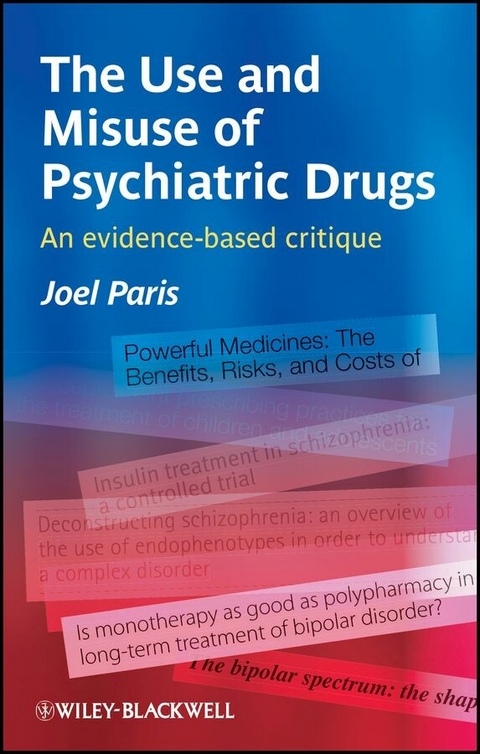
The Use and Misuse of Psychiatric Drugs (eBook)
John Wiley & Sons (Verlag)
978-0-470-66662-3 (ISBN)
-Roger P. Greenberg, Ph.D. Distinguished Professor and Head, Psychology Division Dept. of Psychiatry & Behavioral Science SUNY Upstate Medical University, NY, USA
The message of this book is that psychiatrists have some very good drugs, but can expect bad results when they are over-used, prescribed outside of evidence-based indications, or given to the wrong patients. While acknowledging that many current agents are highly effective and have revolutionized the treatment of certain disorders, Joel Paris criticizes their use outside of an evidence base. Too many patients are either over-medicated or are misdiagnosed to justify aggressive treatment. Dr. Paris calls for more government funding of clinical trials to establish, without bias, the effectiveness of these agents. He has written this book for practitioners and trainees to show that scientific evidence supports a more cautious and conservative approach to drug therapy.
After describing the history of psychopharmacology, including its early successes, Dr. Paris reviews the relationship between psychiatry and the pharmaceutical industry. This problem has received considerable popular attention in recent years and Dr. Paris documents initiatives to increase transparency and decrease the influence of pharmaceutical marketing on diagnosis and prescribing habits.
Dr Paris then examines some major controversies. One is the fact that newer drugs have not been shown to be superior to older agents. Another is that while the number of prescriptions for antidepressants has increased dramatically, meta-analyses show that their value is more limited than previously believed. Still another is the widespread prescription of mood stabilizers and antipsychotic drugs for patients, including children and adolescents, who do not have bipolar illness. Polypharmacy is an especially contentious area: very few drug combinations have been tested in clinical trials, yet many patients end up on a cocktail of powerful drugs, each with its own side effects.
Dr Paris briefly considers alternatives to pharmacology and again calls for more clinical trials of these approaches. He also discusses the current trend to medicalizing what many would describe as normal distress and states succinctly: Some things in life are worth being upset about.
Joel Paris is a professor of psychiatry and former department chair who has taught in a large university for 40 years. A researcher (with over 150 publications), a clinician, and the editor of a major journal, he has written/edited 12 books. He writes in a way that can readily be understood by clinicians.
Joel Paris is an active researcher, primarily in personality disorders and child & adolescent psychiatry, and both this and his considerable practical expertise enable him to argue intelligently both for and against the use of psychotropic medications. His background as a medical investigator and broad experience in teaching young psychiatrists about the use of drugs help him to make neutral judgments about complex issues.
"e;Dr. Paris has written an honest, balanced presentation of the ways in which psychiatric drugs are evaluated and prescribed. He highlights the complexity of the task, the limits of what is known and the mixed picture that research often produces. His conclusions are refreshing because they are built from an even-handed, pragmatic assessment of the empirical evidence. The result is a stimulating look at the world of treatments for emotional disorders that acknowledges the usefulness of both biological and psychosocial explanations where appropriate. His recommendations provide helpful roadmaps for patients, practitioners and researchers alike. The book is sure to serve as a welcome catalyst for the continuing debates about which treatments are likely to produce the best outcomes."e; Roger P. Greenberg, Ph.D. Distinguished Professor and Head, Psychology Division Dept. of Psychiatry & Behavioral Science SUNY Upstate Medical University, NY, USA The message of this book is that psychiatrists have some very good drugs, but can expect bad results when they are over-used, prescribed outside of evidence-based indications, or given to the wrong patients. While acknowledging that many current agents are highly effective and have revolutionized the treatment of certain disorders, Joel Paris criticizes their use outside of an evidence base. Too many patients are either over-medicated or are misdiagnosed to justify aggressive treatment. Dr. Paris calls for more government funding of clinical trials to establish, without bias, the effectiveness of these agents. He has written this book for practitioners and trainees to show that scientific evidence supports a more cautious and conservative approach to drug therapy. After describing the history of psychopharmacology, including its early successes, Dr. Paris reviews the relationship between psychiatry and the pharmaceutical industry. This problem has received considerable popular attention in recent years and Dr. Paris documents initiatives to increase transparency and decrease the influence of pharmaceutical marketing on diagnosis and prescribing habits. Dr Paris then examines some major controversies. One is the fact that newer drugs have not been shown to be superior to older agents. Another is that while the number of prescriptions for antidepressants has increased dramatically, meta-analyses show that their value is more limited than previously believed. Still another is the widespread prescription of mood stabilizers and antipsychotic drugs for patients, including children and adolescents, who do not have bipolar illness. Polypharmacy is an especially contentious area: very few drug combinations have been tested in clinical trials, yet many patients end up on a cocktail of powerful drugs, each with its own side effects. Dr Paris briefly considers alternatives to pharmacology and again calls for more clinical trials of these approaches. He also discusses the current trend to medicalizing what many would describe as normal distress and states succinctly: Some things in life are worth being upset about.
Joel Paris is a professor of psychiatry and former department chair who has taught in a large university for 40 years. A researcher (with over 150 publications), a clinician, and the editor of a major journal, he has written/edited 12 books. He writes in a way that can readily be understood by clinicians. Joel Paris is an active researcher, primarily in personality disorders and child & adolescent psychiatry, and both this and his considerable practical expertise enable him to argue intelligently both for and against the use of psychotropic medications. His background as a medical investigator and broad experience in teaching young psychiatrists about the use of drugs help him to make neutral judgments about complex issues.
The Use and Misuse of Psychiatric Drugs 3
Contents 9
Foreword 11
Introduction 13
Part I OVERVIEW 19
1 The History of Psychopharmacology 21
2 The Science of Psychopharmacology 29
3 The Pharmaceutical Industry 49
Part II DRUGS IN PRACTICE 73
4 Antipsychotics: For Better or For Worse 75
5 Mood Stabilizers and Mood Instability 87
6 Antidepressants 103
7 Prescribing for Children and Adolescents 127
8 Polypharmacy 141
Part III PERSPECTIVES 149
9 Alternatives to Drugs 151
10 Medicalizing Distress 161
11 The Future of Psychopharmacology 173
References 183
Index 213
"The Use and Misuse of Psychiatric Drugs
deserves a place in every health sciences library."
(Metapsychology Online Reviews, 8 January 2013)
"In the book's foreword, Tyrer describes this book as a
''well balanced sober account of a serious issue that
affects almost all of us in one way or another'' and I
would agree with that. The book is well written, easy to read, and
makes good bedtime reading despite the serious nature of its topic.
Epidemiologists will find it useful as background to the use of
these medications, even if observational studies were neglected.
... Paris is not afraid to tackle controversial topics and make
forceful
statements about issues where improvement is needed. I highly
recommend this book to anyone who would like to know more about
this topic." (Annals of Epidemiology, 2012)
| Erscheint lt. Verlag | 6.7.2010 |
|---|---|
| Sprache | englisch |
| Themenwelt | Medizin / Pharmazie ► Gesundheitsfachberufe |
| Medizin / Pharmazie ► Medizinische Fachgebiete ► Psychiatrie / Psychotherapie | |
| Schlagworte | Agents • aggressive treatment • Bad • Book • certain • Clinical psychology • Current • disorders • Drugs • Effective • evidence base • evidencebased indications • Good • highly • Klinische Psychologie • many • Medical Science • Medizin • Message • outside • Paris • patients • Pharmacology & Pharmaceutical Medicine • Pharmakologie • Pharmakologie u. Pharmazeutische Medizin • prescribed outside • Psychiatrie • psychiatrists • Psychologie • Psychology • Psychopharmacology • Psychopharmaka • Psychopharmakologie • Treatment • use • Wrong |
| ISBN-10 | 0-470-66662-5 / 0470666625 |
| ISBN-13 | 978-0-470-66662-3 / 9780470666623 |
| Informationen gemäß Produktsicherheitsverordnung (GPSR) | |
| Haben Sie eine Frage zum Produkt? |
 PDF (Adobe DRM)
Kopierschutz: Adobe-DRM
Adobe-DRM ist ein Kopierschutz, der das eBook vor Mißbrauch schützen soll. Dabei wird das eBook bereits beim Download auf Ihre persönliche Adobe-ID autorisiert. Lesen können Sie das eBook dann nur auf den Geräten, welche ebenfalls auf Ihre Adobe-ID registriert sind.
Details zum Adobe-DRM
Dateiformat: PDF (Portable Document Format)
Mit einem festen Seitenlayout eignet sich die PDF besonders für Fachbücher mit Spalten, Tabellen und Abbildungen. Eine PDF kann auf fast allen Geräten angezeigt werden, ist aber für kleine Displays (Smartphone, eReader) nur eingeschränkt geeignet.
Systemvoraussetzungen:
PC/Mac: Mit einem PC oder Mac können Sie dieses eBook lesen. Sie benötigen eine
eReader: Dieses eBook kann mit (fast) allen eBook-Readern gelesen werden. Mit dem amazon-Kindle ist es aber nicht kompatibel.
Smartphone/Tablet: Egal ob Apple oder Android, dieses eBook können Sie lesen. Sie benötigen eine
Geräteliste und zusätzliche Hinweise
Buying eBooks from abroad
For tax law reasons we can sell eBooks just within Germany and Switzerland. Regrettably we cannot fulfill eBook-orders from other countries.
aus dem Bereich