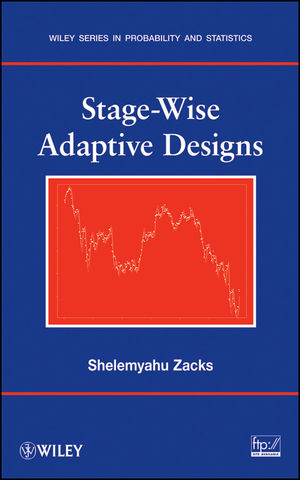
Stage-Wise Adaptive Designs (eBook)
416 Seiten
John Wiley & Sons (Verlag)
978-0-470-46694-0 (ISBN)
areas of statistics
Stage-Wise Adaptive Designs presents the theory and
methodology of stage-wise adaptive design across various areas of
study within the field of statistics, from sampling surveys and
time series analysis to generalized linear models and decision
theory. Providing the necessary background material along with
illustrative S-PLUS functions, this book serves as a valuable
introduction to the problems of adaptive designs.
The author begins with a cohesive introduction to the subject
and goes on to concentrate on generalized linear models, followed
by stage-wise sampling procedures in sampling surveys. Adaptive
forecasting in the area of time series analysis is presented in
detail, and two chapters are devoted to applications in clinical
trials. Bandits problems are also given a thorough treatment along
with sequential detection of change-points, sequential applications
in industrial statistics, and software reliability.
S-Plus functions are available to accompany particular
computations, and all examples can be worked out using R, which is
available on the book's related FTP site. In addition, a detailed
appendix outlines the use of these software functions, while an
extensive bibliography directs readers to further research on the
subject matter.
Assuming only a basic background in statistical topics,
Stage-Wise Adaptive Designs is an excellent supplement to
statistics courses at the upper-undergraduate and graduate levels.
It also serves as a valuable reference for researchers and
practitioners in the fields of statistics and biostatistics.
Shelemyahu Zacks, PhD, is Professor of Statistics in the Department of Mathematical Sciences at Binghamton University. He has published several books and over 170 journal articles in the areas of design and analysis of experiments, statistical control of stochastic processes, statistical decision theory, statistical methods in logistics, and sampling from finite populations. Dr. Zacks is a Fellow of the American Statistical Association, Institute of Mathematical Sciences, and American Association for the Advancement of Sciences.
Preface.
1 Synopsis.
1.1 Multistage and Sequential Estimation.
1.2 Adaptive Designs for Generalized Linear Models.
1.3 Adaptive Methods for Sampling from Finite Populations.
1.4 Adaptive Prediction and Forecasting in Time Series Analysis.
1.5 Adaptive Search of an MTD in Cancer Phase I Clinical Trials.
1.6 Adaptive and Sequential Procedures in Phase III of Clinical Trials.
1.7 Sequential Allocation of Resources.
1.8 Sequential Detection of Change Points.
1.9 Sequential Methods in Industrial Testing, Reliability, and Design of Experiments.
2 Multistage and Sequential Estimation.
2.1 Stein's Two-Stage Procedure.
2.2 Modifications to Attain Asymptotic Efficiency.
2.3 Two-Stage Sampling From Exponential Distributions.
2.4 Sequential Fixed-Width Interval Estimation.
2.5 Distributions of Stopping Variables of Sequential Sampling.
2.6 Sequential Fixed-Width Intervals for the Log-Odds in Bernoulli Trials.
2.7 Bayesian Sequential Estimation.
3 Adaptive Designs For Generalized Linear Models.
3.1 Exponential Example.
3.2 Adaptive Designs for the Fisher Information.
3.3 Adaptive Bayesian Designs.
3.4 Adaptive Designs for Inverse Regression.
3.5 Stochastic Approximation.
4 Adaptive Methods for Sampling from Finite Populations.
4.1 Basic Theory.
4.2 Two-Stage and Sequential Estimation of the Population Mean.
4.3 Adaptive Allocation of Stratified SRS.
4.4 Adaptive Search for Special Units.
4.5 Adaptive Estimation of the Size of a Finite Population.
4.6 Applications in Software Reliability.
4.7 Sampling Inspection Schemes.
4.8 Dynamic Bayesian Prediction.
5 Adaptive Prediction and Forecasting in Time Series Analysis.
5.1 Basic Tools of Time Series Analysis.
5.2 Linear Predictors for Covariance Stationary T.S.
5.3 Quadratic LSE Predictors for Nonstationary T.S.
5.4 Moving Averages Predictors for Nonstationary T.S.
5.5 Predictors for General Trends with Exponential Discounting.
5.6 Dynamic Linear Models.
5.7 Asymptotic Behavior of DLM.
5.8 Linear Control of DLM.
6 Adaptive Search of an MTD in Cancer Phase I Clinical Trials.
6.1 Up-And-Down Adaptive Designs.
6.2 Bayesian Adaptive Search: The Continuous Reassessment Method.
6.3 Efficient Dose Escalation with Overdose Control.
6.4 Patient-Specific Dosing.
6.5 Toxicity versus Efficacy.
7 Adaptive and Sequential Procedures in Clinical Trials, Phases II and III.
7.1 Randomization in Clinical Trials.
7.2 Adaptive Randomization Procedures.
7.3 Fixed-Width Sequential Estimation of the Success Probability in Bernoulli Trials.
7.4 Sequential Procedure for Estimating the Probability of Success in Bernoulli Trials.
7.5 Sequential Comparison of Success Probabilities.
7.6 Group Sequential Methods.
7.7 Dynamic Determination of Stage-Wise Samples Size.
8 Sequential Allocation of Resources.
8.1 Bernoulli Bandits.
8.2 Gittins Dynamic Allocation Indices.
8.3 Sequential Allocations in Clinical Trials.
8.4 Bernoulli Bandits with Changepoint.
8.5 Sequential Designs for Estimating the Common Mean of Two Normal Distributions: One Variance Known.
9 Sequential Detection of Changepoints.
9.1 Bayesian Detection When the Distribution Before and After the Change Are Known.
9.2 Bayesian Detection When the Distributions Before and After the Change Are Unknown.
9.3 CUSUM Procedures for Sequential Detection.
9.4 Tracking Algorithms for Processes with Change Points.
9.5 Recursive Estimation with Changepoints.
9.6 Additional Theoretical Contributions.
10 Sequential Methods in Industrial Testing.
10.1 Sequential Testing (SPRT).
10.2 Characteristics of Sequential Procedures in Reliability Estimation and Testing.
10.3 Some Comments on Sequential Design of Experiments.
10.4 Sequential Testing of Software Reliability.
Bibliography.
Appendix: SPLUS/R Programs.
Author Index.
Subject Index.
"Covering a broad range of material, this book may serve well as a
reference source for adaptive approaches in the design of
experiments." (Mathematical Reviews, 2011)
| Erscheint lt. Verlag | 12.5.2009 |
|---|---|
| Reihe/Serie | Wiley Series in Probability and Statistics | Wiley Series in Probability and Statistics |
| Sprache | englisch |
| Themenwelt | Mathematik / Informatik ► Mathematik ► Wahrscheinlichkeit / Kombinatorik |
| Medizin / Pharmazie | |
| Schlagworte | Biostatistics • Biostatistik • Clinical Trials • Experimental Design • Klinische Studien • Statistics • Statistik • Versuchsplanung |
| ISBN-10 | 0-470-46694-4 / 0470466944 |
| ISBN-13 | 978-0-470-46694-0 / 9780470466940 |
| Informationen gemäß Produktsicherheitsverordnung (GPSR) | |
| Haben Sie eine Frage zum Produkt? |
 PDF (Adobe DRM)
Kopierschutz: Adobe-DRM
Adobe-DRM ist ein Kopierschutz, der das eBook vor Mißbrauch schützen soll. Dabei wird das eBook bereits beim Download auf Ihre persönliche Adobe-ID autorisiert. Lesen können Sie das eBook dann nur auf den Geräten, welche ebenfalls auf Ihre Adobe-ID registriert sind.
Details zum Adobe-DRM
Dateiformat: PDF (Portable Document Format)
Mit einem festen Seitenlayout eignet sich die PDF besonders für Fachbücher mit Spalten, Tabellen und Abbildungen. Eine PDF kann auf fast allen Geräten angezeigt werden, ist aber für kleine Displays (Smartphone, eReader) nur eingeschränkt geeignet.
Systemvoraussetzungen:
PC/Mac: Mit einem PC oder Mac können Sie dieses eBook lesen. Sie benötigen eine
eReader: Dieses eBook kann mit (fast) allen eBook-Readern gelesen werden. Mit dem amazon-Kindle ist es aber nicht kompatibel.
Smartphone/Tablet: Egal ob Apple oder Android, dieses eBook können Sie lesen. Sie benötigen eine
Geräteliste und zusätzliche Hinweise
Buying eBooks from abroad
For tax law reasons we can sell eBooks just within Germany and Switzerland. Regrettably we cannot fulfill eBook-orders from other countries.
aus dem Bereich