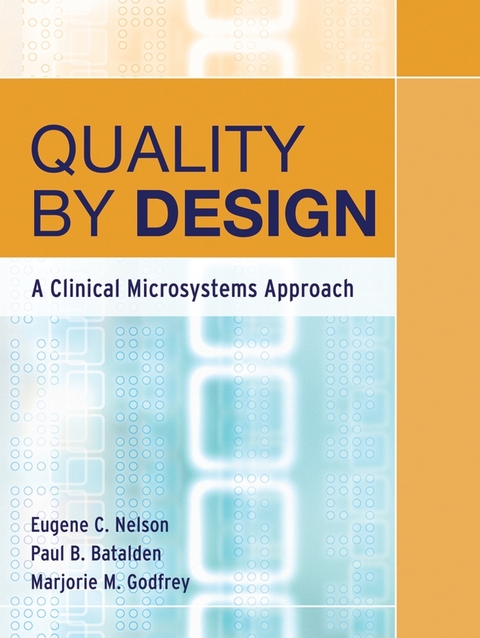
Quality By Design (eBook)
John Wiley & Sons (Verlag)
978-0-7879-9483-9 (ISBN)
- describe how to develop microsystems that can attain peak performance through active engagement of interdisciplinary teams in learning and applying improvement science and measurement;
- explore the essence of leadership for clinical Microsystems;
- show what mid-level leaders can do to enable peak performance at the front lines of care;
- outline the design and redesign of services and planning care to match patient needs with services offered;
- examine the issue of safety;
- describe the vital role of data in creating a rich and useful information environment;
- provide a core curriculum that can build microsystems' capability, provide excellent care, promote a positive work environment, and contribute to the larger organization.
Ancillary materials for use in classroom teaching, training, or coaching are available at https://clinicalmicrosystem.org/
Eugene C. Nelson, D.Sc., M.P.H., is director of quality administration for the Dartmouth-Hitchcock Medical Center and professor of community and family medicine at Dartmouth Medical School.
Paul B. Batalden, M.D. is the director of health care improvement leadership development, Center for the Evaluative Clinical Sciences, and professor of pediatrics and of community and family medicine at Dartmouth Medical School.
Marjorie M. Godfrey, M.S., R.N., is instructor for community and family medicine at and director of the Clinical Microsystem Resource Group at Dartmouth Medical School .
Quality by Design reflects the research and applied training conducted at Dartmouth Medical School under the leadership of Gene Nelson, Paul Batalden, and Marjorie Godfrey. The book includes the research results of high-performing clinical microsystems, illustrative case studies that highlight individual clinical programs, guiding principles that are easily applied, and tools, techniques, and methods that can be adapted by clinical practices and interdisciplinary clinical teams. The authors describe how to develop microsystems that can attain peak performance through active engagement of interdisciplinary teams in learning and applying improvement science and measurement; explore the essence of leadership for clinical Microsystems; show what mid-level leaders can do to enable peak performance at the front lines of care; outline the design and redesign of services and planning care to match patient needs with services offered; examine the issue of safety; describe the vital role of data in creating a rich and useful information environment; provide a core curriculum that can build microsystems capability, provide excellent care, promote a positive work environment, and contribute to the larger organization. Ancillary materials for use in classroom teaching, training, or coaching are available at https://clinicalmicrosystem.org/
Eugene C. Nelson, D.Sc., M.P.H., is director of quality administration for the Dartmouth-Hitchcock Medical Center and professor of community and family medicine at Dartmouth Medical School. Paul B. Batalden, M.D. is the director of health care improvement leadership development, Center for the Evaluative Clinical Sciences, and professor of pediatrics and of community and family medicine at Dartmouth Medical School. Marjorie M. Godfrey, M.S., R.N., is instructor for community and family medicine at and director of the Clinical Microsystem Resource Group at Dartmouth Medical School .
QUALITY BY DESIGN: A Clinical Microsystems Approach 5
CONTENTS 7
TABLES, FIGURES, AND EXHIBITS 15
Tables 15
Figures 16
Exhibits 19
FOREWORD 21
PREFACE 25
References 28
ACKNOWLEDGMENTS 29
INTRODUCTION 33
Need 34
Purpose 34
Scope and Treatment 35
Overview of the Contents 36
How to Use This Book 38
References 39
THE EDITORS 41
THE CONTRIBUTORS 45
PART I: CASES AND PRINCIPLES 49
Chapter 1: SUCCESS CHARACTERISTICS OF HIGH-PERFORMING MICROSYSTEMS 51
True Structure of the System, Embedded Systems, and Need to Transform Frontline Systems 53
The Bladyka Case 56
Research Design 62
Results 67
Practical Implications 77
Conclusion 78
References 80
Chapter 2: DEVELOPING HIGH-PERFORMING MICROSYSTEMS 82
Case Study: A Decade of Progress for an Intensive Care Nursery 83
A Model of Development and a Curriculum to Catalyze Microsystem Growth 90
Conclusion 96
References 97
Chapter 3: LEADING MICROSYSTEMS 99
Leader, Leadership, Leading 100
Recap of Methods 101
Three Fundamental Processes of Leading: What Clinical Microsystem Team Members Observe and Report 102
Discussion 113
Conclusion 114
References 115
Chapter 4: LEADING MACROSYSTEMS AND MESOSYSTEMS FOR MICROSYSTEM PEAK PERFORMANCE 117
Case Study: A True Story, with Names Changed to Protect the Innocent 118
Leadership Frameworks: Some of the Best Approaches 125
Leading Large Health Systems to Peak Performance Using Microsystem Thinking 140
Conclusion 148
References 150
Chapter 5: DEVELOPING PROFESSIONALS AND IMPROVING WORKLIFE 154
Case Study: Staff Development at Massachusetts General Hospital Downtown Associates 155
Conclusion 170
References 171
Chapter 6: PLANNING PATIENT-CENTERED SERVICES 172
Planning Patient-Centered Services and the 5 P’s 173
Case Study: Planning Services for Subpopulations of Patients to Best Provide Care for Individual Patients 175
A Developmental Journey: Beginning to Assess, Understand, and Improve a Clinical Microsystem 179
Analysis and Improvement of Processes 183
A Huddle in Plastic Surgery 192
Conclusion 194
References 194
Chapter 7: PLANNING PATIENT-CENTERED CARE 196
Planning Care Well: Exemplary Clinical Microsystems 197
Planning Care in Any Microsystem 202
A Low-Tech Example for Ambulatory Services: CARE Vital Signs 206
Conclusion 211
References 211
Chapter 8: IMPROVING PATIENT SAFETY 213
Microsystem Patient Safety Scenario 214
Case Study: Dartmouth-Hitchcock PainFree Program 218
Conclusion 222
References 224
Chapter 9: CREATING A RICH INFORMATION ENVIRONMENT 226
Case Study 1: Specialty Care: Dartmouth-Hitchcock Spine Center 227
Case Study 2: Overlook Hospital Emergency Department 230
Case Study 3: Intermountain Health Care Shock Trauma Intensive Care Unit 232
Tips and Principles to Foster a Rich Information Environment 233
Discussion 235
Conclusion 242
References 244
PART II: ACTIVATING THE ORGANIZATION AND THE DARTMOUTH MICROSYSTEM IMPROVEMENT CURRICULUM 245
Chapter 10: OVERVIEW OF PATH FORWARD AND INTRODUCTION TO PART TWO 247
Recap of Part One and Overview of Part Two 248
Using Real Case Studies and Practical Applications of Microsystem Thinking, Methods, and Tools 248
Working at All Levels of a Health System 249
Focusing on the Microsystem Level 263
Review Questions 276
Prework 276
References 276
Chapter 11: INTRODUCTION TO MICROSYSTEM THINKING 278
What Is a System in Health Care? 278
How Did Clinical Microsystem Knowledge Evolve? 280
What Is a Clinical Microsystem? 281
Where Do Clinical Microsystems Fit in the Health Care Delivery System? 281
What Does a Clinical Microsystem Look Like? 282
Why Focus on the Clinical Microsystem? 283
How Do Clinical Microsystems Link to 283
What Were the Findings of the Dartmouth Clinical Microsystem Research? 285
What Does a Microsystem’s Developmental Journey Look Like? 285
Conclusion 287
Case Studies 289
Review Questions 289
Between Sessions Work 290
References 290
Chapter 12: EFFECTIVE MEETING SKILLS I 291
What Is a Productive and Effective Meeting? 293
Why Use Meeting Skills and Roles? 293
What Are Effective Meeting Roles? 293
What Are the Phases of an Effective Meeting? 296
What Processes Are Evident in an Effective Meeting? 296
What Is the Seven-Step Meeting Process? 296
What Does a Meeting Agenda Template Look Like? 298
What Are the Ground Rules for Meetings? 300
What Are Some Tips for Getting Started with Productive Meetings? 301
How Do You Keep a Rhythm of Improvement? 302
Case Studies 303
Review Questions 305
Between Sessions Work 305
Reference 305
Chapter 13: ASSESSING YOUR MICROSYSTEM WITH THE 5 P’S 306
How Does an Interdisciplinary Lead Improvement Team Begin to Assess and Improve a Clinical Microsystem? 308
What Does the 5 P’s Framework Look Like? 308
What Resources Are Available to Guide the 5 P’s Assessment? 309
What Is a Helpful Way to Introduce Your Team to the Assessment Process? 309
What Are the 5 P’s? 309
What Should You Do with the Assessment Findings? 313
Case Studies 313
Review Questions 316
Between Sessions Work 316
References 318
Chapter 14: THE MODEL FOR IMPROVEMENT 319
What Is the Model for Improvement? 321
Why Use the Model for Improvement? 322
How Does the Model Fit into the Improvement Process? 322
What Is the PDSA Part of the Model? 323
What Are the Benefits of Using PDSA? 324
What Is Involved in Each of the Four Steps of Plan, Do, Study, and Act? 324
What Is the SDSA Cycle? 326
What Is Involved in Each of the Four Steps of Standardize, Do, Study, and Act? 327
What Tools Can Assist Your PDSA Cycle. SDSA Implementation? 328
What Are Some Tips for Using the PDSA. SDSA Method? 329
Case Studies 329
Review Questions 331
Between Sessions Work 331
References 331
Chapter 15: SELECTING THEMES FOR IMPROVEMENT 332
What Is a Theme for Improvement? 334
Why Use a Theme? 334
What Are the Theme Selection Considerations? 334
What Process Can You Use to Generate Theme Ideas and Select a First Theme? 336
What Are the Next Steps? 337
Case Studies 337
Review Questions 338
Between Sessions Work 338
References 338
Chapter 16: IMPROVEMENT GLOBAL AIM 339
What Is a Global Aim? 339
Why Use a Global Aim? 341
How Do You Write a Global Aim? 341
What Are the Next Steps? 341
Case Studies 342
Review Questions 343
Between Sessions Work 343
Chapter 17: PROCESS MAPPING 344
What Is Process Mapping? 346
Why Use Process Mapping? 346
What Are the Commonly Used Flowchart Symbols? 347
What Does a High-Level Flowchart Look Like? 348
What Does a Detailed Flowchart Look Like? 348
What Are Some Tips for Creating a Flowchart? 349
What Does a Deployment Flowchart Look Like? 351
What Are Some Tips for Creating a Deployment Flowchart? 351
Case Studies 353
Review Questions 354
Between Sessions Work 355
Reference 355
Chapter 18: SPECIFIC AIM 356
What Is a Specific Aim? 356
Why Use a Specific Aim? 358
Where Do Specific Aims Come From? 358
Where Does the Specific Aim Fit in the Overall Improvement Process? 358
How Do You Write a Specific Aim? 359
What Are the Next Steps? 359
Case Studies 360
Review Questions 360
Between Sessions Work 360
References 360
Chapter 19: CAUSE AND EFFECT DIAGRAMS 361
What Is a Cause and Effect Diagram? 363
Why Use a Fishbone Diagram? 364
What Is the Structure of a Fishbone Diagram? 364
What Does a Completed Fishbone Look Like? 364
What Are Some Tips for Creating a Fishbone Diagram? 366
Case Studies 366
Review Questions 367
Between Sessions Work 368
References 368
Chapter 20: EFFECTIVE MEETING SKILLS II 369
What Is Brainstorming? 371
What Are the Benefits of Brainstorming? 371
What Are Some Different Types of Brainstorming? 371
What Are Some Tips for Conducting Brainstorming? 372
What Is Multi-Voting? 373
Do Teams Always Multi-Vote After a Brainstorming Session? 373
How Do You Multi-Vote? 374
What Does a Brainstorming Session with a Multi-Voting Outcome Look Like? 375
Case Studies 375
Review Questions 377
Between Sessions Work 378
Reference 378
Chapter 21: CHANGE CONCEPTS 379
What Is a Change Concept? 381
Why Use Change Concepts? 381
How Can You Use Change Concepts in a Process? 381
What Are the Next Steps? 383
Case Studies 383
Review Questions 385
Between Sessions Work 385
References 386
Chapter 22: MEASUREMENT AND MONITORING 387
What Are Measures, What Makes Measures Good, and How Do They Relate to Aims? 388
What Is a Run Chart? 390
What Are the Benefits of Using a Run Chart? 392
How Do Run Charts Fit in the Overall Improvement Process? 393
What Do Run Charts Tell You About Your Performance Level and Variation? 393
What Are Special Cause and Common Cause Variation? 394
How Do You Make a Run Chart? 395
How Do You Interpret Run Chart Results? 397
What Is a Control Chart? 398
What Is the Theory Behind Control Charts? 400
What Are the Benefits of Using a Control Chart Instead of a Run Chart? 402
What Are the Different Kinds of Control Charts? 402
What Is an XmR Control Chart? 402
How Do You Interpret Control Chart Results? 405
When Do You Recalculate Control Chart Values? 407
What Are Some Tips for Using Run Charts and Control Charts? 408
Case Studies 408
Review Questions 409
Between Sessions Work 409
References 409
Chapter 23: ACTION PLANS AND GANTT CHARTS 410
What Is an Action Plan? 412
What Is a Gantt Chart? 412
Why Use Action Plans and Gantt Charts? 412
How Do You Write an Action Plan? 413
How Do You Create a Gantt Chart? 413
What Are the Next Steps? 414
Case Studies 414
Review Questions 416
Between Sessions Work 416
Reference 416
Chapter 24: FOLLOW THROUGH ON IMPROVEMENT 417
What Is the Importance of Follow Through? 418
What Can You Do to Follow Through? 418
What Are the Fundamentals of Improvement? 418
What Is a Data Wall? 419
What Is a Playbook? 419
How Is the Playbook Used? 420
How Do You Create a Playbook? 420
How Do You Maintain Your Playbook? 421
What Is a Storyboard? 423
How Do You Make a Storyboard? 423
Discussion 424
Case Studies 424
Review Questions 427
Between Sessions Work 427
Looking Back 428
Chapter 25: CONCLUSION 428
Looking Forward and an Invitation: Make It Personal and Make It Happen 430
APPENDIX A: PRIMARY CARE WORKBOOK 433
Strategies for Improving the Place Where Patients, Families, and Careteams Meet 434
The Path Forward 436
Step 1: Organize a Lead Improvement Team 436
Step 2: Assess Your Primary Care Practice 437
Step 3: Diagnose 469
Step 4: Treat Your Primary Care Practice 469
Step 5: Follow Up 477
References 479
NAME INDEX 481
SUBJECT INDEX 485
| Erscheint lt. Verlag | 22.3.2007 |
|---|---|
| Sprache | englisch |
| Themenwelt | Medizin / Pharmazie ► Allgemeines / Lexika |
| Medizin / Pharmazie ► Gesundheitswesen | |
| Schlagworte | Ãffentlicher Gesundheitsdienst u. Gesundheitspolitik • Approach • Best • Business & Management • Capability • Care • continually • Design • Gesundheits- u. Sozialwesen • great place • Health • Health & Social Care • individual needs • Innovative • microsystem concepts • New • next patient • Öffentlicher Gesundheitsdienst u. Gesundheitspolitik • One • outcomes • Patient • proven approach • Public Health • Public Health Services & Policy • Qualitätsmanagement • Qualitätsmanagement • quality • Quality management • reliable • responsive • SAFE • Staff • System • Wirtschaft u. Management |
| ISBN-10 | 0-7879-9483-9 / 0787994839 |
| ISBN-13 | 978-0-7879-9483-9 / 9780787994839 |
| Informationen gemäß Produktsicherheitsverordnung (GPSR) | |
| Haben Sie eine Frage zum Produkt? |
 PDF (Adobe DRM)
Kopierschutz: Adobe-DRM
Adobe-DRM ist ein Kopierschutz, der das eBook vor Mißbrauch schützen soll. Dabei wird das eBook bereits beim Download auf Ihre persönliche Adobe-ID autorisiert. Lesen können Sie das eBook dann nur auf den Geräten, welche ebenfalls auf Ihre Adobe-ID registriert sind.
Details zum Adobe-DRM
Dateiformat: PDF (Portable Document Format)
Mit einem festen Seitenlayout eignet sich die PDF besonders für Fachbücher mit Spalten, Tabellen und Abbildungen. Eine PDF kann auf fast allen Geräten angezeigt werden, ist aber für kleine Displays (Smartphone, eReader) nur eingeschränkt geeignet.
Systemvoraussetzungen:
PC/Mac: Mit einem PC oder Mac können Sie dieses eBook lesen. Sie benötigen eine
eReader: Dieses eBook kann mit (fast) allen eBook-Readern gelesen werden. Mit dem amazon-Kindle ist es aber nicht kompatibel.
Smartphone/Tablet: Egal ob Apple oder Android, dieses eBook können Sie lesen. Sie benötigen eine
Geräteliste und zusätzliche Hinweise
Buying eBooks from abroad
For tax law reasons we can sell eBooks just within Germany and Switzerland. Regrettably we cannot fulfill eBook-orders from other countries.
aus dem Bereich