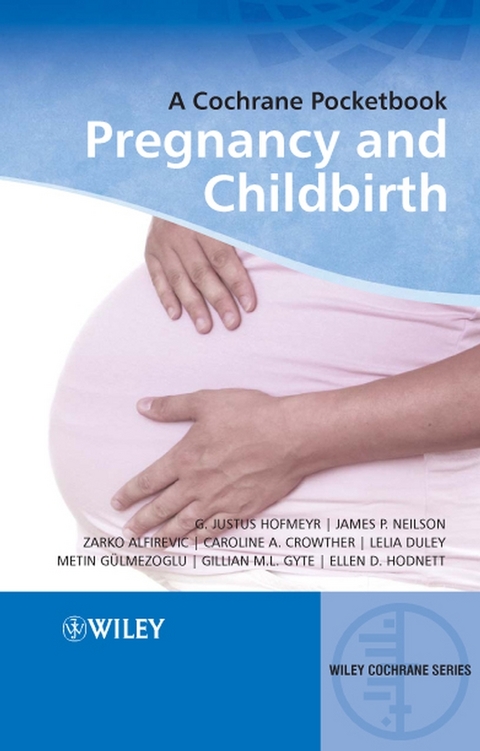
Pregnancy and Childbirth (eBook)
John Wiley & Sons (Verlag)
978-0-470-99461-0 (ISBN)
The Cochrane Library is published by John Wiley on behalf of The Cochrane Collaboration.
Professor G. Justus Hofmeyr
Director/Hon Professor, Effective Care Research Unit, University of the Witwatersrand, University of Fort Hare, Eastern Cape Department of Health, Frere and Cecilia Makiwane Hospitals, South Africa.
Prof Zarko Alfirevic
Professor of Fetal and Maternal Medicine Division of Perinatal and Reproductive Medicine, The University of Liverpool, UK.
Caroline A. Crowther
Associate Professor, Dept Obstetrics and Gynaecology, University of Adelaide, South Africa.
Lelia Duley
Obstetric Epidemiologist, Institute of Health Sciences, Oxford, UK.
Dr A Metin Gülmezoglu
Department of Reproductive Health and Research, World Health Organization.
Mrs Gillian? ML Gyte
Cochrane Pregnancy and Childbirth Group, Division of Perinatal and Reproductive Medicine, The University of Liverpool, UK.
Ellen D. Hodnett
Professor James P. Neilson, Obstetrics and Gynaecology, University of Liverpool, UK.
Pregnancy and Childbirth presents the best evidence for the care of pregnant women to doctors, midwives, students and parents. The logical sequence of chapters and the index give quick access to the abstracts of over four hundred Cochrane systematic reviews. The book serves both as a stand-alone reference, and as a companion to locating full reviews on the Cochrane Library. The Cochrane Library is published by John Wiley on behalf of The Cochrane Collaboration. www.thecochranelibrary.com
Professor G. Justus Hofmeyr Director/Hon Professor, Effective Care Research Unit, University of the Witwatersrand, University of Fort Hare, Eastern Cape Department of Health, Frere and Cecilia Makiwane Hospitals, South Africa. Prof Zarko Alfirevic Professor of Fetal and Maternal Medicine Division of Perinatal and Reproductive Medicine, The University of Liverpool, UK. Caroline A. Crowther Associate Professor, Dept Obstetrics and Gynaecology, University of Adelaide, South Africa. Lelia Duley Obstetric Epidemiologist, Institute of Health Sciences, Oxford, UK. Dr A Metin Gülmezoglu Department of Reproductive Health and Research, World Health Organization. Mrs Gillian? ML Gyte Cochrane Pregnancy and Childbirth Group, Division of Perinatal and Reproductive Medicine, The University of Liverpool, UK. Ellen D. Hodnett Professor James P. Neilson, Obstetrics and Gynaecology, University of Liverpool, UK.
A Cochrane Pocketbook: Pregnancy and Childbirth 1
Contents 7
Foreword 13
Preface 15
How to Use This Book 17
What is evidence? 17
The Cochrane Pregnancy and Childbirth Group 18
Scope of this book 19
Methods for the Cochrane Pregnancy and Childbirth Group reviews 19
Abridgement of the Cochrane Pregnancy and Childbirth abstracts in this book 20
Systematic review protocols 20
Effectiveness icons 21
How to locate the original review 21
A brief guide to the format of results in Cochrane reviews 23
Acknowledgements 27
Authors 29
Chapter 1: The Context of Care for Pregnant Women 31
Chapter 2: Antenatal Care 37
2.1 Pre-pregnancy evaluation 37
2.2 General antenatal care 37
2.3 Behaviour/advice during pregnancy 43
2.3.1 Alcohol in pregnancy drug misuse (Cochrane Drugs and Alcohol Group)
2.3.2 Smoking 50
2.3.3 Work and physical activity 51
2.4 Nutrition during pregnancy 52
2.4.1 Pre/periconceptional nutrition 52
2.4.2 Energy/protein intake 53
2.4.3 Vitamins/minerals 55
2.5 Weight gain in pregnancy 63
2.6 Symptoms during pregnancy 63
2.7 Use of medicines during pregnancy 70
2.8 Miscarriage 71
2.8.1 Prevention 72
2.8.2 Treatment of threatened miscarriage 79
2.8.3 Treatment of miscarriage 80
Chapter 3: Medical Problems During Pregnancy 85
3.1 Hypertension during pregnancy 85
3.1.1 Preventing hypertensive disorders 85
3.1.2 Detection of hypertensive disorders 99
3.1.3 Treatment of mild/moderate hypertension 100
3.1.4 Treatment of severe pre-eclampsia/eclampsia 106
3.2 Anaemia during pregnancy 115
3.2.1 Prevention of anaemia 116
3.2.2 Treatment of anaemia 117
3.3 Diabetes mellitus 119
3.4 Thrombocytopenia 124
3.5 Inherited coagulation defects 125
3.6 Thrombophilias 125
3.7 Haemoglobinopathies 127
3.8 Thromboembolic disease 127
3.9 Myasthenia gravis 128
3.10 Cardiac disease 128
3.11 Renal disease 129
3.12 Epilepsy 129
3.13 Human immunodefi ciency virus infection (HIV) 131
3.14 Other viral infections 144
3.15 Malaria 144
3.16 Other infections 148
3.17 Respiratory illness 149
3.18 Liver disease 149
3.19 Thyroid disease 150
3.20 Haemorrhoids 151
3.21 Psychiatric disorders 153
3.22 Skin diseases 155
Chapter 4: Disorders Affecting the Unborn Baby 157
4.1 Routine assessment of the baby during pregnancy 157
4.1.1 Can routine screening tests do harm? 157
4.2 Prenatal diagnosis 159
4.2.1 Procedures 159
4.2.2 Genetic disorders 161
4.2.3 Counselling 162
4.2.4 Fetal surgery 162
4.3 Impaired growth and wellbeing of the unborn baby 162
4.3.1 Screening and diagnosis 163
4.3.2 Conservative management of compromised babies 170
4.4 Blood group incompatibilities – prevention and treatment 177
4.5 Death of the unborn baby 181
Chapter 5: Pregnancy Complications 183
5.1 Prelabour rupture of membranes 183
5.1.1 Preterm prelabour rupture of membranes 183
5.1.2 Term prelabour rupture of membranes 185
5.2 Preterm birth 186
5.2.1 Prediction/prevention of preterm birth 187
5.2.2 Prenatal treatment for babies born preterm 197
5.2.3 Treatment of preterm labour 204
5.2.4 Maintenance tocolytic therapy after an episode of preterm labour 212
5.2.5 Mode of birth for infants born preterm 216
5.3 Prolonged pregnancy 217
5.4 Multiple pregnancy 218
5.5 Antepartum haemorrhage 227
5.6 Infection during pregnancy 229
5.6.1 Genital tract infections 230
5.6.2 Urinary tract infection 237
5.6.3 Other infections 240
Chapter 6: Induction of Labour 249
6.1 Specific indications for labour induction 249
6.2 Techniques of labour induction – primary reviews 253
6.3 Techniques of labour induction – secondary reviews 279
Chapter 7: Care During Childbirth 281
7.1 Place of birth 282
7.2 Routine care during labour 283
7.2.1 Normal birth – second stage 294
7.2.2 Episiotomy 294
7.2.3 Normal birth – third stage 298
7.3 Pain during labour 310
7.3.1 Non-pharmacological methods of pain relief in labour 310
7.3.2 Pharmacological methods of pain relief in labour 312
7.4 Slow progress during labour 317
7.4.1 Ineffective uterine contractions 317
7.4.2 Diagnosis of fetopelvic disproportion 320
7.4.3 Management of fetopelvic disproportion 321
7.5 Shoulder dystocia 322
7.6 Abnormal presentations and positions of the baby 324
7.6.1 Breech birth 330
7.7 Babies with compromised condition during labour 332
7.7.1 Diagnosis 332
7.7.2 Preventing compromise of the baby’s condition during labour 339
7.7.3 Treatment of babies with evidence of compromised condition 341
7.8 Cord prolapse 347
7.9 Perineal trauma 347
7.9.1 Preventing perineal trauma 348
7.9.2 Repair of perineal trauma 349
7.10 Operative vaginal birth 352
7.11 Caesarean section 357
7.11.1 Anaesthesia 358
7.11.2 Perioperative measures for caesarean section 363
7.11.3 Surgical techniques 371
7.11.4 Post-operative care 382
7.12 Pregnancy following caesarean section 384
7.13 Extrauterine pregnancy 387
7.14 Postpartum haemorrhage and retained placenta 387
7.14.1 Morbidly adherent placenta 391
7.15 Inversion of the uterus 392
Chapter 8: Care After Childbirth 393
8.1 Basic care of mother and baby 393
8.2 Perineal pain 398
8.3 Family planning 402
8.4 Perinatal death 406
8.5 Medical conditions after childbirth 407
8.6 Unhappiness after childbirth 408
8.7 Breastfeeding 416
8.7.1 Antenatal preparation for breastfeeding 416
8.7.2 Supporting breastfeeding mothers 418
8.7.3 Breastfeeding difficulties 424
8.7.4 Duration of breastfeeding 425
8.7.5 Suppressing lactation and breast symptoms in women who are not breastfeeding 427
Chapter 9: Rogues' Gallery 429
Index 431
"Pregnancy and Childbirth presents the best evidence for the care of pregnant women to doctors, midwives, students and parents." (Doody's Reviews)
| Erscheint lt. Verlag | 30.4.2008 |
|---|---|
| Reihe/Serie | Wiley Cochrane Series |
| Wiley Cochrane Series | Wiley Cochrane Series |
| Sprache | englisch |
| Themenwelt | Medizin / Pharmazie ► Medizinische Fachgebiete ► Gynäkologie / Geburtshilfe |
| Schlagworte | Abstracts • ACCESS • Best • Book • Care • Chapters • Childbirth • cochrane library • cochrane systematic • Companion • doctors • Evidence • Four • full • Gynäkologie • Gynäkologie u. Geburtshilfe • Gynäkologie • Gynäkologie u. Geburtshilfe • hundred • Index • Library • Logical • Medical Science • Medizin • Obstetrics & Gynecology • Pregnancy • Pregnant • Quick • Reference • Sequence • Standalone • Women |
| ISBN-10 | 0-470-99461-4 / 0470994614 |
| ISBN-13 | 978-0-470-99461-0 / 9780470994610 |
| Informationen gemäß Produktsicherheitsverordnung (GPSR) | |
| Haben Sie eine Frage zum Produkt? |
 PDF (Adobe DRM)
Kopierschutz: Adobe-DRM
Adobe-DRM ist ein Kopierschutz, der das eBook vor Mißbrauch schützen soll. Dabei wird das eBook bereits beim Download auf Ihre persönliche Adobe-ID autorisiert. Lesen können Sie das eBook dann nur auf den Geräten, welche ebenfalls auf Ihre Adobe-ID registriert sind.
Details zum Adobe-DRM
Dateiformat: PDF (Portable Document Format)
Mit einem festen Seitenlayout eignet sich die PDF besonders für Fachbücher mit Spalten, Tabellen und Abbildungen. Eine PDF kann auf fast allen Geräten angezeigt werden, ist aber für kleine Displays (Smartphone, eReader) nur eingeschränkt geeignet.
Systemvoraussetzungen:
PC/Mac: Mit einem PC oder Mac können Sie dieses eBook lesen. Sie benötigen eine
eReader: Dieses eBook kann mit (fast) allen eBook-Readern gelesen werden. Mit dem amazon-Kindle ist es aber nicht kompatibel.
Smartphone/Tablet: Egal ob Apple oder Android, dieses eBook können Sie lesen. Sie benötigen eine
Geräteliste und zusätzliche Hinweise
Buying eBooks from abroad
For tax law reasons we can sell eBooks just within Germany and Switzerland. Regrettably we cannot fulfill eBook-orders from other countries.
aus dem Bereich