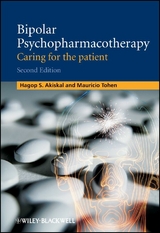
Bipolar Psychopharmacotherapy (eBook)
John Wiley & Sons (Verlag)
978-0-470-97510-7 (ISBN)
Journal of Bipolar Disorders
And the second edition is even better! Bipolar Psychopharmacotherapy covers both pharmacotherapy and the supportive role of psychotherapy, psychoeducation and social approaches to provide a broad integrative philosophy of care for bipolar patients. Extensive coverage is given to special management issues such as the pharmacological care of women with bipolar disorder, children and the elderly, as well as bipolar depression and suicide prevention.
The mood swings that characterize bipolar disorder can now be better stabilized in most patients than in the past, but the illness must be carefully managed throughout a person's life. Pharmacotherapy is central to the acute treatment and long-term management and as there are several classes of drugs which are often prescribed concurrently, treatment issues are complex. This essential reference work features critical reviews of the existing literature, plus information on new treatments that have been reported at peer reviewed scientific meetings, often written by the pioneering experts on a particular treatment. The second-generation antipsychotics are now covered in separate chapters to provide in-depth coverage of these agents. There are also new chapters on the pharmacological treatments of mixed states and rapid cycling and novel therapeutic vistas.
Hagop Akiskal is Distinguished Professor of Psychiatry and Director of the International Mood Center, San Diego Veterans Administration Medical Center, San Diego, California, USA. He was awarded the Jean Delay prize by the World Psychiatric Association in 2002 for research work that better bridges the gap between biological, psychological and social aspects of psychiatry and mental health. He has received the Gold Medal for Pioneer Research (Society of Biological Psychiatry), the German Anna Monika Prize for Depression, the NARSAD Prize for Affective Disorders, the French Jules Baillarger and the Italian Aretaeus Prizes for his research on the bipolar spectrum. He is Editor-in-Chief of the Journal of Affective Disorders.
Mauricio Tohen was appointed to the Krus endowed chair in Psychiatry at the University of Texas Health Science Centre at San Antonio in 2009. He is Chief of the Division of Mood and Anxiety Disorders, Department of Psychiatry, University of Texas Health Science Centre, San Antonio, Texas, USA. He is President of the International Society for Bipolar Disorders (2010 - 2012). His research has focused on the clinical epidemiology and psychopharmacological treatments of bipolar disorder. Professor Tohen has over 200 original publications and over 500 book chapters and scientific abstracts. He has co-edited Mood Disorders Across the Lifespan and Textbook of Psychiatric Epidemiology, and has also edited Comorbidity in Affective Disorders.
"e;If a colleague were to ask me, "e;What would you recommend I read if I want to become a real expert on bipolarity?"e; I would respond Bipolar Psychopharmacotherapy: Caring for the Patient."e; Journal of Bipolar Disorders And the second edition is even better! Bipolar Psychopharmacotherapy covers both pharmacotherapy and the supportive role of psychotherapy, psychoeducation and social approaches to provide a broad integrative philosophy of care for bipolar patients. Extensive coverage is given to special management issues such as the pharmacological care of women with bipolar disorder, children and the elderly, as well as bipolar depression and suicide prevention. The mood swings that characterize bipolar disorder can now be better stabilized in most patients than in the past, but the illness must be carefully managed throughout a person's life. Pharmacotherapy is central to the acute treatment and long-term management and as there are several classes of drugs which are often prescribed concurrently, treatment issues are complex. This essential reference work features critical reviews of the existing literature, plus information on new treatments that have been reported at peer reviewed scientific meetings, often written by the pioneering experts on a particular treatment. The second-generation antipsychotics are now covered in separate chapters to provide in-depth coverage of these agents. There are also new chapters on the pharmacological treatments of mixed states and rapid cycling and novel therapeutic vistas.
Hagop Akiskal is Distinguished Professor of Psychiatry and Director of the International Mood Center, San Diego Veterans Administration Medical Center, San Diego, California, USA. He was awarded the Jean Delay prize by the World Psychiatric Association in 2002 for research work that better bridges the gap between biological, psychological and social aspects of psychiatry and mental health. He has received the Gold Medal for Pioneer Research (Society of Biological Psychiatry), the German Anna Monika Prize for Depression, the NARSAD Prize for Affective Disorders, the French Jules Baillarger and the Italian Aretaeus Prizes for his research on the bipolar spectrum. He is Editor-in-Chief of the Journal of Affective Disorders. Mauricio Tohen was appointed to the Krus endowed chair in Psychiatry at the University of Texas Health Science Centre at San Antonio in 2009. He is Chief of the Division of Mood and Anxiety Disorders, Department of Psychiatry, University of Texas Health Science Centre, San Antonio, Texas, USA. He is President of the International Society for Bipolar Disorders (2010 - 2012). His research has focused on the clinical epidemiology and psychopharmacological treatments of bipolar disorder. Professor Tohen has over 200 original publications and over 500 book chapters and scientific abstracts. He has co-edited Mood Disorders Across the Lifespan and Textbook of Psychiatric Epidemiology, and has also edited Comorbidity in Affective Disorders.
Bipolar Psychopharmacotherapy 3
Contents 9
List of Contributors 17
Preface to the Second Edition 23
Chapter 1 The scope of bipolar disorders 27
1.1 Diagnostic and public health aspects 27
1.2 Psychological and social aspects 30
Appendix 1.A: Laboratory considerations in the clinical use of lithium 31
References 32
Chapter 2 Lithium treatment: Focus on long-term prophylaxis 35
2.1 Introduction 35
2.2 Cade’s pioneering study 36
2.3 Discovery of the prophylactic action of lithium 36
2.4 Practical issues 39
2.5 Are new and better prophylactic agents about to oust lithium? 42
2.6 Combination treatment 43
2.7 Prophylaxis in recurrent depressive disorder 43
2.8 The effect of lithium on the patients’ suicidal behavior 44
2.9 Benefits of prophylactic lithium treatment 44
2.10 Conclusion 45
References 45
Chapter 3 Valproate: Clinical pharmacological profile 51
3.1 Historical background 51
3.2 Structure–activity relationships 51
3.3 Pharmacodynamic properties 52
3.4 Pharmacokinetics and metabolic clearance 53
3.5 Serum concentration and efficacy 54
3.6 Efficacy and indications 54
3.7 Efficacy in bipolar disorder 54
3.8 Combination strategy in acute mania 56
3.9 Prophylaxis in bipolar disorder 56
3.10 Treatment of bipolar depression 57
3.11 Valproate in treatment of bipolar disorder in children and adolescents 58
3.12 Use in bipolar illness comorbid with alcoholism 59
3.13 Bipolar disorder comorbid with ADHD 59
3.14 Bipolar disorder comorbid with borderline personality disorder 60
3.15 Adverse effects 60
3.16 Comparative adverse effects 60
3.17 Adverse effects in combination therapy, compared with monotherapy 60
3.18 Adverse effects by bodily system 61
3.19 Summary 64
References 65
Chapter 4 Pharmacological profile and clinical utility of lamotrigine in mood disorders 71
4.1 Introduction 71
4.2 Clinical pharmacology of lamotrigine 72
4.3 Lamotrigine and mood disorders 73
4.4 Safety 78
4.5 Clinical applications for lamotrigine in mood disorders 80
4.6 Summary 83
References 83
Chapter 5 Carbamazepine and other anticonvulsants 87
5.1 Introduction 87
5.2 Conclusions 95
References 97
Chapter 6 Olanzapine in treatment for bipolar disorder 105
6.1 Introduction 105
6.2 Rationale in the clinical trial development of olanzapine 106
6.3 Efficacy in the treatment of acute mania 107
6.4 Efficacy in the treatment of bipolar depression 115
6.5 Efficacy in bipolar maintenance/relapse prevention 118
6.6 Safety and tolerability 121
6.7 Summary 130
References 130
Chapter 7 Haloperidol and other first generation antipsychotics in mania 135
7.1 Introduction 135
7.2 Acute tranquillization in mania 136
7.3 Sedation is not required for antipsychotics to improve mania 137
7.4 Chlorpromazine in mania 137
7.5 Haloperidol in mania 138
7.6 Hormone changes and mechanisms of antimanic effects of antipsychotics 140
7.7 Antipsychotics as mood stabilizers 140
7.8 Placebo-controlled studies in mania 141
7.9 Recent comparative trials without placebo 147
7.10 Pharmacoeconomics 150
7.11 Conclusions 150
Declaration of interest 152
References 152
Chapter 8 Clinical utility of clozapine in bipolar disorder 157
8.1 Introduction 157
8.2 History 157
8.3 Clinical pharmacology of clozapine 159
8.4 Clozapine in bipolar disorders 162
8.5 Effective pharmacotherapy for bipolar disorder? 171
8.6 Case studies 174
References 175
Chapter 9 Risperidone and paliperidone in the treatment of bipolar disorder 179
9.1 Introduction 179
9.2 Oral risperidone in bipolar mania 180
9.3 Paliperidone extended release (ER) in bipolar mania 189
9.4 Risperidone long-acting injectable (LAI) in the maintenance treatment of bipolar disorder 195
9.5 Elements of special interest 206
9.6 Summary and conclusions 212
References 215
Chapter 10 Quetiapine in bipolar disorder 219
10.1 Introduction 219
10.2 Pharmacology 219
10.3 Quetiapine in the treatment of acute mania 220
10.4 Quetiapine in the treatment of acute bipolar depression 232
10.5 Quetiapine in the maintenance treatment of bipolar disorder 239
10.6 Safety and tolerability of quetiapine 243
10.7 Summary 245
References 245
Chapter 11 Ziprasidone in the treatment of bipolar disorder 249
11.1 Introduction 249
11.2 Ziprasidone and its proposed mechanism of action 249
11.3 Ziprasidone in treatment guidelines 251
11.4 Overview of ziprasidone efficacy from clinical trial data 254
11.5 Acute manic/mixed episodes 255
11.6 Acute depressive episodes 257
11.7 Long term maintenance treatment of bipolar disorder 258
11.8 Practical guidance on the use of ziprasidone in bipolar disorder 259
11.9 Safety and tolerability 264
11.10 Treatment of special populations 266
11.11 Summary and conclusions 266
Acknowledgments 267
References 267
Chapter 12 Aripiprazole in bipolar disorder 271
12.1 Aripiprazole and its mode of action 271
12.2 Aripiprazole in treatment guidelines 272
12.3 Aripiprazole efficacy from clinical trial data 276
12.4 Aripiprazole safety and tolerability 288
12.5 Treatment of special populations 290
12.6 Pharmacogenetics of aripiprazole 291
References 292
Chapter 13 Asenapine in bipolar disorder 297
13.1 Introduction 297
13.2 Pharmacology 297
13.3 Human pharmacokinetics 299
13.4 Asenapine: Efficacy in bipolar mania and mixed states 300
13.5 Asenapine: Efficacy and tolerability during extension treatment 305
13.6 Summary and conclusion 307
References 308
Chapter 14 Complex combination therapy for long-term stability in bipolar disorder 311
14.1 Introduction 311
14.2 Rationale for complex combination therapy in bipolar illness 311
14.3 Principles of building an effective therapeutic regimen 313
14.4 Conclusions 319
References 322
Chapter 15 The role of antidepressants in bipolar disorder 325
15.1 Introduction 325
15.2 Tricyclic antidepressants 327
15.3 MAO inhibitors 329
15.4 SSRIs 330
15.5 SNRIs: Venlafaxine, mirtazapine, duloxetine 335
15.6 Bupropion 336
15.7 Clinical and research implications 336
References 338
Chapter 16 Bipolarity in women: Therapeutic issues 343
16.1 Introduction 343
16.2 Epidemiology and gender distribution of the bipolar spectrum 343
16.3 Gender differences in phenomenology 344
16.4 Gender differences in course and outcome 347
16.5 Gender differences in comorbidity 348
16.6 Bipolar disorder and the reproductive cycle 349
16.7 Treatment of bipolar disorder in females 353
16.8 Summary 363
References 364
Chapter 17 Pediatric bipolar disorder: The promise of psychopharmacotherapy 377
17.1 Introduction 377
17.2 Lithium 378
17.3 Anticonvulsants 381
17.4 Antipsychotics 385
17.5 Conclusion 391
Disclosures 391
References 391
Chapter 18 Treatment of bipolar disorder in old age 395
18.1 Treatment of bipolar disorder in old age 395
18.2 Management of bipolar disorder in the elderly 400
18.3 Treatment of bipolar depression in older adults 404
18.4 The future 408
References 409
Chapter 19 Diagnosis and treatment of mixed states 417
19.1 What is a mixed state? 417
19.2 General considerations for treatment strategies in mixed states 424
19.3 Treating mania in mixed states 425
19.4 Treating depression in mixed states 427
19.5 Nonpharmacological treatments 428
19.6 An Integrated model for treating mixed states 429
19.7 Conclusions 431
References 431
Chapter 20 Rapid cycling of bipolar patients 437
20.1 Introduction 437
20.2 Epidemiological data 437
20.3 Spontaneous and induced rapid cycling 438
20.4 Temperament and rapid cycling 440
20.5 Course 440
20.6 Clinical picture of rapid cycling 441
20.7 Neurobiology of rapid cycling bipolar disorder: The role of dopamine D2 receptors, sensitization 442
20.8 Treatment 443
20.9 Discussion 444
References 446
Chapter 21 Novel therapeutic approaches for treating bipolar disorder 449
21.1 Introduction 449
21.2 The dynorphin opioid neuropeptide system 450
21.3 The purinergic system 451
21.4 The melatonergic system 452
21.5 The glutamatergic system 453
21.6 The tachykinin neuropeptides system 456
21.7 The glucocorticoid system 457
21.8 The arachidonic acid (AA) cascade 458
21.9 The endocannabinoid system 459
21.10 Oxidative stress and bioenergetics 460
21.11 The intracellular signaling pathways 461
21.12 Final remarks 462
References 462
Chapter 22 The pivotal role of psycho-education in the long-term treatment of bipolar disorder 473
22.1 Introduction 473
22.2 On the need for psycho-education 478
22.3 The five ingredients of psycho-education 478
22.4 Substance misuse avoidance 481
22.5 Early warning signs – detection 483
22.6 Lifestyle regularity (and miscellanea) 484
22.7 Psycho-education with the family 486
22.8 Long-term follow-up 486
22.9 The future 487
22.10 Funding sources and acknowledgments 488
References 488
Chapter 23 The role of treatment setting in the pharmacotherapy of bipolar disorder 491
23.1 Implementation of drug treatment according to phase and severity of illness 491
23.2 Pretreatment evaluation and monitoring of pharmacotherapy 492
23.3 Drug response and treatment setting 493
23.4 From efficacy to efficiency of pharmacotherapy in bipolar illness 493
References 494
Chapter 24 Pharmacological prevention of suicide in bipolar patients 497
24.1 Introduction 497
24.2 Mood disorders and suicidal behavior 497
24.3 Risk of suicidal behavior in bipolar disorders 498
24.4 Suicide prevention in bipolar disorders 501
References 507
Chapter 25 Overview of principles of caring for bipolar patients 513
25.1 Introduction 513
25.2 The major players in bipolar disorder 514
25.3 Principles of caring 519
25.4 Special considerations for hypomanic and cyclothymic patients 527
25.5 Conclusion 529
References 530
Index 534
"This is an interesting, easy to read, and informative
book that presents research treatment outcome data to support
treatment direction and choices. Anything one needs to know
about bipolar disorder is thoroughly covered. This is a book
psychiatrists, psychologists, social workers, nurses, doctors of
pharmacy, residents, students in medical training programs,
patients, and their families may find helpful in understanding the
complexities and available treatment choices and their limitations.
With the continuing research, this update is justified, and a third
edition will soon be needed to keep current."
(Doddy's, 20 April 2012)
| Erscheint lt. Verlag | 16.3.2011 |
|---|---|
| Sprache | englisch |
| Themenwelt | Medizin / Pharmazie ► Gesundheitsfachberufe |
| Medizin / Pharmazie ► Medizinische Fachgebiete ► Psychiatrie / Psychotherapie | |
| Schlagworte | APPROACHES • Bipolar • Bipolarity • bipolar psychopharmacotherapy • broad • Care • Caring • Clinical psychology • colleague • Edition • Integrative • Journal • Klinische Psychologie • Medical Science • Medizin • Patient • patients • pharmacotherapy • Philosophy • Psychiatrie • Psychiatry • Psychologie • Psychology • Psychopharmacology • Psychopharmacotherapy • Psychopharmakologie • psychotherapy • real expert • respond • Social |
| ISBN-10 | 0-470-97510-5 / 0470975105 |
| ISBN-13 | 978-0-470-97510-7 / 9780470975107 |
| Informationen gemäß Produktsicherheitsverordnung (GPSR) | |
| Haben Sie eine Frage zum Produkt? |
 PDF (Adobe DRM)
Kopierschutz: Adobe-DRM
Adobe-DRM ist ein Kopierschutz, der das eBook vor Mißbrauch schützen soll. Dabei wird das eBook bereits beim Download auf Ihre persönliche Adobe-ID autorisiert. Lesen können Sie das eBook dann nur auf den Geräten, welche ebenfalls auf Ihre Adobe-ID registriert sind.
Details zum Adobe-DRM
Dateiformat: PDF (Portable Document Format)
Mit einem festen Seitenlayout eignet sich die PDF besonders für Fachbücher mit Spalten, Tabellen und Abbildungen. Eine PDF kann auf fast allen Geräten angezeigt werden, ist aber für kleine Displays (Smartphone, eReader) nur eingeschränkt geeignet.
Systemvoraussetzungen:
PC/Mac: Mit einem PC oder Mac können Sie dieses eBook lesen. Sie benötigen eine
eReader: Dieses eBook kann mit (fast) allen eBook-Readern gelesen werden. Mit dem amazon-Kindle ist es aber nicht kompatibel.
Smartphone/Tablet: Egal ob Apple oder Android, dieses eBook können Sie lesen. Sie benötigen eine
Geräteliste und zusätzliche Hinweise
Buying eBooks from abroad
For tax law reasons we can sell eBooks just within Germany and Switzerland. Regrettably we cannot fulfill eBook-orders from other countries.
aus dem Bereich