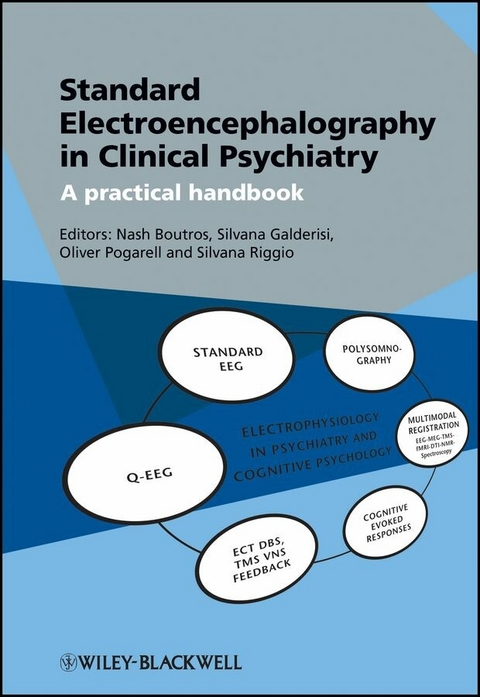
Standard Electroencephalography in Clinical Psychiatry (eBook)
John Wiley & Sons (Verlag)
978-0-470-97462-9 (ISBN)
With the basic information in hand, the reader progresses to an account of the role of EEG in the diagnostic work up in psychiatry, covering nonconvulsive status epilepticus, frontal lobe seizures and non-epileptic seizures. The clinical application of EEG in both childhood and adult disorders follows, including many case vignettes. The effects of psychotropic drugs on EEG are highlighted.
The book closes with a discussion of currently available certification venues for Clinical Neurophysiology along with limitations of each venue. It calls for the development of training guidelines and certification processes specific to Psychiatric Electrophysiology.
The material is clearly presented throughout, with plenty of figures, tables with summaries of relevant findings, flow diagrams for diagnostic work-up, boxes with learning points, and short lists of key references.
We fully expect the book will become the standard teaching source for psychiatry residents and fellows, as well as a useful resource for practising psychiatrists and clinical psychologists.
Praise for the book:
'This distinguished group of editors has put together chapters that represent an excellent practical handbook on electroencephalography in clinical psychiatry, now a very important topic. I highly recommend it not only to psychiatrists, but also to anyone interested in neuroscience.'
John R. Hughes, DM (Oxon), MD, PhD, Professor of Neurology, University of Illinois Medical Center, at Chicago, Illinois, USA
Nash Boutros, MD, is Professor of Psychiatry and Neurology, Director of the Divisions of Clinical Cognitive Neuroscience, Neuropsychiatry and Clinical Electrophysiology, and Associate Chair for Research of the Department of Psychiatry and Behavioral Neurosciences at Wayne State University School of Medicine. He is the local Director of an NIMH-funded multicenter study for the identification of the endophenotypes of schizophrenia and bipolar disorders. Dr. Boutros is internationally renowned for his research on the electrophysiological correlates of psychiatric disorders, particularly schizophrenia, the relationship of isolated epileptic activity to psychiatric disorders and the development of methodology to facilitate the translation of interesting biological findings to clinically useful tests. In recent years, his research has focused on developing an animal model for isolated epileptic spike discharges and examining the behavioral correlates of such events. This effort is motivated by the not uncommon human problem of having isolated epileptic discharges and behavioral aberrations in the absence of frank epilepsy. Dr. Boutros is a senior fellow of the American Psychiatric Association and fellow of the American Neuropsychiatric Association and one of the founders of the EEG and Clinical Neuroscience Society (ECNS). He is Editor-in-Chief of the International Psychiatry and Behavioral Neuroscience Year Book which selects papers published from all non-English languages where science is published. Dr. Boutros has written over 170 peer-reviewed journal articles and chapters, as well as The Brain and Behavior: An Introduction to Behavioral Neuroanatomy.
Silvana Galderisi is Professor of Psychiatry and Director of the training school in Psychiatry at the University of Naples SUN. She is Director of the Emergency Unit of the Department of Mental Health of the same University. She is also Chairperson of the WPA Psychophysiology Section, President of the EEG & Clinical Neuroscience Society, co-Chair of the International Society for Brain Electromagnetic Topography. She has authored more than 150 publications, in national and international journals and books, and is member of the Editorial Board of Psychiatry Research Neuroimaging, European Journal of Psychiatry, Brain Topography, International Journal of Psychophysiology, Neuropsychobiology,Clinical EEG and Neuroscience and European Psychiatric Review. Her main contribution to the international literature in the field of Electrophysiology includes EEG and ERP abnormalities of major psychiatric disorders, especially schizophrenia, and the identification of early drug-induced EEG changes predictive of treatment response in schizophrenia patients.
Oliver Pogarell MD, PhD, is neurologist, psychiatrist and Head of the Dept. of Clinical Neurophysiology and Functional Neuroimaging at the Clinic for Psychiatry and Psychotherapy, University of Munich, Germany. He is member of national and international neurophysiology societies and host of annual scientific training courses in clinical neurophysiology in Germany. His lab offers the entire spectrum of neurophysiological diagnostics for the Dept. of Psychiatry with about 3500 EEG recordings per year. In addition to visual EEGs within the clinical routine, he has expertise in quantitative EEG techniques including dipole source analysis or low resolution electromagnetic tomography both in resting state and under stimulation with cognitive paradigms. His research has focused on neurophysiology as well as functional and molecular neuroimaging in neuropsychiatric disorders.
Silvana Riggio, MD, Professor of Neurology and Psychiatry at the Mount Sinai School of Medicine (MSSM). Dr.Riggio trained in Neurology at Georgetown University. She is fellowship trained in neuro-electrophysiology at John Hopkins and in Clinical Epilepsy at the Medical College of Pennsylvania (MCP). She served as the Co-Director of the Mid- Epilepsy Center from 1989 - 1991 and the Director of the Epilepsy Program at Mayo Clinic Jacksonville, 1992-1995. Dr. Riggio developed a strong interest in disorders of the frontal lobe and their behavioral manifestations. She trained in Psychiatry at Cornell Weill Medical Center after which she came to Mount Sinai in 1998. She has lectured nationally and internationally and has participated on National Committees related to traumatic brain injury (TBI). Dr. Riggio participated on the ACEP-CDC guidelines task force on mild TBI which was published in December 2008 and is currently finishing a CDC project on discharge instructions for patients with mild TBI. Dr. Riggio has expertise in understanding the interface between neurologic, behavioral, and physical health. She has authored over 50 articles and book chapters and has edited 8 books and journal supplements. Most recently she edited a theme issue of the Mount Sinai Journal of Medicine, 'Traumatic Brain Injury, from Bench to Bedside to Home'. She is currently editing an issue for the Psychiatric Clinics of North America on Traumatic Brain Injury. Dr. Riggio is a member of the advisory board for the Indian Head Injury Foundation and also for the Foundation for Education and Research in Neurologic Emergencies (FERNE).She has been the primary investigator or co-investigator on 22 grants. She has been recognized for excellence in teaching having received many awards including the MSSM Institute of Medical Education Teaching Achievement Award; she was honored the title of Commendatore OSSI by the Italian government in 2009. Dr. Riggio is the Medical Director for the NFL Neurological Care Program at Mount Sinai which was established in 2010.
This book provides a concise overview of the possible clinical applications of standard EEG in clinical psychiatry. After a short history, the book describes the physiologic basis of the EEG signal, then reviews the principles of EEG in terms of technical backgrounds and requirements, EEG recording and signal analysis, with plentiful illustrations of the most frequent biological or technical artefacts. Normal EEG patterns and waveforms for easy reference are clearly presented, before the detailed description of abnormal patterns. With the basic information in hand, the reader progresses to an account of the role of EEG in the diagnostic work up in psychiatry, covering nonconvulsive status epilepticus, frontal lobe seizures and non-epileptic seizures. The clinical application of EEG in both childhood and adult disorders follows, including many case vignettes. The effects of psychotropic drugs on EEG are highlighted. The book closes with a discussion of currently available certification venues for Clinical Neurophysiology along with limitations of each venue. It calls for the development of training guidelines and certification processes specific to Psychiatric Electrophysiology. The material is clearly presented throughout, with plenty of figures, tables with summaries of relevant findings, flow diagrams for diagnostic work-up, boxes with learning points, and short lists of key references. We fully expect the book will become the standard teaching source for psychiatry residents and fellows, as well as a useful resource for practising psychiatrists and clinical psychologists. Praise for the book: "e;This distinguished group of editors has put together chapters that represent an excellent practical handbook on electroencephalography in clinical psychiatry, now a very important topic. I highly recommend it not only to psychiatrists, but also to anyone interested in neuroscience."e; John R. Hughes, DM (Oxon), MD, PhD, Professor of Neurology, University of Illinois Medical Center, at Chicago, Illinois, USA
Standard Electroencephalographyin Clinical Psychiatry 3
Contents 7
List of Contributors 11
Preface 13
1 Historical Review of Electroencephalography in Psychiatry 17
Introduction 17
The early pre-clinical era 17
Early history of human electroencephalography 19
Electroencephalography in psychiatry today 21
References 21
2 Physiologic Basis of the EEG Signal 23
Membrane potentials 23
Excitatory and inhibitory postsynaptic potentials 24
Nonsynaptic intercellular events contributing to the EEG signal 24
Factors determining polarity and other characteristics of the surface EEG waveforms 24
Brain structures involved in the genesis of EEG rhythms 26
References 28
3 EEG Recording and Analysis 29
Techniques and technical background 29
References 46
4 Normal EEG Patterns and Waveforms 49
Introduction 49
Normal EEG patterns in the waking adult 51
References 70
5 Abnormal Patterns 75
Introduction 75
Detection of artefacts 76
Abnormal patterns 76
Focal alterations 84
References 92
6 The Role of EEG in the Diagnostic Work Up in Psychiatry: Nonconvulsive Status Epilepticus, Frontal Lobe Seizures, Non-Epileptic Seizures 93
Nonconvulsive status 93
Psychogenic non-epileptic seizures 97
Frontal lobe seizures 101
References 104
7 EEG in Childhood Psychiatric Disorders 107
Introduction 107
Attention deficit disorder 108
Autistic spectrum disorders 116
References 124
8 EEG in Psychoses, Mood Disorders and Catatonia 129
Introduction 129
EEG in psychoses 130
EEG in mood disorders 139
EEG findings in catatonia 140
References 145
9 Standard EEG in Personality and Anxiety Disorders 149
Introduction 149
EEG in aggression and impulse dyscontrol 149
Panic attacks 154
Borderline personality disorder 158
References 160
10 EEG in Delirium and Dementia 163
Introduction: Epidemiology of delirium and dementia 163
Clinical diagnosis in delirium 165
EEG work up in delirium 166
Metabolic causes of delirium 167
Infectious causes of delirium 170
Clinical diagnosis and EEG work up in dementia 171
Conclusion 174
References 175
11 Effects of Psychotropic Drugs on EEG 179
Introduction 179
The role of EEG assessment of drug-induced CNS toxicity in psychiatric patients 179
Antipsychotic drugs 180
Lithium 182
Other mood stabilisers 183
Anxiolytics 184
Antidepressants 185
Recreational drugs 185
Case vignette 186
References 187
12 Certification and Training in EEG and Clinical Neurophysiology 189
Clinical neurophysiology board certification 189
Index 195
"This handbook, written and edited by experts in the field, is a welcome addition to the psychiatric literature. The only comparable book on this topic is EEG and Evoked Potentials in Psychiatry and Behavioral Neurology, Hughes and Wilson (Butterworth-Heinemann, 1983). This handbook is sort of an update of that classic." (Doody's, 7 October 2011)
"Whether such a curriculum is defined in your country or not the book is recommended to all psychiatrists and clinical psychologists working with diagnosis of patients. For psychiatric residents it is an easily accessible, handy yet sufficiently exhaustive introduction to EEG." (Acta Neuropsychiatrica, 2011)
"In summary, this book will most certainly be included in psychiatry curricula and will be a milestone of which Hans Berger will be proud." (Epilepsy & Behavior, 7 May 2011)
"The guide is readable and is useful for medical students, psychiatric residents and clinicians seeking to augment their clinical skills in managing complex psychiatric treatments. The book fills a need and is a reminder that brain physiology is the core component in understanding and treating the aberrant behaviors that fill psychiatric clinics." (Acta, 1 May 2011)
| Erscheint lt. Verlag | 10.2.2011 |
|---|---|
| Sprache | englisch |
| Themenwelt | Medizin / Pharmazie ► Medizinische Fachgebiete ► Neurologie |
| Medizin / Pharmazie ► Medizinische Fachgebiete ► Psychiatrie / Psychotherapie | |
| Schlagworte | Applications • artefacts • biological • Book • Clinical • Clinical psychology • concise • EEG • Frequent • Illustrations • Klinische Psychologie • Medical Science • Medizin • Neurologie • Neurology • Overview • Physiologic basis • plentiful • possible • Principles • Psychiatrie • Psychiatry • Psychologie • Psychology • Requirements • short history • Signal • Standard • technical • Terms |
| ISBN-10 | 0-470-97462-1 / 0470974621 |
| ISBN-13 | 978-0-470-97462-9 / 9780470974629 |
| Informationen gemäß Produktsicherheitsverordnung (GPSR) | |
| Haben Sie eine Frage zum Produkt? |
 PDF (Adobe DRM)
Kopierschutz: Adobe-DRM
Adobe-DRM ist ein Kopierschutz, der das eBook vor Mißbrauch schützen soll. Dabei wird das eBook bereits beim Download auf Ihre persönliche Adobe-ID autorisiert. Lesen können Sie das eBook dann nur auf den Geräten, welche ebenfalls auf Ihre Adobe-ID registriert sind.
Details zum Adobe-DRM
Dateiformat: PDF (Portable Document Format)
Mit einem festen Seitenlayout eignet sich die PDF besonders für Fachbücher mit Spalten, Tabellen und Abbildungen. Eine PDF kann auf fast allen Geräten angezeigt werden, ist aber für kleine Displays (Smartphone, eReader) nur eingeschränkt geeignet.
Systemvoraussetzungen:
PC/Mac: Mit einem PC oder Mac können Sie dieses eBook lesen. Sie benötigen eine
eReader: Dieses eBook kann mit (fast) allen eBook-Readern gelesen werden. Mit dem amazon-Kindle ist es aber nicht kompatibel.
Smartphone/Tablet: Egal ob Apple oder Android, dieses eBook können Sie lesen. Sie benötigen eine
Geräteliste und zusätzliche Hinweise
Buying eBooks from abroad
For tax law reasons we can sell eBooks just within Germany and Switzerland. Regrettably we cannot fulfill eBook-orders from other countries.
aus dem Bereich