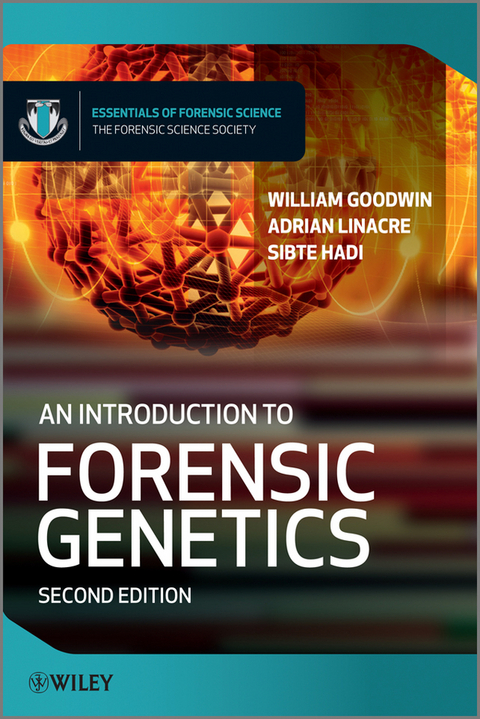
An Introduction to Forensic Genetics (eBook)
John Wiley & Sons (Verlag)
978-0-470-97307-3 (ISBN)
Key Features:
- Greater in-depth coverage of kinship problems now covered in two separate chapters: one dealing with relationships between living individuals and the other covering identification of human remains.
- New chapter on non-human forensic genetics, including identification of bacteria and viruses, animals and plants.
- Self assessment questions to aid student understanding throughout the text.
- Now with full colour illustrations throughout
- New companion website
- Accessible introduction to forensic genetics, from the collection of evidence to the presentation of evidence in a legal context.
Included in the Forensic Science Society 'Essentials in Forensic Science' book series. This edition is to be included in the Forensic Science Society 'Essentials of Forensic Science' book series aimed at advanced level undergraduates and new practitioners to the field.
Dr Will Goodwin, Senior Lecturer in Forensic Genetics, Faculty of Science and Technology, University of Central Lancashire.
Dr Sibte Hadi, Senior Lecturer in Forensic Genetics, Faculty of Science and Technology, University of Central Lancashire.
Dr Adrian M. T. Linacre, Department of Pure and Applied Chemistry, University of Strathclyde.
This is a completely revised edition of a comprehensive and popular introduction to the fast moving area of Forensic Genetics. The text begins with key concepts needed to fully appreciate the subject and moves on to examine the latest developments in the field. Now illustrated in full colour throughout, this accessible textbook includes numerous references to relevant casework. With information on the full process of DNA evidence from collection at the scene of a crime to presentation in a legal context this book provides a complete overview of the field. Key Features: Greater in-depth coverage of kinship problems now covered in two separate chapters: one dealing with relationships between living individuals and the other covering identification of human remains. New chapter on non-human forensic genetics, including identification of bacteria and viruses, animals and plants. Self assessment questions to aid student understanding throughout the text. Now with full colour illustrations throughout New companion website Accessible introduction to forensic genetics, from the collection of evidence to the presentation of evidence in a legal context. Included in the Forensic Science Society 'Essentials in Forensic Science' book series. This edition is to be included in the Forensic Science Society 'Essentials of Forensic Science' book series aimed at advanced level undergraduates and new practitioners to the field.
Dr Will Goodwin, Senior Lecturer in Forensic Genetics, Faculty of Science and Technology, University of Central Lancashire. Dr Sibte Hadi, Senior Lecturer in Forensic Genetics, Faculty of Science and Technology, University of Central Lancashire. Dr Adrian M. T. Linacre, Department of Pure and Applied Chemistry, University of Strathclyde.
An Introduction to Forensic Genetics 3
Contents 7
Foreword 11
Preface 13
Preface to first edition 15
1 Introduction to forensic genetics 17
Forensic genetics 17
A brief history of forensic genetics 18
References 22
2 DNA structure and the genome 27
DNA structure 27
Organization of DNA into chromosomes 27
The structure of the human genome 29
Genetic diversity of modern humans 31
The genome and forensic genetics 32
Tandem repeats 32
Single nucleotide polymorphisms 34
References 35
3 Biological material – collection, characterization and storage 37
Sources of biological evidence 37
Collection and handling of material at the crime scene 39
Identification and characterization of biological evidence 39
Evidence collection 45
Sexual and physical assault 47
Storage of biological material 48
References 48
4 DNA extraction and quantification 53
DNA extraction 53
General principles of DNA extraction 53
DNA extraction from challenging samples 57
Quantification of DNA 61
DNA IQ system 64
References 65
5 Polymerase chain reaction 69
The evolution of PCR-based profiling in forensic genetics 69
DNA replication: the basis of the PCR 70
The components of PCR 70
Taq DNA polymerase 70
The PCR process 72
PCR inhibition 74
Sensitivity and contamination 76
The PCR laboratory 76
Further reading 78
References 78
6 The analysis of short tandem repeats 83
Structure of STR loci 83
The development of STR multiplexes 83
Detection of STR polymorphisms 86
Interpretation of STR profiles 88
Further reading 93
References 93
7 Assessment of STR profiles 97
Stutter peaks 97
Split peaks (±N) 97
Pull-up 99
Template DNA 100
Overloaded profiles 100
Low template DNA typing 100
Peak balance 102
Mixtures 102
Degraded DNA 104
PCR inhibition 106
References 107
8 Statistical interpretation of STR profiles 111
Population genetics 111
Deviation from the Hardy–Weinberg equilibrium 112
Statistical tests to determine deviation from the Hardy–Weinberg equilibrium 113
Estimating the frequencies of STR profiles 114
Corrections to allele frequency databases 114
Which population frequency database should be used? 119
Conclusions 120
Further reading 120
References 120
9 Evaluation and presentation of DNA evidence 123
Hierarchies of propositions 123
Likelihood ratios 125
Two fallacies 129
Comparison of three approaches 130
Further reading 131
References 131
10 Databases of DNA profiles 133
The UK National DNA Database 133
International situation 140
Further reading 144
References 144
11 Kinship testing 147
Parentage testing 147
Punnett square 148
Identification of human remains 155
Further reading 156
References 156
12 Single nucleotide polymorphisms 161
SNPs – occurrence and structure 161
Detection of SNPs 162
SNP detection for forensic applications 164
Forensic applications of SNPs 165
SNPs compared with STR loci 166
References 168
13 Lineage markers 171
Mitochondria 171
Applications of mtDNA profiling 173
Haplotypes and haplogroups 175
The Y chromosome 177
Forensic applications of Y chromosome polymorphisms 178
Further reading 181
References 181
14 Non-human DNA typing 187
Non-human sample types 187
Species identification 189
Linkage to an individual using STR loci 190
Linkage to an individual using mitochondrial loci 191
Microbial DNA testing 192
Concluding comments 192
Further reading 192
References 192
Appendix A Forensic parameters 197
Appendix B Useful web links 199
Glossary 201
Abbreviations 205
Index 209
"William Goodwin, Sibte Hadi (both U. of Central Lancashire, England), and Adrian Linacre (Flinders U. Australia) provide a textbook for a first undergraduate course, covering all aspects of forensic genetics briefly, with references to more detailed coverage of particular aspects elsewhere." (Booknews, 1 April 2011)
| Erscheint lt. Verlag | 4.11.2010 |
|---|---|
| Reihe/Serie | Essential Forensic Science |
| Essential Forensic Science | Essentials of Forensic Science |
| Sprache | englisch |
| Themenwelt | Studium ► 2. Studienabschnitt (Klinik) ► Humangenetik |
| Studium ► 2. Studienabschnitt (Klinik) ► Rechtsmedizin | |
| Naturwissenschaften ► Biologie | |
| Naturwissenschaften ► Chemie | |
| Schlagworte | accessible • Analytische Chemie / Forensik • area • Biowissenschaften • Book • Casework • Chemie • Chemistry • Collection • Colour • Concepts • Crime • DNA • Edition • fast moving • forensic genetics • Forensics • Forensic Science • Forensik • Forensische Wissenschaft • full • Genetics • Genetik • Introduction • Key • Latest • Life Sciences • popular introduction • References • relevant • Scene • Subject • Textbook • throughout |
| ISBN-10 | 0-470-97307-2 / 0470973072 |
| ISBN-13 | 978-0-470-97307-3 / 9780470973073 |
| Informationen gemäß Produktsicherheitsverordnung (GPSR) | |
| Haben Sie eine Frage zum Produkt? |
 PDF (Adobe DRM)
Kopierschutz: Adobe-DRM
Adobe-DRM ist ein Kopierschutz, der das eBook vor Mißbrauch schützen soll. Dabei wird das eBook bereits beim Download auf Ihre persönliche Adobe-ID autorisiert. Lesen können Sie das eBook dann nur auf den Geräten, welche ebenfalls auf Ihre Adobe-ID registriert sind.
Details zum Adobe-DRM
Dateiformat: PDF (Portable Document Format)
Mit einem festen Seitenlayout eignet sich die PDF besonders für Fachbücher mit Spalten, Tabellen und Abbildungen. Eine PDF kann auf fast allen Geräten angezeigt werden, ist aber für kleine Displays (Smartphone, eReader) nur eingeschränkt geeignet.
Systemvoraussetzungen:
PC/Mac: Mit einem PC oder Mac können Sie dieses eBook lesen. Sie benötigen eine
eReader: Dieses eBook kann mit (fast) allen eBook-Readern gelesen werden. Mit dem amazon-Kindle ist es aber nicht kompatibel.
Smartphone/Tablet: Egal ob Apple oder Android, dieses eBook können Sie lesen. Sie benötigen eine
Geräteliste und zusätzliche Hinweise
Buying eBooks from abroad
For tax law reasons we can sell eBooks just within Germany and Switzerland. Regrettably we cannot fulfill eBook-orders from other countries.
aus dem Bereich