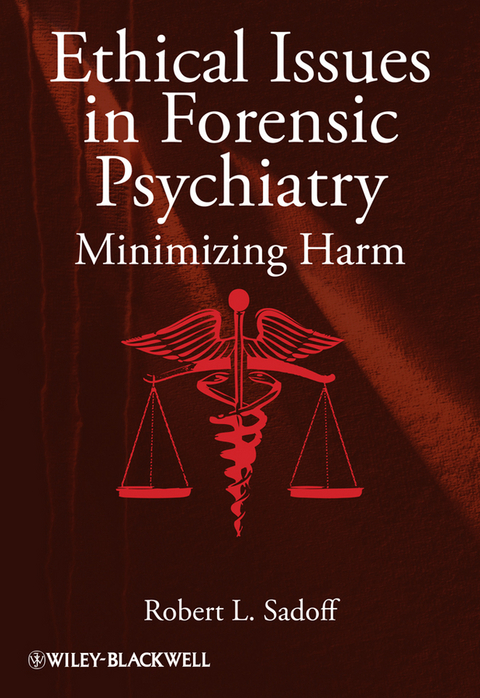
Ethical Issues in Forensic Psychiatry (eBook)
John Wiley & Sons (Verlag)
978-0-470-97187-1 (ISBN)
Robert Sadoff addresses the long-term harm that can be either avoided or minimized through careful planning and application of ethical principles. He is not advocating that the harm can be totally eliminated, because that is impossible in the adversarial system in which forensic psychiatrists work. However, there are means by which harm may be minimized if care is taken during the assessment, the report writing, and the testimony phase of the proceedings. The book develops the scope of forensic psychiatry from the standpoint of administrative, civil and criminal cases. It presents the practical issues involved in conducting forensic psychiatric assessments under various conditions plus special considerations, such as bias, minimizing harm, developing a therapeutic approach, and elaborating on various vulnerable individuals who are frequently examined in forensic cases. These include juveniles, mentally retarded, autistic, sexual assault victims, the elderly, the organically damaged, the psychotic, and mentally disabled prisoners. Immigrants are covered in a chapter by Solange Margery Bertoglia. The ethical issues in conducting forensic psychiatric examinations and presenting psychiatric testimony in court are examined and discussed. Cases illustrating the difficulties involved punctuate the presentation. The book closes with a fascinating account of the legal perspective by Donna Vanderpool.
In summary, this book illustrates the ethical and practical issues that affect forensic psychiatric practice. The question is not what we do, but how we do it, and which standards, ethical guidelines and personal values contribute to the total picture. Despite the fact that we cannot always adhere to the doctrine of 'primum non nocere,' we can minimize the harm caused inherently by the adversarial system in which we participate.
Praise for Ethical Issues in Forensic Psychiatry
'One of the founding giants of the forensic psychiatric field has written here far more than a 'mere' ethics textbook. Instead, this compendium serves multiple purposes: it is a valuable primer on forensic techniques of examination and testimony, a model of best forensic practices, and an instruction on the most appropriately civilized way in which to conduct oneself as a forensic psychiatrist.
The success of these multiple accomplishments clearly derives from characteristics of the author. In both sage advice to practitioners and in many revealing case examples, Dr. Sadoff displays the tact, good manners and sensitivity of a consummate gentleman - a term not always associated with the hurly-burly of courtroom work. The book's primary focus on avoiding harm to all the parties involved in the work places it on the moral high ground of the legal system in which participating clinicians must find a place.'
Thomas G. Gutheil, MD, Professor of Psychiatry and Co-Founder, Program in Psychiatry and the Law, Beth Israel Deaconess Medical Center, Harvard Medical School
Robert L. Sadoff, M.D. is Clinical Professor of Psychiatry and Director of the Center for Studies in Social-Legal Psychiatry at the University of Pennsylvania School of Medicine. He is board certified in psychiatry, forensic psychiatry, and legal medicine, and has added qualifications in forensic psychiatry with the American Board of Psychiatry and Neurology.
Dr. Sadoff is the author of over 100 articles in medical and legal journals, more than 30 chapters in other books, and has authored, edited, or coauthored 8 books, including Forensic Psychiatry: A Practical Guide for Lawyers and Psychiatrists, Psychiatry Malpractice: Cases and Comments for Clinicians and Mental Health Experts: Roles and Qualifications for Court. Dr. Sadoff has examined over 10,000 individuals charged with crimes during the past 40 years, and has testified for both the prosecution and defense in criminal cases and for the plaintiff and defense in civil cases in approximately 20 states and several federal jurisdictions.
Dr. Sadoff is the recipient of numerous awards, including Best Doctors in America, Who's Who in the World, The Lifetime Achievement Award of the Philadelphia Psychiatric Society, the Nathaniel Winkelman Award, the Manfred Guttmacher Award from the American Psychiatric Association, the Philippe Pinel Award from the International Academy of Law and Mental Health, and the prestigious Isaac Ray Award from the American Psychiatric Association. He has also received the Earl Bond Award from the University of Pennsylvania as the Outstanding Teacher in Psychiatry for 1979, and the Dean's Award for Outstanding Contributions to Medicine at the University of Pennsylvania Medical School for 2008.
Ethical medical practice and treatment in psychiatry are based on the concept of first do no harm. However, this cannot, and does not, apply to forensic cases where there is no doctor patient relationship and the forensic psychiatrist may indeed cause harm to the examinee. In this book, Robert Sadoff analyzes the ethical issues affecting forensic psychiatric practice, especially those promulgated by the American Academy of Psychiatry and the Law. Within those guidelines, he looks at individual bias, vulnerability of the examinee, and potential harm to the mental health professional. The book discusses each of the procedures of the forensic expert separately with respect to minimizing harm. It has been written with an international audience in mind and features chapters reviewing the European and UK perspectives, by Emanuele Valenti and John Baird, respectively. Robert Sadoff addresses the long-term harm that can be either avoided or minimized through careful planning and application of ethical principles. He is not advocating that the harm can be totally eliminated, because that is impossible in the adversarial system in which forensic psychiatrists work. However, there are means by which harm may be minimized if care is taken during the assessment, the report writing, and the testimony phase of the proceedings. The book develops the scope of forensic psychiatry from the standpoint of administrative, civil and criminal cases. It presents the practical issues involved in conducting forensic psychiatric assessments under various conditions plus special considerations, such as bias, minimizing harm, developing a therapeutic approach, and elaborating on various vulnerable individuals who are frequently examined in forensic cases. These include juveniles, mentally retarded, autistic, sexual assault victims, the elderly, the organically damaged, the psychotic, and mentally disabled prisoners. Immigrants are covered in a chapter by Solange Margery Bertoglia. The ethical issues in conducting forensic psychiatric examinations and presenting psychiatric testimony in court are examined and discussed. Cases illustrating the difficulties involved punctuate the presentation. The book closes with a fascinating account of the legal perspective by Donna Vanderpool. In summary, this book illustrates the ethical and practical issues that affect forensic psychiatric practice. The question is not what we do, but how we do it, and which standards, ethical guidelines and personal values contribute to the total picture. Despite the fact that we cannot always adhere to the doctrine of "e;primum non nocere,"e; we can minimize the harm caused inherently by the adversarial system in which we participate. Praise for Ethical Issues in Forensic Psychiatry "e;One of the founding giants of the forensic psychiatric field has written here far more than a "e;mere"e; ethics textbook. Instead, this compendium serves multiple purposes: it is a valuable primer on forensic techniques of examination and testimony, a model of best forensic practices, and an instruction on the most appropriately civilized way in which to conduct oneself as a forensic psychiatrist. The success of these multiple accomplishments clearly derives from characteristics of the author. In both sage advice to practitioners and in many revealing case examples, Dr. Sadoff displays the tact, good manners and sensitivity of a consummate gentleman a term not always associated with the hurly-burly of courtroom work. The book's primary focus on avoiding harm to all the parties involved in the work places it on the moral high ground of the legal system in which participating clinicians must find a place."e; Thomas G. Gutheil, MD, Professor of Psychiatry and Co-Founder, Program in Psychiatry and the Law, Beth Israel Deaconess Medical Center, Harvard Medical School
Robert L. Sadoff, M.D. is Clinical Professor of Psychiatry and Director of the Center for Studies in Social-Legal Psychiatry at the University of Pennsylvania School of Medicine. He is board certified in psychiatry, forensic psychiatry, and legal medicine, and has added qualifications in forensic psychiatry with the American Board of Psychiatry and Neurology. Dr. Sadoff is the author of over 100 articles in medical and legal journals, more than 30 chapters in other books, and has authored, edited, or coauthored 8 books, including Forensic Psychiatry: A Practical Guide for Lawyers and Psychiatrists, Psychiatry Malpractice: Cases and Comments for Clinicians and Mental Health Experts: Roles and Qualifications for Court. Dr. Sadoff has examined over 10,000 individuals charged with crimes during the past 40 years, and has testified for both the prosecution and defense in criminal cases and for the plaintiff and defense in civil cases in approximately 20 states and several federal jurisdictions. Dr. Sadoff is the recipient of numerous awards, including Best Doctors in America, Who's Who in the World, The Lifetime Achievement Award of the Philadelphia Psychiatric Society, the Nathaniel Winkelman Award, the Manfred Guttmacher Award from the American Psychiatric Association, the Philippe Pinel Award from the International Academy of Law and Mental Health, and the prestigious Isaac Ray Award from the American Psychiatric Association. He has also received the Earl Bond Award from the University of Pennsylvania as the Outstanding Teacher in Psychiatry for 1979, and the Dean's Award for Outstanding Contributions to Medicine at the University of Pennsylvania Medical School for 2008.
Ethical Issues in Forensic Psychiatry 3
Contents 9
About the Authors 11
Preface 15
Acknowledgments 23
Introduction 25
List of Contributors 35
Part One Ethics in Forensic Psychiatry 37
1 Ethical Issues in Forensic Psychiatry in the United States 39
2 Minimizing Harm: A Perspective from Forensic Psychiatry in the United Kingdom 63
3 Mental Health and Human Rights in Forensic Psychiatry in the European Union 71
Part Two The Practice of Forensic Psychiatry 93
4 The Forensic Psychiatric Examination 95
5 The Forensic Psychiatric Report 115
6 Expert Psychiatric Testimony 133
Part Three Vulnerable Populations in the Justice System 147
7 Children and Adolescents 149
8 The Elderly, the Mentally Retarded, and the Severely Mentally Disabled 171
9 Victims and Predators of Sexual Violence 185
10 Immigrants: A Vulnerable Population 191
11 Prisoners and Death Row Inmates 203
12 Forensic Psychiatric Experts: Risks and Liability 213
13 Risks of Harm to the Forensic Expert: the Legal Perspective 233
Index 249
"Sadoff's book is a vital contribution to the psychiatric
literature, as it fills a need unaddressed by more theoretically
oriented works. Anyone interested in mental health or medical
ethics will find this text worthwhile, especially as it contains an
introduction for lay readers explaining basic forensic roles and
functions.The book is most valuable, however, to forensic mental
health practioners, who will benefit from its practical instruction
aimed at minimizing harm." (Journal of Clinical Psychiatry,
December 2012)
"Sadoff has crafted an admirable mix of facts and anecdotes,
presented in a manner
that could help undergraduates get a taste for the realities of
forensic practice, help graduate
students connect the theoretical with the practical, and even
provide veteran practitioners
with helpful reminders and provocative food for thought."
(PsycCRITIQUES, 23 November 2011)
"It will serve as a useful resource and is a welcome addition to
my library." (Doody's, 11 November 2011)
"While Ethical Issues in Forensic Psychiatry appears to be
targeted at the forensic psychiatrist, as emphasised in the title,
I believe that it can be valuable reading for all forensic mental
health professionals. . . Ethical Issues in Forensic Psychiatry
makes practical ethics easy reading. . . This book is an invaluable
guide to ethical practice." (Journal of Mental Health, 1 October
2011)
| Erscheint lt. Verlag | 3.12.2010 |
|---|---|
| Sprache | englisch |
| Themenwelt | Medizin / Pharmazie ► Medizinische Fachgebiete ► Medizinethik |
| Medizin / Pharmazie ► Medizinische Fachgebiete ► Psychiatrie / Psychotherapie | |
| Studium ► 2. Studienabschnitt (Klinik) ► Rechtsmedizin | |
| Studium ► Querschnittsbereiche ► Geschichte / Ethik der Medizin | |
| Schlagworte | Academy • American • Book • cases • cause • Concept • doctorpatient relationship • Ethical • First • Forensic • Harm • indeed • Individual • Issues • Medical • Medical Science • Medizin • Practice • Psychiatric • Psychiatrie • Psychiatrist • Psychiatry • Robert • sadoff • Treatment |
| ISBN-10 | 0-470-97187-8 / 0470971878 |
| ISBN-13 | 978-0-470-97187-1 / 9780470971871 |
| Informationen gemäß Produktsicherheitsverordnung (GPSR) | |
| Haben Sie eine Frage zum Produkt? |
 PDF (Adobe DRM)
Kopierschutz: Adobe-DRM
Adobe-DRM ist ein Kopierschutz, der das eBook vor Mißbrauch schützen soll. Dabei wird das eBook bereits beim Download auf Ihre persönliche Adobe-ID autorisiert. Lesen können Sie das eBook dann nur auf den Geräten, welche ebenfalls auf Ihre Adobe-ID registriert sind.
Details zum Adobe-DRM
Dateiformat: PDF (Portable Document Format)
Mit einem festen Seitenlayout eignet sich die PDF besonders für Fachbücher mit Spalten, Tabellen und Abbildungen. Eine PDF kann auf fast allen Geräten angezeigt werden, ist aber für kleine Displays (Smartphone, eReader) nur eingeschränkt geeignet.
Systemvoraussetzungen:
PC/Mac: Mit einem PC oder Mac können Sie dieses eBook lesen. Sie benötigen eine
eReader: Dieses eBook kann mit (fast) allen eBook-Readern gelesen werden. Mit dem amazon-Kindle ist es aber nicht kompatibel.
Smartphone/Tablet: Egal ob Apple oder Android, dieses eBook können Sie lesen. Sie benötigen eine
Geräteliste und zusätzliche Hinweise
Buying eBooks from abroad
For tax law reasons we can sell eBooks just within Germany and Switzerland. Regrettably we cannot fulfill eBook-orders from other countries.
aus dem Bereich