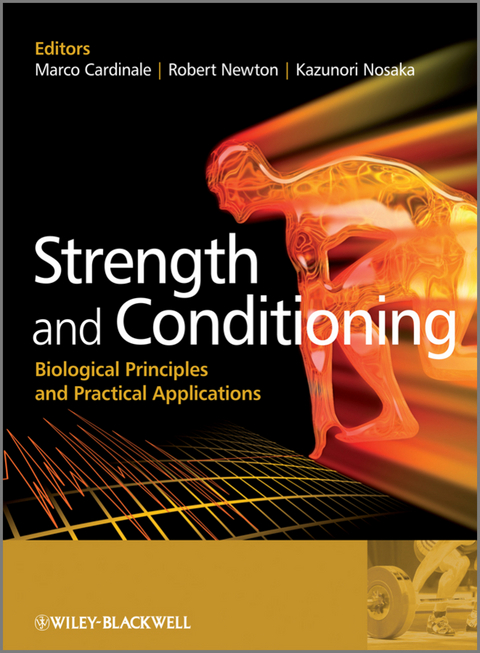
Strength and Conditioning (eBook)
John Wiley & Sons (Verlag)
978-0-470-97000-3 (ISBN)
from the foreword by Sir Clive Woodward, Olympic Performance Director, British Olympic Association
This book provides the latest scientific and practical information in the field of strength and conditioning.
The text is presented in four sections, the first of which covers the biological aspects of the subject, laying the foundation for a better understanding of the second on the biological responses to strength and conditioning programs. Section three deals with the most effective monitoring strategies for evaluating a training program and establishing guidelines for writing a successful strength and conditioning program. The final section examines the role of strength and conditioning as a rehabilitation tool and as applied to those with disabilities.
This book is an invaluable textbook and reference both for academic programs and for the continuing education of sports professionals.
- Integrates the latest research on physiological, anatomical and biomechanical aspects of strength and conditioning
- Offers numerous practical examples of applications
- Provides guidelines for writing and monitoring effective strength training programs
Dr. Marco Cardinale is the Head of Sports Physiology at Aspire Academy in Qatar. He was the former Head of Sports Science and Research of the British Olympic Association.
Robert Newton is the editor of Strength and Conditioning: Biological Principles and Practical Applications, published by Wiley.
Kazunori Nosaka is the editor of Strength and Conditioning: Biological Principles and Practical Applications, published by Wiley.
"e;I recommend that you read and use the information in this book to provide your athletes with the best chances of performing at their best"e; from the foreword by Sir Clive Woodward, Olympic Performance Director, British Olympic Association This book provides the latest scientific and practical information in the field of strength and conditioning. The text is presented in four sections, the first of which covers the biological aspects of the subject, laying the foundation for a better understanding of the second on the biological responses to strength and conditioning programs. Section three deals with the most effective monitoring strategies for evaluating a training program and establishing guidelines for writing a successful strength and conditioning program. The final section examines the role of strength and conditioning as a rehabilitation tool and as applied to those with disabilities. This book is an invaluable textbook and reference both for academic programs and for the continuing education of sports professionals. Integrates the latest research on physiological, anatomical and biomechanical aspects of strength and conditioning Offers numerous practical examples of applications Provides guidelines for writing and monitoring effective strength training programs
Dr. Marco Cardinale is the Head of Sports Physiology at Aspire Academy in Qatar. He was the former Head of Sports Science and Research of the British Olympic Association. Robert Newton is the editor of Strength and Conditioning: Biological Principles and Practical Applications, published by Wiley. Kazunori Nosaka is the editor of Strength and Conditioning: Biological Principles and Practical Applications, published by Wiley.
Strength and Conditioning 1
Contents 7
Foreword by Sir Clive Woodward 15
Preface 17
List of Contributors 19
Section 1: Strength and Conditioning Biology 23
1.1 Skeletal Muscle Physiology 25
1.1.1 INTRODUCTION 25
1.1.2 SKELETAL MUSCLE MACROSTRUCTURE 25
1.1.3 SKELETAL MUSCLE MICROSTRUCTURE 25
1.1.3.1 Sarcomere and myofilaments 26
1.1.3.2 Sarcoplasmic reticulum and transverse tubules 29
1.1.4 CONTRACTION MECHANISM 29
1.1.4.1 Excitation–contraction (E-C) coupling 29
1.1.4.2 Skeletal muscle contraction 29
1.1.5 MUSCLE FIBRE TYPES 31
1.1.6 MUSCLE ARCHITECTURE 32
1.1.7 HYPERTROPHY AND HYPERPLASIA 33
1.1.8 SATELLITE CELLS 34
1.2 Neuromuscular Physiology 39
1.2.1 THE NEUROMUSCULAR SYSTEM 39
1.2.1.1 Motor units 39
1.2.1.2 Muscle receptors 39
1.2.1.3 Nervous and muscular conduction velocity 40
1.2.1.4 Mechanical output production 40
1.2.1.5 Muscle force modulation 42
1.2.1.6 Electrically elicited contractions 44
1.2.2 MUSCLE FATIGUE 44
1.2.2.1 Central and peripheral fatigue 44
1.2.2.2 The role of oxygen availability in fatigue development 45
1.2.3 MUSCLE FUNCTION ASSESSMENT 45
1.2.3.1 Imaging techniques 45
1.2.3.2 Surface EMG as a muscle imaging tool 46
1.2.3.3 Surface EMG for noninvasive neuromuscular assessment 47
1.3 Bone Physiology 51
1.3.1 INTRODUCTION 51
1.3.2 BONE ANATOMY 51
1.3.2.1 Bones as organs 51
1.3.2.2 Bone tissue 52
1.3.2.3 The material level: organic and inorganic constituents 53
1.3.3 BONE BIOLOGY 54
1.3.3.1 Osteoclasts 54
1.3.3.2 Osteoblasts 54
1.3.3.3 Osteocytes 55
1.3.4 MECHANICAL FUNCTIONS OF BONE 55
1.3.4.1 Material properties 55
1.3.4.2 Structural properties 56
1.3.5 ADAPTIVE PROCESSES IN BONE 57
1.3.5.1 Modelling 57
1.3.5.2 Remodelling 57
1.3.5.3 Theories of bone adaptation 58
1.3.5.4 Mechanotransduction 59
1.3.6 ENDOCRINE INVOLVEMENT OF BONE 60
1.3.6.1 Calcium homoeostasis 60
1.3.6.2 Phosphorus homoeostasis 60
1.3.6.3 Oestrogens 60
1.4 Tendon Physiology 67
1.4.1 TENDONS 67
1.4.2 THE MUSCULOTENDINOUS JUNCTION 68
1.4.3 THE OSEOTENDINOUS JUNCTION 68
1.4.4 NERVE SUPPLY 68
1.4.5 BLOOD SUPPLY 68
1.4.6 COMPOSITION 69
1.4.7 COLLAGEN FORMATION 69
1.4.8 CROSS-LINKS 69
1.4.9 ELASTIN 70
1.4.10 CELLS 70
1.4.11 GROUND SUBSTANCE 70
1.4.12 CRIMP 70
1.5 Bioenergetics of Exercise 75
1.5.1 INTRODUCTION 75
1.5.2 EXERCISE, ENERGY, WORK, AND POWER 75
1.5.3 SOURCES OF ENERGY 76
1.5.3.1 Phosphagen metabolism 77
1.5.3.2 The glycolytic system 78
1.5.3.3 Aerobic metabolism: oxidation of carbohydrate, lipid, and protein 79
1.5.4 THE TRICARBOXYLIC ACID (TCA) CYCLE 79
1.5.5 OXYGEN DELIVERY 80
1.5.6 ENERGY STORES 80
1.5.7 CONCLUSION 82
1.6 Respiratory and Cardiovascular Physiology 85
1.6.1 THE RESPIRATORY SYSTEM 85
1.6.1.1 Introduction 85
1.6.1.2 Anatomy 85
1.6.1.3 Gas exchange 85
1.6.1.4 Mechanics of ventilation 88
1.6.1.5 Minute ventilation 89
1.6.1.6 Control of ventilation 90
1.6.2 THE CARDIOVASCULAR SYSTEM 90
1.6.2.1 Introduction 90
1.6.2.2 Anatomy 90
1.6.2.3 The heart 92
1.6.2.4 The vascular system 93
1.6.2.5 Blood and haemodynamics 94
1.6.3 CONCLUSION 96
1.7 Genetic and Signal Transduction Aspects of Strength Training 99
1.7.1 GENETICS OF STRENGTH AND TRAINABILITY 99
1.7.1.1 Introduction to sport and exercise genetics 99
1.7.1.2 Heritability of muscle mass, strength, and strength trainability 99
1.7.2 SIGNAL TRANSDUCTION PATHWAYS THAT MEDIATE THE ADAPTATION TO STRENGTH TRAINING 101
1.7.2.1 Introduction to adaptation to exercise: signal transduction pathway regulation 101
1.7.2.2 Human protein synthesis and breakdown after exercise 102
1.7.2.3 The AMPK–mTOR system and the regulation of protein synthesis 103
1.7.2.4 Potential practical implications 104
1.7.2.5 Myostatin–Smad signalling 105
1.7.2.6 Signalling associated with muscle protein breakdown 105
1.7.2.7 Satellite-cell regulation during strength training 106
1.7.2.8 What we have not covered 106
1.8 Strength and Conditioning Biomechanics 111
1.8.1 INTRODUCTION 111
1.8.1.1 Biomechanics and sport 111
1.8.2 BIOMECHANICAL CONCEPTS FOR STRENGTH AND CONDITIONING 111
1.8.2.1 Time, distance, velocity, and acceleration 112
1.8.2.2 Mass, force, gravity, momentum, work, and power 112
1.8.2.3 Friction 113
1.8.3 THE FORCE–VELOCITY–POWER RELATIONSHIP 113
1.8.4 MUSCULOSKELETAL MACHINES 114
1.8.4.1 Lever systems 114
1.8.4.2 Wheel-axle systems 115
1.8.5 BIOMECHANICS OF MUSCLE FUNCTION 115
1.8.5.1 Length–tension effect 115
1.8.5.2 Muscle angle of pull 115
1.8.5.3 Strength curve 116
1.8.5.4 Line and magnitude of resistance 117
1.8.5.5 Sticking region 117
1.8.5.6 Muscle architecture, strength, and power 117
1.8.5.7 Multiarticulate muscles, active and passive insufficiency 118
1.8.6 BODY SIZE, SHAPE, AND POWER-TO-WEIGHT RATIO 118
1.8.7 BALANCE AND STABILITY 118
1.8.7.1 Factors contributing to stability 118
1.8.7.2 Initiating movement or change of motion 119
1.8.8 THE STRETCH–SHORTENING CYCLE 119
1.8.9 BIOMECHANICS OF RESISTANCE MACHINES 120
1.8.9.1 Free weights 120
1.8.9.2 Gravity-based machines 120
1.8.9.3 Hydraulic resistance 121
1.8.9.4 Pneumatic resistance 121
1.8.9.5 Elastic resistance 122
1.8.10 MACHINES VS FREE WEIGHTS 122
1.8.11 CONCLUSION 122
Section 2: Physiological adaptations to strength and conditioning 125
2.1 Neural Adaptations to Resistance Exercise 127
2.1.1 INTRODUCTION 127
2.1.2 EFFECTS OF STRENGTH TRAINING ON MECHANICAL MUSCLE FUNCTION 127
2.1.2.1 Maximal concentric and eccentric muscle strength 127
2.1.2.2 Muscle power 128
2.1.2.3 Contractile rate of force development 129
2.1.3 EFFECTS OF STRENGTH TRAINING ON NEURAL FUNCTION 129
2.1.3.1 Maximal EMG amplitude 130
2.1.3.2 Contractile RFD: changes in neural factors with strength training 131
2.1.3.3 Maximal eccentric muscle contraction: changes in neural factors with strength training 132
2.1.3.4 Evoked spinal motor neuron responses 136
2.1.3.5 Excitability in descending corticospinal pathways 138
2.1.3.6 Antagonist muscle coactivation 138
2.1.3.7 Force steadiness, fine motor control 141
2.1.4 CONCLUSION 141
2.2 Structural and Molecular Adaptations to Training 147
2.2.1 INTRODUCTION 147
2.2.2 PROTEIN SYNTHESIS AND DEGRADATION IN HUMAN SKELETAL MUSCLE 147
2.2.3 MUSCLE HYPERTROPHY AND ATROPHY 149
2.2.3.1 Changes in fibre type composition with strength training 150
2.2.4 WHAT IS THE SIGNIFICANCE OF SATELLITE CELLS IN HUMAN SKELETAL MUSCLE? 153
2.2.5 CONCURRENT STRENGTH AND ENDURANCE TRAINING: CONSEQUENCES FOR MUSCLE ADAPTATIONS 154
2.3 Adaptive Processes in Human Bone and Tendon 159
2.3.1 INTRODUCTION 159
2.3.2 BONE 159
2.3.2.1 Origin of musculoskeletal forces 159
2.3.2.2 Effects of immobilization on bone 160
2.3.2.3 Effects of exercise on bone 162
2.3.2.4 Bone adaptation across the life span 162
2.3.3 TENDON 163
2.3.3.1 Functional and mechanical properties 163
2.3.3.2 In vivo testing 165
2.3.3.3 Tendon adaptations to altered mechanical loading 165
2.3.4 CONCLUSION 169
2.4 Biochemical Markers and Resistance Training 177
2.4.1 INTRODUCTION 177
2.4.2 TESTOSTERONE RESPONSES TO RESISTANCE TRAINING 177
2.4.2.1 Effects of workout design 177
2.4.2.2 Effects of age and gender 178
2.4.2.3 Effects of training history 178
2.4.3 CORTISOL RESPONSES TO RESISTANCE TRAINING 178
2.4.3.1 Effects of workout design 178
2.4.3.2 Effects of age and gender 179
2.4.3.3 Effects of training history 179
2.4.4 DUAL ACTIONS OF TESTOSTERONE AND CORTISOL 179
2.4.5 GROWTH HORMONE RESPONSES TO RESISTANCE TRAINING 179
2.4.5.1 Effects of workout design 180
2.4.5.2 Effects of age and gender 180
2.4.5.3 Effects of training history 180
2.4.6 OTHER BIOCHEMICAL MARKERS 180
2.4.7 LIMITATIONS IN THE USE AND INTERPRETATION OF BIOCHEMICAL MARKERS 181
2.4.8 APPLICATIONS OF RESISTANCE TRAINING 181
2.4.9 CONCLUSION 182
2.5 Cardiovascular Adaptations to Strength and Conditioning 187
2.5.1 INTRODUCTION 187
2.5.2 CARDIOVASCULAR FUNCTION 187
2.5.2.1 Oxygen uptake 187
2.5.2.2 Maximal oxygen uptake 187
2.5.2.3 Cardiac output 187
2.5.2.4 Cardiovascular overload 188
2.5.2.5 The cardiovasculart raining stimulus 189
2.5.2.6 Endurance exercise training 189
2.5.3 CARDIOVASCULAR ADAPTATIONS TO TRAINING 189
2.5.3.1 Myocardial adaptations to endurance training 189
2.5.3.2 Circulatory adaptations to endurance training 192
2.5.4 CARDIOVASCULAR-RELATED ADAPTATIONS TO TRAINING 194
2.5.4.1 The pulmonary system 194
2.5.4.2 The skeletal muscular system 195
2.5.5 CONCLUSION 196
2.6 Exercise-induced Muscle Damage and Delayed-onset Muscle Soreness (DOMS) 201
2.6.1 INTRODUCTION 201
2.6.2 SYMPTOMS AND MARKERS OF MUSCLE DAMAGE 201
2.6.2.1 Symptoms 201
2.6.2.2 Histology 201
2.6.2.3 MRI and B-mode ultrasound images 202
2.6.2.4 Blood markers 202
2.6.2.5 Muscle function 203
2.6.2.6 Exercise economy 204
2.6.2.7 Range of motion (ROM) 204
2.6.2.8 Swelling 204
2.6.2.9 Muscle pain 205
2.6.3 RELATIONSHIP BETWEEN DOMS AND OTHER INDICATORS 206
2.6.4 FACTORS INFLUENCING THE MAGNITUDE OF MUSCLE DAMAGE 206
2.6.4.1 Contraction parameters 207
2.6.4.2 Training status 207
2.6.4.3 Repeated-bout effect 207
2.6.4.4 Muscle 208
2.6.4.5 Other factors 208
2.6.5 MUSCLE DAMAGE AND TRAINING 209
2.6.5.1 The importance of eccentric contractions 209
2.6.5.2 The possible role of muscle damage in muscle hypertrophy and strength gain 209
2.6.5.3 No pain, no gain? 210
2.6.6 CONCLUSION 210
2.7 Alternative Modalities of Strength and Conditioning: Electrical Stimulation and Vibration 215
2.7.1 INTRODUCTION 215
2.7.2 ELECTRICAL-STIMULATION EXERCISE 215
2.7.2.1 Methodological aspects: ES parameters and settings 215
2.7.2.2 Physiological aspects: motor unit recruitment and muscle fatigue 216
2.7.2.3 Does ES training improve muscle strength? 217
2.7.2.4 Could ES training improve sport performance? 218
2.7.2.5 Practical suggestions for ES use 218
2.7.3 VIBRATION EXERCISE 219
2.7.3.1 Is vibration a natural stimulus? 222
2.7.3.2 Vibration training is not just about vibrating platforms 223
2.7.3.3 Acute effects of vibration in athletes 223
2.7.3.4 Acute effects of vibration exercise in non-athletes 224
2.7.3.5 Chronic programmes of vibration training in athletes 224
2.7.3.6 Chronic programmes of vibration training in non-athletes 225
2.7.3.7 Applications in rehabilitation 225
2.7.3.8 Safety considerations 225
2.8 The Stretch–Shortening Cycle (SSC) 231
2.8.1 INTRODUCTION 231
2.8.2 MECHANISMS RESPONSIBLE FOR PERFORMANCE ENHANCEMENT WITH THE SSC 231
2.8.2.1 Elastic mechanisms 231
2.8.2.2 Contractile mechanisms 234
2.8.2.3 Summary of mechanisms 238
2.8.3 FORCE UNLOADING: A REQUIREMENT FOR ELASTIC RECOIL 238
2.8.4 OPTIMUM MTU PROPERTIES FOR SSC PERFORMANCE 239
2.8.5 EFFECTS OF THE TRANSITION TIME BETWEEN STRETCH AND SHORTENING ON SSC PERFORMANCE 240
2.8.6 CONCLUSION 240
2.9 Repeated-sprint Ability (RSA) 245
2.9.1 INTRODUCTION 245
2.9.1.1 Definitions 245
2.9.1.2 Indices of RSA 245
2.9.2 LIMITING FACTORS 245
2.9.2.1 Muscular factors 246
2.9.2.2 Neuromechanical factors 249
2.9.2.3 Summary 251
2.9.3 ERGOGENIC AIDS AND RSA 251
2.9.3.1 Creatine 252
2.9.3.2 Carbohydrates 252
2.9.3.3 Alkalizing agents 252
2.9.3.4 Caffeine 253
2.9.3.5 Summary 254
2.9.4 EFFECTS OF TRAINING ON RSA 254
2.9.4.1 Introduction 254
2.9.4.2 Training the limiting factors 254
2.9.4.3 Putting it all together 257
2.9.5 CONCLUSION 257
2.10 The Overtraining Syndrome (OTS) 265
2.10.1 INTRODUCTION 265
2.10.2 DEFINITIONS 265
2.10.2.1 Functional overreaching (FO) 265
2.10.2.2 Nonfunctional overreaching (NFO) 266
2.10.2.3 The overtraining syndrome (OTS) 266
2.10.2.4 Summary 266
2.10.3 PREVALENCE 266
2.10.4 MECHANISMS AND DIAGNOSIS 267
2.10.4.1 Hypothetical mechanisms 267
2.10.4.2 Biochemistry 267
2.10.4.3 Physiology 267
2.10.4.4 The immune system 268
2.10.4.5 Hormones 268
2.10.4.6 Is the brain involved? 268
2.10.4.7 Training status 269
2.10.4.8 Psychometric measures 269
2.10.4.9 Psychomotor speed 269
2.10.4.10 Are there definitive diagnostic criteria? 270
2.10.5 PREVENTION 270
2.10.6 CONCLUSION 271
Section 3: Monitoring strength and conditioning progress 275
3.1 Principles of Athlete Testing 277
3.1.1 INTRODUCTION 277
3.1.2 GENERAL PRINCIPLES OF TESTING ATHLETES 277
3.1.2.1 Validity 277
3.1.2.2 Reliability 277
3.1.2.3 Specificity 277
3.1.2.4 Scheduling 278
3.1.2.5 Selection of movement tested 278
3.1.2.6 Stretching and other preparation for the test 278
3.1.3 MAXIMUM STRENGTH 279
3.1.3.1 Isoinertial strength testing 279
3.1.3.2 Isometric strength testing 280
3.1.3.3 Isokinetic strength testing 281
3.1.4 BALLISTIC TESTING 281
3.1.4.1 Jump squats 282
3.1.4.2 Rate of force development (RFD) 283
3.1.4.3 Temporal phase analysis 283
3.1.4.4 Equipment and analysis methods for ballistic testing 286
3.1.5 REACTIVE STRENGTH TESTS 287
3.1.6 ECCENTRIC STRENGTH TESTS 288
3.1.6.1 Specific tests of skill performance 289
3.1.6.2 Relative or absolute measures 289
3.1.7 CONCLUSION 289
3.2 Speed and Agility Assessment 293
3.2.1 SPEED 293
3.2.1.1 Introduction 293
3.2.1.2 Testing acceleration speed 293
3.2.1.3 Testing maximum speed 294
3.2.1.4 Testing speed endurance 294
3.2.1.5 Standardizing speed-testing protocols 295
3.2.2 AGILITY 295
3.2.3 CONCLUSION 297
3.3 Testing Anaerobic Capacity and Repeated-sprint Ability 299
3.3.1 INTRODUCTION 299
3.3.1.1 Energy systems 299
3.3.1.2 The importance of anaerobic capacity and RSA 299
3.3.2 TESTING ANAEROBIC CAPACITY 299
3.3.2.1 Definition 299
3.3.2.2 Assessment 301
3.3.3 TESTING REPEATED-SPRINT ABILITY 306
3.3.3.1 Definition 306
3.3.3.2 Assessment 306
3.3.4 CONCLUSION 308
3.4 Cardiovascular Assessment and Aerobic Training Prescription 313
3.4.1 INTRODUCTION 313
3.4.2 CARDIOVASCULAR ASSESSMENT 313
3.4.2.1 Health screening and risk stratification 313
3.4.2.2 Cardiorespiratory fitness and VO2max 313
3.4.2.3 Submaximal exercise testing 314
3.4.2.4 Maximal exercise testing 314
3.4.3 AEROBIC TRAININGP RESCRIPTION 319
3.4.3.1 Specificity and aerobic overload 319
3.4.3.2 Mode 319
3.4.3.3 Frequency 319
3.4.3.4 Total volume 320
3.4.3.5 Intensity 320
3.4.3.6 Total volume vs volume per unit time 320
3.4.3.7 Progression 321
3.4.3.8 Reversibility 321
3.4.3.9 Parameter-specific cardiorespiratory enhancement 321
3.4.3.10 VO2max improvement 321
3.4.3.11 Exercise economy improvement 322
3.4.3.12 LT/LTP improvement 322
3.4.3.13 VO2 kinetics improvement 322
3.4.3.14 Prescribing exercise for competitive athletes 323
3.4.4 CONCLUSION 323
3.5 Biochemical Monitoring in Strength and Conditioning 327
3.5.1 INTRODUCTION 327
3.5.2 HORMONAL MONITORING 327
3.5.2.1 Cortisol 327
3.5.2.2 Testosterone 327
3.5.2.3 Catecholamines 328
3.5.2.4 Growth hormone 328
3.5.2.5 IGF 328
3.5.2.6 Leptin 329
3.5.2.7 Research on hormones in sporting environments 329
3.5.2.8 Methodological considerations 330
3.5.3 METABOLIC MONITORING 330
3.5.3.1 Muscle biopsy 330
3.5.3.2 Biochemical testing 331
3.5.4 IMMUNOLOGICAL AND HAEMATOLOGICAL MONITORING 331
3.5.4.1 Immunological markers 331
3.5.4.2 Haematological markers 332
3.5.5 PRACTICAL APPLICATION 332
3.5.5.1 Evaluating the effects of training 332
3.5.5.2 Assessment of training workload 333
3.5.5.3 Monitoring of fatigue 333
3.5.5.4 Conclusions and specific advice for implementation of a biochemical monitoring programme 333
3.6 Body Composition: Laboratory and Field Methods of Assessment 339
3.6.1 INTRODUCTION 339
3.6.2 HISTORY OF BODY COMPOSITION METHODS 339
3.6.3 FRACTIONATION MODELS FOR BODY COMPOSITION 339
3.6.4 BIOMECHANICAL IMPERATIVES FOR SPORTS PERFORMANCE 340
3.6.5 METHODS OF ASSESSMENT 341
3.6.5.1 Laboratory methods 341
3.6.5.2 Field methods 345
3.6.6 PROFILING 352
3.6.7 CONCLUSION 352
3.7 Total Athlete Management (TAM) and Performance Diagnosis 357
3.7.1 TOTAL ATHLETE MANAGEMENT 357
3.7.1.1 Strength and conditioning 357
3.7.1.2 Nutrition 357
3.7.1.3 Rest and recovery 358
3.7.1.4 Travel 358
3.7.2 PERFORMANCE DIAGNOSIS 358
3.7.2.1 Optimizing training-programme design and the window of adaptation 359
3.7.2.2 Determination of key performance characteristics 360
3.7.2.3 Testing for specific performance qualities 361
3.7.2.4 What to look for 361
3.7.2.5 Assessing imbalances 361
3.7.2.6 Session rating of perceived exertion 362
3.7.2.7 Presenting the results 362
3.7.2.8 Sophisticated is not necessarily expensive 362
3.7.2.9 Recent advances and the future 363
3.7.3 CONCLUSION 364
Section 4: Practical applications 367
4.1 Resistance Training Modes: A Practical Perspective 369
4.1.1 INTRODUCTION 369
4.1.2 BASIC TRAINING PRINCIPLES 370
4.1.2.1 Overload 370
4.1.2.2 Variation 370
4.1.2.3 Specificity 370
4.1.3 STRENGTH, EXPLOSIVE STRENGTH, AND POWER 370
4.1.3.1 Joint-angle specificity 371
4.1.3.2 Movement-pattern specificity 372
4.1.3.3 Machines vs free-weights 373
4.1.3.4 Practical considerations: advantages and disadvantages associated with different modes of training 377
4.1.4 CONCLUSION 379
4.2 Training Agility and Change-of-direction Speed (CODS) 385
4.2.1 FACTORS AFFECTING AGILITY 385
4.2.2 ORGANIZATION OF TRAINING 385
4.2.3 CHANGE-OF-DIRECTION SPEED 386
4.2.3.1 Leg-strength qualities and CODS 388
4.2.3.2 Technique 388
4.2.3.3 Anthropometrics and CODS 391
4.2.4 PERCEPTUAL AND DECISION-MAKING FACTORS 392
4.2.5 TRAINING AGILITY 393
4.2.6 CONCLUSION 396
4.3 Nutrition for Strength Training 399
4.3.1 INTRODUCTION 399
4.3.2 THE METABOLIC BASIS OF MUSCLE HYPERTROPHY 399
4.3.3 OPTIMAL PROTEIN INTAKE 399
4.3.3.1 The importance of energy balance 400
4.3.4 ACUTE EFFECTS OF AMINO ACID/PROTEIN INGESTION 401
4.3.4.1 Amino acid source 401
4.3.4.2 Timing 403
4.3.4.3 Dose 404
4.3.4.4 Co-ingestion of other nutrients 404
4.3.4.5 Protein supplements 405
4.3.4.6 Other supplements 405
4.3.5 CONCLUSION 405
4.4 Flexibility 411
4.4.1 DEFINITIONS 411
4.4.2 WHAT IS STRETCHING? 412
4.4.3 A MODEL OF EFFECTIVE MOVEMENT: THE INTEGRATION OF FLEXIBILITY AND STRENGTH 415
4.5 Sensorimotor Training 421
4.5.1 INTRODUCTION 421
4.5.2 THE IMPORTANCE OF SENSORIMOTOR TRAINING TO THE PROMOTION OF POSTURAL CONTROL AND STRENGTH 422
4.5.3 THE EFFECTS OF SENSORIMOTOR TRAINING ON POSTURAL CONTROL AND STRENGTH 423
4.5.3.1 Sensorimotor training in healthy children and adolescents 423
4.5.3.2 Sensorimotor training in healthy adults 423
4.5.3.3 Sensorimotor training in healthy seniors 423
4.5.4 ADAPTIVE PROCESSES FOLLOWING SENSORIMOTOR TRAINING 424
4.5.5 CHARACTERISTICS OF SENSORIMOTOR TRAINING 424
4.5.5.1 Activities 424
4.5.5.2 Load dimensions 425
4.5.5.3 Supervision 427
4.5.5.4 Efficiency 427
4.5.6 CONCLUSION 428
Section 5: Strength and Conditioning special cases 433
5.1 Strength and Conditioning as a Rehabilitation Tool 435
5.1.1 INTRODUCTION 435
5.1.2 NEUROMUSCULAR EFFECTS OF INJURY AS A BASIS FOR REHABILITATION STRATEGIES 436
5.1.3 STRENGTH AND CONDITIONING IN RETRAINING OF THE NEUROMUSCULAR SYSTEM 437
5.1.3.1 Targeted muscle overloading: criteria for exercise choice 437
5.1.3.2 Active lengthening/eccentric training 439
5.1.3.3 Passive lengthening/stretching 441
5.1.3.4 Training of the muscles of the lumbopelvic hip complex 443
5.1.3.5 Training of sport-specific movements 444
5.1.4 CONCLUSION 445
5.2 Strength Training for Children and Adolescents 449
5.2.1 INTRODUCTION 449
5.2.2 RISKS AND CONCERNS ASSOCIATED WITH YOUTH STRENGTH TRAINING 449
5.2.3 THE EFFECTIVENESS OF YOUTH RESISTANCE TRAINING 451
5.2.3.1 Persistence of training-induced strength gains 451
5.2.3.2 Programme evaluation and testing 451
5.2.4 PHYSIOLOGICAL MECHANISMS FOR STRENGTH DEVELOPMENT 452
5.2.5 POTENTIAL HEALTH AND FITNESS BENEFITS 452
5.2.5.1 Cardiovascular risk profile 453
5.2.5.2 Bone health 453
5.2.5.3 Motor performance skills and sports performance 454
5.2.5.4 Sports-related injuries 454
5.2.6 YOUTH STRENGTH-TRAINING GUIDELINES 454
5.2.6.1 Choice and order of exercise 455
5.2.6.2 Training intensity and volume 456
5.2.6.3 Rest intervals between sets and exercises 456
5.2.6.4 Repetition velocity 457
5.2.6.5 Training frequency 457
5.2.6.6 Programme variation 457
5.2.7 CONCLUSION 457
ACKNOWLEDGEMENTS 457
5.3 Strength and Conditioning Considerations for the Paralympic Athlete 463
5.3.1 INTRODUCTION 463
5.3.2 PROGRAMMING CONSIDERATIONS 463
5.3.3 CURRENT CONTROVERSIES IN PARALYMPIC STRENGTH AND CONDITIONING 464
5.3.4 SPECIALIST EQUIPMENT 465
5.3.5 CONSIDERATIONS FOR SPECIFIC DISABILITY GROUPS 465
5.3.5.1 Spinal-cord injuries 465
5.3.5.2 Amputees 467
5.3.5.3 Cerebral palsy 468
5.3.5.4 Visual impairment 469
5.3.5.5 Intellectual disabilities 470
5.3.5.6 Les autres 471
5.3.6 TIPS FOR MORE EFFECTIVE PROGRAMMING 471
Index 475
"The field of strength and conditioning is always evolving and this
book provides current research to help readers to stay informed. It
should be a part of the library of professionals and students who
are affiliated with this field." (Doody's, 17 February 2012)
| Erscheint lt. Verlag | 11.11.2010 |
|---|---|
| Sprache | englisch |
| Themenwelt | Medizin / Pharmazie ► Medizinische Fachgebiete ► Chirurgie |
| Medizin / Pharmazie ► Medizinische Fachgebiete ► Sportmedizin | |
| Studium ► 1. Studienabschnitt (Vorklinik) ► Physiologie | |
| Naturwissenschaften ► Biologie | |
| Schlagworte | Anatomie u. Physiologie • Anatomy & Physiology • Applications • Aspects • Better • biological • Biowissenschaften • Book • Conditioning • Field • First • Foundation • Four • Information • latest scientific • Life Sciences • Medical Science • Medizin • Monitoring • Practical • Program • Programs • responses • Second • sections • Sportmedizin • sports medicine • Strength • Subject • Understanding |
| ISBN-10 | 0-470-97000-6 / 0470970006 |
| ISBN-13 | 978-0-470-97000-3 / 9780470970003 |
| Informationen gemäß Produktsicherheitsverordnung (GPSR) | |
| Haben Sie eine Frage zum Produkt? |
 PDF (Adobe DRM)
Kopierschutz: Adobe-DRM
Adobe-DRM ist ein Kopierschutz, der das eBook vor Mißbrauch schützen soll. Dabei wird das eBook bereits beim Download auf Ihre persönliche Adobe-ID autorisiert. Lesen können Sie das eBook dann nur auf den Geräten, welche ebenfalls auf Ihre Adobe-ID registriert sind.
Details zum Adobe-DRM
Dateiformat: PDF (Portable Document Format)
Mit einem festen Seitenlayout eignet sich die PDF besonders für Fachbücher mit Spalten, Tabellen und Abbildungen. Eine PDF kann auf fast allen Geräten angezeigt werden, ist aber für kleine Displays (Smartphone, eReader) nur eingeschränkt geeignet.
Systemvoraussetzungen:
PC/Mac: Mit einem PC oder Mac können Sie dieses eBook lesen. Sie benötigen eine
eReader: Dieses eBook kann mit (fast) allen eBook-Readern gelesen werden. Mit dem amazon-Kindle ist es aber nicht kompatibel.
Smartphone/Tablet: Egal ob Apple oder Android, dieses eBook können Sie lesen. Sie benötigen eine
Geräteliste und zusätzliche Hinweise
Buying eBooks from abroad
For tax law reasons we can sell eBooks just within Germany and Switzerland. Regrettably we cannot fulfill eBook-orders from other countries.
aus dem Bereich