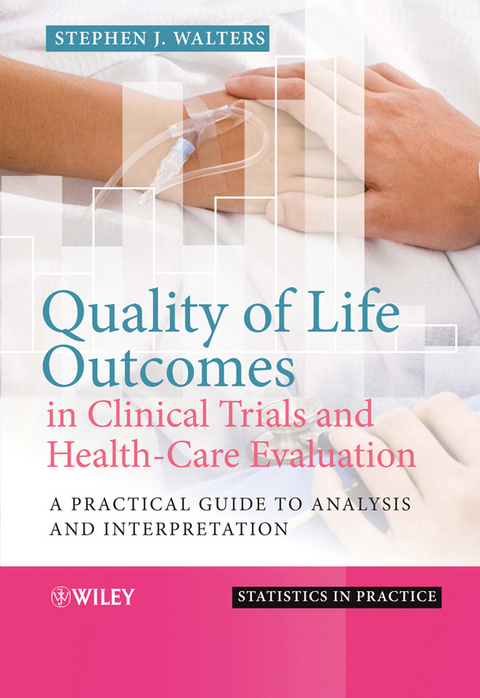
Quality of Life Outcomes in Clinical Trials and Health-Care Evaluation (eBook)
John Wiley & Sons (Verlag)
978-0-470-87191-1 (ISBN)
Quality of Life (QoL) outcomes or Person/Patient Reported Outcome Measures (PROMs) are now frequently being used in randomised controlled trials (RCTs) and observational studies. This book provides a practical guide to the design, analysis and interpretation of studies that use such outcomes.
QoL outcomes tend to generate data with discrete, bounded and skewed distributions. Many investigators are concerned about the appropriateness of using standard statistical methods to analyse QoL data and want guidance on what methods to use. QoL outcomes are frequently used in cross-sectional surveys and non-randomised health-care evaluations.
- Provides a user-friendly guide to the design and analysis of clinical trials and observational studies in relation to QoL outcomes.
- Discusses the problems caused by QoL outcomes and presents intervention options to help tackle them.
- Guides the reader step-by-step through the selection of appropriate QoLs.
- Features exercises and solutions and a supporting website providing downloadable data files.
Illustrated throughout with examples and case studies drawn from the author's experience, this book offers statisticians and clinicians guidance on choosing between the numerous available QoL instruments.
Stephen J. Walters - School of Health and Related Research, University of Sheffield. Dr Walters has had experience both in research and teaching, and is currently the Senior Lecturer in Medical Statistics at Sheffield University. He has conducted numerous grant-funded research projects, and has nearly 150 publications to his name. These include 85 articles in a range of refereed journals, 2 co-authored books, and contributed chapters in three other books.
An essential, up-to-date guide to the design of studies and selection of the correct QoL instruments for observational studies and clinical trials. Quality of Life (QoL) outcomes or Person/Patient Reported Outcome Measures (PROMs) are now frequently being used in randomised controlled trials (RCTs) and observational studies. This book provides a practical guide to the design, analysis and interpretation of studies that use such outcomes. QoL outcomes tend to generate data with discrete, bounded and skewed distributions. Many investigators are concerned about the appropriateness of using standard statistical methods to analyse QoL data and want guidance on what methods to use. QoL outcomes are frequently used in cross-sectional surveys and non-randomised health-care evaluations. Provides a user-friendly guide to the design and analysis of clinical trials and observational studies in relation to QoL outcomes. Discusses the problems caused by QoL outcomes and presents intervention options to help tackle them. Guides the reader step-by-step through the selection of appropriate QoLs. Features exercises and solutions and a supporting website providing downloadable data files. Illustrated throughout with examples and case studies drawn from the author s experience, this book offers statisticians and clinicians guidance on choosing between the numerous available QoL instruments.
Stephen J. Walters - School of Health and Related Research, University of Sheffield. Dr Walters has had experience both in research and teaching, and is currently the Senior Lecturer in Medical Statistics at Sheffield University. He has conducted numerous grant-funded research projects, and has nearly 150 publications to his name. These include 85 articles in a range of refereed journals, 2 co-authored books, and contributed chapters in three other books.
Quality of Life Outcomes in Clinical Trials and Health-Care Evaluation 3
Contents 7
Preface 13
1 Introduction 15
Summary 15
1.1 What is quality of life? 15
1.2 Terminology 16
1.3 History 16
1.4 Types of quality of life measures 18
1.5 Why measure quality of life? 24
1.6 Further reading 25
2 Measuring quality of life 27
Summary 27
2.1 Introduction 27
2.2 Principles of measurement scales 27
2.2.1 Scales and items 27
2.2.2 Constructs and latent variables 28
2.3 Indicator and causal variables 29
2.3.1 Indicator variables 29
2.3.2 Causal variables 29
2.3.3 Why do we need to worry about the distinction between indicator and causal items? 30
2.3.4 Single-item versus multi-item scales 30
2.4 The traditional psychometric model 30
2.4.1 Psychometrics and QoL scales 31
2.5 Item response theory 31
2.5.1 Traditional scales versus IRT 32
2.6 Clinimetric scales 32
2.7 Measuring quality of life: Indicator or causal items 33
2.8 Developing and testing questionnaires 33
2.8.1 Specify the research question and define the target population 33
2.8.2 Identify concepts 34
2.8.3 Create instrument 35
2.8.4 Assess measurement properties 40
2.8.5 Modify instrument 44
2.9 Further reading 44
3 Choosing a quality of life measure for your study 45
Summary 45
3.1 Introduction 45
3.2 How to choose between instruments 45
3.3 Appropriateness 47
3.4 Acceptability 47
3.5 Feasibility 48
3.6 Validity 49
3.6.1 Tests for criterion validity 49
3.6.2 Tests for face and content validity 50
3.6.3 Tests for construct validity 50
3.7 Reliability 52
3.7.1 Repeatability reliability 54
3.7.2 Graphical methods for assessing reliability between two repeated measurements 54
3.7.3 Internal reliability or internal consistency reliability 56
3.8 Responsiveness 58
3.8.1 Floor and ceiling effects 58
3.9 Precision 63
3.10 Interpretability 65
3.11 Finding quality of life instruments 67
4 Design and sample size issues: How many subjects do I need for my study? 69
Summary 69
4.1 Introduction 69
4.2 Significance tests, P-values and power 70
4.3 Sample sizes for comparison of two independent groups 72
4.3.1 Normally distributed continuous data – comparing two means 72
4.3.2 Transformations 75
4.3.3 Comparing two groups with continuous data using non-parametric methods 75
4.3.4 Dichotomous categorical data – comparing two proportions 77
4.3.5 Ordered categorical (ordinal) data 80
4.4 Choice of sample size method with quality of life outcomes 83
4.5 Paired data 84
4.5.1 Paired continuous data – comparison of means 84
4.5.2 Paired binary data – comparison of proportions 86
4.6 Equivalence/non-inferiority studies 87
4.6.1 Continuous data – comparing the equivalence of two means 88
4.6.2 Binary data – comparing the equivalence of two proportions 89
4.7 Unknown standard deviation and effect size 89
4.7.1 Tips on obtaining the standard deviation 90
4.8 Cluster randomized controlled trials 90
4.9 Non-response 91
4.10 Unequal groups 91
4.11 Multiple outcomes/endpoints 93
4.12 Three or more groups 94
4.13 What if we are doing a survey, not a clinical trial? 94
4.13.1 Sample sizes for surveys 94
4.13.2 Confidence intervals for estimating the mean QoL of a population 95
4.13.3 Confidence intervals for a proportion 96
4.14 Sample sizes for reliability and method comparison studies 99
4.15 Post-hoc sample size calculations 100
4.16 Conclusion: Usefulness of sample size calculations 100
4.17 Further reading 100
5 Reliability and method comparison studies for quality of life measurements 105
Summary 105
5.1 Introduction 105
5.2 Intra-class correlation coefficient 106
5.2.1 Inappropriate method 108
5.3 Agreement between individual items on a quality of life questionnaire 109
5.3.1 Binary data: Proportion of agreement 109
5.3.2 Binary data: Kappa 109
5.3.3 Ordered categorical data: Weighted kappa 110
5.4 Internal consistency and Cronbach’s alpha 112
5.5 Graphical methods for assessing reliability or agreement between two quality of life measures or assessments 113
5.6 Further reading 116
5.7 Technical details 116
5.7.1 Calculation of ICC 116
5.7.2 Calculation of kappa 117
5.7.3 Calculation of weighted kappa 118
5.7.4 Calculation of Cronbach’s alpha 118
6 Summarizing, tabulating and graphically displaying quality of life outcomes 123
Summary 123
6.1 Introduction 123
6.2 Graphs 124
6.2.1 Dot plots 126
6.2.2 Histograms 126
6.2.3 Box-and-whisker plot 128
6.2.4 Scatter plots 130
6.3 Describing and summarizing quality of life data 130
6.3.1 Measures of location 131
6.3.2 Measures of spread 133
6.4 Presenting quality of life data and results in tables and graphs 136
6.4.1 Tables for summarizing QoL outcomes 136
6.4.2 Tables for multiple outcome measures 138
6.4.3 Tables and graphs for comparing two groups 140
6.4.4 Profile graphs 143
7 Cross-sectional analysis of quality of life outcomes 147
Summary 147
7.1 Introduction 147
7.2 Hypothesis testing (using P-values) 148
7.3 Estimation (using con.dence intervals) 151
7.4 Choosing the statistical method 152
7.5 Comparison of two independent groups 152
7.5.1 Independent samples t -test for continuous outcome data 154
7.5.2 Mann–Whitney U-test 158
7.6 Comparing more than two groups 160
7.6.1 One-way analysis of variance 161
7.6.2 The Kruskal–Wallis test 164
7.7 Two groups of paired observations 164
7.7.1 Paired t -test 167
7.7.2 Wilcoxon test 171
7.8 The relationship between two continuous variables 171
7.9 Correlation 174
7.10 Regression 179
7.11 Multiple regression 182
7.12 Regression or correlation? 185
7.13 Parametric versus non-parametric methods 185
7.14 Technical details: Checking the assumptions for a linear regression analysis 187
8 Randomized controlled trials 195
Summary 195
8.1 Introduction 195
8.2 Randomized controlled trials 196
8.3 Protocols 196
8.4 Pragmatic and explanatory trials 196
8.5 Intention-to-treat and per-protocol analyses 197
8.6 Patient flow diagram 200
8.7 Comparison of entry characteristics 200
8.8 Incomplete data 203
8.9 Main analysis 205
8.10 Interpretation of changes/differences in quality of life scores 210
8.11 Superiority and equivalence trials 211
8.12 Adjusting for other variables 213
8.13 Three methods of analysis for pre-test/post-test control group designs 216
8.14 Cross-over trials 217
8.15 Factorial trials 220
8.16 Cluster randomized controlled trials 223
8.17 Further reading 224
9 Exploring and modelling longitudinal quality of life data 231
Summary 231
9.1 Introduction 231
9.2 Summarizing, tabulating and graphically displaying repeated QoL assessments 232
9.3 Time-by-time analysis 236
9.4 Response feature analysis – the use of summary measures 237
9.4.1 Area under the curve 237
9.4.2 Acupuncture study – analysis of covariance 241
9.5 Modelling of longitudinal data 243
9.5.1 Autocorrelation 245
9.5.2 Repeated measures analysis of variance 246
9.5.3 Marginal general linear models – generalized estimating equations 246
9.5.4 Random effects models 251
9.5.5 Random effects versus marginal modelling 253
9.5.6 Use of marginal and random effects models to analyse data from a cluster RCT 255
9.6 Conclusions 257
10 Advanced methods for analysing quality of life outcomes 263
Summary 263
10.1 Introduction 263
10.2 Bootstrap methods 265
10.3 Bootstrap methods for confidence interval estimation 265
10.4 Ordinal regression 269
10.5 Comparing two independent groups: Ordinal quality of life measures (with less than 7 categories) 271
10.6 Proportional odds or cumulative logit model 272
10.7 Continuation ratio model 273
10.8 Stereotype logistic model 274
10.9 Conclusions and further reading 278
11 Economic evaluations 279
Summary 279
11.1 Introduction 279
11.2 Economic evaluations 280
11.3 Utilities and QALYs 280
11.4 Economic evaluations alongside a controlled trial 281
11.5 Cost-effectiveness analysis 281
11.6 Cost–effectiveness ratios 282
11.7 Cost–utility analysis and cost–utility ratios 283
11.8 Incremental cost per QALY 284
11.9 The problem of negative (and positive) incremental cost–effectiveness ratios 286
11.10 Cost-effectiveness acceptability curves 287
11.11 Further reading 289
12 Meta-analysis 291
Summary 291
12.1 Introduction 291
12.2.1 Is a meta-analysis appropriate? 293
12.2.2 Combining the results of different studies 293
12.2.3 Choosing the appropriate statistical method 294
12.2 Planning a meta-analysis 292
12.3 Statistical methods in meta-analysis 296
12.3.1 The choice of effect measure: What outcome measures am I combining? 296
12.3.2 Model choice: fixed or random? 297
12.3.3 Homogeneity 299
12.3.4 Fixed effects model 299
12.3.5 Forest plots 301
12.3.6 Random effects 303
12.3.7 Funnel plots 303
12.4 Presentation of results 307
12.5 Conclusion 308
12.6 Further reading 309
13 Practical issues 311
Summary 311
13.1 Missing data 311
13.1.1 Why do missing data matter? 311
13.1.2 Methods for missing items within a form 312
13.1.3 Methods for missing forms 314
13.1.4 The regulator’s view on statistical considerations for patient-level missing data 322
13.1.5 Conclusions and further reading on missing QoL data 323
13.2 Multiplicity, multi-dimensionality and multiple quality of life outcomes 324
13.2.1 Which multiple comparison procedure to use? 326
13.3 Guidelines for reporting quality of life studies 328
Solutions to exercises 333
Appendix A: Examples of questionnaires 349
Appendix B: Statistical tables 359
References 365
Index 375
"The book covers a wide range of issues and techniques. ... Subjects are exposed clearly, with the obvious aim of being accessible to clinicians unfamiliar with mathematical formalism, and the methods are nicely illustrated with QoL data examples." (Journal of Biopharmaceutical Statistics, April 2010)
| Erscheint lt. Verlag | 10.9.2009 |
|---|---|
| Reihe/Serie | Statistics in Practice |
| Statistics in Practice | Statistics in Practice |
| Sprache | englisch |
| Themenwelt | Mathematik / Informatik ► Mathematik ► Statistik |
| Mathematik / Informatik ► Mathematik ► Wahrscheinlichkeit / Kombinatorik | |
| Medizin / Pharmazie ► Medizinische Fachgebiete | |
| Schlagworte | appropriateness • Biostatistik • Book • Clinical Trials • Controlled • Data • Design • discrete • Guide • Klinische Studien • life qol outcomes • many • measures • Medical Science • Medizin • Methods • Outcome • outcomes • Patient • Pharmacology & Pharmaceutical Medicine • Pharmakologie u. Pharmazeutische Medizin • Practical • PROMs • QOL • qol outcomes • quality • randomised • reported • Standard • Statistical • Statistics • Statistik • Studies • Trials |
| ISBN-10 | 0-470-87191-1 / 0470871911 |
| ISBN-13 | 978-0-470-87191-1 / 9780470871911 |
| Informationen gemäß Produktsicherheitsverordnung (GPSR) | |
| Haben Sie eine Frage zum Produkt? |
 PDF (Adobe DRM)
Kopierschutz: Adobe-DRM
Adobe-DRM ist ein Kopierschutz, der das eBook vor Mißbrauch schützen soll. Dabei wird das eBook bereits beim Download auf Ihre persönliche Adobe-ID autorisiert. Lesen können Sie das eBook dann nur auf den Geräten, welche ebenfalls auf Ihre Adobe-ID registriert sind.
Details zum Adobe-DRM
Dateiformat: PDF (Portable Document Format)
Mit einem festen Seitenlayout eignet sich die PDF besonders für Fachbücher mit Spalten, Tabellen und Abbildungen. Eine PDF kann auf fast allen Geräten angezeigt werden, ist aber für kleine Displays (Smartphone, eReader) nur eingeschränkt geeignet.
Systemvoraussetzungen:
PC/Mac: Mit einem PC oder Mac können Sie dieses eBook lesen. Sie benötigen eine
eReader: Dieses eBook kann mit (fast) allen eBook-Readern gelesen werden. Mit dem amazon-Kindle ist es aber nicht kompatibel.
Smartphone/Tablet: Egal ob Apple oder Android, dieses eBook können Sie lesen. Sie benötigen eine
Geräteliste und zusätzliche Hinweise
Buying eBooks from abroad
For tax law reasons we can sell eBooks just within Germany and Switzerland. Regrettably we cannot fulfill eBook-orders from other countries.
aus dem Bereich