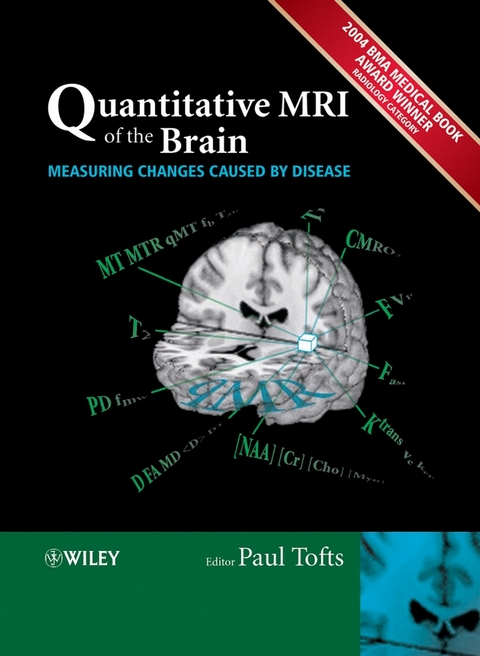
Quantitative MRI of the Brain (eBook)
John Wiley & Sons (Verlag)
978-0-470-86949-9 (ISBN)
(Radiology category)
'This is an exciting book, with a new approach to use of the MRI scanner. It bridges the gap between clinical research and general neuro-radiological practice. It is accessible to the clinical radiologist, and yet thorough in its treatment of the underlying physics and of the science of measurement. It is likely to become a classic.' British Medical Association
This indispensable 'how to' manual of quantitative MR is essential for anyone who wants to use the gamut of modern quantitative methods to measure the effects of neurological disease, its progression, and its response to treatment. It contains both the methodology and clinical applications, reflecting the increasing interest in quantitative MR in studying disease and its progression.
- The editor is an MR scientist with an international reputation for high quality research
- The contributions are written jointly by MR physicists and MR clinicians, producing a practical book for both the research and medical communities
- A practical book for both the research and medical communities
'Paul Tofts has succeeded brilliantly in capturing the essence of what needs to become the future of radiology in particular, and medicine in general - quantitative measurements of disease.' Robert I. Grossman, M.D. New York, University School of Medicine (from the Foreword)
Professor Paul Tofts has worked on the physical aspects of quantitative brain imaging since the early days of clinical NMR. He was the first to measure in-vivo concentrations of metabolites, and to use dynamic imaging to measure blood-brain barrier permeability and extra-cellular space in multiple sclerosis.
2004 BMA Medical Book Competition Winner (Radiology category) This is an exciting book, with a new approach to use of the MRI scanner. It bridges the gap between clinical research and general neuro-radiological practice. It is accessible to the clinical radiologist, and yet thorough in its treatment of the underlying physics and of the science of measurement. It is likely to become a classic. British Medical Association This indispensable 'how to' manual of quantitative MR is essential for anyone who wants to use the gamut of modern quantitative methods to measure the effects of neurological disease, its progression, and its response to treatment. It contains both the methodology and clinical applications, reflecting the increasing interest in quantitative MR in studying disease and its progression. The editor is an MR scientist with an international reputation for high quality research The contributions are written jointly by MR physicists and MR clinicians, producing a practical book for both the research and medical communities A practical book for both the research and medical communities Paul Tofts has succeeded brilliantly in capturing the essence of what needs to become the future of radiology in particular, and medicine in general quantitative measurements of disease. Robert I. Grossman, M.D. New York, University School of Medicine (from the Foreword)
Professor Paul Tofts has worked on the physical aspects of quantitative brain imaging since the early days of clinical NMR. He was the first to measure in-vivo concentrations of metabolites, and to use dynamic imaging to measure blood-brain barrier permeability and extra-cellular space in multiple sclerosis.
Quantitative MRI of the Brain 3
Contents 9
Contributors 11
Reviewers 13
Foreword 15
Introduction 17
Section A: The Measurement Process 19
1 Concepts: Measurement and MR 21
2 The Measurement Process: MR Data Collection and Image Analysis 35
3 QA: Quality Assurance, Accuracy, Precision and Phantoms 73
Section B: Windows into the Brain: Measuring MR Parameters 101
4 PD: Proton Density of Tissue Water 103
5 T(1): the Longitudinal Relaxation Time 129
6 T(2): the Transverse Relaxation Time 161
7 D: the Diffusion of Water 221
8 MT: Magnetization Transfer 275
9 Spectroscopy: (1)H Metabolite Concentrations 317
10 T(1)-w DCE-MRI: T(1)-weighted Dynamic Contrast-enhanced MRI 359
11 T(2)- and T*(2)-w DCE-MRI: Blood Perfusion and Volume Estimation using Bolus Tracking 383
12 Functional MRI 431
13 ASL: Blood Perfusion Measurements Using Arterial Spin Labelling 473
Section C: The Biology 493
14 Biology: The Significance of MR Parameters in Multiple Sclerosis 495
Section D: Analysing Images 519
15 Spatial Registration of Images 521
16 Volume and Atrophy 551
17 Shape and Texture 577
18 Histograms: Measuring Subtle Diffuse Disease 599
Section E: Where are we Going? 629
19 The Future of qMRI: Conclusions and Speculation 631
Appendix 1 – Greek alphabet for scientific use 637
Index 639
| Erscheint lt. Verlag | 19.8.2005 |
|---|---|
| Sprache | englisch |
| Themenwelt | Medizin / Pharmazie ► Medizinische Fachgebiete ► Neurologie |
| Medizinische Fachgebiete ► Radiologie / Bildgebende Verfahren ► Kernspintomographie (MRT) | |
| Medizinische Fachgebiete ► Radiologie / Bildgebende Verfahren ► Radiologie | |
| Schlagworte | Assurance • Biochemie • Biochemie u. Chemische Biologie • Biochemistry (Chemical Biology) • Biowissenschaften • Book • brain • Cell & Molecular Biology • Change • Chemie • Chemistry • Computertomographie (MRI) • Concepts • Good • Human Brain • Life Sciences • machine • Magnetische Kernresonanz • Magnetische Resonanz • measurements • Medical Science • Medizin • Molekularbiologie • MRI • New • noted • Physical • Practice • Principles • qualitatively • Quantification • quantities • radiologists • Scientific Instrument • section • undergoing • use • voxel • Zell- u. Molekularbiologie |
| ISBN-10 | 0-470-86949-6 / 0470869496 |
| ISBN-13 | 978-0-470-86949-9 / 9780470869499 |
| Informationen gemäß Produktsicherheitsverordnung (GPSR) | |
| Haben Sie eine Frage zum Produkt? |
 PDF (Adobe DRM)
Kopierschutz: Adobe-DRM
Adobe-DRM ist ein Kopierschutz, der das eBook vor Mißbrauch schützen soll. Dabei wird das eBook bereits beim Download auf Ihre persönliche Adobe-ID autorisiert. Lesen können Sie das eBook dann nur auf den Geräten, welche ebenfalls auf Ihre Adobe-ID registriert sind.
Details zum Adobe-DRM
Dateiformat: PDF (Portable Document Format)
Mit einem festen Seitenlayout eignet sich die PDF besonders für Fachbücher mit Spalten, Tabellen und Abbildungen. Eine PDF kann auf fast allen Geräten angezeigt werden, ist aber für kleine Displays (Smartphone, eReader) nur eingeschränkt geeignet.
Systemvoraussetzungen:
PC/Mac: Mit einem PC oder Mac können Sie dieses eBook lesen. Sie benötigen eine
eReader: Dieses eBook kann mit (fast) allen eBook-Readern gelesen werden. Mit dem amazon-Kindle ist es aber nicht kompatibel.
Smartphone/Tablet: Egal ob Apple oder Android, dieses eBook können Sie lesen. Sie benötigen eine
Geräteliste und zusätzliche Hinweise
Buying eBooks from abroad
For tax law reasons we can sell eBooks just within Germany and Switzerland. Regrettably we cannot fulfill eBook-orders from other countries.
aus dem Bereich