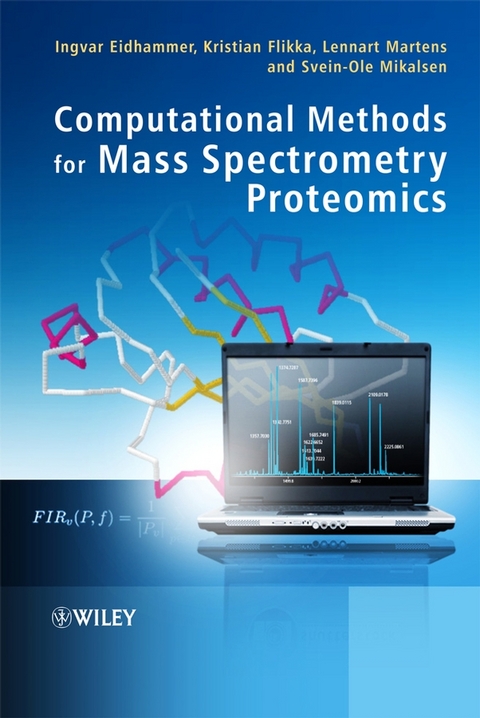
Computational Methods for Mass Spectrometry Proteomics (eBook)
John Wiley & Sons (Verlag)
978-0-470-72429-3 (ISBN)
Computational Methods for Mass Spectrometry Proteomics describes the different instruments and methodologies used in proteomics in a unified manner. The authors put an emphasis on the computational methods for the different phases of a proteomics analysis, but the underlying principles in protein chemistry and instrument technology are also described. The book is illustrated by a number of figures and examples, and contains exercises for the reader. Written in an accessible yet rigorous style, it is a valuable reference for both informaticians and biologists.
Computational Methods for Mass Spectrometry Proteomics is suited for advanced undergraduate and graduate students of bioinformatics and molecular biology with an interest in proteomics. It also provides a good introduction and reference source for researchers new to proteomics, and for people who come into more peripheral contact with the field.
Ingvar Eidhammer. Associate Professor, Department of Informatics, University of Bergen, Norway
Lennart Martens. European Bioinformatics Institute, EBI, Hinxton, Cambridge, UK
Svein-Ole Mikalsen. The Norwegian Radium Hospital, Oslo, Norway
Kristian Flikka. University of Bergen, Norway
Proteomics is the study of the subsets of proteins present in different parts of an organism and how they change with time and varying conditions. Mass spectrometry is the leading technology used in proteomics, and the field relies heavily on bioinformatics to process and analyze the acquired data. Since recent years have seen tremendous developments in instrumentation and proteomics-related bioinformatics, there is clearly a need for a solid introduction to the crossroads where proteomics and bioinformatics meet. Computational Methods for Mass Spectrometry Proteomics describes the different instruments and methodologies used in proteomics in a unified manner. The authors put an emphasis on the computational methods for the different phases of a proteomics analysis, but the underlying principles in protein chemistry and instrument technology are also described. The book is illustrated by a number of figures and examples, and contains exercises for the reader. Written in an accessible yet rigorous style, it is a valuable reference for both informaticians and biologists. Computational Methods for Mass Spectrometry Proteomics is suited for advanced undergraduate and graduate students of bioinformatics and molecular biology with an interest in proteomics. It also provides a good introduction and reference source for researchers new to proteomics, and for people who come into more peripheral contact with the field.
Ingvar Eidhammer. Associate Professor, Department of Informatics, University of Bergen, Norway Lennart Martens. European Bioinformatics Institute, EBI, Hinxton, Cambridge, UK Svein-Ole Mikalsen. The Norwegian Radium Hospital, Oslo, Norway Kristian Flikka. University of Bergen, Norway
Computational Methods for Mass Spectrometry Proteomics 3
Contents 7
Preface 11
Acknowledgements 13
1 Protein, proteome, and proteomics 15
1.1 Primary goals for studying proteomes 15
1.2 Defining the protein 17
1.3 Protein properties – attributes and values 19
1.4 Posttranslational modifications 28
1.5 Protein sequence databases 30
1.6 Identification and characterization of proteins 32
1.7 Two approaches for bottom-up protein analysis by mass spectrometry 34
1.8 Instrument calibration and measuring errors 39
Exercises 42
Bibliographic notes 42
2 Protein separation – 2D gel electrophoresis 45
2.1 Separation on molecular mass – SDS-PAGE 46
2.2 Separation on isoelectric point – IEF 49
2.3 Separation on mass and isoelectric point – 2D SDS-PAGE 50
2.4 2D SDS-PAGE for (complete) proteomics 51
Exercises 54
Bibliographic notes 55
3 Protein digestion 57
3.1 Experimental digestion 60
3.2 In silico digestion 64
Exercises 65
Bibliographic notes 66
4 Peptide separation – HPLC 67
4.1 High-pressure liquid chromatography, HPLC 68
4.2 Stationary phases and separation modes 70
4.3 Component migration and retention time 72
4.4 The shape of the peaks 73
4.5 Chromatography used for protein identification 74
4.6 Chromatography used for quantification 77
Exercises 77
Bibliographic notes 79
5 Fundamentals of mass spectrometry 81
5.1 The principle of mass spectrometry 81
5.2 Ionization sources 83
5.3 Mass analyzers 86
5.4 Isotopic composition of peptides 86
5.5 Fractional masses 87
5.6 The raw data 91
5.7 Mass resolution and resolving power 91
Exercises 93
Bibliographic notes 93
6 Mass spectrometry – MALDI-TOF 95
6.1 TOF analyzers and their resolution 96
6.2 Constructing the peak list 100
6.3 Peak list preprocessing 106
6.4 Peak list format 107
6.5 Automation of MALDI-TOF-MS 107
Exercises 108
Bibliographic notes 108
7 Protein identification and characterization by MS 111
7.1 The main search procedure 112
7.2 The peptide mass comparison 116
7.3 Database search and recalibration 117
7.4 Score calculation 119
7.5 Statistical significance – the P-value 125
7.6 Characterization 129
Exercises 130
Bibliographic notes 131
8 Tandem MS or MS/MS analysis 133
8.1 Peptide fragments 134
8.2 Fragmentation techniques 137
8.3 MS/MS spectrometers 138
8.4 Different types of analyzers 139
8.5 Overview of the process for MS/MS analysis 146
8.6 Fragment ion masses and residue masses 147
8.7 Deisotoping and charge state deconvolution 149
8.8 Precursor treatment 150
8.9 MS3 spectra 153
Exercises 153
Bibliographic notes 154
9 Fragmentation models 155
9.1 Chemical approach 155
9.2 Statistical approach 156
9.3 Learning (collecting statistics) 158
9.4 The effect of amino acids on the fragmentation 163
Exercises 164
Bibliographic notes 165
10 Identification and characterization by MS/MS 167
10.1 Effect of operations (modifications, mutations) on spectra 168
10.2 Filtering and organization of the database 170
10.3 Scoring and statistical significance 171
Exercises 171
11 Spectral comparisons 173
11.1 Constructing a theoretical spectrum 173
11.2 Non-probabilistic scoring 174
11.3 Probabilistic scoring 178
11.4 Comparison with modifications 183
Exercises 190
Bibliographic notes 191
12 Sequential comparison – de novo sequencing 193
12.1 Spectrum graphs 194
12.2 Preprocessing 197
12.3 Node scores 198
12.4 Constructing the spectrum graph 199
12.5 The sequencing procedure using spectrum graphs 200
12.6 Combined spectra to improve de novo sequencing 203
Exercises 204
Bibliographic and additional notes 205
13 Database searching for de novo sequences 207
13.1 Using general sequence search programs 208
13.2 Specialized search programs 212
13.3 Peptide sequence tags 215
13.4 Comparison by threading 220
Exercises 222
Bibliographic notes 223
14 Large-scale proteomics 225
14.1 Coverage and complexity 225
14.2 Selecting a representative peptide sample – COFRADIC 226
14.3 Separating peptides into fractions 229
14.4 Producing MS/MS spectra 230
14.5 Spectrum filtering 231
14.6 Spectrum clustering 234
14.7 Searching the database 241
14.8 LIMS 241
Exercises 242
Bibliographic notes 242
15 Quantitative MS-based proteomics 243
15.1 Defining the quantification task 243
15.2 mRNA and protein quantification 244
15.3 Quantification of peaks 244
15.4 Normalization 245
15.5 Different methods for quantification 246
15.6 Label-free quantification 246
15.7 Label-based quantification 250
15.8 Variance-stabilizing transformations 254
15.9 Dynamic range 254
15.10 Inferring relative quantity from peptide identification scores 254
15.11 Absolute quantification methods 255
Bibliographic notes 256
16 Peptides to proteins 257
16.1 Peptides and proteins 257
16.2 Protein identification using peptide masses: an example revisited 257
16.3 Minimal and maximal explanatory sets 260
Bibliographic notes 261
17 Top-down proteomics 263
17.1 Separation of intact proteins 263
17.2 Ionization of intact proteins 263
17.3 Resolution and accuracy requirements for charge state determination and mass calculation 264
17.4 Fragmentation of intact proteins 265
17.5 Charges of the fragments 266
17.6 Protein identification 266
17.7 Protein characterization – detecting modifications 266
17.8 Problems with top-down approach 267
Exercises 267
Bibliographic notes 268
18 Standards 269
18.1 Standard creation 269
18.2 Standards from a proteomics perspective 270
18.3 The Proteomics Standards Initiative 274
18.4 Mass spectrometry standards 274
18.5 Modification standards 276
18.6 Identification standards 276
Bibliographic notes 277
Bibliography 279
Index 291
"I will suggest it to new staff entering our computational biology
group that would like to work with LC-MS/MS data. I look forward to
see what the authors have in store for the next edition." (J Am Soc
Mass Spectrom, 2011)
| Erscheint lt. Verlag | 28.2.2008 |
|---|---|
| Sprache | englisch |
| Themenwelt | Studium ► Querschnittsbereiche ► Infektiologie / Immunologie |
| Naturwissenschaften ► Biologie | |
| Naturwissenschaften ► Chemie ► Analytische Chemie | |
| Schlagworte | Bioinformatics • Bioinformatics & Computational Biology • Bioinformatik • Bioinformatik u. Computersimulationen in der Biowissenschaften • Biowissenschaften • Chemie • Chemistry • Data • Developments • Different • Field • Genomforschung u. Proteomik • Genomics & Proteomics • heavily • Instrumentation • leading • Life Sciences • Massenspektrometrie • Massenspektroskopie • Mass Spectrometry • organism • present • proteins • Proteomics • relies • solid • Study • Subsets • Technology • tremendous • years |
| ISBN-10 | 0-470-72429-3 / 0470724293 |
| ISBN-13 | 978-0-470-72429-3 / 9780470724293 |
| Informationen gemäß Produktsicherheitsverordnung (GPSR) | |
| Haben Sie eine Frage zum Produkt? |
 PDF (Adobe DRM)
Kopierschutz: Adobe-DRM
Adobe-DRM ist ein Kopierschutz, der das eBook vor Mißbrauch schützen soll. Dabei wird das eBook bereits beim Download auf Ihre persönliche Adobe-ID autorisiert. Lesen können Sie das eBook dann nur auf den Geräten, welche ebenfalls auf Ihre Adobe-ID registriert sind.
Details zum Adobe-DRM
Dateiformat: PDF (Portable Document Format)
Mit einem festen Seitenlayout eignet sich die PDF besonders für Fachbücher mit Spalten, Tabellen und Abbildungen. Eine PDF kann auf fast allen Geräten angezeigt werden, ist aber für kleine Displays (Smartphone, eReader) nur eingeschränkt geeignet.
Systemvoraussetzungen:
PC/Mac: Mit einem PC oder Mac können Sie dieses eBook lesen. Sie benötigen eine
eReader: Dieses eBook kann mit (fast) allen eBook-Readern gelesen werden. Mit dem amazon-Kindle ist es aber nicht kompatibel.
Smartphone/Tablet: Egal ob Apple oder Android, dieses eBook können Sie lesen. Sie benötigen eine
Geräteliste und zusätzliche Hinweise
Buying eBooks from abroad
For tax law reasons we can sell eBooks just within Germany and Switzerland. Regrettably we cannot fulfill eBook-orders from other countries.
aus dem Bereich