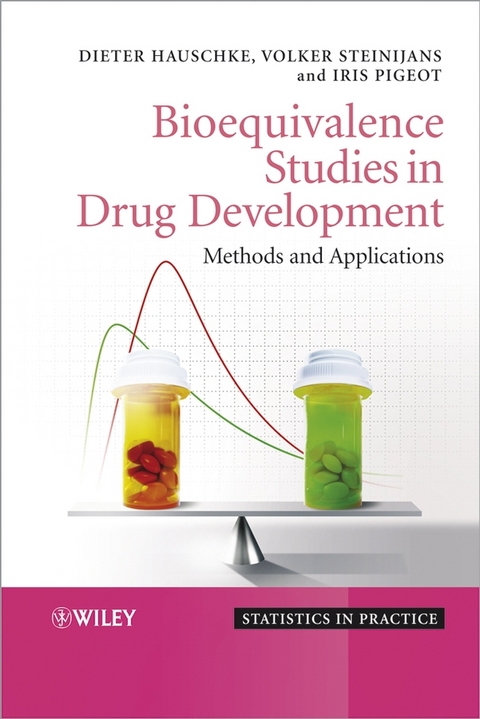
Bioequivalence Studies in Drug Development (eBook)
John Wiley & Sons (Verlag)
978-0-470-09476-1 (ISBN)
Bioequivalence Studies in Drug Development focuses on the planning, conducting, analysing and reporting of bioequivalence studies, covering all aspects required by regulatory authorities. This text presents the required statistical methods, and with an outstanding practical emphasis, demonstrates their applications through numerous examples using real data from drug development.
- Includes all the necessary pharmacokinetic background information.
- Presents parametric and nonparametric statistical techniques.
- Describes adequate methods for power and sample size determination.
- Includes appropriate presentation of results from bioequivalence studies.
- Provides a practical overview of the design and analysis of bioequivalence studies.
- Presents the recent developments in methodology, including population and individual bioequivalence.
- Reviews the regulatory guidelines for such studies, and the existing global discrepancies.
- Discusses the designs and analyses of drug-drug and food-drug interaction studies.
Bioequivalence Studies in Drug Development is written in an accessible style that makes it ideal for pharmaceutical scientists, clinical pharmacologists, and medical practitioners, as well as biometricians working in the pharmaceutical industry. It will also be of great value for professionals from regulatory bodies assessing bioequivalence studies.
Dieter Hauschke, ALTANA Pharma, Konstanz, Germany. Well-respected statistician working in the pharmaceutical industry, specializing in bioequivalence studies, with over 60 publications in leading journals.
Volker Steinijans, ALTANA Pharma, Konstanz, Germany. Head of the Department of Biometry and Clinical Data Management at ALTANA.
Iris Pigeot, Institute for Statistics, University of Bremen, Germany. Has over 50 published papers, and also written a number of books in German.
Studies in bioequivalence are the commonly accepted method to demonstrate therapeutic equivalence between two medicinal products. Savings in time and cost are substantial when using bioequivalence as an established surrogate marker of therapeutic equivalence. For this reason the design, performance and evaluation of bioequivalence studies have received major attention from academia, the pharmaceutical industry and health authorities. Bioequivalence Studies in Drug Development focuses on the planning, conducting, analysing and reporting of bioequivalence studies, covering all aspects required by regulatory authorities. This text presents the required statistical methods, and with an outstanding practical emphasis, demonstrates their applications through numerous examples using real data from drug development. Includes all the necessary pharmacokinetic background information. Presents parametric and nonparametric statistical techniques. Describes adequate methods for power and sample size determination. Includes appropriate presentation of results from bioequivalence studies. Provides a practical overview of the design and analysis of bioequivalence studies. Presents the recent developments in methodology, including population and individual bioequivalence. Reviews the regulatory guidelines for such studies, and the existing global discrepancies. Discusses the designs and analyses of drug-drug and food-drug interaction studies. Bioequivalence Studies in Drug Development is written in an accessible style that makes it ideal for pharmaceutical scientists, clinical pharmacologists, and medical practitioners, as well as biometricians working in the pharmaceutical industry. It will also be of great value for professionals from regulatory bodies assessing bioequivalence studies.
Dieter Hauschke, ALTANA Pharma, Konstanz, Germany. Well-respected statistician working in the pharmaceutical industry, specializing in bioequivalence studies, with over 60 publications in leading journals. Volker Steinijans, ALTANA Pharma, Konstanz, Germany. Head of the Department of Biometry and Clinical Data Management at ALTANA. Iris Pigeot, Institute for Statistics, University of Bremen, Germany. Has over 50 published papers, and also written a number of books in German.
Bioequivalence Studies in Drug Development 3
Contents 9
Preface 15
1 Introduction 17
1.1 Definitions 17
1.1.1 Bioavailability 18
1.1.2 Bioequivalence 18
1.1.3 Therapeutic equivalence 19
1.2 When are bioequivalence studies performed 20
1.2.1 Applications for products containing new active substances 20
1.2.2 Applications for products containing approved active substances 20
1.2.3 Applications for modified release forms essentially similar to a marketed modified release form 20
1.3 Design and conduct of bioequivalence studies 21
1.3.1 Crossover design and alternatives 21
1.3.2 Single- vs. multiple-dose studies 22
1.3.3 Pharmacokinetic characteristics 22
1.3.4 Subjects 23
1.3.5 Statistical models 24
1.3.5.1 Average bioequivalence 24
1.3.5.2 Population bioequivalence 25
1.3.5.3 Individual bioequivalence 27
1.3.6 Sample size 28
1.4 Aims and structure of the book 30
References 31
2 Metrics to characterize concentration-time profiles in single- and multiple-dose bioequivalence studies 33
2.1 Introduction 33
2.2 Pharmacokinetic characteristics (metrics) for single-dose studies 36
2.2.1 Extent of bioavailability 36
2.2.2 Rate of bioavailability 40
2.3 Pharmacokinetic rate and extent characteristics (metrics) for multiple-dose studies 42
2.4 Conclusions 50
References 50
3 Basic statistical considerations 53
3.1 Introduction 53
3.2 Additive and multiplicative model 54
3.2.1 The normal distribution 54
3.2.2 The lognormal distribution 57
3.3 Hypotheses testing 60
3.3.1 Consumer and producer risk 60
3.3.2 Types of hypotheses 62
3.3.2.1 Test for difference 63
3.3.2.2 Test for superiority 63
3.3.2.3 Test for noninferiority 64
3.3.2.4 Test for equivalence 65
3.3.3 Difference versus ratio of expected means 67
3.3.3.1 The normal distribution 67
3.3.3.2 The lognormal distribution 69
3.4 The RT/TR crossover design assuming an additive model 71
3.4.1 Additive model and effects 71
3.4.2 Parametric analysis based on t-tests 72
3.4.2.1 Test for difference in carryover effects 75
3.4.2.2 Test for difference in formulation effects 76
3.4.2.3 Test for difference in period effects 79
3.4.3 Nonparametric analysis based on Wilcoxon rank sum tests 81
3.4.3.1 Test for difference in carryover effects 81
3.4.3.2 Test for difference in formulation effects 82
3.4.3.3 Test for difference in period effects 83
References 84
4 Assessment of average bioequivalence in the RT/TR design 85
4.1 Introduction 85
4.2 The RT/TR crossover design assuming a multiplicative model 88
4.2.1 Multiplicative model and effects 89
4.2.2 Test problem 91
4.2.3 Estimation of the formulation difference 93
4.3 Test procedures for bioequivalence assessment 96
4.3.1 Analysis of variance 96
4.3.1.1 Example: Dose equivalence study 100
4.3.2 Two one-sided t-tests and (1 – 2?)100 % confidence interval 105
4.3.2.1 Example: Dose equivalence study 107
4.3.3 Two one-sided Wilcoxon rank sum tests and (1?2?)100 % confidence interval 110
4.3.3.1 Example: Dose equivalence study 112
4.3.3.2 Analysis of time to maximum concentration 113
4.3.4 Bioequivalence ranges 117
4.4 Conclusions 119
References 119
5 Power and sample size determination for testing average bioequivalence in the RT/TR design 121
5.1 Introduction 121
5.2 Challenging the classical approach 122
5.3 Exact power and sample size calculation 125
5.4 Modified acceptance ranges 128
5.5 Approximate formulas for sample size calculation 130
5.6 Exact power and sample size calculation by nQuery® 133
Appendix 136
References 137
6 Presentation of bioequivalence studies 139
6.1 Introduction 139
6.2 Results from a single-dose study 140
6.3 Results from a multiple-dose study 156
6.4 Conclusions 168
References 170
7 Designs with more than two formulations 173
7.1 Introduction 173
7.2 Williams designs 174
7.3 Example: Dose linearity study 175
7.4 Multiplicity 177
7.4.1 Joint decision rule 181
7.4.2 Multiple decision rule 187
7.5 Conclusions 188
References 188
8 Analysis of pharmacokinetic interactions 191
8.1 Introduction 191
8.2 Pharmacokinetic drug–drug interaction studies 194
8.2.1 Absorption 194
8.2.2 Distribution 194
8.2.3 Elimination 194
8.2.3.1 Metabolism 195
8.2.3.1.1 Metabolic induction 195
8.2.3.1.2 Metabolic inhibition 197
8.2.3.1.3 Change of blood flow 198
8.2.3.2 Renal excretion 198
8.2.3.3 Hepatic/ biliary excretion 199
8.2.4 Experimental design of in vivo drug–drug interaction studies 199
8.2.5 Examples to illustrate drug–drug interactions and the lack thereof 200
8.2.6 Pharmacokinetic characteristics for extent of absorption and clearance in drug–drug interaction studies 203
8.2.6.1 Theoretical background on AUC as a composite measure of absorption and clearance 206
8.2.6.2 Examples to illustrate the composite character of AUC 208
8.2.6.3 Recommendation for subsequent analyses 209
8.3 Pharmacokinetic food–drug interactions 210
8.3.1 Classification of food effects 210
8.3.2 Experimental design of food–drug interaction studies 212
8.3.3 Example: Theophylline food interaction study 213
8.4 Goal posts for pharmacokinetic drug interaction studies including no effect boundaries 213
8.5 Labeling 215
8.6 Conclusions 216
References 216
9 Population and individual bioequivalence 221
9.1 Introduction 221
9.2 Brief history 224
9.3 Study designs and statistical models 226
9.3.1 Classical two-period, two-sequence crossover design 226
9.3.2 Replicate designs 226
9.3.3 Additive model 228
9.3.4 Basic concepts of aggregate measures 229
9.3.5 Example: The antihypertensive patch dataset 231
9.4 Population bioequivalence 233
9.4.1 Moment-based criteria 233
9.4.1.1 Statistical procedures 235
9.4.1.1.1 The bootstrap procedure 235
9.4.1.1.2 A parametric confidence interval 236
9.4.2 Probability-based criteria 241
9.4.2.1 Statistical procedures 241
9.4.2.1.1 A distribution-free approach 241
9.4.2.1.2 A parametric approach 244
9.5 Individual bioequivalence 246
9.5.1 Moment-based criteria 246
9.5.1.1 Statistical procedures 248
9.5.1.1.1 The bootstrap procedure 248
9.5.1.1.2 A parametric confidence interval 249
9.5.2 Probability-based criteria 252
9.5.2.1 Statistical procedures 252
9.5.2.1.1 A distribution-free approach 253
9.5.2.1.2 A parametric approach 255
9.5.2.1.3 Test for individual equivalence ratio (TIER) 257
9.5.3 Relationships between aggregate bioequivalence criteria 259
9.5.4 Drawbacks of aggregate measures 261
9.6 Disaggregate criteria 262
9.6.1 Stepwise procedure on the original scale 262
9.6.2 Stepwise procedure on the logarithmic scale 269
9.7 Other approaches 271
9.7.1 Trimmed Mallows distance 271
9.7.2 Kullback–Leibler divergence 272
9.7.3 Structural equation model 273
9.8 Average bioequivalence in replicate designs 274
9.9 Example: The antihypertensive patch dataset 275
9.10 Conclusions 294
References 296
10 Equivalence assessment for clinical endpoints 299
10.1 Introduction 299
10.2 Design and testing procedure 301
10.2.1 Parallel group design 301
10.2.2 Crossover design 303
10.3 Power and sample size calculation 305
10.3.1 Parallel group design 305
10.3.2 Crossover design 308
10.3.3 Approximate formulas for sample size calculation 313
10.3.4 Exact power and sample size calculation by nQuery® 318
10.4 Conclusions 319
Appendix 320
References 321
Index 323
"The book provides an excellent introduction for researchers
approaching the concept of bioequivalence and is a complete and
useful compendium for experienced statisticians." (Biometrical
Journal, April 2009)
"The book provides an important reference providing many worked
examples with real data from drug development. Professionals from
the harmaceutical industry and regulatory bodies will particularly
appreciate the emphasis made on regulatory guidelines."
(Statistical Methods in Medical Research, February 2009)
"Bioequivalence Studies in Drug Development: Methods and
Applications is an informative, timely, and easy-to-read
contribution to bioequivalence and drug-drug/food-drug interaction
literature." (Journal of the American Statistical
Association, September 2008)
"...those statisticians working in this area of research
will find that this book will serve as an excellent reference for
their work..." (Journal of Biopharmaceutical Statistics,
January 2008)
"This book would be beneficial to both pharmaceutical
scientists/researchers and biostatisticians..."
(Biometrics, September 2007)
"For anyone interested in any aspect of bioequivalence, the book
is a very valuable reference." (International Statistical
Review, 2007)
"...my pleasure to review...I would like to add this
book to my book collection of pharmaceutical research and
development." (Biometrics, September 2007)
| Erscheint lt. Verlag | 13.3.2007 |
|---|---|
| Reihe/Serie | Statistics in Practice |
| Statistics in Practice | Statistics in Practice |
| Sprache | englisch |
| Themenwelt | Mathematik / Informatik ► Mathematik ► Statistik |
| Mathematik / Informatik ► Mathematik ► Wahrscheinlichkeit / Kombinatorik | |
| Medizin / Pharmazie ► Allgemeines / Lexika | |
| Medizin / Pharmazie ► Gesundheitsfachberufe | |
| Medizin / Pharmazie ► Medizinische Fachgebiete ► Pharmakologie / Pharmakotherapie | |
| Schlagworte | Between • bioequivalence • Biostatistics • Biostatistik • commonly • demonstrate • Design • Equivalence • established • Major • Marker • Medicinal • Method • Performance • Products • reason • Savings • Statistics • Statistik • Studies • substantial • Surrogate • Therapeutic • Time • two |
| ISBN-10 | 0-470-09476-1 / 0470094761 |
| ISBN-13 | 978-0-470-09476-1 / 9780470094761 |
| Informationen gemäß Produktsicherheitsverordnung (GPSR) | |
| Haben Sie eine Frage zum Produkt? |
 PDF (Adobe DRM)
Kopierschutz: Adobe-DRM
Adobe-DRM ist ein Kopierschutz, der das eBook vor Mißbrauch schützen soll. Dabei wird das eBook bereits beim Download auf Ihre persönliche Adobe-ID autorisiert. Lesen können Sie das eBook dann nur auf den Geräten, welche ebenfalls auf Ihre Adobe-ID registriert sind.
Details zum Adobe-DRM
Dateiformat: PDF (Portable Document Format)
Mit einem festen Seitenlayout eignet sich die PDF besonders für Fachbücher mit Spalten, Tabellen und Abbildungen. Eine PDF kann auf fast allen Geräten angezeigt werden, ist aber für kleine Displays (Smartphone, eReader) nur eingeschränkt geeignet.
Systemvoraussetzungen:
PC/Mac: Mit einem PC oder Mac können Sie dieses eBook lesen. Sie benötigen eine
eReader: Dieses eBook kann mit (fast) allen eBook-Readern gelesen werden. Mit dem amazon-Kindle ist es aber nicht kompatibel.
Smartphone/Tablet: Egal ob Apple oder Android, dieses eBook können Sie lesen. Sie benötigen eine
Geräteliste und zusätzliche Hinweise
Buying eBooks from abroad
For tax law reasons we can sell eBooks just within Germany and Switzerland. Regrettably we cannot fulfill eBook-orders from other countries.
aus dem Bereich