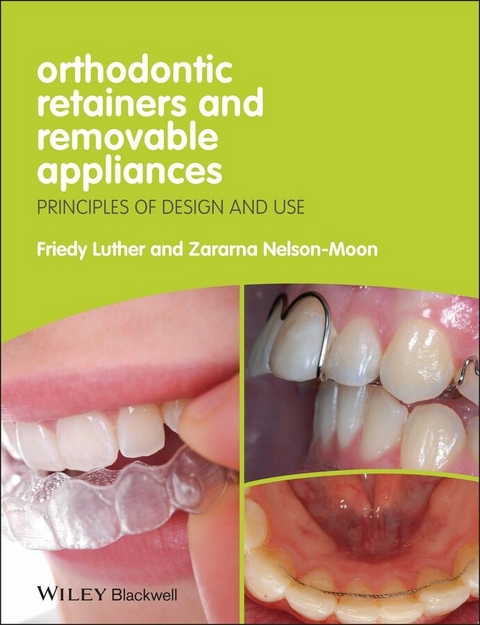
Orthodontic Retainers and Removable Appliances (eBook)
John Wiley & Sons (Verlag)
978-1-118-43276-1 (ISBN)
UseThis book is a unique practical guide for dental students, general dental practitioners, orthodontic students, therapists and others who have an interest in knowing how to design, fit, adjust and maintain retainers (both fixed and removable) and removable orthodontic appliances.
The book offers step-by-step instructions alongside clear illustrations within the key areas of clinical orthodontic practice. In each case, information is provided on indications for use, principles of design, fitting, activation and trouble shooting.
Further chapters coach the clinician on dealing with various frequently occurring situations and provide tips on effective patient management. Topics covered include: things to check at the chair side; follow up appointments - what to check and why; the importance of knowing when and how to refer.
KEY FEATURES
- Highly illustrated in full colour throughout
- Case examples
- Self-assessment section
- Step-by-step instruction
ABOUT THE AUTHORS
Friedy Luther was formerly Academic Head of Orthodontics at the Leeds Dental Institute and is currently Consultant Orthodontist at the Charles Clifford Dental Hospital in Sheffield. She has always had a strong interest in both teaching and research, publishing widely in the scientific literature, and was formerly Editor-in-Chief of Journal of Orthodontics. She has always enjoyed teaching, has over 20 years of experience of teaching, training and examining undergraduate and postgraduate orthodontic students, and has regularly created or contributed to a variety of learning resources.
Zararna Nelson-Moon is Consultant Orthodontist at York Teaching Hospital NHS Foundation Trust and is currently involved in the training of orthodontic therapists and specialist trainees up to consultant level. She was previously Consultant Orthodontist and Honorary Senior Clinical Lecturer at Leeds Dental Institute where she was the Undergraduate Course Leader for Orthodontics. Her interests include interceptive orthodontics and ensuring appropriate standards of dental education.
This book is a practical guide for both dental students and practitioners to designing, fitting and adjusting removable orthodontic appliances and retainers. The book offers step by step instructions with clear illustrations on the key areas of clinical practice. In each case, information is provided on indications for use, principles of design, fitting, activation and trouble shooting. Further chapters coach students to deal effectively with their patients and to manage the treatment plan in question.
ABOUT THE AUTHORS Friedy Luther was formerly Academic Head of Orthodontics at the Leeds Dental Institute and is currently Consultant Orthodontist at the Charles Clifford Dental Hospital in Sheffield. She has always had a strong interest in both teaching and research, publishing widely in the scientific literature, and was formerly Editor-in-Chief of Journal of Orthodontics. She has always enjoyed teaching, has over 20 years of experience of teaching, training and examining undergraduate and postgraduate orthodontic students, and has regularly created or contributed to a variety of learning resources. Zararna Nelson-Moon is Consultant Orthodontist at York Teaching Hospital NHS Foundation Trust and is currently involved in the training of orthodontic therapists and specialist trainees up to consultant level. She was previously Consultant Orthodontist and Honorary Senior Clinical Lecturer at Leeds Dental Institute where she was the Undergraduate Course Leader for Orthodontics. Her interests include interceptive orthodontics and ensuring appropriate standards of dental education.
Title page 5
Copyright page 6
Contents 7
Preface 9
Acknowledgements 11
Abbreviations 13
1: Assumptions: What You Should Know and Understand Before You Use this Book 15
2: Upper Removable Appliances: Indications and Principles of Design 17
Prerequisites for orthodontic treatment 17
Anchorage 18
What is anchorage? 18
Causes of anchorage loss 19
Results of anchorage loss 20
Sources of anchorage 20
Components of URAs 20
What are the indications for the use of URAs? 21
Advantages and disadvantages of removable appliances 21
Advantages 21
Disadvantages 22
Design 23
Laboratory prescription 23
A: Active components 25
R: Retention 28
A: Anchorage 30
B: Baseplate 30
What wire should be prescribed? 33
3: Cases Suitable for Treatment with Removable Appliances 34
Expansion 35
Design 1: Midline expansion screw 35
Design 2: Asymmetric expansion screw 37
Moving teeth around the arch 38
Design 1: Use of palatal finger springs 38
Design 2: Use of buccal canine retractors 39
Design 3: Use of orthodontic screws 40
Moving teeth labially 42
Design 1: Use of Z-springs 42
Design 2: Use of T-springs 44
Design 3: Use of an expansion screw to move a block of teeth labially 45
Reduction of overbite 46
Design: Flat anterior biteplane 46
Reducing an overjet 48
Design: A URA to retrocline upper incisors, reducing overjet and eliminating spacing 48
Other individual tooth movements: Extrusion of incisors 49
Design: A URA to extrude an intruded UL1 49
Space maintainers 51
3.7.1 Design: Space maintainer 51
Basic errors 53
Summary 53
4: Fitting and Activating Removable Appliances 54
When the URA arrives from the laboratory 54
Advice to the patient prior to fitting 55
Fitting the appliance and what to check for 56
Trouble-shooting 57
Adjustment and/or activation of components 59
Adjustment of retentive components 59
Activation of active components 62
Instructing the patient/parent/guardian on insertion and removal of the appliance 70
Instructions and advice to the patient and parent/guardian 71
When should the appliance be worn? 71
How should the appliance be cared for? 71
Should the appliance be worn when eating? 72
Will the appliance hurt? 72
Oral hygiene measures 72
Fluoride mouthwash 72
What should the patient do if the appliance breaks or is loose or digs in? 73
Reference 73
5: Follow-up Appointments: What to Check and Why 74
Appointment frequency 74
What to monitor 75
Is the patient wearing the appliance, and how? 75
Oral hygiene 75
Maintenance of the appliance 77
Tooth movement, both wanted and unwanted, and adjustments 77
Adjustments at follow-up appointments 78
Expansion 78
Moving teeth around the arch 79
Moving teeth labially 81
Reduction of overbite 82
Reducing an overjet 83
Extrusion of incisors 83
Space maintainers 84
Managing the end of treatment and retention 85
Posterior capping 85
Recreating space for the eruption of an incisor 86
What not to treat with standard removable appliances 87
Anterior crossbite with minimal overbite 87
Anterior crossbite with proclined upper incisors and/or retroclined lower incisors 88
Severe skeletal Class III 88
Class II division 1 malocclusion with upright upper incisors 89
Severe skeletal class II 89
Buccal canines that are distally tipped pre-treatment 93
Crowded cases 93
Tooth malalignment that cannot be corrected with tipping movements 93
When to refer 94
Referral to a specialist orthodontist 95
Information to include in the referral letter 95
Example of referral letter 97
6: Test Yourself 98
Questions 99
Case 1 99
Case 2 100
Case 3 101
Case 4 102
Case 5 103
Case 6 104
Case 7 105
Case 8 106
Case 9 107
Case 10 108
Case 11 109
Case 12 110
Case 13 111
Case 14 112
Case 15 113
Case 16 114
Answers 115
Case 1 115
Case 2 115
Case 3 117
Case 4 118
Case 5 118
Case 6 119
Case 7 121
Case 8 122
Case 9 123
Case 10 123
Case 11 125
Case 12 126
Case 13 127
Case 14 128
Case 15 129
Case 16 130
7: Retainers 132
What is relapse? 132
Features of relapse 133
What are maturational changes? How do they differ from relapse? 133
What is the importance of distinguishing relapse from maturational change? 133
Cases that are particularly prone to relapse and why 134
Rotations 134
Spacing due to small and/or developmentally absent teeth: diastemas 135
Movements involving significant expansion 135
Periodontally involved teeth 135
Types of retainers 136
Removable retainers 136
Bonded (or fixed) retainers 139
Removable versus fixed retainers 140
Retention regimes 142
Retention following simple, limited tooth movement 142
Pushing teeth over the bite 142
Simple, single-arch fixed appliance cases 143
Retention following fixed appliances (multiple tooth movements) 143
Liaison with the specialist: why do we need to know what is being retained? 143
Contra-indications to retention 145
‘Natural’ retention 145
Reference 145
8: Fitting and Checking Retainers 146
First fitting of removable retainers 146
Checking the fit of Hawley retainers in the mouth 147
Checking the fit of vacuum-formed retainers 148
Checking and fitting bonded retainers 149
Follow-up visits: is the retention working? 151
Follow-up visits 151
What to check 152
What to measure 154
Long-term follow-up 155
Removable retainers 155
Bonded retainers 155
References 155
9: Problems with Retainers and Trouble-shooting 156
Problems with removable retainers and trouble-shooting 156
Problems the patient is aware of 156
Problems the patient is unlikely to be aware of 159
Problems with bonded retainers and trouble-shooting 160
Problems the patient is aware of 160
Problems the patient is unaware of 161
Bonded retainers: how to repair them 165
When repairs are not possible 165
Managing treatment termination and removal of retainers 166
What consequences need to be explained to the patient when retainers have to be stopped? 167
10: Removable Appliances for the Postgraduate in Specialist Orthodontic Training 168
Removable appliances for correcting excessive positive overjet 169
Effects of functional appliances 169
Clark Twin Block 170
Other functional appliances 176
Removable appliances and their role in correcting molar relationships 178
En masse appliance 179
Nudger appliance 180
URA with expansion screw for distalisation 181
Headgear safety 182
Other types of removable appliances for correcting reverse overjets 182
Types of appliance 183
References 185
11: Vacuum-Formed Active Appliances 186
General considerations 187
Types of cases 187
Manufacture 188
Wear of VFAAs 189
Summary 190
Example cases 190
Case 1 190
Case 2 191
Case 3 192
Case 4 192
References 194
Index 195
"This is a fine addition to the literature that will be
useful to many practitioners as it is so comprehensive. I do not
know of any other book that covers this number of different
appliances with such good descriptions."
(Doody's, 13 December 2013)
"I found this book largely beneficial as it is not
profusely technical and so is easily understood by the general
dental audience. The proof of the success of the book is very much
evident in the 'test yourself' sections. I found after
reading it my knowledge had vastly improved, which was reflected in
my answers to the case discussions. So for anyone who wants a
better understanding of both removable appliances and retainers I
would highly recommend this book." (British Dental
Journal, 23 November 2013)
"Removable appliances are a more than useful adjunct to
comprehensive orthodontic treatment, and Drs Luther and Nelson-Moon
have produced an excellent text which brings removable appliances
right up to date for the 21st Century."
(Orthodontics, 1 October 2013)
"As a whole, this book is well organized, clear, and easy
to read. . . I also recommend this book to dental technicians as an
additional text for their training program."
(European Journal of Orthodontics, 1 August 2013)
| Erscheint lt. Verlag | 1.10.2012 |
|---|---|
| Sprache | englisch |
| Themenwelt | Medizin / Pharmazie ► Allgemeines / Lexika |
| Medizin / Pharmazie ► Zahnmedizin | |
| Schlagworte | appliances • Areas • Book • clear • Clinical • Dental • dentistry • Design • Einführung i. d. Zahnmedizin • Einführung i. d. Zahnmedizin • Guide • Instructions • Interest • Introductions to Dentistry • Key • Offers • Orthodontic • orthodontic appliances • Orthodontic Practice • Orthodontics • Orthodontik • Practical • Principles • removable • Retainers • students • Therapists • Unique • Zahnmedizin |
| ISBN-10 | 1-118-43276-2 / 1118432762 |
| ISBN-13 | 978-1-118-43276-1 / 9781118432761 |
| Informationen gemäß Produktsicherheitsverordnung (GPSR) | |
| Haben Sie eine Frage zum Produkt? |
 PDF (Adobe DRM)
Kopierschutz: Adobe-DRM
Adobe-DRM ist ein Kopierschutz, der das eBook vor Mißbrauch schützen soll. Dabei wird das eBook bereits beim Download auf Ihre persönliche Adobe-ID autorisiert. Lesen können Sie das eBook dann nur auf den Geräten, welche ebenfalls auf Ihre Adobe-ID registriert sind.
Details zum Adobe-DRM
Dateiformat: PDF (Portable Document Format)
Mit einem festen Seitenlayout eignet sich die PDF besonders für Fachbücher mit Spalten, Tabellen und Abbildungen. Eine PDF kann auf fast allen Geräten angezeigt werden, ist aber für kleine Displays (Smartphone, eReader) nur eingeschränkt geeignet.
Systemvoraussetzungen:
PC/Mac: Mit einem PC oder Mac können Sie dieses eBook lesen. Sie benötigen eine
eReader: Dieses eBook kann mit (fast) allen eBook-Readern gelesen werden. Mit dem amazon-Kindle ist es aber nicht kompatibel.
Smartphone/Tablet: Egal ob Apple oder Android, dieses eBook können Sie lesen. Sie benötigen eine
Geräteliste und zusätzliche Hinweise
Buying eBooks from abroad
For tax law reasons we can sell eBooks just within Germany and Switzerland. Regrettably we cannot fulfill eBook-orders from other countries.
aus dem Bereich