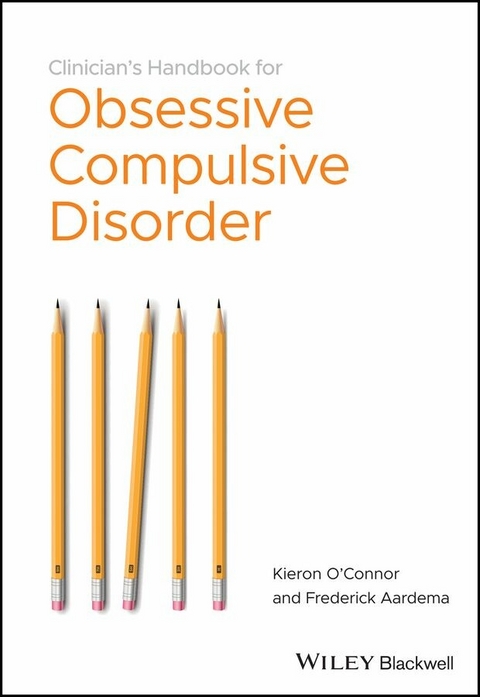
Clinician's Handbook for Obsessive Compulsive Disorder (eBook)
352 Seiten
John Wiley & Sons (Verlag)
978-1-119-96003-4 (ISBN)

hands-on clinical guide to treating people with all types of
obsessive compulsive disorder (OCD) using an inference-based
therapy (IBT).
* Provides clinical examples from the full range of OCD
subtypes
* Coverage integrates theory and application
* Decribes case management in detail - from initial assessment to
terminating therapy and follow-up
* Shows how IBT can also be generalized and applied to other
serious psychiatric disorders
Dr Kieron O'Connor is currently the Director of the Centre for Research on Tic and Obsessional Disorders at the Fernand Seguin Research Center, Louis H. Lafontaine hospital affiliated with University of Montreal. He is also affiliated with the University of Quebec in Outaouais. His research focuses on improving understanding and treatment of people suffering from obsessive-compulsive spectrum and related disorders. The current IBT program is a product of this research. Dr O'Connor's publications include Behavioural Management of Tic Disorders (Wiley, 2005), and Beyond Reasonable Doubt: Reasoning Process in Obsessive Compulsive Disorder (with F. Aardema & M. C. Pélissier; Wiley, 2005). Dr Frederick Aardema is a Clinical Researcher at the Fernand Seguin Research Center, Louis H. Lafontaine hospital affiliated with the University of Montreal. He played a vital role in the development of the inference based approach to the treatment of OCD and his work on reasoning led to the development of an innovative theoretical approach to pure obsessional ruminations. Dr Aardema has published widely on obsessive-compulsive and related disorders. His books include Beyond Reasonable Doubt: Reasoning Process in Obsessive Compulsive Disorder (with K. P. O'Connor & M. C. Pélissier, Wiley, 2005).
List of Cartoons vii
About the Authors ix
Acknowledgements xi
Introduction xiii
Chapter One: Overview of the IBT Programme 1
Chapter Two: IBT: Evaluation Tools 9
Part I: Education and Foundation 21
Chapter Three: When OCD Begins 23
Chapter Four: The 'Logic' behind OCD 43
Chapter Five: The Obsessional Story 57
Chapter Six: The Vulnerable Self-Theme 73
Part II: Intervention 89
Chapter Seven: OCD Doubt is 100% Imaginary 91
Chapter Eight: OCD Doubt is 100% Irrelevant 115
Chapter Nine: The OCD Bubble 129
Chapter Ten: Reality Sensing 143
Part III: Consolidation 157
Chapter Eleven: A Different Story 159
Chapter Twelve: Tricks and Cheats of the OCD Con Artist 175
Chapter Thirteen: The Real Self 189
Chapter Fourteen: Knowing and Doing: Moving On and Preventing Relapse 205
Chapter Fifteen: Trouble-Shooting 221
Case Illustrations 231
Case Illustrations: Clinical Data 257
Answers to Common Queries from Clients 277
Therapist Queries 283
Quiz Answers Sheet 289
Appendix 1: Inferential Confusion Questionnaire (ICQ-EV) 291
Appendix 2: IBT Clinical Scales 293
Appendix 3: Therapy Evaluation Form and Scale 299
Appendix 4: Avoidance and Situational Profile Scale 307
Appendix 5: Diary 311
Bibliography: Key IBA Publications and Other References 321
Index 325
The authors outline a fresh and creative perspective on cognitive
therapy for OCD, derived from the development and testing of their
Inference-Based Approach (IBA). This makes an important
contribution by addressing components neglected or omitted in
earlier approaches - a must read for anybody involved in the
treatment of OCD.
--Jan van Niekerk, Clinical Psychologist,
Fulbourn Hospital, Cambridge, UK
It is refreshing to have a new approach to therapy for OCD
explained so clearly, with due regard to the theoretical subtlety
of the Inference-Based Approach (IBA) approach. This book is a
game-changer in this area of work and is a model of what careful
research and evaluation can yield.
--Richard S. Hallam, Visiting Professor of
Clinical Psychology, University of Greenwich, UK
The Inference-Based Approach (IBA) to the treatment of
Obsessive-Compulsive Disorders presents a new and useful way to
provide an evidence-based intervention for OCD. This approach is
compatible with standard cognitive-behaviour therapy, but it adds a
fresh perspective with new emphases for clinicians and clients
alike. You will no doubt find it to be most interesting, and highly
useful.
--Adam S. Radomsky, Associate Professor of
Psychology, Concordia University, Canada
The Inference-Based Approach (IBA) has transformed the treatment
of OCD in my private practice. This finely detailed treatment
manual will now give clinicians - and their clients -
access to the most innovative horizons of OCD clinical research and
practice.
--Bob Safion, LMHC Private
Practitioner, Anxiety Treatments, Massachusetts, USA
Building on a solid empirical and philosophical foundation,
O'Connor and Aardema have written the definitive, practical
guide to inference-based therapy for OCD for the practicing
clinician that the field has been waiting for.
--Gary Brown, Research Director and Doctor in
Clinical Psychology, Royal Holloway University of London,
UK
This is an excellent handbook on the Inference-Based Approach,
the most viable and promising approach to OCD of the past ten
years. Based on firm research, the book is highly practical.
The authors provide clear guidelines as to how therapists should
deal with the underlying thoughts of OCD patients. A must for
clinicians and students.
--Paul Emmelkamp, Academy Professor,
University of Amsterdam, Netherlands
| Erscheint lt. Verlag | 18.11.2011 |
|---|---|
| Sprache | englisch |
| Themenwelt | Geisteswissenschaften ► Psychologie ► Klinische Psychologie |
| Medizin / Pharmazie ► Medizinische Fachgebiete ► Psychiatrie / Psychotherapie | |
| Schlagworte | Clinical psychology • Klinische Psychologie • Psychologie • Psychology |
| ISBN-10 | 1-119-96003-7 / 1119960037 |
| ISBN-13 | 978-1-119-96003-4 / 9781119960034 |
| Informationen gemäß Produktsicherheitsverordnung (GPSR) | |
| Haben Sie eine Frage zum Produkt? |
 PDF (Adobe DRM)
Kopierschutz: Adobe-DRM
Adobe-DRM ist ein Kopierschutz, der das eBook vor Mißbrauch schützen soll. Dabei wird das eBook bereits beim Download auf Ihre persönliche Adobe-ID autorisiert. Lesen können Sie das eBook dann nur auf den Geräten, welche ebenfalls auf Ihre Adobe-ID registriert sind.
Details zum Adobe-DRM
Dateiformat: PDF (Portable Document Format)
Mit einem festen Seitenlayout eignet sich die PDF besonders für Fachbücher mit Spalten, Tabellen und Abbildungen. Eine PDF kann auf fast allen Geräten angezeigt werden, ist aber für kleine Displays (Smartphone, eReader) nur eingeschränkt geeignet.
Systemvoraussetzungen:
PC/Mac: Mit einem PC oder Mac können Sie dieses eBook lesen. Sie benötigen eine
eReader: Dieses eBook kann mit (fast) allen eBook-Readern gelesen werden. Mit dem amazon-Kindle ist es aber nicht kompatibel.
Smartphone/Tablet: Egal ob Apple oder Android, dieses eBook können Sie lesen. Sie benötigen eine
Geräteliste und zusätzliche Hinweise
Buying eBooks from abroad
For tax law reasons we can sell eBooks just within Germany and Switzerland. Regrettably we cannot fulfill eBook-orders from other countries.
aus dem Bereich