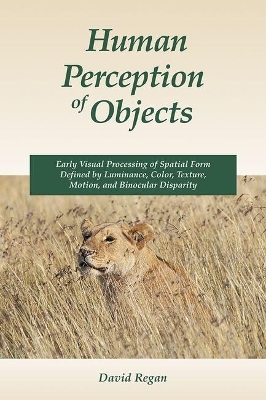
Human Perception of Objects
Oxford University Press Inc (Verlag)
978-0-87893-753-0 (ISBN)
Human Perception of Objects is a detailed and systematic treatment of how we see objects and discriminate their shapes. Chapter 1 explains the concepts that are necessary to understand modern psychophysical vision research, making a sharp distinction between research on human visual system function and research on visual system physiology ("psychophysics is not physiology"), and treating psychophysics as a branch of nonlinear systems analysis. With the aim of emphasizing understanding (as distinct from a facility in mathematical exercises), the nature of the human visual system is placed firmly within an evolutionary context. Chapter 2 is a thorough critical review of what we know about the visual processing that underlies our ability to see objects that are rendered visible by being brighter or dimmer than their surroundings. This chapter also draws attention to those aspects of this process that we do not yet understand, and to conflicts between different models of luminance-defined form perception. Chapters 3-6 are similarly organized critical reviews of how we see objects that are rendered visible by differing from their surroundings in color, texture, motion, or depth. In Chapter 7 the author presents an integrated model of the early processing that underlies object perception, drawing on the material discussed in the previous five chapters.
A considerable knowledge of physics and mathematics is required to understand fully many of the papers that are published in the leading vision research journals. For the reader who has little or no experience with differential calculus, "sidebars" are included in the main text. More advanced material is collected into nine appendices that present the material correctly but are accessible to students with little background in physics or mathematics. These appendices outline the relevant elements of nonlinear system analysis, Fourier methods, geometrical and physical optics, aberrations of the eye, the wave and quantum aspects of light, sampling theory, line element theory, and vector calculus.
Recognizing that many students find the transition from undergraduate life to real research akin to "being thrown into the deep end," Regan includes notes to students and an appendix that, by anecdote, indicate some unwritten "rules of the game," and provide some advice on how not to write a grant proposal.
The book will be of interest to researchers in basic and clinical visual psychophysics, human factors specialists, optometrists, graduate and advanced undergraduate students, physiologists, and biologists interested in the visually guided behavior of animals.
David M. Regan is Professor of Psychology Emeritus and a member of the Center for Vision Research at York University, and Professor of Ophthalmology at the University of Toronto.
How Do We See Ojects? Conceptualizing The Question and Tackling It.- Luminance-Defined Form.- Color-Defined Form.- Texture-Defined Form.- Motion-Defined Form.- Disparity-Defined Form.- Integration of the Five Kinds of Spatial Information, and Some Speculation.- Appendix A: Systems Science and Systems Analysis.- Appendix B: Outline of Fourier Methods and Related Topics.- Appendix C: Imaging.- Appendix D: Opponent-Process and Line-Element Models of Spatial Discriminations.- Appendix E: Rectification, Linearizing "ON" and "OFF" Physiological Systems, and Clynes's Theory of Physiological Rein Control.- Appendix F: A Note on Spatial Sampling and Nyquist's Theorem.- Appendix G: The Measurement of Light.- Appendix H: Linear and Logarithmic Scales: The Decibel.- Appendix I: Elements of Vector Calculus.- Appendix J: Hypotheses, Experiments, Serendipity, Journals, and Grants.- References.- Index.
| Erscheint lt. Verlag | 18.4.2000 |
|---|---|
| Verlagsort | New York |
| Sprache | englisch |
| Maße | 225 x 152 mm |
| Gewicht | 807 g |
| Themenwelt | Geisteswissenschaften ► Psychologie ► Allgemeine Psychologie |
| Geisteswissenschaften ► Psychologie ► Biopsychologie / Neurowissenschaften | |
| Medizin / Pharmazie ► Medizinische Fachgebiete ► Augenheilkunde | |
| Studium ► 1. Studienabschnitt (Vorklinik) ► Physiologie | |
| ISBN-10 | 0-87893-753-6 / 0878937536 |
| ISBN-13 | 978-0-87893-753-0 / 9780878937530 |
| Zustand | Neuware |
| Informationen gemäß Produktsicherheitsverordnung (GPSR) | |
| Haben Sie eine Frage zum Produkt? |
aus dem Bereich