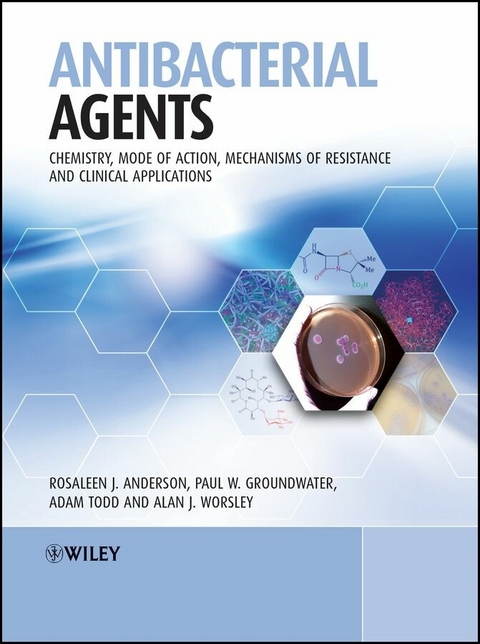
Antibacterial Agents (eBook)
John Wiley & Sons (Verlag)
978-1-118-32543-8 (ISBN)
Antibacterial Agents is an essential guide to this important class of chemotherapeutic drugs. Compounds are organised according to their target, which helps the reader understand the mechanism of action of these drugs and how resistance can arise. The book uses an integrated “lab-to-clinic” approach which covers drug discovery, source or synthesis, mode of action, mechanisms of resistance, clinical aspects (including links to current guidelines, significant drug interactions, cautions and contraindications), prodrugs and future improvements. Agents covered include:
• agents targeting DNA - quinolone, rifamycin, and nitroimidazole antibacterial agents
• agents targeting metabolic processes - sulfonamide antibacterial agents and trimethoprim
• agents targeting protein synthesis - aminoglycoside, macrolide and tetracycline antibiotics, chloramphenicol, and oxazolidinones
• agents targeting cell wall synthesis - β-Lactam and glycopeptide antibiotics, cycloserine, isonaizid, and daptomycin
Antibacterial Agents will find a place on the bookshelves of students of pharmacy, pharmacology, pharmaceutical sciences, drug design/discovery, and medicinal chemistry, and as a bench reference for pharmacists and pharmaceutical researchers in academia and industry.
Antibacterial agents act against bacterial infection either by killing the bacterium or by arresting its growth. They do this by targeting bacterial DNA and its associated processes, attacking bacterial metabolic processes including protein synthesis, or interfering with bacterial cell wall synthesis and function. Antibacterial Agents is an essential guide to this important class of chemotherapeutic drugs. Compounds are organised according to their target, which helps the reader understand the mechanism of action of these drugs and how resistance can arise. The book uses an integrated lab-to-clinic approach which covers drug discovery, source or synthesis, mode of action, mechanisms of resistance, clinical aspects (including links to current guidelines, significant drug interactions, cautions and contraindications), prodrugs and future improvements. Agents covered include: agents targeting DNA - quinolone, rifamycin, and nitroimidazole antibacterial agents agents targeting metabolic processes - sulfonamide antibacterial agents and trimethoprim agents targeting protein synthesis - aminoglycoside, macrolide and tetracycline antibiotics, chloramphenicol, and oxazolidinones agents targeting cell wall synthesis - -Lactam and glycopeptide antibiotics, cycloserine, isonaizid, and daptomycin Antibacterial Agents will find a place on the bookshelves of students of pharmacy, pharmacology, pharmaceutical sciences, drug design/discovery, and medicinal chemistry, and as a bench reference for pharmacists and pharmaceutical researchers in academia and industry.
Professor Rosaleen Anderson, Professor of Pharmaceutical Chemistry, Sunderland Pharmacy School, University of Sunderland, UK Professor Paul Groundwater, Professor of Medicinal Chemistry, Faculty of Pharmacy, The University of Sydney, Australia Dr Adam Todd, Senior Lecturer in Pharmacy Practice, Sunderland Pharmacy School, University of Sunderland, UK Dr Alan Worsley, Principal Lecturer in Pharmacy Practice, Sunderland Pharmacy School, University of Sunderland, UK
| Erscheint lt. Verlag | 30.5.2012 |
|---|---|
| Sprache | englisch |
| Themenwelt | Medizin / Pharmazie ► Gesundheitsfachberufe |
| Medizin / Pharmazie ► Medizinische Fachgebiete ► Pharmakologie / Pharmakotherapie | |
| Naturwissenschaften ► Chemie | |
| Technik | |
| Schlagworte | Biowissenschaften • Chemie • Chemistry • Life Sciences • Medical Science • Medizin • Medizinische Chemie • Microbiology & Virology • Mikrobiologie • Mikrobiologie u. Virologie • Pharmaceutical & Medicinal Chemistry • Pharmacology & Pharmaceutical Medicine • Pharmakologie u. Pharmazeutische Medizin • Pharmazeutische Chemie • Pharmazeutische u. Medizinische Chemie • quinolones, rifamycins, sulphonamides, trimethoprim, chloramphenicol, macrolides, tetracyclines, b-lactams, D-cycloserine, vancomycin, isoniazid, drug discovery, source or synthesis, mode of action, mechanisms of resistance, clinical aspects, prodrugs, pharmaceutical science, chemotherapeutic drugs |
| ISBN-10 | 1-118-32543-5 / 1118325435 |
| ISBN-13 | 978-1-118-32543-8 / 9781118325438 |
| Informationen gemäß Produktsicherheitsverordnung (GPSR) | |
| Haben Sie eine Frage zum Produkt? |
 PDF (Adobe DRM)
Kopierschutz: Adobe-DRM
Adobe-DRM ist ein Kopierschutz, der das eBook vor Mißbrauch schützen soll. Dabei wird das eBook bereits beim Download auf Ihre persönliche Adobe-ID autorisiert. Lesen können Sie das eBook dann nur auf den Geräten, welche ebenfalls auf Ihre Adobe-ID registriert sind.
Details zum Adobe-DRM
Dateiformat: PDF (Portable Document Format)
Mit einem festen Seitenlayout eignet sich die PDF besonders für Fachbücher mit Spalten, Tabellen und Abbildungen. Eine PDF kann auf fast allen Geräten angezeigt werden, ist aber für kleine Displays (Smartphone, eReader) nur eingeschränkt geeignet.
Systemvoraussetzungen:
PC/Mac: Mit einem PC oder Mac können Sie dieses eBook lesen. Sie benötigen eine
eReader: Dieses eBook kann mit (fast) allen eBook-Readern gelesen werden. Mit dem amazon-Kindle ist es aber nicht kompatibel.
Smartphone/Tablet: Egal ob Apple oder Android, dieses eBook können Sie lesen. Sie benötigen eine
Geräteliste und zusätzliche Hinweise
Buying eBooks from abroad
For tax law reasons we can sell eBooks just within Germany and Switzerland. Regrettably we cannot fulfill eBook-orders from other countries.
aus dem Bereich