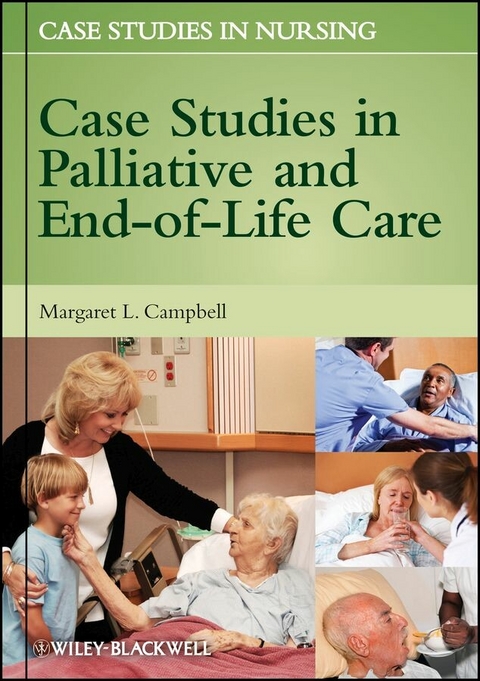
Case Studies in Palliative and End-of-Life Care (eBook)
John Wiley & Sons (Verlag)
978-1-118-36327-0 (ISBN)
The book is organized into three sections covering subjects related to communication, symptom management, and family care. Each case is presented in a consistent, logical format for ease of use, highlighting key evidence-based concepts including the case history, care setting, diagnosis and prognosis, assessment, treatment considerations, and family support.
A key reference, Case Studies in Palliative and End-of-Life Care is an invaluable resource for clinicians who provide palliative care to patients with life-limiting illnesses and those at the end of life along with their families.Margaret L. Campbell, PhD, RN, FPCN is Associate Professor – Research in the Office for Health Research at the College of Nursing at Wayne State University in Detroit, Michigan.
Case Studies in Palliative and End-of-Life Care uses a case-based approach to provide students and practitioners with an important learning tool to improve critical thinking skills and encourage discussion toward improving experiences for patients and their families. The book is organized into three sections covering subjects related to communication, symptom management, and family care. Each case is presented in a consistent, logical format for ease of use, highlighting key evidence-based concepts including the case history, care setting, diagnosis and prognosis, assessment, treatment considerations, and family support. A key reference, Case Studies in Palliative and End-of-Life Care is an invaluable resource for clinicians who provide palliative care to patients with life-limiting illnesses and those at the end of life along with their families.
Margaret L. Campbell, PhD, RN, FPCN is Associate Professor - Research in the Office for Health Research at the College of Nursing at Wayne State University in Detroit, Michigan.
Contributor List viii
Introduction xii
Margaret L. Campbell
Section 1 Communication Case Studies 1
Case 1.1 Comsmunicating about a Progressive Diagnosis and Prognosis 5
Julia A. Walch
Case 1.2 Diagnosis/Prognosis Uncomplicated Death at Home 12
Constance Dahlin
Case 1.3 Accommodating Religiosity and Spirituality in Medical Decision-Making 18
Jennifer Gentry
Case 1.4 Discussing Cardiopulmonary Resuscitation When it May Be Useful 26
Kelli Gershon
Case 1.5 Discussing CPR When it is a Non-Beneficial Intervention 33
Judy Passaglia
Case 1.6 Discussing Brain Death, Organ Donation, and Donation after Cardiac Death 41
Christine Westphal and Rebecca Williams
Case 1.7 Discussing Physiological Futility 52
Judy C. Wheeler
Case 1.8 Wounded Families: Decision-Making in the Setting of Stressed Coping and Maladaptive Behaviors in Health Crises 60
Kerstin McSteen
Case 1.9 Notification of an Expected Death 68
Peg Nelson
Case 1.10 Death Notification after Unexpected Death 73
Garrett K. Chan
Section 2 Symptom Management Case Studies 83
Case 2.1 Pain: Cancer in the Home 87
Constance Dahlin
Case 2.2 Treating an Acute, Severe, Cancer Pain Exacerbation 98
Patrick J. Coyne
Case 2.3 Pain and Advanced Heart Failure 104
Margaret L. Campbell
Case 2.4 Dyspnea and Advanced COPD 110
Margaret L. Campbell
Case 2.5 Dyspnea and Heart Failure 117
Garrett K. Chan
Case 2.6 Treating Dyspnea during Ventilator Withdrawal 128
Margaret L. Campbell
Case 2.7 Cough Associated with COPD and Lung Cancer 138
Peg Nelson
Case 2.8 Hiccups and Advanced Illness 145
Marian Grant
Case 2.9 Treating Nausea Associated with Advanced Cancer 152
Judy C. Wheeler
Case 2.10 Nausea Associated with Bowel Obstruction 161
Terri L. Maxwell
Case 2.11 Nausea Related to Uremia, Dialysis Cessation 168
Linda M. Gorman
Case 2.12 Opioid-Induced Pruritus 176
Richelle Nugent Hooper
Case 2.13 Pruritus in End-Stage Renal Disease 183
Linda M. Gorman
Case 2.14 Opioid-Induced Constipation 190
Grace Cullen Oligario
Case 2.15 Depression in Advanced Disease 198
Todd Hultman
Case 2.16 Treating Anxiety 205
Darrell Owens
Case 2.17 Terminal Secretions 213
Terri L. Maxwell
Case 2.18 Fungating Wounds and the Palliative Care Patient 220
Laura C. Harmon
Case 2.19 Pressure Ulcer Care in Palliative Care 229
Laura C. Harmon
Case 2.20 Treating Ascites 239
Darrell Owens
Case 2.21 Delirium Management in Palliative Care 247
Kerstin McSteen
Section 3 Family Care Case Studies 257
Case 3.1 Caring for the Family Expecting a Loss 259
Patricia A. Murphy and David M. Price
Case 3.2 Anticipatory Grief and the Dysfunctional Family 266
Rita J. DiBiase
Case 3.3 Acute and Uncomplicated Grief after an Expected Death 277
Rita J. DiBiase
Case 3.4 Bereavement after Unexpected Death 289
Garrett K. Chan
Case 3.5 Complicated Grief 300
Rita J. DiBiase
Index 309
Case 1.1 Communicating about a Progressive Diagnosis and Prognosis
Julia A. Walch
HISTORY
Thomas was an 88-year-old African-American man who was admitted to the hospital for the third time in a month via the Emergency Department with fever and difficulty breathing; the admission diagnosis was urinary tract infection. He was discharged from the hospital just two days prior to the most recent admission after a prolonged hospitalization for health-care-acquired pneumonia which required intensive care and a short course of mechanical ventilation. He made slow but steady clinical improvements with the exception of his appetite, which remained poor. A percutaneous endoscopic gastrostomy (PEG) tube was being considered by the attending physician. Prior to recent admissions the patient had not been hospitalized in several years.
His past medical history included coronary artery disease status post coronary artery bypass graft surgery, atrial fibrillation, hypertension, Alzheimer’s dementia (AD), and chronic kidney disease. He resided in a nursing home because his wife could no longer care for him at home. A palliative care consult was placed to discuss diagnosis, prognosis, and treatment goals with the patient’s wife.
Thomas’s wife reported that Thomas had been steadily declining over the past six to eight months, he was incontinent of bowel and bladder, and he was able to ambulate short distances and interact with her and other family members.
A geriatric assessment disclosed: needs assistance with activities of daily living (ADLs); dependent for instrumental activities of daily living (IADLs); able to remember three objects after five minutes; clock test abnormal; could not finish the Montreal Cognitive Assessment; able to draw a cube, name animals, recall four out of five words; and oriented to person and place but not time. Thus, he was categorized as being moderately impaired secondary to AD.
Further medical issues identified included malnutrition with hypoalbuminemia, depression with a geriatric depression scale score of 9/15, and debility. A speech language pathology evaluation revealed dysphagia related to pneumonia that may improve once pneumonia improves.
PHYSICAL EXAMINATION
DIAGNOSTICS
No diagnostic studies were conducted during this visit.
CLINICAL QUESTION
How should diagnosis and prognosis be discussed with the surrogate decision maker?
DISCUSSION
Most of what is known about communication of breaking bad news has focused on physician-patient communication in the oncology population at the end of life. Bad news is defined as any information which adversely and seriously affects an individual’s view of his or her future and is always in the eye of the beholder.1 Effective communication is the key to developing a relationship with the patient or family. This level of communication requires mutual respect and strong listening skills that allow for gathering and eliciting information and the implementation of a treatment plan. Doing this well can have a profound effect on how the patient or family approach their disease and its treatment. Effective communication can be achieved in the first meeting. In a first-person account a woman who had been a hospital patient explained how she changed hospitals and doctors three times during the course of her illness not because she was unhappy with the care, but because she was unhappy with the communication.2
Although physicians typically discuss diagnosis and prognosis, nurses are the constant, consistent health care providers, especially in the hospital or nursing home setting. Nurses are often the clinician who the patient or family asks to clarify questions or concerns after the multidisciplinary meeting is completed. Experienced nurses are more comfortable discussing prognosis compared to nurse with less experience.3
The communication strategy SPIKES (Setting, Perception, Invitation, Knowledge, Emotions and Empathic responses, and Strategies and Summary) is a mnemonic device developed to educate physicians on how to deliver bad news.4 Communicating bad news or counseling a patient/family about a chronic, progressive, eventually terminal disease is an essential skill for nurses as well. The nurse can apply the SPIKES mnemonic device to discuss diagnosis and prognosis with patients or families.
Setting up the Interview
Before starting a family meeting, confirm the medical facts of the case and plan what will be discussed. Ascertain if the patient will be able to participate. The patient’s preferences about which family members to include should be elicited. If uncomfortable with communicating the information, rehearse either mentally or to a colleague what you will say. Create the setting for the meeting, which should allow for privacy. A conference room is the ideal setting but if it is at the patient’s bedside draw the curtains around the bed. Some families still prefer to meet at the patient’s bedside even when the patient is unable to participate. Ensure there are enough chairs for everyone and that everyone is sitting down. This aids in relaxing the patient, gives the message that the focus is on the patient, gives an impression that time is not rushed, and prevents the psychological barrier of distance such as when one is seated and another is standing. Plan adequate time for discussion and alert nursing staff about the meeting to prevent interruptions.
Perception
Perception is assessing what the patient or family already understands about the patient’s health. The meeting should start with asking the patient or family to describe the medical condition. The statement “Tell me what you understand about your condition” is an effective opening. A common misunderstanding among health care providers when caring for a patient with a chronic progressive medical condition is that the patient or family may be in denial. However, the real issue is that they do not understand the disease process. This is also the time for the nurse to assess the patient’s or family’s ability to understand and their readiness to accept information.
Invitation
Invitation involves finding out how much the patient or family wants to know. Ask, “Are you ready to talk about our impressions?” or “Is this a good time to talk?” This is also when the nurse establishes how much information the patient wants or whether the patient prefers his or her condition be discussed with someone else. Most people want to know the truth; more than 90% of people want to know the truth about their diagnosis even if it is grave.4 Assessing the level of understanding the patient or family has about the disease helps the clinician to determine how much information/detail they need.
Knowledge
Sharing the information needs to be done in a straightforward, honest, yet sensitive manner. The information conveyed needs to be based on facts and evidence, not on personal opinion. Some families will ask, “What would you do?” A helpful response may be “It is important to base decisions on what your loved one would want.” Information that is conveyed correctly to the patient or family allows them to cope with the situation and plan for the future. Avoid the use of medical terminology or technical jargon. There are times when a “warning shot” is needed to prepare the family that bad news is coming; for instance, the clinician might say “We have your results and I have bad news.”
Emotions with Empathetic Responses
The clinician can display empathy while delivering bad news by saying “I am sorry to have to tell you this.” It is best not to just say “I’m sorry” because this can be misinterpreted for pity or being responsible for the situation.
Patients and families respond to the news in a variety of ways such as through tears, sadness, love, anxiety, or other emotions. Some experience denial, blame, guilt, or disbelief. Some people walk out of a meeting or respond nonverbally. Patients who might not be able to walk away but do not want to participate any longer may turn away, close their eyes, or just stop speaking. In this case clarify with the patient that they want to stop meeting and ask permission to return at another time or day. It is important to acknowledge emotions by asking for a description about what is being displayed. “You appear to be....Can you tell me how you are feeling?” or “Tell me more about what you are feeling.” Once the patient or family has worked through their emotions they are often able to make decisions in the best interests of themselves or their loved one. Patients or families who have good information and...
| Erscheint lt. Verlag | 2.8.2012 |
|---|---|
| Reihe/Serie | Case Studies in Nursing |
| Case Studies in Nursing | Case Studies in Nursing |
| Sprache | englisch |
| Themenwelt | Medizin / Pharmazie ► Pflege ► Palliativpflege / Sterbebegleitung |
| Schlagworte | Approach • Book • Cancer & Palliative Care Nursing • Care • CASE • casebased • Clinicians • Communication • consistent • Covering • endoflife • evidencebased concepts • Format • highlighting • History • important learning • Key • Krankenpflege • Logical • nursing • Palliative • Palliativmedizin • Pflege i. d. Krebs- u. Palliativmedizin • sections • Studies • subjects • Three • use |
| ISBN-10 | 1-118-36327-2 / 1118363272 |
| ISBN-13 | 978-1-118-36327-0 / 9781118363270 |
| Informationen gemäß Produktsicherheitsverordnung (GPSR) | |
| Haben Sie eine Frage zum Produkt? |
 EPUB (Adobe DRM)
Kopierschutz: Adobe-DRM
Adobe-DRM ist ein Kopierschutz, der das eBook vor Mißbrauch schützen soll. Dabei wird das eBook bereits beim Download auf Ihre persönliche Adobe-ID autorisiert. Lesen können Sie das eBook dann nur auf den Geräten, welche ebenfalls auf Ihre Adobe-ID registriert sind.
Details zum Adobe-DRM
Dateiformat: EPUB (Electronic Publication)
EPUB ist ein offener Standard für eBooks und eignet sich besonders zur Darstellung von Belletristik und Sachbüchern. Der Fließtext wird dynamisch an die Display- und Schriftgröße angepasst. Auch für mobile Lesegeräte ist EPUB daher gut geeignet.
Systemvoraussetzungen:
PC/Mac: Mit einem PC oder Mac können Sie dieses eBook lesen. Sie benötigen eine
eReader: Dieses eBook kann mit (fast) allen eBook-Readern gelesen werden. Mit dem amazon-Kindle ist es aber nicht kompatibel.
Smartphone/Tablet: Egal ob Apple oder Android, dieses eBook können Sie lesen. Sie benötigen eine
Geräteliste und zusätzliche Hinweise
Buying eBooks from abroad
For tax law reasons we can sell eBooks just within Germany and Switzerland. Regrettably we cannot fulfill eBook-orders from other countries.
aus dem Bereich