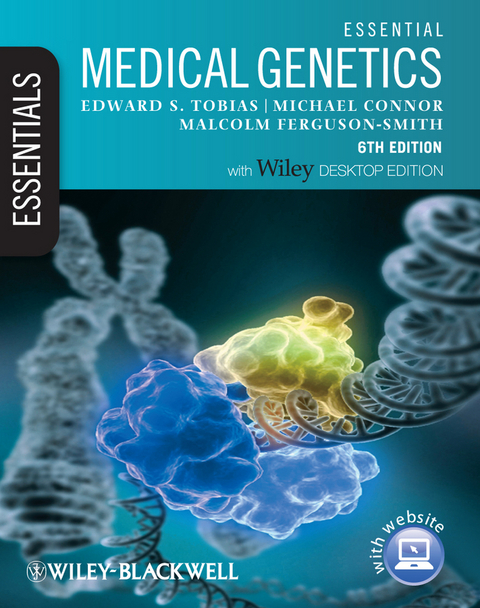
Essential Medical Genetics (eBook)
John Wiley & Sons (Verlag)
9781118293713 (ISBN)
Essential Medical Genetics provides students, clinicians, counsellors and scientists with the up-to-date information they need regarding the basic principles underlying medical genetics. It also provides guidance on how to apply current knowledge in clinical contexts, covering a wide variety of topics: from genome structure and function to mutations, screening and risk assessment for inherited disorders.
This sixth edition has been substantially updated to include, for instance, the latest information on the Human Genome Project as well as several new molecular genetic and chromosome analysis techniques. In full colour throughout, it includes a number of brand new features, including: a large number of self-assessment questions; 'Essentials' chapter summaries; further reading suggestions; and case study scenarios introducing clinical situations. An invaluable new section gives illustrated practical advice regarding how to choose the best available online genetic databases and also, importantly, how to most easily and most efficiently use them, for a wide range of purposes.
Essential Medical Genetics is the perfect resource for a course on medical genetics, and is now accompanied by a regularly updated website and the FREE enhanced Wiley Desktop Edition (upon purchase of the book).
The companion website at www.wiley.com/go/tobias features figures from the book in PowerPoint format and a link to the authors' website with regularly updated links to genetic databases and additional self-test questions.
This title is also available as a mobile App from MedHand Mobile Libraries. Buy it now from iTunes, Google Play or the MedHand Store.
Edward S. Tobias, Professor of Genetic Medicine, University of Glasgow, and Honorary Consultant in Medical Genetics, West of Scotland Regional Genetics Service, Institute of Medical Genetics, Glasgow. Medical Genetics undergraduate Teaching Lead, Clinical Director, MSc in Medical Genetics, and Fellow of the Higher Education Authority.
Dr Tobias won the Best College Teacher Award at Glasgow University in March 2013, as chosen by the Student Representative Council and the students themselves.
He also won the Teaching Excellence Award 2012 from the University's Principal and Senate Committee.
Glasgow University came top in the UK National Student Survey 2012 for Genetics teaching.
Michael Connor, Professor of Medical Genetics, University of Glasgow, and Director of the West of Scotland Regional Genetics Service, Institute of Medical Genetics, Yorkhill, Glasgow
Malcolm Ferguson-Smith, Emeritus Professor of Pathology, University of Cambridge and formerly Director of the East Anglia Regional Genetics Service, Addenbrooke's Hospital, Cambridge
Adopted at Cambridge University Essential Medical Genetics provides students, clinicians, counsellors and scientists with the up-to-date information they need regarding the basic principles underlying medical genetics. It also provides guidance on how to apply current knowledge in clinical contexts, covering a wide variety of topics: from genome structure and function to mutations, screening and risk assessment for inherited disorders. This sixth edition has been substantially updated to include, for instance, the latest information on the Human Genome Project as well as several new molecular genetic and chromosome analysis techniques. In full colour throughout, it includes a number of brand new features, including: a large number of self-assessment questions; 'Essentials' chapter summaries; further reading suggestions; and case study scenarios introducing clinical situations. An invaluable new section gives illustrated practical advice regarding how to choose the best available online genetic databases and also, importantly, how to most easily and most efficiently use them, for a wide range of purposes. Essential Medical Genetics is the perfect resource for a course on medical genetics, and is now accompanied by a regularly updated website and the FREE enhanced Wiley Desktop Edition (upon purchase of the book). The companion website at www.wiley.com/go/tobias features figures from the book in PowerPoint format and a link to the authors' website with regularly updated links to genetic databases and additional self-test questions. This title is also available as a mobile App from MedHand Mobile Libraries. Buy it now from iTunes, Google Play or the MedHand Store.
Edward S. Tobias, Professor of Genetic Medicine, University of Glasgow, and Honorary Consultant in Medical Genetics, West of Scotland Regional Genetics Service, Institute of Medical Genetics, Glasgow. Medical Genetics undergraduate Teaching Lead, Clinical Director, MSc in Medical Genetics, and Fellow of the Higher Education Authority. Dr Tobias won the Best College Teacher Award at Glasgow University in March 2013, as chosen by the Student Representative Council and the students themselves. He also won the Teaching Excellence Award 2012 from the University's Principal and Senate Committee. Glasgow University came top in the UK National Student Survey 2012 for Genetics teaching. Michael Connor, Professor of Medical Genetics, University of Glasgow, and Director of the West of Scotland Regional Genetics Service, Institute of Medical Genetics, Yorkhill, Glasgow Malcolm Ferguson-Smith, Emeritus Professor of Pathology, University of Cambridge and formerly Director of the East Anglia Regional Genetics Service, Addenbrooke's Hospital, Cambridge
Title page 2
Table of Contents 4
Preface 8
Acknowledgements 10
How to get the best out of your textbook 11
Part 1: Basic Principles 14
Medical genetics in perspective 16
Scientific basis of medical genetics 18
Clinical applications of medical genetics 22
The human genome 26
Structure and organisation of the genome 27
Gene identification 27
The Human Genome Project 27
Nucleic acid structure and function 36
Nucleic acid structure 37
Nucleic acid function 39
Gene regulation 42
DNA replication 44
Mutation types, effects and nomenclature 45
DNA analysis 54
Basic methods 55
Mutation detection 56
Indirect mutant gene tracking 65
Analysis of DNA length polymorphisms 66
Analysis of single nucleotide polymorphisms 67
Chromosomes 70
Chromosome structure 71
Chromosome analysis 72
Chromosome heteromorphisms 78
Chromosomes in other species 79
Mitochondrial chromosomes 81
Mitosis 82
Gametogenesis 86
Meiosis 87
Spermatogenesis 89
Oogenesis 91
Fertilisation 91
X-inactivation and dosage compensation 92
Sex chromosome aberrations 93
Sex determination and differentiation 96
Genomic imprinting (parental imprinting) 96
Chromosome aberrations 102
Numerical aberrations 103
Structural aberrations 105
Cytogenetic and molecularm ethods for the detection of chromosomal aberrations 113
Identification of the chromosomal origin of complex structural rearrangements 120
Typical mendelian inheritance 130
Introduction to autosomal single-gene inheritance 131
Autosomal dominant inheritance 131
Autosomal recessive inheritance 133
Introduction to sex linked inheritance 136
X-linked recessive inheritance 138
X-linked dominant inheritance 140
Y-linked inheritance (holandric inheritance) 141
Atypical mendelian inheritance 144
Genetic anticipation 145
Pseudoautosomal inheritance 147
Autosomal dominant inheritance with sex limitation 147
Pseudodominant inheritance 147
X-linked dominant inheritance with male lethality 148
Mosaicism 148
Modifier genes and digenic inheritance 148
Uniparental disomy 149
Imprinting disorders 149
Non-mendelian inheritance 154
Multifactorial disorders 155
Mitochondrial disorders 160
Somatic cell genetic disorders 160
Medical genetics in populations 164
Selection for single-gene disorders 165
Founder effect and genetic drift for single-gene disorders 166
Altered mutation rate for single-gene disorders 167
Linkage analysis and the International HapMap Project 167
Human population evolution and migration 168
Part 2: Clinical Applications 174
Genetic assessment, genetic counselling and reproductive options 176
Communication of advice 177
Special points in counselling 181
Prenatal diagnosis 183
Amniocentesis 183
Chorionic villus sampling 187
Cordocentesis, fetal skin biopsy and fetal liver biopsy 188
Ultrasonography 188
Fetal cells in the maternal circulation 188
Free fetal DNA and RNA detection 188
Preimplantation genetic diagnosis 189
Family history of cancer 192
General principles 193
Tumour suppressor genes 194
Genes involved in DNA repair mechanisms 200
Oncogenes 200
Other cancer-related genes 202
Genetic counselling aspects of cancer 202
Common familial cancer predisposition syndromes 202
Family history of common adult-onset disorder 212
General principles 213
Diabetes mellitus: common and monogenic forms 213
Strong family history – typical mendelian disease 222
Cystic fibrosis 223
Duchenne and becker muscular dystrophies 225
Neurofibromatosis type 1 227
Strong family history – other inheritance mechanisms 232
Myotonic dystrophy 233
Fragile X syndrome 234
Mitochondrial disorder 235
Imprinting-related disorder 236
Chromosomal translocation 237
Screening for disease and for carriers 242
Prenatal screening 243
Neonatal screening 246
Carrier detection in the adult population 247
Presymptomatic screening of adults 250
Family history of one or more congenital malformations 254
Aetiology 255
Chromosomal disorders 256
Neural tube defects 260
Teratogenic effects 263
Multiple malformation syndromes 266
Part 3: Electronic databases – A user’s guide 278
Electronic databases – A user’s guide 280
Finding information regardings pecific conditions and names of associated genes 281
Laboratories undertaking genetic testing 283
Patient information and support groups 283
Gene and protein specific sequence, structure, function and expression information 285
Nucleotide sequences and human mutations 294
Automatic primer design tools 294
Displaying map data for genes and markers 300
Online missense mutation analysis tools 301
Computer aided syndrome diagnosis 306
Professional genetics societies 310
The human genome project: ethics and education 310
Maintenance of gene frequencies 328
Self - a ssessment 317
APPENDIX 1: Odds, probabilities and applications of Bayes’ theorem 325
APPENDIX 2: Calculation of the coefficients of relationshipand inbreeding 327
APPENDIX 3: Population genetics of single-gene disorders 328
APPENDIX 4: Legal aspects 330
Glossary 331
Index 337
"Essential Medical Genetics is the perfect resource for a
course on medical genetics, and is now accompanied by a regularly
updated website and the FREE enhanced Wiley Desktop Edition (upon
purchase of the book) ." (MedReport, 9 October
2012)
"I have watched this textbook from its first inception and
was disappointed that there was no new edition for so many years.
Having waited, the result now is excellent and it has overcome my
preference for Emery's Elements as a basic human genetics
text." Emeritus Professor in Clinical Genetics
"I find the reference to electronic resources particularly
useful, especially for people who approach clinical genetics for
the first time and are not familiar with these tools." Dr Sixto
García-Miñaúr, Imperial College London, and
Hospital Universitario La Paz, Madrid, Spain
Reviews of the previous edition
"This book is an easy to read, well illustrated introduction to
medical genetics. It deals nicely with all the classical aspects of
the subject..." Black Bag, Medical Students' Society of
Bristol University
"...a justifiably popular introductory text." The British
Medical Journal
| Erscheint lt. Verlag | 22.11.2011 |
|---|---|
| Reihe/Serie | Essentials |
| Essentials | Essentials |
| Sprache | englisch |
| Themenwelt | Medizin / Pharmazie ► Medizinische Fachgebiete |
| Studium ► 2. Studienabschnitt (Klinik) ► Humangenetik | |
| Schlagworte | BASIC • Basic Medical Sciences • Biowissenschaften • Clinical • Community Nursing • contexts • Counsellors • Current • disorders • Edition • essential medical genetics • Gemeindekrankenpflege • Genetics • Genetik • genome structure • Information • instance • Knowledge • Krankenpflege • Life Sciences • Medical • Medical Science • Medizin • Medizinische Grundlagenfächer • Medizinische Grundlagenfächer • nursing • Principles • provides • Risk • scientists • sixth • Topics • uptodate • variety • wide |
| ISBN-13 | 9781118293713 / 9781118293713 |
| Informationen gemäß Produktsicherheitsverordnung (GPSR) | |
| Haben Sie eine Frage zum Produkt? |
 PDF (Adobe DRM)
Kopierschutz: Adobe-DRM
Adobe-DRM ist ein Kopierschutz, der das eBook vor Mißbrauch schützen soll. Dabei wird das eBook bereits beim Download auf Ihre persönliche Adobe-ID autorisiert. Lesen können Sie das eBook dann nur auf den Geräten, welche ebenfalls auf Ihre Adobe-ID registriert sind.
Details zum Adobe-DRM
Dateiformat: PDF (Portable Document Format)
Mit einem festen Seitenlayout eignet sich die PDF besonders für Fachbücher mit Spalten, Tabellen und Abbildungen. Eine PDF kann auf fast allen Geräten angezeigt werden, ist aber für kleine Displays (Smartphone, eReader) nur eingeschränkt geeignet.
Systemvoraussetzungen:
PC/Mac: Mit einem PC oder Mac können Sie dieses eBook lesen. Sie benötigen eine
eReader: Dieses eBook kann mit (fast) allen eBook-Readern gelesen werden. Mit dem amazon-Kindle ist es aber nicht kompatibel.
Smartphone/Tablet: Egal ob Apple oder Android, dieses eBook können Sie lesen. Sie benötigen eine
Geräteliste und zusätzliche Hinweise
Buying eBooks from abroad
For tax law reasons we can sell eBooks just within Germany and Switzerland. Regrettably we cannot fulfill eBook-orders from other countries.
aus dem Bereich