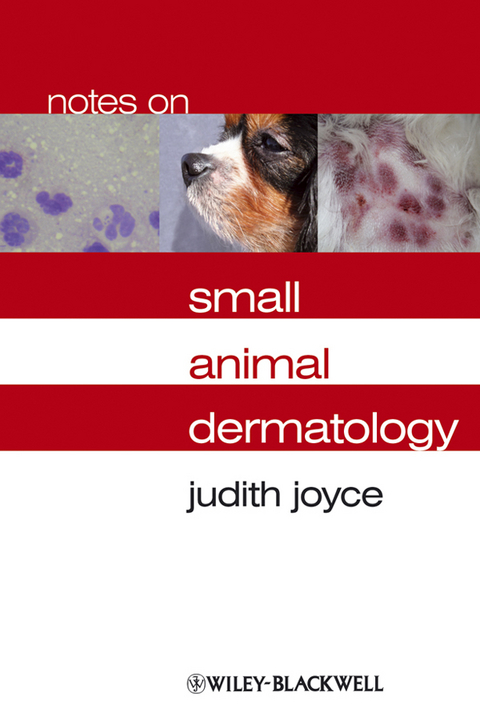
Notes on Small Animal Dermatology (eBook)
John Wiley & Sons (Verlag)
978-1-118-27934-2 (ISBN)
Part of the popular Notes On series, this book is full of practical advice and information on diagnosing and treating common dermatological problems in small animals. The rapid reference format is designed to help you locate information as quickly as possible. Information on common dermatological complaints is offered in different ways to meet a variety of needs. Firstly a problem-orientated perspective is provided, and then a disease-based perspective looking at what underlying problems cause particular diseases. This is followed by a section that looks at dermatological disease by anatomical location, and a section that outlines different treatments. Supplemented with full-colour photographs throughout to aid diagnosis Detailed flow-diagrams illustrate the problem-orientated approach Text is laid out in note form for ease of reference This book is ideal for veterinary students, new practitioners and established professionals who need a quick refresher
Judith Joyce BVetMed, Cert SAD, MRCVS, has put her 28 years of small animal dermatology experience into this highly practical book. She currently works at the Croft Veterinary Hospital, Northumberland, UK, and is responsible for first opinion dermatology service throughout the practice as well as seeing dermatology referrals from surrounding practices. .
Title Page 5
Table of Contents 7
Section 1: The basic tools 13
Terminology and Glossary 15
Lesions 23
Investigation and diagnosis 32
3.1 History 32
3.2 Clinical Examination 33
3.3 Examination For Ectoparasites 37
3.4 Cytology 43
3.5 Skin biopsies 46
3.6 Fungal examination 50
3.7 Examinations for bacteria and yeasts 52
3.8 Allergy testing 53
3.9 Tests for endocrine disease 55
Section 2: Problem-orientated approach 59
The pruritic patient 61
4.1 Causes of pruritus 61
4.2 The pruritic dog 62
4.3 The more mature patient 66
4.4 The pruritic cat 66
4.5 Clinical approach to the pruritic cat 72
The scaling patient 77
5.1 The most common cause of scaling conditions is parasites 77
5.2 Localisation of scaling disorders 80
5.3 Dermatophytosis 80
5.4 Bacterial and yeast infections 80
5.5 Systemic disease 80
5.6 Endocrine disease 81
5.7 Mild scaling 81
5.8 Biopsy 82
5.9 Immune-mediated disease 82
5.10 Primary genetic scaling disorders 83
5.11 Hypersensitivity dermatitis 83
5.12 Treatment of scaling disorders 83
The alopecic patient 84
6.1 Congenital or inherited hairloss 84
6.2 Pattern alopecias 84
6.3 Traumatic hairloss 84
6.4 Inflammatory hairloss 85
6.5 Screen for alopecia due to systemic disease 87
6.6 Paraneoplastic alopecia 87
6.7 Endocrine alopecia 87
6.8 Biopsy 88
6.9 Non-endocrine alopecias 89
6.10 Long-term palliative treatment is usually necessary in alopecic skin conditions to address secondary complications (see chapter 27) 89
Management of diseases presenting with spots (papules, pustules, vesicles and bullae) 90
7.1 Young animals 90
7.2 Severe/recurrent or persistent lesions 92
7.3 Investigation of papular disease 93
7.4 Investigation of vesicular disease 93
7.5 Investigation of pustular disease 93
7.6 Folliculitis 95
Approach to changes in pigmentation 97
8.1 Changes in pigmentation may be generalised or may be localised in specific patterns 97
8.2 Secondary changes in pigmentation should be differentiated from primary changes 97
8.3 Generalised hyperpigmentation may occur in some endocrine and non-endocrine conditions 97
8.4 Pigmentary change may be benign and/or transient 99
8.5 Loss of pigmentation of the skin 99
8.6 Reddening of the skin 99
8.7 Increase in pigmentation 100
8.8 Loss of pigmentation of hair coat 100
8.9 Early histopathological examination is essential 100
8.10 Some lesions cannot always be definitively diagnosed on biopsy 101
Management of raised and ulcerative skin lesions 102
9.1 Papular pustular and vesicular disease 102
9.2 Eosinophilic granuloma complex 102
9.3 Cytology or histopathology 102
9.4 Treatment of neoplastic disease 104
9.5 Raised lesions due to micro-organisms 104
9.6 Definitive diagnosis reached 104
9.7 Chronic inflammatory and bacterial/fungal lesions 105
Section 3: Aetiological approach 107
Diseases caused by ectoparasites 109
10.1 Dog 109
10.2 Cats 121
10.3 Rabbit 126
10.4 Guinea pigs 130
10.5 Other Mites And Lice Of Rabbits Mice And Gerbils(Figures 3.18b, 3.20b And 3.21) 132
Skin disease caused by micro-organisms 133
11.1 Bacterial infections 133
11.2 Leishmaniosis 140
11.3 Fungal infections 141
11.4 Malassezia Dermatitis 146
11.5 Skin diseases caused by viruses 148
Hypersensitivity dermatitis 150
12.1 Parasitic hypersensitivity 150
12.2 Atopic dermatitis 152
12.3 Adverse cutaneous reaction to food 155
12.4 Insect bite hypersensitivity 161
12.5 Bacterial, fungal and yeast hypersensitivity 162
Management of immune-mediated disease 164
13.1 Types of immune-mediated disease 164
13.2 The management of immune-mediated disease 164
13.3 Specific diseases 168
Endocrine disease 175
14.1 Hyperadrenocorticism 175
14.2 Hypothyroidism 179
14.3 Less common endocrine diseases with a primary effect on the skin 183
14.4 Common endocrine diseases that have a secondary effect on the skin 186
14.5 Rare endocrine problems 187
Disorders of the pilosebaceous unit (hair follicle disorders) 188
15.1 Primary hair follicle dysplasias 188
15.2 Secondary hair follicle dysplasias 190
Neoplastic skin disease 192
16.1 Primary skin masses 192
16.2 Common types of skin neoplasia 195
16.3 Generalised skin neoplasia 197
16.4 Metastatic skin neoplasia 198
16.5 Paraneoplastic syndromes 198
Other skin diseases 200
17.1 Metabolic disease 200
17.2 Nutritional disease 201
17.3 Environmental causes 202
17.4 Psychogenic dermatoses 203
17.5 Dermatoses of neurological origin 203
Section 4: Anatomically localised skin disease 205
The foot 207
18.1 Management of claw disease 207
18.2 Management of footpad disease 213
18.3 Pododermatitis 216
Skin disease affecting the perianal region 222
19.1 Management of perianal skin disease 222
Ear disease 229
20.1 Management of pinnal disease 229
20.2 Management of acute otitis externa (figure 20.7) 234
20.3 Management of chronic or recurrent otitis externa (figures 20.8 and 20.9) 234
Periocular skin disease 242
21.1 management of periocular disease 243
Dermatoses affecting the muzzle 246
22.1 management of the haired skin of the muzzle 246
22.2 management of diseases affecting the nasal planum 252
Management of facial lesions 254
Management of skin disease affecting the legs 258
Management of diseases affecting mainly the trunk and dorsum 264
Section 5: Treatment of skin diseases 271
Treatment of primary skin disease 273
26.1 Ectoparasiticides 273
26.2 Treatment of diseases caused by micro-organisms 283
26.3 Treatment of hypersensitivity dermatitis 290
26.4 Treatment of immune-mediated disease 293
26.5 Treatment of endocrine disease 302
26.6 Treatments for hair follicle disorders and keratinisation defects (primary scaling disorders, primary seborrhoea) 307
26.7 Chemotherapeutic agents commonly used in skin neoplasia 312
Treatment of presenting signs 316
27.1 Management of pruritus 316
27.2 Bacterial And Yeast Infections 324
27.3 Management of scaling 333
27.4 Nutritional support for damaged skin 334
Use and abuse of glucocorticoids 336
28.1 Indications 336
28.2 Dose and formulation 336
28.3 Steroid sparing measures 338
28.4 Side-effects 339
28.5 Contraindications 340
Topical treatments 342
29.1 Use of topical preparations 342
29.2 Inappropriate use of topical products can be harmful 343
29.3 Formulations of topical treatments 343
Appendices 351
Appendix 1: History form 352
Appendix 2: Clinical examination 354
Appendix 3: Testing food intolerance 355
Appendix 4: Advice on the use of medicinal products 357
Appendix 5: Safe use of glucocorticoids 359
Appendix 6: Side-effects seen when steroids are given 361
Index 363
Clinical Pathology for the Veterinary Team will help experienced veterinary technicians set up various clinical laboratory diagnostic tests. It provides a good explanation of basic laboratory practices, the underlying concepts of many laboratory tests, and the physiology of common disease conditions. This book is well worth the price. (Journal of the American Veterinary Medical Association, December 2010)
This book provides a good overall summary of basic clinical pathology in small animals. Although it is fairly short and concise, it contains all the necessary relevant information and includes a CD that takes readers thorough six complicated cases, step by step. This is a useful book that would be a handy reference to have in a practice. It is easy to read, concise, and informative. Although it is aimed at small animal veterinary teams, it includes limited information about large animal species, which is important for a good, general understanding. (Doodys, December 2010)
Clinical Pathology for the Veterinary Team offers a fine recourse for technical team members involved in clinical diagnostic evaluation. Machinery calibration, normal anatomy, clinical diagnostics and more are revealed in chapters that provide key technical information for Obtaining and evaluating samples, surveying the disease process, the progress of identification and treatment, and including a DVD with interactive cases. Vet collections need this! (THE MIDWEST BOOK REVIEW, November 2010)
Rosenfeld, a veterinarian who is associated with an education corporation that specializes in seminar training for the hospital team, and Dial (veterinary science and microbiology, U. of Arizona) provide a resource for technical veterinary team members performing clinical diagnostic evaluation in small animal lab work. (Book News, September 2010) ReviewUpdater-Profile_29@1326747470438
| Erscheint lt. Verlag | 22.11.2011 |
|---|---|
| Reihe/Serie | Notes on |
| Sprache | englisch |
| Themenwelt | Medizin / Pharmazie |
| Veterinärmedizin ► Klinische Fächer ► Dermatologie | |
| Veterinärmedizin ► Kleintier | |
| Schlagworte | animals • Book • Common • common dermatological • complaints • Dermatological • Dermatologie • Different • full • Information • locate • Notes • offered • Part • Popular • possible • Practical • Problems • Quickly • Rapid • reference format • series • variety • Veterinärmedizin • Veterinärmedizin / Dermatologie • Veterinärmedizin f. Kleintiere • Veterinärmedizin • Veterinärmedizin / Dermatologie • Veterinärmedizin f. Kleintiere • Veterinary Dermatology • Veterinary Medicine • Veterinary Medicine - Small Animal General • Ways |
| ISBN-10 | 1-118-27934-4 / 1118279344 |
| ISBN-13 | 978-1-118-27934-2 / 9781118279342 |
| Informationen gemäß Produktsicherheitsverordnung (GPSR) | |
| Haben Sie eine Frage zum Produkt? |
 PDF (Adobe DRM)
Kopierschutz: Adobe-DRM
Adobe-DRM ist ein Kopierschutz, der das eBook vor Mißbrauch schützen soll. Dabei wird das eBook bereits beim Download auf Ihre persönliche Adobe-ID autorisiert. Lesen können Sie das eBook dann nur auf den Geräten, welche ebenfalls auf Ihre Adobe-ID registriert sind.
Details zum Adobe-DRM
Dateiformat: PDF (Portable Document Format)
Mit einem festen Seitenlayout eignet sich die PDF besonders für Fachbücher mit Spalten, Tabellen und Abbildungen. Eine PDF kann auf fast allen Geräten angezeigt werden, ist aber für kleine Displays (Smartphone, eReader) nur eingeschränkt geeignet.
Systemvoraussetzungen:
PC/Mac: Mit einem PC oder Mac können Sie dieses eBook lesen. Sie benötigen eine
eReader: Dieses eBook kann mit (fast) allen eBook-Readern gelesen werden. Mit dem amazon-Kindle ist es aber nicht kompatibel.
Smartphone/Tablet: Egal ob Apple oder Android, dieses eBook können Sie lesen. Sie benötigen eine
Geräteliste und zusätzliche Hinweise
Buying eBooks from abroad
For tax law reasons we can sell eBooks just within Germany and Switzerland. Regrettably we cannot fulfill eBook-orders from other countries.
aus dem Bereich