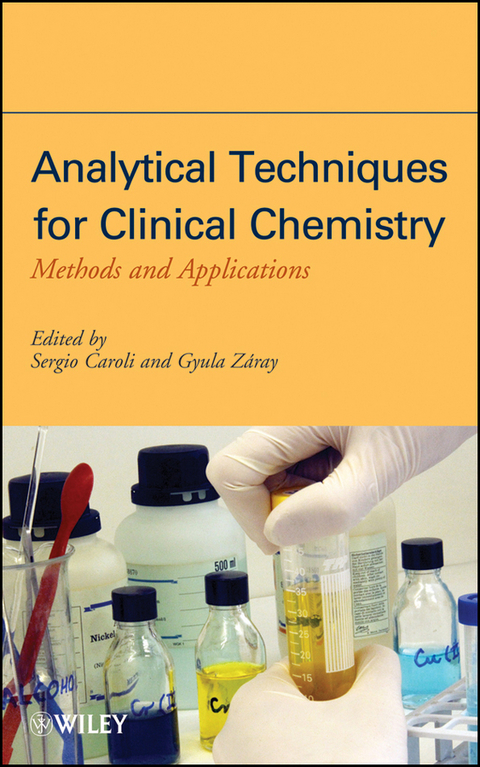
Analytical Techniques for Clinical Chemistry (eBook)
830 Seiten
John Wiley & Sons (Verlag)
978-1-118-27183-4 (ISBN)
This book details the role played by analytical chemistry in fostering clinical research. Readers will discover how a broad range of analytical techniques support all phases of clinical research, from early stages to the implementation of practical applications. Moreover, the contributing authors' careful step-by-step guidance enables readers to better understand standardized techniques and steer clear of everyday problems that can arise in the lab.
Analytical Techniques for Clinical Chemistry opens with an overview of the legal and regulatory framework governing clinical lab analysis. Next, it details the latest progress in instrumentation and applications in such fields as biomonitoring, diagnostics, food quality, biomarkers, pharmaceuticals, and forensics. Comprised of twenty-five chapters divided into three sections exploring Fundamentals, Selected Applications, and Future Trends, the book covers such critical topics as:
* Uncertainty in clinical chemistry measurements
* Metal toxicology in clinical, forensic, and chemical pathology
* Role of analytical chemistry in the safety of drug therapy
* Atomic spectrometric techniques for the analysis of clinical samples
* Biosensors for drug analysis
* Use of X-ray techniques in medical research
Each chapter is written by one or more leading pioneers and experts in analytical chemistry. Contributions are based on a thorough review and analysis of the current literature as well as the authors' own firsthand experiences in the lab. References at the end of each chapter serve as a gateway to the literature, enabling readers to explore individual topics in greater depth.
Presenting the latest achievements and challenges in the field, Analytical Techniques for Clinical Chemistry sets the foundation for future advances in laboratory research techniques.
SERGIO CAROLI, PhD, was a research director in the Department of Food and Animal Safety, National Institute of Health in Rome, and Honorary Professor at Eötvös Loránd University. He is the author of approximately 400 papers and editor or coauthor of six books, including The Determination of Chemical Elements in Food: Applications for Atomic and Mass Spectrometry (Wiley). GYULA ZÁRAY, PhD, DSc, is a Professor of Analytical Chemistry and the Director of the Cooperative Research Centre for Environmental Sciences at Eötvös Loránd University in Budapest. He has written more than 180 peer-reviewed publications and is the editor or coauthor of three books.
Foreword
Preface
Contributors
Chapter 1. Good Clinical Practice Principles: Legal background and applicability
U. Filibeck, A. Del Vecchio, F. Galliccia
Chapter 2. Clinical chemistry and the quest for quality
S. Caroli
Chapter 3. Uncertainty in clinical chemistry measurements including preanalytical variables
M. Sverresdotter Sylte, T. Wentzel-Larsen, B. J. Bolann
Chapter 4. The role and significance of reference values in the identification and evaluation of trace elements from diet
A. Apostoli, M. C. Ricossa
Chapter 5. Sample collection, storage, and pre-treatment in clinical chemistry
A. Taylor
Chapter 6. Metal toxicology in clinical, forensic, and chemical pathology
J. A. Centeno, T. I. Todorov, G. B. van der Voet, F. C. Mullick
Chapter 7. Elemental speciation in clinical sciences
D. Templeton
Chapter 8. The role of analytical chemistry in the safety of drug therapy
S. Görög
Chapter 9. Analytical techniques and quality control of pharmaceuticals
F. Manna, F. Rossi, R. Fioravanti
Chapter 10. Detection of drugs in biological fluids for anti-doping controls
S. Strano Rossi, M. Chiarotti
Chapter 11. The applicability of plasma-based techniques to biological monitoring
I. Steffan, G. Vujicic
Chapter 12. Atomic spectrometric techniques for the analysis of clinical samples
P. Bermejo Barrera, A. Moreda Piñeiro, M. de Carmen Barciela Alonso
Chapter 13. Applications of ICP-MS in human biomonitoring studies
P. Heitland
Chapter 14. Molybdenum in biological samples and clinical significance of serum molybdenum
M. Yoshida
Chapter 15. Application of organometallic speciation in clinical studies
Bin He, Chungang Yuan, Jing Sun, Guibin Jiang
Chapter 16. Biosensors for drug analysis
D. Deriu, F. Mazzei
Chapter 17. Bioimaging of metals and proteomic studies of clinical samples by laser ablation inductively coupled plasma mass spectrometry (LA-ICP-MS)
J. Sabine Becker, J. Susanne Becker
Chapter 18. Application of LC-MS/MS in clinical laboratory diagnostics
U. Ceglarek, G. M. Fiedler, J. Thiery
Chapter 19. Metabolomics using UPLC/HPLC-tandem mass spectrometry in diagnosis and research of inherited metabolic diseases
W. Kulik, B. P. van Kuilenburg
Chapter 20. Biomarkers of Oxidative stress in plasma and urine
P. V. Subbaiah
Chapter 21. The use of X-ray techniques in medical research
I. Szalóki, Gy. Záray, N. Szoboszlai
Chapter 22. A new tool based on the use of stable isotopes and Isotope Pattern Deconvolution (IPD) - ICP-MS for nutritional and clinical studies
H. González Iglesias, M. L. Fernández Sánchez, A. Sanz Medel
Chapter 23. Breath analysis: analytical methodologies and clinical applications
A. Ceccarini, F. Di Francesco, R. Fuoco, S. Ghimenti, M. Onor, S. Tabucchi, M. G. Trivella
Chapter 24. Preteo-metabolomic strategies in the future of drug development
U. Christians, V. Schmitz, J. Kalwitter, J. Kalwitter
Chapter 25. Basics in laboratory medicine: past, present, and future
L. A. Debteczeni, A. Kovácsay, S. Nagy
Index
"This book is unique in its composition, as it focuses
mainly on the analysis of heavy metals and trace elements but also
includes some chapters that describe different aspects of the
analysis of biological fluids and some other chapters on the
analysis of pharmaceutical products. Based on the title of the
book, it can be compared with other books that describe analytical
techniques in clinical chemistry or clinical
biochemistry." (Anal Bioanal Chem, 29 December
2013)
"The book is certainly worth buying for a laboratory or
institution library, and individual chapters might be a useful
background reading for specific topics that are covered in an
analytical or clinical university course."
(Accreditation and Quality Assurance, 1 October 2013)
| Erscheint lt. Verlag | 11.6.2012 |
|---|---|
| Sprache | englisch |
| Themenwelt | Medizin / Pharmazie |
| Naturwissenschaften ► Chemie | |
| Technik | |
| Schlagworte | Analytical Chemistry • Analytische Chemie • Chemie • Chemistry • Clinical Chemistry • Klinische Chemie • Massenspektrometrie • Medical Science • Medizin • Toxicology • Toxikologie |
| ISBN-10 | 1-118-27183-1 / 1118271831 |
| ISBN-13 | 978-1-118-27183-4 / 9781118271834 |
| Informationen gemäß Produktsicherheitsverordnung (GPSR) | |
| Haben Sie eine Frage zum Produkt? |
 PDF (Adobe DRM)
Kopierschutz: Adobe-DRM
Adobe-DRM ist ein Kopierschutz, der das eBook vor Mißbrauch schützen soll. Dabei wird das eBook bereits beim Download auf Ihre persönliche Adobe-ID autorisiert. Lesen können Sie das eBook dann nur auf den Geräten, welche ebenfalls auf Ihre Adobe-ID registriert sind.
Details zum Adobe-DRM
Dateiformat: PDF (Portable Document Format)
Mit einem festen Seitenlayout eignet sich die PDF besonders für Fachbücher mit Spalten, Tabellen und Abbildungen. Eine PDF kann auf fast allen Geräten angezeigt werden, ist aber für kleine Displays (Smartphone, eReader) nur eingeschränkt geeignet.
Systemvoraussetzungen:
PC/Mac: Mit einem PC oder Mac können Sie dieses eBook lesen. Sie benötigen eine
eReader: Dieses eBook kann mit (fast) allen eBook-Readern gelesen werden. Mit dem amazon-Kindle ist es aber nicht kompatibel.
Smartphone/Tablet: Egal ob Apple oder Android, dieses eBook können Sie lesen. Sie benötigen eine
Geräteliste und zusätzliche Hinweise
Buying eBooks from abroad
For tax law reasons we can sell eBooks just within Germany and Switzerland. Regrettably we cannot fulfill eBook-orders from other countries.
aus dem Bereich