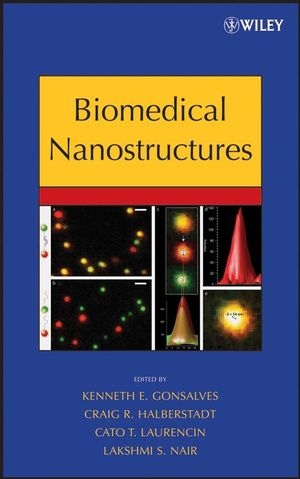
Biomedical Nanostructures (eBook)
John Wiley & Sons (Verlag)
978-0-470-18582-7 (ISBN)
Kenneth E. Gonsalves, PhD, is Distinguished Professor in the Department of Chemistry at the University of North Carolina at Charlotte. Dr. Gonsalves has more than fifteen years of experience in using photolithography and chemistry to develop materials that have features at both the micron and nanoscale. Working with Dr. Craig Halberstadt, he has successfully demonstrated the ability to create a new material that can be controlled at both these size scales to influence cell behavior. He has also developed active polymeric nanoparticles for delivery of antibiotics and genes. Craig R. Halberstadt, PhD, is Director of Tissue Engineering and Senior Research Scientist at the Cannon Research Center of Carolinas Medical Center. Dr. Halberstadt is a pioneer in the development of a scalable commercial process for the growth of a human skin product. He has also published extensively on cell/biomaterial interactions for cellular transplantation. Cato T. Laurencin, MD, PhD, is Lillian T. Pratt Distinguished Professor and Chair of the Department of Orthopaedic Surgery and Professor of Biomedical Engineering and Chemical Engineering at the University of Virginia. He has also been designated one of fifteen University Professors at the School. He has authored more than 250 peer-reviewed articles and has edited books in the areas of biomaterials, orthopaedic tissue engineering, and nanotechnology. He is the recipient of several national and international awards and was elected to the National Academy of Sciences, Institutes of Medicine. His current research interests include biomaterial synthesis, orthopaedic tissue engineering, gene therapy, drug delivery, and nanotechnology. Lakshmi S. Nair, MPhil, PhD, is Assistant Professor in the Department of Orthopaedic Surgery at the University of Virginia. She has authored more than fifty peer-reviewed articles in the areas of biomaterials, tissue engineering, drug delivery, and nanotechnology. Her research interests include hydrogels for tissue engineering and drug delivery, stimuli sensitive materials, and biomedical nanotechnology.
PART I. NANOSTRUCTURE FABRICATION.
1. Nanofabrication Techniques.
2. Micro/ Nano-Machining and Fabrication of Materials for
Biomedical Applications.
3. Novel Nanostructures as Molecular Nanomotors.
4. Bioconjugation of Soft Nanomaterials.
5. Nanotechnology and Drug Delivery.
6. Polymeric NanoParticles and Nanopore Membranes for Controlled
Drug and Gene Delivery .
7. Development of Nanostructures for Drug Delivery
Applications.
8. Bioconjugated Nanoparticles for Ultrasensitive Detection of
Molecular Biomarkers and Infectious Agents.
PART II. BIO-NANO INTERFACES.
9. ECM Interactions With Cells From The Meso To NanoScale.
10. Cell Behavior Towards Nanostructured Surfaces.
11. Cellular Behavior on Basement Membranes Inspired
Topographically Patterned Synthetic Matrices.
12. Focal Adhesions: Self-Assembling Nanoscale Mechanochemical
Machines that Control Cell Function.
13. Controlling Cell Behavior via DNA and RNA Transfections.
14. Multi-Scale Co-Culture Models for Orthopaedic Interface
Tissue Engineering.
PART III. CLINICAL APPLICATIONS OF NANOSTRUCTURES.
15. Nanostructures for Tissue Engineering/Regenerative
Medicine.
16. Nanostructures for Cancer Therapy.
17. Clinical Applications of Micro-and NanoScale Biosensors.
18. Nanoscale Iron Compounds Related to Neurodegenerative
Disorders.
19. Application of Nanotechnology into Life Science: Benefit or
Risk.
"...the book is a fruitful source of information and it is enjoyable to read thanks to nice illustrations. It will be of interest not only to students or scientists not familiar with these fields, but also to specialists, because of the large number of references, many as recent as 2006." (Macromol. Chem. Phys. 04/2008)
| Erscheint lt. Verlag | 28.6.2008 |
|---|---|
| Sprache | englisch |
| Themenwelt | Medizin / Pharmazie ► Allgemeines / Lexika |
| Naturwissenschaften ► Biologie | |
| Naturwissenschaften ► Chemie | |
| Technik ► Medizintechnik | |
| Schlagworte | Addition • advantage • Applications • Authors • Between • Biomaterial • biomedical • Biotechnologie • Biotechnologie i. d. Biowissenschaften • Biotechnology • Biowissenschaften • Clinical • Delivery • Development • devices • Discover • Drug • Engineering • full • Interface • introduce • Life Sciences • Materials • Nanobiotechnologie • nanobiotechnology • Nanomaterialien • nanomaterials • nanoscale • Nanotechnologie • nanotechnology • Novel • possible • tissue • variety |
| ISBN-10 | 0-470-18582-1 / 0470185821 |
| ISBN-13 | 978-0-470-18582-7 / 9780470185827 |
| Informationen gemäß Produktsicherheitsverordnung (GPSR) | |
| Haben Sie eine Frage zum Produkt? |
 PDF (Adobe DRM)
Kopierschutz: Adobe-DRM
Adobe-DRM ist ein Kopierschutz, der das eBook vor Mißbrauch schützen soll. Dabei wird das eBook bereits beim Download auf Ihre persönliche Adobe-ID autorisiert. Lesen können Sie das eBook dann nur auf den Geräten, welche ebenfalls auf Ihre Adobe-ID registriert sind.
Details zum Adobe-DRM
Dateiformat: PDF (Portable Document Format)
Mit einem festen Seitenlayout eignet sich die PDF besonders für Fachbücher mit Spalten, Tabellen und Abbildungen. Eine PDF kann auf fast allen Geräten angezeigt werden, ist aber für kleine Displays (Smartphone, eReader) nur eingeschränkt geeignet.
Systemvoraussetzungen:
PC/Mac: Mit einem PC oder Mac können Sie dieses eBook lesen. Sie benötigen eine
eReader: Dieses eBook kann mit (fast) allen eBook-Readern gelesen werden. Mit dem amazon-Kindle ist es aber nicht kompatibel.
Smartphone/Tablet: Egal ob Apple oder Android, dieses eBook können Sie lesen. Sie benötigen eine
Geräteliste und zusätzliche Hinweise
Buying eBooks from abroad
For tax law reasons we can sell eBooks just within Germany and Switzerland. Regrettably we cannot fulfill eBook-orders from other countries.
aus dem Bereich