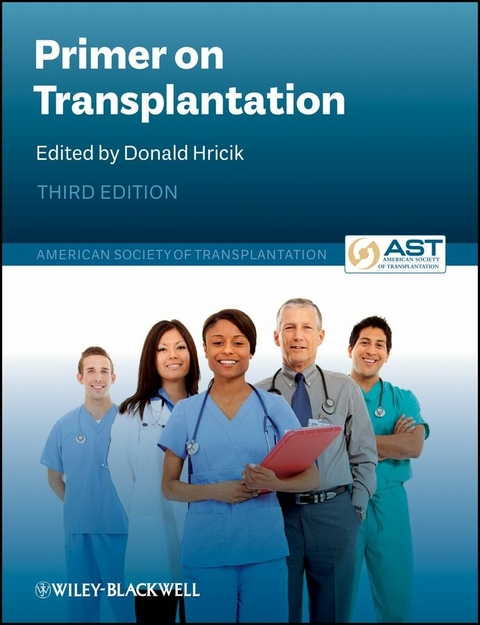
Primer on Transplantation (eBook)
John Wiley & Sons (Verlag)
978-1-4443-9176-3 (ISBN)
In addition to 5 organ-specific chapters: kidney, pancreas, heart, lung and liver, the book includes essential information on:
- immunobiology
- pharmacology
- donor management
- infectious complications
- pediatric transplantation
- general principles of patient management
Fully updated and redesigned to make it even more user-friendly, the book now contains clinical vignettes, key point boxes, and self-assessment multiple choice questions in each chapter.
Primer on Transplantation, Third Edition is an invaluable resource for all health professionals in the transplant team including trainees, residents, fellows, physicians, surgeons, nurses and transplant co-ordinators.
Purchasing this book entitles you to access to the companion website:
The website includes:
- Interactive Multiple-Choice Questions for each chapter
- Figures from the book as Powerpoints for downloading
- All chapters online
Donald Hricik; University Hospitals Case Medical Center, Division of Nephrology, Cleveland, USA.
Donald Hricik; University Hospitals Case Medical Center, Division of Nephrology, Cleveland, USA.
Preface vi
Contributors vii
Acknowledgments ix
1 Immunology of transplantation, 1
Qiquan Sun, Jason M Zimmerer, and Gregg A Hadley
2 Pharmacology of transplantation, 18
Ian AC Rowe and James M Neuberger
3 Medical management of the deceased donor in solid organ transplantation, 35
John McCartney and Kenneth E Wood
4 Infectious diseases in transplantation, 51
Robin K Avery and Jay A Fishman
5 Management of the successful solid organ transplant recipient, 73
Elizabeth A Kendrick and Connie L Davis
6 Pediatric transplantation, 103
William Harmon
7 Kidney and pancreas transplantation, 129
Joshua J Augustine, Kenneth A Bodziak, Aparna Padiyar, James A Schulak, and Donald E Hricik
8 Heart transplantation, 171
Maryl R Johnson, Walter G Kao, Elaine M Winkel, Joseph L Bobadilla, Takushi Kohmoto, and Niloo M Edwards
9 Lung transplantation, 205
Jonathan E Spahr and Keith C Meyer
10 Liver transplantation, 238
Kimberly A Brown, Mary Ann Huang, Marwan Kazimi, and Dilip Moonka
Multiple choice questions, 274
Answers to multiple choice questions, 291
Index 295
"This book strives to introduce a broad audience to the critical
issues in solid organ transplantation. A book providing such an
overview to people with a basic medical background is valuable to
the educational mission of the American Society of
Transplantation." (Doody's, 16 September 2011)
2
Pharmacology of transplantation
Ian AC Rowe1,2 and James M Neuberger2
1University of Birmingham, Birmingham, UK
2Queen Elizabeth Hospital, Birmingham, UK
Over the last three decades, there have been major developments in the drugs available for optimal management of the allograft recipient. Regimens for immunosuppression will vary for different organs and within different transplant units. Suggested regimens are described in the organ-specific chapters. Here, the pharmacology of the currently available immunosuppressive agents, and some agents in various stages of development, are discussed. Transplant recipients are often treated with many other drugs, including antiviral, antifungal, and antibacterial drugs used as prophylaxis or as treatment for various infections. Other drug classes commonly administered to transplant recipients include antihypertensives, lipid-lowering drugs, and a variety of medications used to prevent or treat post-transplant osteopenia. These latter drug categories fall out of the scope of this chapter and are covered in other chapters.
It is axiomatic that all drugs are potentially toxic but some have a beneficial effect and those benefits must be balanced against side effects. Most of the therapeutic agents used for immunosuppression are relatively non-specific in their action on the immune system. Side effects of these agents can be considered either as drug or as class specific (such as calcineurin inhibitor [CNI]-related nephrotoxicity) or integral to immunosuppression (such as increased susceptibility to infection and some cancers).
Drug Metabolism in Organ Failure
Disease of some organs, notably the liver and kidney, may affect both the pharmacokinetics (the relationship between the dose of a drug and changes in concentration over time) and the pharmacodynamics (the relationship between the drug concentration in the blood and the clinical response). The term “pharmacokinetics” encompasses a number of pharmacologic phenomena including bioavailability, absorption, volume of distribution, clearance, and drug elimination. Each of these parameters may be abnormal in the presence of liver or kidney disease. It is therefore important for the clinician to have some understanding of the potential problems that may arise when prescribing drugs for patients with organ dysfunction. In this chapter, it is not possible to give any more than a superficial account of some of the factors that are of potential importance so the clinician will need to seek specific information in individual cases.
Liver Disease
Although the standard liver tests are often referred to as ‘liver function tests,’ this is a misnomer because the analytes do not accurately reflect liver function nor are they always specific to the liver. Several tests of liver function have been developed and validated (such as the aminopyrine or caffeine clearance tests) but these are rarely used in clinical practice, will reflect only some aspects of liver function, and may not give any useful information about appropriate prescription of drugs in patients with liver impairment. The best, but still not robust, guide to drug handling is probably the serum albumin.
The presence of liver disease may alter the response to drugs by one or more of several different mechanisms.
Absorption
Absorption of some drugs, especially those that are fat soluble, may be affected by the relative lack of excreted bile, or by the co-administration of agents (e.g., cholestyramine) that reduce absorption.
First-Pass Effect
Cirrhosis itself and intrahepatic stents (e.g., transjugular intrahepatic portosystemic shunts) may be associated with intrahepatic shunting of blood flow. In the presence of such shunts, drugs that are subject to significant first-pass metabolism will exhibit a significantly different profile which may make the patient more susceptible to the drug’s effects.
Clearance
Hepatic drug clearance is related to both blood flow and extraction. Blood flow to the liver from the portal vein and hepatic artery may be abnormal in some liver diseases and post-transplantation situations, thus affecting drug clearance
Metabolism
Drug metabolism is potentially affected by liver disease. Distinction must be made between hepatocellular disease (e.g., alcoholic liver disease, viral hepatitis, or acute allograft rejection) and biliary disease (e.g., primary biliary cirrhosis, primary sclerosing cholangitis, or chronic allograft rejection). Most drugs undergo metabolism within the hepatocyte and so will be affected by a variety of factors, including the patient’s age, total hepatic mass, and the constituent drug-metabolizing enzymes. The activity of these enzymes may be affected by many factors including concomitant administration of other drugs that may act either as enzyme inducers or inhibitors, or that may compete for metabolic pathways. Drugs may be metabolized to the active agent and/or may be detoxified. Activities of the cytochromes (the major drug metabolizing enzymes) tend to vary during the first 6 months after liver transplantation
Distribution
The presence of ascites and peripheral edema may alter the volume of distribution of a drug. The concentrations of proteins that bind drugs and changes in acid–base balance are affected in liver disease. All of these factors may affect the drug pharmacokinetics and pharmacodynamics, e.g., drugs that are highly protein bound (such as prednisolone and phenytoin) may be more active in patients with low protein concentrations. Understanding the extent of protein binding is important because, for any total plasma concentration of drug, the amount of free (and therefore therapeutically effective) drug will vary with the protein concentration.
Excretion
For drugs that are excreted in the bile, biliary outflow obstruction (whether at the level of the cholangiocyte or the bile duct) may affect elimination, leading to retention of the parent drug and/or its metabolites. Some metabolites may themselves have a therapeutic effect and may or may not be measured in standard assays. For drugs that undergo enterohepatic recirculation, alterations in bile excretion may influence the drug’s effects.
End-Organ Sensitivity
Liver disease may affect end-organ sensitivity, e.g., patients with advanced liver disease may be more likely to develop renal failure when given non-steroidal anti-inflammatory drugs. Those with advanced liver disease are more prone to cerebral depression and encephalopathy when given opiates for analgesia. In some cases, the presence of liver disease itself may be a risk factor for drug toxicity, e.g., methotrexate tends to be more hepatotoxic in the presence of steatosis and steatohepatitis. Of interest, viral infection may affect drug metabolism. It is now clear that tacrolimus levels will be affected when there is evidence of hepatitis C viral replication. The mechanism is not clear but the dose of CNI may need to be altered when the virus reactivates.
Drug Hepatotoxicity
Drug hepatotoxicity can be categorized as either type I or II. Type I is predictable and dose related and the classic example is acetaminophen toxicity. When the normal detoxification mechanisms are overwhelmed by the amount of drug to be metabolized, there is retention of a toxic intermediate that binds to cellular macromolecules and causes liver cell necrosis. The level at which toxicity occurs depends on many factors such as the amount of glutathione present (reduced in those with significant liver disease or malnutrition) and the rate at which the toxic metabolites are generated. The latter rate is increased in patients receiving concomitant enzyme inducers (e.g., phenobarbital or alcohol) and decreased when there is concomitant enzyme inhibition (e.g., by cimetidine).
Type II drug toxicity is unpredictable and may be due to idiosyncrasies in drug metabolism (type IIa) or the involvement of immune mechanisms (type IIb). In some transplant recipients, the patient may acquire the idiosyncratic drug responses of the donor, as has been well documented for peanut allergy. It must be stressed that there are no specific tests for adverse drug reactions and the diagnosis is one of exclusion.
Virtually every pattern of hepatic disease can be mimicked by drugs and some drugs may be associated with more than one type of liver damage, e.g., estrogens can be associated with cholestasis, peliosis, vascular thrombosis, adenoma, and even hepatocellular cancer. Azathioprine can be associated with focal nodular hyperplasia and/or hepatitis. If an adverse drug reaction is suspected, the drug should be withdrawn.
Kidney Disease
As with liver disease, the presence and extent of kidney damage or reduced kidney function may affect the pharmacology of drugs by a number of mechanisms.
Metabolism
The kidney can metabolize some drugs, but this is rarely of clinical importance. In patients with impaired kidney function, alterations in drug pharmacokinetics and pharmacodynamics may occur as the result of altered acid–base homeostasis and/or with changes in the volume of distribution and concentrations of some drug-binding proteins (e.g., albumin).
Excretion
Impaired kidney function may be associated with reduced excretion of either active or inactive drug or metabolites. These may be pharmacologically significant or give misleading values in some therapeutic drug assays.
Sensitivity
The effects of some drugs may be increased in patients with impaired kidney function, even if metabolism is not affected.
Thus, the significance of impaired kidney function on the pharmacology of drugs will vary according to the extent and type of renal damage, the extent to...
| Erscheint lt. Verlag | 15.12.2010 |
|---|---|
| Sprache | englisch |
| Themenwelt | Medizin / Pharmazie ► Medizinische Fachgebiete ► Chirurgie |
| Schlagworte | Addition • American Society • association • Book • Brustchirurgie • Chapters • complications • Donor • Edition • Essential • full • Generation • Immunobiology • kidney • Medical Science • Medizin • New • NeXT • Pediatric • pharmacology • Practical • Professionals • Transplant • Transplantation • Transplantationen |
| ISBN-10 | 1-4443-9176-3 / 1444391763 |
| ISBN-13 | 978-1-4443-9176-3 / 9781444391763 |
| Informationen gemäß Produktsicherheitsverordnung (GPSR) | |
| Haben Sie eine Frage zum Produkt? |
 EPUB (Adobe DRM)
Kopierschutz: Adobe-DRM
Adobe-DRM ist ein Kopierschutz, der das eBook vor Mißbrauch schützen soll. Dabei wird das eBook bereits beim Download auf Ihre persönliche Adobe-ID autorisiert. Lesen können Sie das eBook dann nur auf den Geräten, welche ebenfalls auf Ihre Adobe-ID registriert sind.
Details zum Adobe-DRM
Dateiformat: EPUB (Electronic Publication)
EPUB ist ein offener Standard für eBooks und eignet sich besonders zur Darstellung von Belletristik und Sachbüchern. Der Fließtext wird dynamisch an die Display- und Schriftgröße angepasst. Auch für mobile Lesegeräte ist EPUB daher gut geeignet.
Systemvoraussetzungen:
PC/Mac: Mit einem PC oder Mac können Sie dieses eBook lesen. Sie benötigen eine
eReader: Dieses eBook kann mit (fast) allen eBook-Readern gelesen werden. Mit dem amazon-Kindle ist es aber nicht kompatibel.
Smartphone/Tablet: Egal ob Apple oder Android, dieses eBook können Sie lesen. Sie benötigen eine
Geräteliste und zusätzliche Hinweise
Buying eBooks from abroad
For tax law reasons we can sell eBooks just within Germany and Switzerland. Regrettably we cannot fulfill eBook-orders from other countries.
aus dem Bereich