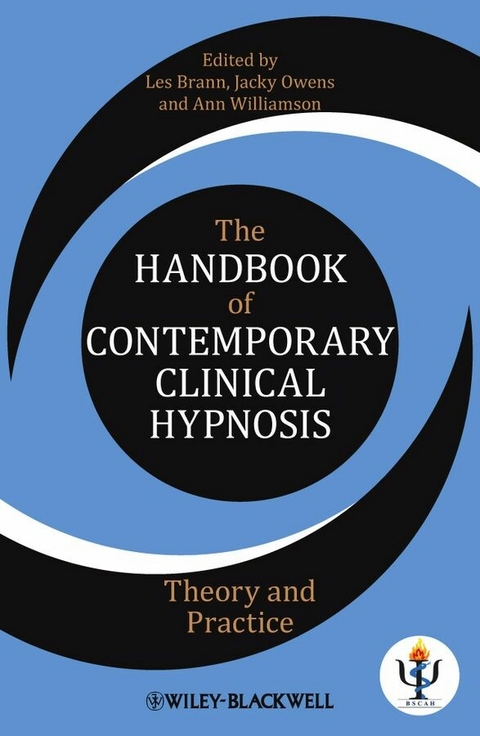
The Handbook of Contemporary Clinical Hypnosis (eBook)
John Wiley & Sons (Verlag)
978-1-119-97992-0 (ISBN)
- Provides an authoritative reference for practitioners and trainees on the diverse applications of hypnosis, published under the auspices of the British Society for Clinical and Academic Hypnosis (BSCAH)
- Combines a theoretical framework with material on a wide range of specific disorders including anxiety, stress phobias, eczema, oncology, eating disorders and infertility
- Shows how to adjust hypnotic techniques for different contexts e.g. when working with children, in emergencies and via a translator
- Features a variety of case studies that illustrate hypnosis techniques in action
Les Brann is President of the British Society for Clinical and Academic Hypnosis (BSCAH), and Clinical Lead for Chelmford NHS Medical Hypnosis Unit, UK. He is the author of Just Close Your Eyes and Relax (1988).
Jacky Owens is a Past President of the Royal Society of Medicine's Section of Hypnosis and Psychosomatic Medicine. She worked for more than thirty years in the NHS before becoming independent practitioner running a company providing holistic services and support for cancer sufferers. Jacky retired from active practice in 2014 but remains on the Council for Royal Society of Medicine's Section of Hypnosis and Psychosomatic Medicine.
Ann Williamson has used hypnosis for more than 15 years to tackle stress and anxiety. An accredited member of BSCAH, she is the author of several books including Brief Psychological Interventions (Wiley-Blackwell, 2008).
Covering theory and practice, The Handbook of Contemporary Clinical Hypnosis is an up-to-date, authoritative resource to support health professionals in their use of hypnosis in clinical settings. Provides an authoritative reference for practitioners and trainees on the diverse applications of hypnosis, published under the auspices of the British Society for Clinical and Academic Hypnosis (BSCAH) Combines a theoretical framework with material on a wide range of specific disorders including anxiety, stress phobias, eczema, oncology, eating disorders and infertility Shows how to adjust hypnotic techniques for different contexts e.g. when working with children, in emergencies and via a translator Features a variety of case studies that illustrate hypnosis techniques in action
Les Brann is President of the British Society for Clinical and Academic Hypnosis (BSCAH), and Clinical Lead for Chelmford NHS Medical Hypnosis Unit, UK. He is the author of Just Close Your Eyes and Relax (1988). Jacky Owens is a Past President of the Royal Society of Medicine's Section of Hypnosis and Psychosomatic Medicine. She worked for more than thirty years in the NHS before becoming independent practitioner running a company providing holistic services and support for cancer sufferers. Jacky retired from active practice in 2014 but remains on the Council for Royal Society of Medicine's Section of Hypnosis and Psychosomatic Medicine. Ann Williamson has used hypnosis for more than 15 years to tackle stress and anxiety. An accredited member of BSCAH, she is the author of several books including Brief Psychological Interventions (Wiley-Blackwell, 2008).
About the Editors xi
About the Contributors xiii
Foreword xvii
Preface xix
Part One Hypnosis: The Fundamentals 1
1. Hypnosis: The Theory behind the Therapy 3
Dr Peter Naish
2. Hypnotic Phenomena and Hypnotisability 19
Dr Ann Williamson
3. History of Hypnosis 31
Dr Ann Williamson
4. Imagery and Visualisation 41
Mrs Jacky Owens
5. Use of Language and Metaphor 51
Dr Ann Williamson
6. Safety 77
Mrs Jacky Owens
Part Two The Stages of Therapy 87
Dr Les Brann with contributions from Dr Geoff Ibbotson, Mrs Jacky Owens and Dr Ann Williamson
7. Initial Steps 89
8. Explanation of Hypnosis: The Working Model 97
9. Induction and Deepening 107
10. Establishing the Problem 123
11. Resolving the Problem 131
12. Ego Strengthening, Anchoring and Re-alerting 141
13. Self Hypnosis and Other Homework 151
Part Three Specific Disorders 155
14. Self Esteem and Self Confidence 157
Dr Ann Williamson
15. Anxiety and Panic Disorder 169
Dr Ann Williamson
16. Depression 195
Dr Alastair Dobbin
17. Phobias 211
Dr Les Brann
18. Medically Unexplained Symptoms 229
Dr Michael E.Y. Capek
19. Specific Psychosomatic Disorders 247
Dr Les Brann
20. Dermatology 281
Dr Mhairi McKenna
21. Pain 293
Dr Les Brann
22. Anaesthesia, Surgery and Invasive Procedures 315
Dr David Rogerson, Mrs Jacky Owens and Dr Les Brann
23. Oncology 333
Mrs Jacky Owens and Dr Leslie Walker
24. Cancer Care 351
Mrs Phyllis Alden and Mrs Jacky Owens
25. Death, Dying and Loss 375
Dr K K Aravind, Mrs Jacky Owens and Dr Ann Williamson
26. Post-traumatic Stress Disorder (PTSD) 389
Dr Geoff Ibbotson
27. Adjustment Disorders 413
Peter J Hawkins
28. Eating Disorders 425
Dr David Kraft and Dr Peter J Hawkins
29. Habit Disorder and Addiction 441
Dr David Medd and Dr Ann Williamson
30. Obsessive Compulsive Disorder 457
Mrs Phyllis Alden and Dr Ann Williamson
31. Obstetrics 463
Mrs Diana Tibble and Dr Les Brann
32. Infertility 483
Dr Les Brann
33. Psychosexual Problems 493
Dr Peter J Hawkins and Dr Les Brann
34. Children 507
Dr David Byron and Dr Sobharani R Sungum-Paliwal
35. Learning Disability and Autistic Spectrum Disorder 525
Mr Cliff Robins
36. Sleep Disorders 537
Dr Les Brann
37. Performance Enhancement 547
Dr Barry Cripps
38. Informal Hypnotic Techniques 567
Dr Caron Moores, Dr Grahame Smith and Mr Martin Wall
39. Working Transculturally 575
Dr Geoff Ibbotson
40. Commissioning, Providing and Auditing a Hypnotherapy Service 583
Dr Les Brann
Appendix 1: Life History Inventory 591
Appendix 2: What goes in must come out 593
Glossary 595
Author Index 599
Subject Index 621
Coming from the capable hands of editors Brann, Owens and Williamson, this book will be a valuable source of information for those interested in hypnosis as a serious and effective tool in clinical settings.
Claudia Nielsen, Psychotherapist and Vice-President of the Scientific and Medical Network, UK
The Handbook of Contemporary Clinical Hypnosis highlighted for me what is often lacking in most hypnosis works: a truly integrative effort to enable the clinician to appreciate the theoretical and experimental underpinnings of the clinical techniques. Beginning with an outstanding introduction and continuing with an excellent series of chapters elucidating the different areas and techniques of hypnosis, the various authors share their approaches in a succinct yet comprehensive manner. I am delighted to recommend this contribution to the hypnosis literature."
Shaul Livnay PhD, Chairperson, The Committee for Educational Programs in Europe, European Society of Hypnosis, Israeli Society of Hypnosis
Chapter 1
Hypnosis: The Theory behind the Therapy
Dr Peter Naish
Introduction
There seems to be a tendency for people using hypnosis therapeutically to be surprizingly uninformed about the science behind the process. There are doubtless a number of reasons for this, not least that a busy therapist will feel there is little time for keeping up to date with the latest research. This may be so, but imagine consulting a surgeon who said, “Yes, I've got a vague idea of how the body works and I gather they have scanning and so on nowadays, but I just do what I picked up when I first started this. It seems to work for me!” One would have to ask, “But does it work for the patient; could it be made to work better?”
Therapists who have ‘been around a while’ do actually have a reason for turning their backs on hypnosis research in the past; a few decades ago, that research appeared to be investigating a very different phenomenon from the one they used every day in their practices. As will be explained, the message coming from the laboratory seemed, in effect, to be that hypnosis was not ‘real’. Meanwhile the therapists were using these ‘unreal’ procedures and getting very real therapeutic effects – something was wrong somewhere!
Nevertheless, even from the seemingly uninviting scientific landscape of that era there were gems to be mined. For example, it was shown that merely instructing people to relax and imagine could produce quite convincing hypnotic effects. However, giving precisely the same instructions, but preceding them with the information that this was hypnosis, produced stronger effects (Kirsch, 1997). It was possible to draw a number of conclusions from this, including the observation that since simply speaking the word ‘hypnosis’ can hardly do anything very dramatic, the enhanced performance seemed unlikely to have involved any impressive change in brain state. A therapist may not be very concerned whether there is a change in brain state or not, but he or she should note that an important element in getting people to behave ‘hypnotically’ seems to lie in defining the situation as ‘doing hypnosis’, rather than in the precise instructions spoken. Many people starting to use hypnosis therapeutically try to learn so-called induction scripts verbatim, as if, like some necromancer's conjuration, a single wrong word will bring catastrophe. Clearly this is untrue; whatever words work for the hypnotist should work for the clients – as long as they believe it is all in the cause of hypnotizing them. Even better of course is to choose words that are well suited to the particular client; that is where the skill lies, not in remembering a script.
Magic or Medicine?
It has been mentioned above that hypnosis produces very real therapeutic effects – but does it? Many members of the general public attribute almost magical powers to hypnosis, and with expectation of that sort there is bound to be a significant placebo effect. Could it be the only effect? A conspiracy theorist might postulate that therapists deliberately ignore the science, because they believe that if simply saying ‘hypnosis’ makes things work better, then it is clearly a placebo. If that truth leaked out it would be like GP patients learning that a pill was only sugar; the magic would evaporate and the cure would cease to work. In fact therapists need have no fear, because good, laboratory based research has shown that hypnosis is more than just a placebo. One of the most impressive and effective uses of hypnosis is in the treatment of pain. Non-harmful pain can be produced in the laboratory, making it possible to research the impact of various forms of analgesic. One thing that can be done is to apply a pharmaceutically inactive cream, along with the message that it will help the pain: it does – clearly a placebo effect. The pain relief is due to the release of endorphins, which are endogenous morphine-like substances that block the neural pain signals. Naloxone is a morphine antagonist – a compound that prevents the action of morphine and thus permits pain to resurface. It has exactly the same effect on endorphins, so that the administration of Naloxone undermines the pain reducing qualities of a placebo cream. So much for placebos; what of hypnosis? Well, it turns out that Naloxone does not block the analgesic effects of hypnosis (Spiegel & Albert, 1983). Hypnosis must be something more than just a placebo.
Hopefully this brief introduction has convinced you that anyone intending to use hypnosis in a therapeutic setting should understand something of the science behind it. Theory should inform practice, just as clinical observation should be part of the seed-corn of research. It is hoped too that the preceding paragraphs offer a sufficient taster for you to see that the science need not be dry and dull; it offers the tantalizing promise of explaining the paradox that while hypnosis has none of the magic that many people imagine, in fact it seems capable of far more than many trained scientists once believed. So, now we must make a very brief exploration of the path science has trodden and consider the vistas that have only recently started to unfold.
A Quick Look Backwards
It is something of a tradition in books on hypnosis to begin with Franz Anton Mesmer (1734–1815); one could say that was when science first took an interest in hypnosis like processes. Mesmer practiced in Paris in the days before the French Revolution, and also the days before it was called hypnosis or even (subsequently in his honour) Mesmerism – it was then called magnetism. This episode of history is instructive because it picks up two themes raised in the introduction of this chapter. We need not be concerned with the finer details of Mesmer's theories; it is sufficient to say that he believed cures could be effected by correcting the flow of a kind of magnetic fluid through the body. Even in those days theory influenced therapy. Thus, when Mesmer became too popular to deal with so many people on a one to one basis, he devised a table-like drum called the Baquet, filled with iron and appropriate magnetic paraphernalia. A whole group of people could sit around this and receive the healing power simultaneously. Of course Mesmer's beliefs were wrong, as demonstrated very effectively and scientifically by a French royal commission, so eventually the theories as to what was going on evolved, as did the way in which they were implemented in therapeutic practice. That is as it should be: no one claiming that the final, ‘right’ answer has been found, but practitioners keeping up with current thinking. Unfortunately, even then the signs of a disconnection between science and practice were apparent. The French scientific team showed convincingly that magnetism was in no way involved in whatever was going on in these mesmeric sessions. Nevertheless, many people clung to the idea that the wonderful effects (that we would recognize today and call ‘hypnotic’) could all be attributed to the power of magnets. It was Thomas Wakley, founder of the journal The Lancet, who made a dummy magnet from wood (that could not be magnetic, of course) and showed that it was just as effective.
Wooden ‘magnets’ seem to be getting us back to the realm of placebos again – it is what you believe that counts. In Mesmer's day it was believed that recovery could not be attained without passing through a kind of internal struggle, referred to as the crisis. Mesmer's patients expected to have this experience, and they duly exhibited it. Fortunately for today's patients there is no such expectation, so they are spared that little episode. Nevertheless they still tend to follow expectations, and the fact that they do so, rather than just sticking to ‘basic hypnotic behaviour’, is something that science must explain. In fact, truth be told, there is little that could count as a basic behavioural hallmark of hypnosis. People simply do what they are told to do, so that a hypnotic induction involving relaxation just makes them look relaxed. Nothing much happens after that, unless a specific suggestion is given for a particular behaviour. This absence of a clear hypnotic hallmark was one of the factors which made it difficult for researchers to accept that hypnosis was in any sense a ‘thing apart’; the brain, it was concluded, must be doing much the same as in many other situations.
Scepticism and Social Effects
Before considering explanations for hypnotic behaviour, we must note that some of us do not exhibit any such behaviour at all. People vary in their responsiveness to hypnosis; some seem untouched by it, while others respond dramatically; most lie between the extremes. In research it is common to assess experimental participants, to get a measure of their responsiveness; to do this, hypnotic susceptibility scales are used. These comprise a series of graded suggestions that may or may not produce effects in the person being tested. The suggestions cover a range of potential experiences, for example motor effects such as “Your arm is getting lighter and will begin to lift” or sensory ones such as “There is sugar dissolving on your tongue and it tastes sweet”. People are rated by the proportion of the test items that ‘work’ for them. In the clinical field it is often considered a waste of valuable time to carry out a test on someone who is to be treated anyway, whether of...
| Erscheint lt. Verlag | 7.10.2011 |
|---|---|
| Sprache | englisch |
| Themenwelt | Geisteswissenschaften ► Psychologie ► Biopsychologie / Neurowissenschaften |
| Geisteswissenschaften ► Psychologie ► Humanistische Psychotherapien | |
| Geisteswissenschaften ► Psychologie ► Klinische Psychologie | |
| Medizin / Pharmazie ► Medizinische Fachgebiete ► Psychiatrie / Psychotherapie | |
| Schlagworte | Hypnose • Psychologie • Psychology • Psychotherapie u. Beratung • Psychotherapy & Counseling • psychotherapy, counseling, BSCAH, anxiety, stress, phobias, eczema treatments, eating disorders, hypnotic techniques, psychology, clinical hypnotists |
| ISBN-10 | 1-119-97992-7 / 1119979927 |
| ISBN-13 | 978-1-119-97992-0 / 9781119979920 |
| Informationen gemäß Produktsicherheitsverordnung (GPSR) | |
| Haben Sie eine Frage zum Produkt? |
 EPUB (Adobe DRM)
Kopierschutz: Adobe-DRM
Adobe-DRM ist ein Kopierschutz, der das eBook vor Mißbrauch schützen soll. Dabei wird das eBook bereits beim Download auf Ihre persönliche Adobe-ID autorisiert. Lesen können Sie das eBook dann nur auf den Geräten, welche ebenfalls auf Ihre Adobe-ID registriert sind.
Details zum Adobe-DRM
Dateiformat: EPUB (Electronic Publication)
EPUB ist ein offener Standard für eBooks und eignet sich besonders zur Darstellung von Belletristik und Sachbüchern. Der Fließtext wird dynamisch an die Display- und Schriftgröße angepasst. Auch für mobile Lesegeräte ist EPUB daher gut geeignet.
Systemvoraussetzungen:
PC/Mac: Mit einem PC oder Mac können Sie dieses eBook lesen. Sie benötigen eine
eReader: Dieses eBook kann mit (fast) allen eBook-Readern gelesen werden. Mit dem amazon-Kindle ist es aber nicht kompatibel.
Smartphone/Tablet: Egal ob Apple oder Android, dieses eBook können Sie lesen. Sie benötigen eine
Geräteliste und zusätzliche Hinweise
Buying eBooks from abroad
For tax law reasons we can sell eBooks just within Germany and Switzerland. Regrettably we cannot fulfill eBook-orders from other countries.
aus dem Bereich