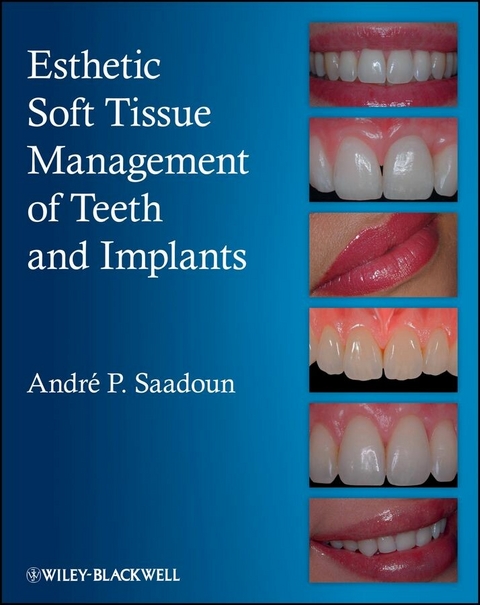
Esthetic Soft Tissue Management of Teeth and Implants (eBook)
John Wiley & Sons (Verlag)
978-1-118-30113-5 (ISBN)
This is a step by step guide to success in periodontics and implant dentistry, helping clinicians to create a natural and esthetically pleasing smile for their patients. Starting with a general discussion of facial esthetics and analyzing the dento-gingival constituents of the smile, the book goes on to consider the impact of these on people's quality of life, both in terms of health and social engagement. Subsequent chapters focus on specific esthetic treatments such as crown lengthening procedures, gingival recession coverage with connective tissue grafts or periodontal regenerative material, and soft tissue management for natural teeth and implants.
Highly illustrated with an abundance of supporting photographs, Esthetic Soft Tissue Management of Teeth and Implants is an essential companion for periodontists and other dental specialists, as well as advanced general dentists with an interest in esthetic periodontics and implant dentistry.
KEY FEATURES
- Provides practical coverage of an important and challenging skill in periodontics and implant dentistry
- Emphasizes the esthetic preservation of the natural dentition as well as implants
- Includes a comprehensive review of literature on these topics
- Contains many high quality full color clinical photographs
- Written by an internationally renowned expert in the field
André P. Saadoun is a Diplomate of the American Academy of Periodontology, former Associate Professor of Periodontics at the University of Southern California, and Visiting Professor in Periodontics and Implantology at the Hadassah School of Dental Medicine in Jerusalem. Dr Saadoun also maintains a private practice in Paris which focuses on Esthetic Periodontics and Implant Surgery.
André P. Saadoun is a Diplomate of the American Academy of Periodontology, former Associate Professor of Periodontics at the University of Southern California, and Visiting Professor in Periodontics and Implantology at the Hadassah School of Dental Medicine in Jerusalem. Dr Saadoun also maintains a private practice in Paris which focuses on Esthetic Periodontics and Implant Surgery.
Foreword ix
Acknowledgments x
1 Introduction 1
2 To smile or not to smile 5
The impact of esthetics 5
Dental esthetics 7
The smile-related quality of life 7
The senior citizen's smile 10
3 The esthetics of the face 13
The face 13
The lips 13
4 The dentoalveolar gingival unit 20
The gingiva 21
The bone 37
The teeth 50
The interproximal bone height and the interdental implant
papilla 54
The pink/white esthetic score, or PES/WES 61
The biological space 63
Final remarks 65
5 Esthetic periodontal treatment 66
The biological rationale 66
Crown lengthening procedures 68
Gingival recession coverage 85
Final remarks 100
6 Esthetic implant treatment 102
Peri-implant risk factors 103
Soft tissue management 106
Final remarks 155
7 Conclusion 160
References 165
Index 175
2
To smile or not to smile
The mouth acts as a mirror for the body. The link between substances in the oral cavity and other vital organs has been well documented worldwide, and oral care can have significant effects on all parts of the body (Ravins, 2008).
The perception of beauty is subject to continual change. With today’s conceptual thinking and treatment planning, it is essential to incorporate an interdisciplinary approach that may include orthodontics, periodontics, operative dentistry, implant dentistry, and restorative dentistry (Gürel, 2008a).
Patients today are educated and just as concerned with feeling well as they are with looking well. Facial appeal (the attraction that a face can provoke) has an impact on health, which is defined by the World Health Organization (2006) as “a state of complete mental, physical, and social well-being and not only constituting the absence of disease or infirmity.”
Esthetically oriented treatment has a significant and proven impact on the psychological balance of our patients and thus on their health (Decharrière-Hamzawi et al., 2007). This esthetic demand is satisfied in various ways, with very different expectations from one patient to another, notably when talking about changes that a patient desires in the lower part of the face. The fact that this esthetic demand, across all socioeconomic strata, is greater amongst women than amongst men has been shown to be statistically significant. However, one does not have to respond to the esthetic demands of every patient, particularly if his or her wants are obviously unreasonable – or even pathological, as in the case of those with body dysmorphia (Zlowodzki et al., 2008).
The clinician must adopt a scientific approach to the creation of the perfect result, employing a methodical and/or experimental strategy. This is the only way to ensure a predictable, acceptable end product.
The impact of esthetics
Our contemporary society emphasizes the importance of appearance and attaches a notion of success and well-being to beauty. Esthetics indeed plays a significant role in the psychosocial aspects that determine the nature of an individual’s existence. Self-esteem remains one of the main indicators of a person’s well-being (Decharrière-Hamzawi et al., 2005). The medical profession must not view esthetic demands with disdain, because all imbalances in self-esteem will cause a change in health, as defined by the World Health Organization (Patzer and Faucher, 1996; Decharrière-Hamzawi et al., 2007).
The impact of esthetics on behavior from infancy to adulthood (Figs 2.1a–d) has been confirmed in several publications (Savard et al., 2007):
- Young babies stare at attractive faces longer than at others. As early as the infant stage, one notices a more sustained attraction to pretty faces (Bruchon-Schweitzer, 1990).
- Teachers show a preference for children who are pleasant to watch.
- Given equal ability, pupils seen as attractive earn better grades.
- The more attractive a child is, the more he or she will provoke expectations from the teacher; hence the child will benefit from a more favorable learning environment (Decharrière-Hamzawi et al., 2005).
- For a good homework assignment, a bonus of 5% has been observed with respect to the average result if the appearance of a set photograph is attractive, and a decrease of 7% if it is unattractive.
- Academic failure is observed to be aggravated when a student’s physical appearance is seen as unattractive by his or her peers.
- There is a link between the productivity of a business and the physical beauty of its employees.
- It seems that our brains are more attracted to people who are seen as beautiful, either in that we expect a reward or that this beauty in itself constitutes a reward (Kawabata and Zeki, 2004).
- Esthetics plays an important role in the psychosocial aspects that determine the nature of an individual’s existence and the limits of that person’s well-being and self-esteem.
- All imbalances in self-esteem will lead to a decrease in health, with possible repercussions at the biological level.
Figure 2.1 (a) A 10-month-old baby girl teething, with her fingers on her erupting teeth. (b) The smile of a 3-year-old child, with only the lower teeth showing. (c) The smile of a 4-year-old child, with the lips and some upper teeth showing. (d) An adolescent’s full smile, with beautiful lips, teeth and gingiva. (© A. Saadoun.)
Figure 2.2 (a) An unnatural smile, with old full-mouth ceramic restoration. (b) NobelProcera™ shells of the different restorations (crowns and bridges). (c) Full-mouth restoration with ceramic, giving the patient a new smile. (Courtesy of Dr. M. Okawa, Tokyo, Japan.)
Dental esthetics
Only one out of two adults is satisfied with his or her smile, so when people say, “I need a beautiful smile,” they really mean “I want a beautiful smile,” and they deserve to look and feel good about themselves. Consequently, turning people’s smiles into their best feature improves their perception of self-worth in life (Mechanic, 2008).
For the majority of patients, a desired change or improvement to their faces is related to their teeth; missing teeth and the whiteness of the teeth are these patients’ main concerns (Figs 2.2a–c).
The majority of people seeking a consultation for esthetic dental reasons do so for social and psychological reasons:
- Changing the smile, and the lower third of the face, has a positive effect on facial features and on self-esteem (Figs 2.3a–e).
- The improvement of physical features through specialized esthetic dental therapy has a positive effect on social relations (Patzer, 1997).
Dentists, laboratory technicians, and patients have differing perceptions of what makes a smile esthetically pleasing, and their diverging opinions confirm the importance of good communication in producing a successful course of treatment. By including esthetics-specific treatments in the context of a complete treatment plan, practitioners show that they are thorough professionals, who are contributing to the improvement of the mental and social well-being, and thus the health, of their patients.
It is important to highlight the fact that such progress in dentistry could not have been made if esthetic results had not become so important to our patients as well as to our colleagues.
The desire to create more esthetically pleasing smiles was surely one of the driving forces which pushed researchers, manufacturers, clinicians, and patients to refine their criteria for what constitutes a clinical success (Miara and Touati, 2011).
The smile-related quality of life
Today, not only is there a considerable demand for esthetic dental work across all socioeconomic strata, but he importance of dentofacial appearance for psychosocial well-being is now widely appreciated (Neumann et al., 1989). There is a correlation between having a naturally beautiful smile (Fig. 2.4a), esthetic dentistry and quality of life (Davis et al., 1998; Newton et al., 2004), and the notion of well-being (Singh et al., 2005). Improving a smile changes the perceptions of others and contributes to improving self-esteem (Decharrière-Hamzawi et al., 2007). This is proven at all stages in life.
In a study by Patel et al. (2008), the smile-related quality of life was found to correlate significantly with indicators of the periodontal health of the subjects, such as the number of mobile teeth, missing teeth, and gingival recession (Figs 2.4b, c) in the esthetic zone.
Figure 2.3 (a) The unpleasant right-side profile of a 10-year-old girl, with a short upper lip and a wide overjet. (b) A facial view showing the Class II, division I disharmonious smile, with diastema and overjet affecting the central incisors, at an early stage of orthodontic treatment. (c) The final stage of the esthetic therapy, with the teeth in a perfect occlusal relation on the right side. (d) A beautiful relationship between the teeth and the gingiva, with an excellent white esthetic score (WES) and pink esthetic score (PES) (see Chapter 4), and a perfect occlusal relation on the left side. (e) The same patient’s new profile 8 years later, with a harmonious jaw relation, a symmetrical smile, and a delightful change of attitude. (Courtesy of Dr. J.L. Pruvost, Paris, France.)
Periodontal health and smiling patterns were likewise correlated:
- The more teeth with probing depths between 4 and 6 mm that the subjects had, the less widely they opened their mouths when they smiled; the more hypermobile teeth they had, the less open their smiles were, and the more they were covering their mouths when they smiled.
- In the esthetic zone, the more sites of gingival recession that the subjects had, the fewer teeth they showed when they smiled.
- The periodontal health of the subjects affected their smiling patterns and their quality of life.
- Poor periodontal health (longer teeth, a gingival appearance, and bad breath) might prevent adults from expressing positive emotions which, in turn, could impact their self-image as well as their social interactions.
- This might be improved through the treatment of periodontitis and effective oral hygiene maintenance.
In the...
| Erscheint lt. Verlag | 28.8.2012 |
|---|---|
| Sprache | englisch |
| Themenwelt | Medizin / Pharmazie ► Allgemeines / Lexika |
| Medizin / Pharmazie ► Zahnmedizin ► Praxismanagement | |
| Schlagworte | Ästhetische Zahnheilkunde • Ãsthetische Zahnheilkunde • dentistry • Esthetic Dentistry • Guide to periodontics, guide to implant dentistry, analyzing dento-gingival constituents, dental esthetic treatments, crown lengthening procedures, gingival recession coverage with connective tissue grafts, periodontal regenerative material, soft tissue management for natural teeth, soft tissue management for implants • Parodontologie • Periodontology • Zahnheilkunde • Zahnmedizin |
| ISBN-10 | 1-118-30113-7 / 1118301137 |
| ISBN-13 | 978-1-118-30113-5 / 9781118301135 |
| Informationen gemäß Produktsicherheitsverordnung (GPSR) | |
| Haben Sie eine Frage zum Produkt? |
 EPUB (Adobe DRM)
Kopierschutz: Adobe-DRM
Adobe-DRM ist ein Kopierschutz, der das eBook vor Mißbrauch schützen soll. Dabei wird das eBook bereits beim Download auf Ihre persönliche Adobe-ID autorisiert. Lesen können Sie das eBook dann nur auf den Geräten, welche ebenfalls auf Ihre Adobe-ID registriert sind.
Details zum Adobe-DRM
Dateiformat: EPUB (Electronic Publication)
EPUB ist ein offener Standard für eBooks und eignet sich besonders zur Darstellung von Belletristik und Sachbüchern. Der Fließtext wird dynamisch an die Display- und Schriftgröße angepasst. Auch für mobile Lesegeräte ist EPUB daher gut geeignet.
Systemvoraussetzungen:
PC/Mac: Mit einem PC oder Mac können Sie dieses eBook lesen. Sie benötigen eine
eReader: Dieses eBook kann mit (fast) allen eBook-Readern gelesen werden. Mit dem amazon-Kindle ist es aber nicht kompatibel.
Smartphone/Tablet: Egal ob Apple oder Android, dieses eBook können Sie lesen. Sie benötigen eine
Geräteliste und zusätzliche Hinweise
Buying eBooks from abroad
For tax law reasons we can sell eBooks just within Germany and Switzerland. Regrettably we cannot fulfill eBook-orders from other countries.
aus dem Bereich